
ClamWin Review 2026: Free Scanner, Obsolete Engine
ClamWin is free and open source, but its last Windows release is five years old, has no real-time protection and uses an unsupported ClamAV branch.
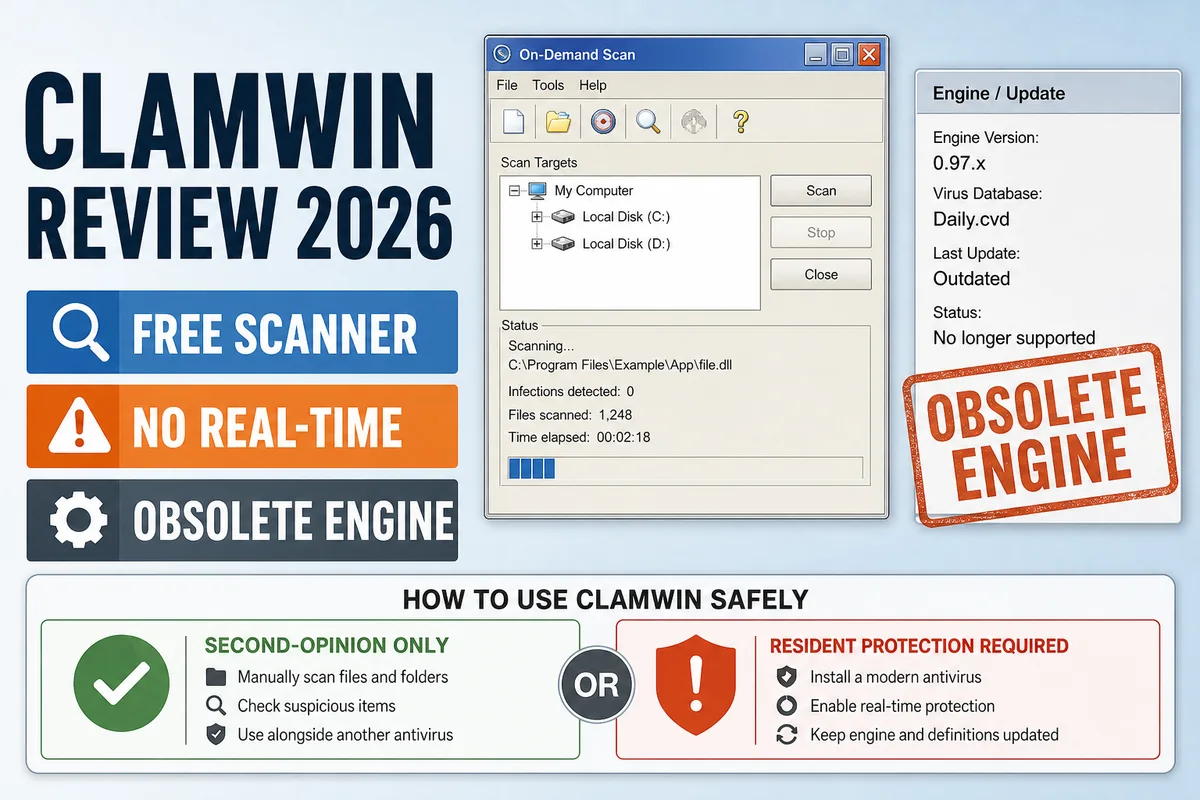
Our verdict: Don't use ClamWin as antivirus on an internet-connected Windows PC in 2026. The official site still identifies 0.103.2.1 as the latest version and explicitly says there's no on-access real-time scanner. SourceForge dates that release to June 7, 2021. More decisively, ClamWin is based on the ClamAV 0.103 engine family, while ClamAV's current policy says every release from 0.105 downward is unsupported and actively blocked from downloading new updates. A scan may still open, and a cached database may still recognize old signatures, but the combination of an obsolete engine, blocked current database access and no real-time interception isn't current endpoint protection. Keep Microsoft Defender or another supported antivirus active; remove ClamWin unless you preserve an isolated legacy machine for historical use. Editorial score: 1.0/10.
- Free to download and use
- Open-source code under GNU GPL
- Simple on-demand file, folder and drive scans
- Scheduled scans and Explorer context-menu integration
- Historically useful on very old Windows editions
- No paid plan, trial conversion or renewal trap
- Latest release is 0.103.2.1 from June 2021
- No on-access real-time scanner
- Underlying ClamAV 0.103 family is unsupported
- ClamAV says 0.105 and lower are blocked from new updates
- No current consumer lab result for ClamWin
- Official platform list stops at Windows 10/Server 2012
ClamWin 0.103.2.1 is still downloadable, but not current protection
The official ClamWin About page still identifies version 0.103.2.1 as the latest release. SourceForge's project file archive dates the 0.103.2.1 folder to June 7, 2021. No later Windows build appears in either first-party distribution path we checked on July 23, 2026.
That isn't merely a slow graphical-interface release cycle. The bundled scanning engine belongs to ClamAV's 0.103 line, and ClamAV has moved through 0.104, 0.105, 1.0, 1.1, 1.2, 1.3, 1.4 and 1.5. Current engine patches include parser and denial-of-service security fixes that can't be assumed present in ClamWin's five-year-old package.
| Question | Verified answer | Meaning |
|---|---|---|
| Latest ClamWin version? | 0.103.2.1 | No new build since June 2021. |
| Is it free/open source? | Yes, GNU GPL. | Licensing isn't the problem. |
| Real-time Windows protection? | No. | Files can execute before any manual/scheduled scan. |
| Underlying engine family? | ClamAV 0.103 | Unsupported and below the current signature cutoff. |
| New official database access? | ClamAV says 0.105 and lower are actively blocked. | Don't trust a stale database timestamp or cached scan. |
| Current independent consumer test? | None found in the major current sets checked. | No current detection/performance score to publish. |
| Our current rating? | 1.0/10, one editor. | Historical utility only; not recommended protection. |
The recovered page presented ClamWin as adequate protection and used a generic open-source argument as proof of safety. That conclusion has been removed. Open code can improve auditability, but it doesn't create releases, port engine fixes, restore database access or add real-time interception.
ClamWin and ClamAV are related, not interchangeable
ClamWin is a community Windows graphical application that packages a ClamAV engine with a scheduler, tray/UI, Explorer integration and an old Outlook add-in. Its version number 0.103.2.1 reflects the engine generation plus ClamWin packaging.
ClamAV is the actively maintained Cisco open-source scanning toolkit. Its own current documentation calls it a toolkit designed especially for email scanning on mail gateways, not a traditional consumer antivirus or endpoint security suite. It exposes command-line scanners, a daemon, signature update tooling and a shared scanning library.
As of July 23, 2026, the current ClamAV downloads page lists 1.5.3 as the latest stable release and 1.4.5 as the LTS line, both published July 1, 2026. Those current Windows packages don't update ClamWin in place or turn its 0.103 GUI into a modern endpoint suite.
A result, vulnerability fix or capability documented for ClamAV 1.5.3 can't be copied to ClamWin 0.103.2.1. The shared project ancestry is exactly why the version gap matters.

ClamWin has no on-access real-time scanner
The limitation is stated on ClamWin's own About page: the program doesn't include an on-access real-time scanner, so a user must manually scan a file to detect a virus or spyware. A scheduled scan is still delayed detection. An attachment, download, script or USB payload can be opened between scheduled runs.
Real-time/on-access protection observes files as they're created, opened, moved or executed and can block the access before the payload runs. ClamWin instead checks items selected by the user, an Explorer command, Outlook integration or a scheduled task. That can be useful as a second opinion only when the engine and signatures are current—which they aren't here.
Don't disable Microsoft Defender real-time protection to “avoid conflicts” with ClamWin. ClamWin isn't a replacement Windows Security provider. A supported Defender or third-party antivirus should remain active while an on-demand tool scans, subject to the tool's documented compatibility.
Clam Sentinel is sometimes suggested as a community add-on for watching filesystem changes. It's a separate project and can't repair ClamWin's obsolete ClamAV engine or blocked signature-update eligibility. Adding a watcher around an outdated scanner doesn't create current protection.

ClamAV 0.103 is EOL and blocked from new signature updates
This is the decisive 2026 change. ClamAV's current End of Life policy and support matrix lists 0.103 as an LTS branch whose database-download allowance ended September 14, 2025. It then states explicitly that every version from 0.105 downward, including every patch release, is unsupported and actively blocked from downloading new updates.
ClamWin 0.103.2.1 isn't even the final ClamAV patch in that old branch; the matrix lists 0.103.12 as the last patch. The ClamWin website's evergreen copy still promises automatic downloads of a regularly updated virus database and has an “outdated installation” page telling 0.103.2.1 users to wait for a ClamWin update. Five years after release, that advice no longer matches the engine vendor's lifecycle state.
| Component | Version/date | Lifecycle | Security consequence |
|---|---|---|---|
| ClamWin package | 0.103.2.1 · June 7, 2021 | No newer release found | Old GUI/integration and embedded engine. |
| ClamAV 0.103 LTS | Final patch 0.103.12 | EOL; DB allowance ended Sep. 14, 2025 | Unsupported; updates actively blocked. |
| ClamAV latest stable | 1.5.3 · July 1, 2026 | Current | Different product/build; not inherited by ClamWin. |
| ClamAV current LTS | 1.4.5 · July 1, 2026 | Supported LTS | Different maintained engine line. |
A database file can have a recent-looking timestamp without making the engine current. ClamAV's FreshClam FAQ explains that engine functionality levels determine which signatures can be used; an old scanner may download a database yet be unable to use all of it. In ClamWin's case, the branch is now beyond that warning stage and below the active update cutoff.
Installing current ClamAV for Windows is a different technical choice
Cisco publishes current ClamAV 1.5.3 and LTS 1.4.5 Windows MSI/ZIP packages. They provide a maintained scanner and database updater, but the Windows documentation says on-access scanning is the exception: the Linux-only ClamOnAcc feature isn't present on Windows.
Current ClamAV can make sense for an administrator building a mail/file scanning pipeline, CI upload gate, server-side service or scripted second-opinion workflow. It requires configuration, update monitoring, logging, resource limits and a separate endpoint-protection layer. It isn't a drop-in consumer successor with phishing protection, behavior blocking, Windows Security integration and recovery UI.
If your need is simply “scan a suspicious file,” a supported consumer antivirus or maintained on-demand scanner is usually safer and easier. If your need is to build around libclamav/clamd, use the latest stable or LTS version, follow the vendor's upgrade policy and treat it as infrastructure—not the ClamWin app reviewed here.
What ClamWin actually includes
The last official feature list includes an on-demand virus scanner, automatic virus-database downloads, a scanning scheduler, standalone/Explorer right-click scanning and a Microsoft Outlook add-in that removes infected attachments. The software is free and open source.
| Feature | Present in 0.103.2.1? | 2026 limitation |
|---|---|---|
| Manual file/folder/drive scan | Yes | Old engine/database; no current efficacy proof. |
| Scheduled scan | Yes | Runs after exposure, not at access/execute time. |
| Database updater | Included | 0.103 branch is actively blocked from new updates. |
| Explorer right-click scan | Yes | User must remember to invoke it. |
| Outlook integration | Historical add-in | Old Outlook-era integration; not current Microsoft 365 proof. |
| Real-time/on-access shield | No | Can't intercept files automatically. |
| Web/phishing protection | No documented modern layer | Browser/download risks remain. |
| Behavior/ransomware rollback | No documented modern layer | No current endpoint response. |
The list describes software functions, not a recommendation. A scheduler button still exists even when the scanner behind it's obsolete. Feature count must be read with version, update status and test evidence.
No current independent consumer test supports ClamWin
We checked the current Windows consumer sets from AV-TEST, AV-Comparatives and SE Labs and didn't find ClamWin 0.103.2.1 as a current tested endpoint product. That absence isn't proof of a specific detection rate; it means there's no current, product-specific protection/performance/false-positive result to publish.
Old ClamAV or ClamWin detection figures from the 2000s/2010s aren't decision-grade in 2026. Malware families, packing, script chains, cloud reputation, Windows internals and the engine itself changed. A scan-only result also can't be compared directly with a full real-world test that lets an endpoint product block URLs, downloads, behavior and execution.
We also don't borrow current ClamAV 1.5 scores or signature counts. ClamWin embeds a far older engine, and the current toolkit doesn't provide Windows real-time protection. The honest table row is “no current result,” not a speculative percentage.
Windows 11 isn't in ClamWin's official platform list
ClamWin's About page lists Windows 10, 8, 7, Vista, XP, Me, 2000 and 98 plus Windows Server 2012, 2008 and 2003. It doesn't list Windows 11 or newer Windows Server releases. The breadth is historical, not evidence of modern certification.
A program may launch on Windows 11 through backward compatibility and still be unsupported in every security-relevant sense: engine, updater, Outlook integration, high-DPI UI, signed components, installer behavior and remediation. “It installed” isn't a compatibility test.
Several operating systems in the list are themselves far past Microsoft support. Adding a scan-only antivirus doesn't patch the browser, kernel, SMB/RDP services, TLS stack or exposed applications. A legacy Windows machine used online remains unsafe even if ClamWin recognizes some old malware.
Open source is valuable, but it doesn't cancel lifecycle risk
ClamWin's GPL licensing allows code inspection, modification and redistribution under its terms. That's a real benefit for transparency, research and community maintenance. It also avoids opaque subscription renewal and paid upsells.
Security, however, depends on operational maintenance: reproducible/current releases, patched dependencies, signed artifacts, active signature distribution, compatibility testing, response to false positives and a supported threat model. A public repository can be abandoned or lag its upstream engine just as closed software can.
ClamWin Pty Ltd's donation page says contributions are optional and points to a privacy statement for website data. That says little about modern endpoint telemetry because the 2021 app doesn't document a current cloud reputation service comparable with modern suites. Less cloud submission can be privacy-friendly, but it also removes a detection layer; neither makes an EOL engine safe.
For sensitive files, remember that uploading to VirusTotal or another multi-scanner service may share samples with security partners. Use enterprise/private submission controls where confidentiality matters.
Don't confuse an active download counter with active maintenance
SourceForge still serves ClamWin and shows thousands of weekly downloads. A current counter proves demand and distribution, not a current build. The files directory remains anchored to 0.103.2.1 from 2021, while the project page's “Last Update” field is January 6, 2022.
If you preserve a research copy, use the official ClamWin/SourceForge project only, keep it off production endpoints and retain the exact installer hash/signature with your archive. Avoid third-party portals whose page date automatically changes to 2026; a refreshed landing page doesn't modify the binary.
Don't install ClamWin to scan a modern PC “because it is lightweight.” Use a maintained scanner. Installing obsolete security software adds old parsers that process hostile archives, documents and executables—precisely the code paths where current security patches matter.
How to interpret an existing ClamWin scan result
If ClamWin is already installed, treat its result as a historical signal only. “No virus found” doesn't clear the machine: the old engine may not receive/use current signatures and can't observe behavior that happened between scans. “Infected” is also not a command to delete immediately because false positives can damage a legacy system.
- Record the ClamWin version, engine version, database version/date and full detection name/path.
- Disconnect from sensitive accounts/network shares if compromise is plausible.
- Don't open, execute or restore the file to test it.
- Scan the system with an updated supported antivirus; use an offline scan when appropriate.
- For a nonsensitive individual file, compare hashes/signatures and use a reputable multi-engine service with confidentiality caveats.
- If infostealer behavior is plausible, rotate credentials and revoke sessions from a separate clean device after remediation.
The ClamWin label may still correctly identify an old family. The required response is simply based on current tools and incident scope, not confidence in the old scanner.
Use report/quarantine, never automatic delete on a legacy copy
Historical ClamWin forum guidance says the default infected-file action is Report Only and warns against automatic Remove because a false positive on a system file can break Windows. Quarantine is reversible, but even that can disrupt software until the detection is verified.
Before uninstalling ClamWin, inspect its quarantine and logs. Don't restore unknown files just to empty the folder. If a file is confirmed legitimate with publisher signature, hash/source and a current scanner, restore it to a controlled location and rescan. If malicious, preserve only the evidence needed and let a supported product remediate or rebuild the system.
| Old ClamWin state | Do | Avoid |
|---|---|---|
| No detections | Rescan with current supported protection. | Assuming the PC is clean. |
| Detection on download | Keep file unopened; verify with current tools. | Running it to see what happens. |
| Detection on Windows/system file | Quarantine/report, verify signature and use SFC/current AV. | Automatic permanent deletion. |
| Files already in quarantine | Document, validate, migrate needed evidence. | Restore all or delete all blindly. |
| Update failed | Remove/migrate; the engine family is EOL. | Downloading database files from random mirrors. |

Outlook add-in and scheduled scans are legacy conveniences
ClamWin's feature list describes an Outlook add-in for infected attachments, and an old FAQ says it appeared through an “About ClamWin” menu entry. That material predates modern Microsoft 365 app architecture, protected attachment services and the new Outlook experience. We found no current compatibility statement for today's Outlook.
A scheduled nightly scan is better than never scanning, but it can't prevent a user opening a malicious attachment at noon. Current mail protection combines server-side filtering, attachment/link detonation or reputation, browser protections and endpoint behavior controls.
Don't keep the old Outlook integration installed after removing the scanner. Check Outlook add-ins, startup items and Explorer context-menu entries, restart, and verify mail/file associations still work normally.
For an offline Windows XP museum PC, isolation is the protection
Community users still value ClamWin because it runs on Windows editions abandoned by modern antivirus vendors. On an offline retro-gaming or software-preservation machine, the scanner may help identify old known files. That's an archival use, not safe internet access.
Use network isolation, read-only media where possible, a clean modern transfer station, known hashes, snapshots/images and versioned backups. Scan files on a supported system before they reach the legacy machine. Never sign into email, cloud storage, banking or a password manager from the old OS.
If the machine must expose a service or exchange current files, virtualize/rebuild the workload on a supported platform. An obsolete operating system plus an obsolete scan-only engine doesn't become safe through layering.
How to remove ClamWin and restore a supported workflow
- Save scan logs and record any quarantined file you genuinely need to investigate.
- Verify suspicious/quarantined content with a current supported scanner; don't restore blindly.
- Open Windows Settings → Apps → Installed apps, select ClamWin and choose Uninstall.
- Restart Windows to unload tray components, Explorer handlers and old Outlook integration.
- Open Windows Security and confirm Microsoft Defender or one supported third-party antivirus is active and updated.
- Run a current Quick/Full scan; use Microsoft Defender Offline when compromise is plausible.
- Check scheduled tasks, Outlook add-ins and Explorer menu remnants if the old integrations remain.
ClamWin normally shouldn't have replaced Defender's real-time provider because it lacks one, but verify anyway. Don't install several permanent antivirus engines while migrating. One supported real-time provider plus a maintained on-demand scanner is enough.
Community evidence shows the niche—and the confusion
Recent discussions still ask whether ClamWin updates, whether it can protect Windows XP and whether a real-time add-on makes it sufficient. Users value a familiar GUI and support for old systems; others report slow scans or correctly note the absence of real-time protection.
Those posts are useful for defining search intent, not rating protection. Different users may have cached databases, blocked updaters, offline machines or separate Defender protection. A report that “it works” can mean only that the interface opens and scans.
The current decision doesn't depend on sentiment: version 0.103.2.1 is from 2021, has no real-time scanner, and its upstream engine family is officially unsupported and actively blocked from new updates. We therefore use no SourceForge crowd stars or fabricated community score in schema.
Who should use ClamWin in 2026?
| Scenario | Recommendation | Why |
|---|---|---|
| Everyday Windows 11 PC | Don't use | No real-time shield; EOL engine/update block. |
| Business/server endpoint | Don't deploy | No current support, testing or response layer. |
| Second-opinion scan | Choose a maintained scanner | ClamWin's engine can't receive current updates. |
| Current ClamAV integration developer | Use ClamAV 1.5.3 or 1.4.5 LTS | Different maintained toolkit; engineer controls around it. |
| Offline legacy/museum PC | Historical use only | Isolation, hashes and external scans provide the safety. |
| Research/archival copy | Keep isolated with exact hash | Preserve history without production exposure. |

Supported ClamWin alternatives
Microsoft Defender is already included with a supported Windows 11 installation and provides real-time, cloud and behavior-based layers plus offline scanning. For most ClamWin searchers, it's the correct free primary protection.
Malwarebytes is a better maintained on-demand second opinion; its paid real-time mode is a separate primary-protection decision. Don't enable several active engines simultaneously.
Bitdefender and ESET are supported paid choices with current endpoint features and independent consumer testing. Avast Free, AVG Free and Avira Free are current free third-party options with their own upsell/privacy trade-offs.
For technical server/mail scanning, current ClamAV 1.5.3 or the 1.4.5 LTS line can be engineered into a pipeline. It isn't a consumer antivirus replacement, and its Windows build lacks Linux ClamOnAcc real-time prevention.
Frequently asked questions
Is ClamWin still maintained in 2026?
No current release was found. ClamWin's official site still names 0.103.2.1 as latest, and SourceForge dates it to June 7, 2021. Its ClamAV 0.103 engine family is now unsupported and actively blocked from downloading new updates, so we don't consider it maintained protection.
Does ClamWin have real-time protection?
No. ClamWin's own About page says it doesn't include an on-access real-time scanner; the user must manually scan a file. Scheduled and right-click scans happen after or only when invoked, so Microsoft Defender or another supported real-time antivirus must remain active.
Can ClamWin still update virus definitions?
Don't rely on it. ClamAV's current EOL matrix says every engine from 0.105 downward is unsupported and actively blocked from downloading new updates. ClamWin 0.103.2.1 belongs to the older 0.103 family, whose database allowance ended September 14, 2025.
Are ClamWin and ClamAV the same product?
No. ClamWin is an old Windows GUI/package based on ClamAV 0.103. ClamAV is the actively maintained Cisco scanning toolkit; current releases are 1.5.3 stable and 1.4.5 LTS as of July 2026. Installing current ClamAV doesn't update ClamWin or create Windows real-time endpoint protection.
Is ClamWin good as a second-opinion scanner?
Not now. An on-demand second opinion can be useful, but its engine and signatures must be current. ClamWin's branch is EOL and below the active update cutoff. Use Microsoft Defender Offline, a maintained on-demand scanner or a current professionally configured ClamAV build instead.
Does ClamWin work on Windows 11?
Windows 11 isn't in the official platform list, which stops at Windows 10 and Server 2012 among many legacy editions. The app may launch through compatibility, but that doesn't establish support, current engine updates, Outlook integration or safe protection.
Is ClamWin safe because it's open source?
Open source improves auditability and avoids subscription lock-in, but it doesn't guarantee maintenance. ClamWin has no release after 2021, lacks real-time protection and embeds an unsupported engine. Security also requires patched releases, current signatures, compatibility work and incident response.
How should I remove ClamWin?
Save needed logs and inspect quarantine without restoring unknown files, then uninstall ClamWin from Windows Installed apps and restart. Verify Microsoft Defender or one supported antivirus is active and updated, run a current scan, and remove leftover scheduled tasks, Outlook add-ins or Explorer integration if present.
Final verdict: preserve the project, retire the endpoint
ClamWin represents a valuable open-source chapter: a free graphical scanner that ran across an unusually broad range of Windows versions, exposed simple scheduling and helped users scan without a subscription. That history should remain accessible.
The current security decision is different. Version 0.103.2.1 hasn't moved since June 2021, never provided real-time Windows protection, and sits on a ClamAV branch now officially unsupported and actively blocked from new signature updates. A current download counter or cached scan can't close those gaps.
Our editorial score is 1.0/10. Keep the source/installer only for isolated research or a museum machine. On any internet-connected PC, remove ClamWin, keep Defender or one supported alternative active, update and run a current scan.