
Best Antivirus for Business in 2026: 5 SMB Picks
Microsoft Defender for Business is the best value when a company already pays for Microsoft 365 Business Premium. Bitdefender GravityZone is our strongest standalone mixed-fleet choice; ESET gives administrators unusually clear policy control; Sophos makes the most sense when the real need is 24/7 managed response; Norton Small Business is the simple option for a three-to-10-employee office. The right purchase is the console and response workflow your team can actually operate—not the highest malware percentage on a consumer chart.
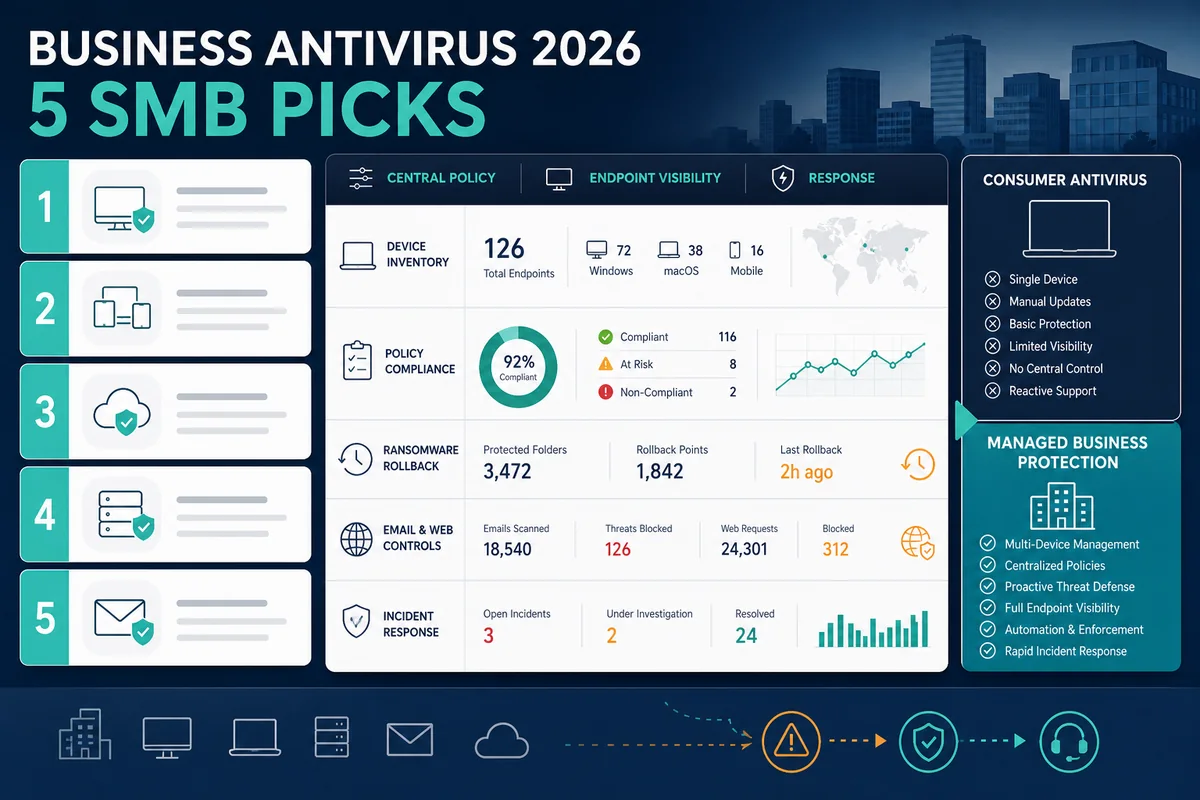
Quick answer: choose Microsoft Defender for Business for a Microsoft 365 Business Premium organization of up to 300 users; Bitdefender GravityZone Business Security Premium for a standalone Windows/macOS/Linux console; ESET PROTECT Entry for granular policy and server coverage; Sophos Endpoint/MDR when nobody in-house can monitor and respond around the clock; or Norton Small Business for a very small office that needs straightforward protection rather than EDR. Before buying, inventory every endpoint, server, owner and operating system, then price the required tier—not the vendor's cheapest badge.
For admin-first buying criteria and the maintained Avast, AVG and Kaspersky business reviews, use the business endpoint security directory.
Five business antivirus picks for five operating models
“Best” changes with the person who owns alerts. A five-person design studio, a 60-user Microsoft tenant, a mixed Linux engineering fleet and a clinic buying an MDR service shouldn't land on the same product. Our order weighs current independent Windows business tests, management and response depth, platform fit, licensing clarity and the amount of skilled administration required.
Microsoft Defender for Business
Endpoint prevention, vulnerability management, EDR, automated investigation and remediation in the Microsoft Defender portal. Included with Microsoft 365 Business Premium or sold standalone.
Bitdefender GravityZone Business Security Premium
Strong current protection, low false-positive band and one cloud console for workstations and servers. Premium adds risk analytics and stronger prevention; EDR/XDR and some response modules depend on tier or add-on.

ESET PROTECT Entry
Cloud or on-prem management, endpoint/server security, device control and anti-phishing with clear cross-platform coverage. Advanced Threat Defense, patching, encryption, EDR/XDR and MDR are separate tiers or add-ons.

Sophos Endpoint with MDR
Sophos Central unifies endpoint protection, EDR/XDR and an optional 24/7 MDR team. This is the choice for an under-resourced company that needs humans to investigate and respond—not merely another alert queue.

Norton Small Business
A transparent small-office bundle with device security, software updater, password manager and Windows cloud backup. Strong current lab protection; deliberately simpler than a full EDR/XDR platform.
Business endpoint security comparison
| Product/tier | Best fit | Management | Detection/response depth | Servers/Linux | Pricing boundary |
|---|---|---|---|---|---|
| Microsoft Defender for Business | Microsoft 365, 1–300 users | Defender portal; Intune when licensed | EPP + EDR + automated investigation/remediation | Windows/Linux server add-on; maximum 60 server licenses in SMB offer | $3/user/month standalone or included in $22 Business Premium; annual billing |
| Bitdefender GravityZone Business Security Premium | Standalone mixed workstations/servers | GravityZone cloud/on-prem ecosystem | Advanced prevention/risk; EDR/XDR varies by package/add-on | Windows, macOS, Linux; exact features vary | Seat/term/tier pricing; verify renewal and all add-ons |
| ESET PROTECT Entry | Admin-led mixed fleet needing policy control | PROTECT Cloud or on-prem | Endpoint prevention; EDR/MDR not in Entry | Windows/macOS/Linux endpoints and file servers; mobile limits | Online/quote; EDR/MDR marketed from 25 devices |
| Sophos Endpoint/MDR | Company that needs outsourced monitoring/response | Sophos Central | Endpoint, EDR, XDR or 24/7 MDR tier | Server/Linux use Workload Protection subscription | Quote and partner-led; compare service scope and retention |
| Norton Small Business | Microbusiness without security staff | Simple account/device administration | Prevention bundle; not a full SOC/EDR platform | No business Linux/server fleet story | 3/5/10-employee plans, two devices per user; first-year/renewal gap |
Prices are US list prices rechecked July 22, 2026 before tax and partner discounts. Microsoft and Norton publish usable list prices; Bitdefender, ESET and Sophos totals depend on seat count, term, tier, server count and add-ons. Obtain a written renewal quote with every required module.
What the current independent business tests actually measured
The newest directly comparable evidence is the AV-Comparatives Business Security Test March–June 2026, published July 23. It used vendor-configured Windows 11 business products, 400 real-world web/download cases, a separate malware-protection set and June performance testing. Configuration still matters: the report documents product settings, and its results don't guarantee that an untouched tenant or a different operating system will behave identically.
| Exact tested vendor | Real-world protection / FP | Malware protection / business FP | Non-business FP band | June impact score |
|---|---|---|---|---|
| Bitdefender | 99.8% · 1 compromised / 4 FP | 99.5% / 0 | Very Low | 26.3 |
| ESET | 98.8% · 5 compromised / 2 FP | 99.2% / 0 | Medium/Average | 3.7 |
| Microsoft | 98.8% · 5 compromised / 0 FP | 99.3% / 0 | Very Low | 18.6 |
| Norton | 99.0% · 4 compromised / 4 FP | 99.8% / 0 | Low | 6.6 |
| Sophos | 98.3% · 6 compromised / 2 FP | 96.6% / 0 | Medium/Average | 49.1 |
Every product above produced zero false alarms on the common business-software set. That doesn't erase the separate uncommon/non-business file bands, which are particularly relevant for unsigned internal tools. Bitdefender, ESET, Microsoft and Norton received the lab’s July 2026 Approved Business Product award. Sophos didn't because its 49.1 performance-impact score exceeded the report’s 40-point approval limit—not because its protection engine failed.
The performance row changes the buying conversation. ESET (3.7), Kaspersky (3.9) and Norton (6.6) were the lightest among the vendors discussed here; Microsoft measured 18.6 and Bitdefender 26.3. Sophos at 49.1 needs an especially careful hardware and workload pilot. These are lab aggregate impact scores where lower is better, not CPU percentages and not a promise for your fleet.
The SE Labs January–March 2026 SMB report ran full-chain targeted and public web/email attacks. ESET and Microsoft blocked all 100 threats and scored 100% protection/total accuracy. Its Bitdefender product was Small Office Security, not GravityZone; it scored 98% protection and 99% total. Sophos Endpoint scored 97% and 99%. We keep product names visible instead of merging consumer, small-office and enterprise tiers.
AV-TEST’s March–April 2026 Windows business results awarded Microsoft Defender Enterprise and Norton Small Business 6/6/6 for protection, performance and usability. Sophos Intercept X Advanced received 6/5.5/6. Bitdefender and ESET weren't in that April table, so we don't fill their cells with consumer results from another test.
Lab protection is only one layer. These Windows tests don't validate macOS/Linux parity, console usability, tenant configuration, device isolation, EDR investigation, MDR service quality, email security, patching, backup recovery, support response or your line-of-business software. Pilot those separately.

1. Microsoft Defender for Business: best Microsoft 365 value
Defender for Business is a real SMB endpoint-security product, not merely the Windows Security icon. Microsoft documents next-generation protection, attack-surface reduction, vulnerability management, EDR and automated investigation/remediation in the Defender portal. It's designed for organizations with up to 300 users and protects up to five client devices per user license across supported Windows, macOS, Android and iOS/iPadOS clients.
The economics are hard to beat if the organization already uses Microsoft 365 Business Premium: the current US plan is $22 per user/month paid yearly and includes Defender for Business, Intune, Entra ID features and the productivity suite. Standalone Defender for Business is $3 per user/month paid yearly. Windows and Linux servers need a separate $3-per-server/month add-on, and Microsoft caps that SMB add-on at 60 server licenses per subscription.
The catch is operational. Buying a license doesn't onboard devices, secure every policy or turn an unmanaged Windows Defender install into a monitored response program. Assign licenses, onboard endpoints, confirm sensor health, set tamper protection and cloud-delivered protection, define attack-surface-reduction policy, configure alerts/notifications and decide who investigates. Intune is included with Business Premium but not implied by the $3 standalone product.
Choose it when
- Identity, email and endpoints already live in Microsoft 365
- You want EDR without another endpoint agent
- Your tenant is at or below 300 users
- An admin or MSP can own the Defender portal
Look elsewhere when
- You need more than 60 SMB server add-ons
- Your environment isn't Microsoft-centered
- You want a vendor-operated MDR service by default
- You can't staff or outsource alert response
2. Bitdefender GravityZone: best standalone mixed-fleet choice
GravityZone Business Security Premium remains a strong directly matched choice: AV-Comparatives measured 99.8% real-world protection with one compromise and four false alarms, plus 99.5% malware protection and zero false alarms on common business software. Its uncommon/non-business false-positive count stayed in the very-low band. That makes it especially attractive to companies that run uncommon utilities, internal tools or specialized software—but a pilot still matters because the lab didn't contain your applications.
GravityZone covers Windows, macOS and supported Linux workstations and servers from a central platform. The base and Premium packages don't equal the Enterprise/EDR/XDR stack. Bitdefender's current feature matrix separates antimalware, firewall, content/device control, risk analytics, sandbox, EDR, XDR, patch management, email security, cloud workload and MDR capabilities by product/add-on. Write the needed response action beside each threat before choosing a tier.
For example, “detect ransomware” isn't the same requirement as “isolate the device, kill the process, see the root cause, restore affected files and have a human respond at 3 a.m.” GravityZone can address more of that chain at higher tiers, but a low entry quote may not. Confirm Linux/macOS parity, server licensing, data-retention period, API/SIEM access, ransomware remediation and renewal price in writing.
3. ESET PROTECT Entry: best for policy control and mixed servers
ESET PROTECT Entry combines the management console, endpoint protection and server security. Its official current product page supports Windows, macOS and Linux computers/file servers, with cloud or on-prem management and transferable/mix-and-match licenses. iOS/iPadOS at this tier is mobile-device management rather than a desktop-style antivirus engine; feature parity always depends on OS.
Current results are strong but nuanced. AV-Comparatives measured 98.8% real-world protection with five compromises and two false alarms, 99.2% malware protection with no common-business false alarms and a light 3.7 performance-impact score; uncommon/non-business files landed in the medium/average false-positive band. SE Labs' exact ESET Endpoint Security agent blocked all 100 attacks and scored 100% protection and total accuracy. If your company ships its own unsigned utilities, test those during the pilot rather than loosening every detection rule globally.
Entry isn't the whole ESET platform. Advanced Threat Defense, cloud-app protection, full-disk encryption, vulnerability/patch management, XDR through ESET Inspect and MDR are higher tiers or add-ons. The current US page says EDR and MDR start at 25 devices. ESET is a good engineering/admin choice because it exposes policy detail; it's a poor “install and forget” choice if nobody will interpret that detail.
4. Sophos Endpoint with MDR: buy response, not just an agent
Sophos's best argument is organizational: an endpoint alert without a responder is unfinished work. The current portfolio progresses from Endpoint to EDR, XDR and MDR, all in Sophos Central. The MDR service adds 24/7 human monitoring and response for teams that can't staff a security operations function. That can be more valuable than a one-point lab difference.
The current lab picture prevents an automatic #1. Sophos scored 98.3% real-world protection with six compromises and two false alarms, plus 96.6% in AV-Comparatives’ malware test. Its 49.1 performance-impact score exceeded the lab’s approval threshold, so Sophos didn't receive the July 2026 Approved Business Product award. AV-TEST gave it 6 for protection, 5.5 for performance and 6 for usability. SE Labs' Sophos Endpoint scored 97% protection and 99% total accuracy. Those are capable results, but the managed-service and integrated-response case—not an invented “perfect detection” claim—is why Sophos is here.
Windows/macOS endpoints, mobile management and server/Linux workloads don't all use one identical license. Sophos states that Windows Server and Linux require Workload Protection. Ask whether the quote includes endpoint, servers, EDR/XDR data retention, identity/network integrations, MDR response authority and incident assistance. Also define whether the MDR team may isolate a production device automatically or must wait for approval.
5. Norton Small Business: simple protection for a microbusiness
Norton Small Business is intentionally narrower. Its current standard plans cover three, five or 10 employees with two devices per user across Windows, Mac, Android and iOS and bundles device security, a secure browser, software updater, password manager, dark-web notification and 250 GB of cloud backup. Premium plans add VPN and 500 GB backup. Several extras, including cloud backup and updater functions, are Windows-specific; mobile apps aren't equivalent endpoint agents.
The US standard plans rechecked July 22 were $59.99/$119.99 for three employees, $99.99/$179.99 for five and $149.99/$249.99 for 10; each employee receives two device seats. Norton now markets the tiers by employee count, so an older 6/10/20-device table is no longer reliable. That transparency is useful, but the product isn't a substitute for a full multi-tenant EDR/XDR console, Linux/server protection, device isolation or a staffed SOC. Treat it as a micro-office security bundle.
Its protection evidence is current: AV-Comparatives measured 99.0% real-world protection with four compromises and four false alarms, 99.8% malware protection with zero common-business false alarms and a light 6.6 performance-impact score; AV-TEST gave Norton Small Business 6/6/6. Norton uses the Avast engine in this AV-Comparatives test. If your team grows beyond 10 employees or needs centralized investigation or handles regulated/high-impact systems, move to a managed endpoint platform before the simple bundle becomes operational debt.
Avast, CrowdStrike, SentinelOne and Kaspersky: where they fit
Avast Business Security
A credible self-service alternative for roughly one to 100+ devices. The tested Avast product scored 99.0% real-world/99.8% malware protection, an 8.1 performance impact and AV-TEST 6/6/6. Essential/Premium/Ultimate add web control, VPN, USB protection and patching by tier; Avast says VPN and patch management aren't available on macOS. See our current Avast Business guide.
CrowdStrike or SentinelOne
Stronger shortlist candidates when the question is enterprise EDR/XDR, threat hunting and an experienced security team—not “antivirus for a small office.” CrowdStrike Falcon Enterprise scored 98.5% real-world and 99.7% malware protection in the current AV-C factsheet. Compare the exact Falcon Go/Pro/Enterprise or SentinelOne Control/Complete service, retention and MDR scope.
Kaspersky
Kaspersky Endpoint tested strongly (99.8% real-world, 99.6% malware, 3.9 performance impact; SE Labs Small Office 100%). It isn't recommended for US organizations because US Commerce restrictions prohibit sales and update delivery. Elsewhere, technical results, local regulation, procurement policy and telemetry/jurisdiction trust are separate decisions. Read our Kaspersky Business context.
Webroot, Trellix and old names
Don't carry the recovered page's 2021 hierarchy forward. In current SE Labs, Webroot scored 86% protection/95% total. “McAfee Endpoint Security” became Trellix ENS after the McAfee Enterprise/FireEye merger. Trend Micro OfficeScan is now Apex One. Compare current SKUs and current tests, not an inherited brand label.
EPP, EDR, XDR and MDR in plain language
| Layer | What it should do | What you still need | Procurement question |
|---|---|---|---|
| EPP / endpoint protection | Prevent and remediate common malware, scripts, exploits, phishing/web threats | Policy owner, patching, identity, backup, response | Which prevention layers are on by default on each OS? |
| EDR | Record endpoint behavior, investigate alerts, isolate/respond/hunt | Skilled people to triage and act | How long is telemetry retained and which response actions are included? |
| XDR | Correlate endpoint with identity, email, network, cloud and other signals | Connected data sources and tuned workflows | Which integrations are native, licensed or merely possible via API? |
| MDR | Provide a human team to monitor, investigate and respond under a contract | Clear authority, contacts, asset context and incident plan | Is response 24/7, what is the SLA, and can analysts contain devices without approval? |
A small company with no security analyst often benefits more from a competent MSP/MDR contract than from buying a powerful EDR license and ignoring its alerts. NIST's current small-business guidance explicitly treats an MSP, MSSP or fractional security leader as a practical route when expertise can't be hired internally.

Build the requirements sheet before asking for quotes
- Count identities and assets separately. Record employees, contractors, shared devices, Windows/macOS/Linux endpoints, mobile devices, Windows/Linux servers, VDI, cloud workloads and unsupported systems. Per-user and per-device quotes aren't interchangeable.
- Name the owner. Decide who receives alerts after hours, who can isolate a device, who approves an exclusion and who talks to cyber-insurance, legal, customers and law enforcement.
- Map operating-system parity. Ask for a feature matrix for the exact current OS versions. “Supports macOS/Linux/iOS” may mean a sensor, web filter, MDM profile or server agent—not the Windows feature set.
- Define response outcomes. Require the actions you actually need: process kill, file quarantine, host isolation, remote shell, evidence collection, rollback, tenant-wide search, API/SIEM export or managed containment.
- List business-critical software. Include accounting, CAD, medical, POS, production and internally built/unsigned tools. False positives can stop the company; broad exclusions can expose it.
- Document retention and residency. Ask where telemetry/files are processed, how long EDR data remains searchable, who can access it and what export exists after cancellation.
- Price the complete term. Include server seats, EDR/MDR, email security, patching, encryption, mobile, onboarding, partner labor, tax and renewal—not only the first-year endpoint line.
- Set an exit plan. Confirm data export, agent removal, tamper-protection recovery and replacement overlap. Two real-time agents shouldn't run indefinitely during migration.
A safe 30-day rollout plan
| Phase | Action | Evidence to keep | Stop condition |
|---|---|---|---|
| Days 0–3: baseline | Inventory assets/owners, confirm backups, capture current exclusions and uninstall keys, assign incident contacts | Asset list, policy export, restore test, rollback owner | No tested backup or no recovery access |
| Days 4–10: pilot | Deploy to 5–10% across every hardware/OS/app cohort, including remote staff | Agent/sensor health, CPU/I/O, application tickets, update path | Boot, VPN, database, build or line-of-business failure |
| Days 11–17: tune | Use narrow vendor-approved exclusions, enable tamper/cloud protection, RBAC/admin MFA and alert routing | Approved exceptions with owner, reason and expiry | Global path/process exclusion proposed without risk review |
| Days 18–24: deploy | Roll out in rings, remove conflicting agent, watch failed/offline/unhealthy endpoints | Coverage report by owner/asset, remaining legacy-agent list | Unknown/unmanaged critical devices remain |
| Days 25–30: validate | Use vendor/AMTSO safe feature checks, confirm an alert reaches the right person, run a ransomware tabletop and restore exercise | Alert-to-action time, containment decision, restore result | Alerts have no responder or backups can't restore |
Don't execute real malware or public red-team tools on production endpoints to “test the antivirus.” Use the vendor's documented test procedures, the harmless EICAR/AMTSO feature checks where appropriate, an isolated authorized lab and a tabletop. A production test that disrupts business isn't evidence of readiness.

Business antivirus can't carry the security program alone
NIST's Cybersecurity Framework 2.0 small-business guide organizes work under Govern, Identify, Protect, Detect, Respond and Recover. Endpoint protection lives mostly inside Protect/Detect. It can't define risk ownership, recover data or notify customers.
Identity and email
- Phishing-resistant MFA for admins and remote access
- Separate admin accounts and least privilege
- Email authentication/filtering and mailbox audit logs
- Rapid offboarding and session/token revocation
Patch and configuration
- OS and third-party application patch SLAs
- Internet-facing vulnerability inventory
- Secure remote management and no exposed RDP
- Hardened baselines and device encryption
Recovery
- Versioned offline/immutable backups
- Separate backup credentials and MFA
- Measured RPO/RTO and restore tests
- Clean rebuild images and configuration records
Response
- 24/7 contact and authority matrix
- Isolation, evidence and credential-rotation runbooks
- Cyber-insurance/legal/reporting contacts
- Tabletop exercises and lessons tracked to closure
CISA's small-business resources prioritize phishing avoidance, passwords, MFA, software updates, logging, backups and encryption. If a vendor pitch treats its endpoint agent as a replacement for those controls, the pitch is incomplete.

Business antivirus FAQ
What is the best antivirus for a small business in 2026?
Microsoft Defender for Business is our best value for companies already using Microsoft 365 Business Premium; Bitdefender GravityZone is the stronger standalone mixed-fleet pick. ESET suits hands-on administrators, Sophos suits teams buying MDR, and Norton suits a simple three-to-10-employee office. The best choice still depends on platform, servers, responder and required tier.
Is Microsoft Defender enough for a business?
Defender for Business can be enough when devices are properly onboarded, policies are configured, alerts have an owner and identity/email/patch/backup controls are also in place. The unmanaged consumer Defender built into Windows isn't the same operating model as Defender for Business with EDR and centralized response.
Can a business use free antivirus?
A commercial-use license may allow it, but free consumer antivirus usually lacks central policy, inventory, tamper control, reporting, isolation, EDR and support. Those gaps matter more as soon as several employees handle company/customer data. Built-in Microsoft protection becomes a business solution only when it's licensed, onboarded and managed appropriately.
What is the difference between antivirus and EDR?
Antivirus/EPP primarily prevents and remediates common endpoint threats. EDR records behavior and gives investigators tools to search, isolate and respond after suspicious activity. EDR doesn't respond by itself unless automation is configured or a person/MDR service owns the alert.
Does business antivirus stop ransomware?
It can block many ransomware payloads and behaviors, but no endpoint product guarantees prevention. Stolen credentials, unpatched servers, remote-management abuse and backup compromise can bypass or outlast one agent. Use MFA, patching, least privilege, segmentation, monitored detection and offline/immutable tested backups.
How much does business antivirus cost?
Current public entry points range from Microsoft Defender for Business at $3 per user/month paid yearly to Norton at $59.99 first year for three employees and six device seats; managed EDR/MDR and servers cost more. Compare a three-year total including renewal, server/mobile seats, add-ons, onboarding, management labor and incident service.
Should servers use the same endpoint license?
Don't assume so. Microsoft requires a separate server add-on, Sophos uses Workload Protection for Windows Server/Linux, and other vendors count servers or enable features differently. Confirm operating system, workload, clustering/VDI/container support, performance exclusions and response capability in the exact quote.
How should we test business antivirus before rollout?
Pilot 5–10% of endpoints across every OS/hardware/application cohort, confirm sensor and update health, measure business-app impact, validate narrow exclusions, test alert routing with vendor/AMTSO safe checks, run an incident tabletop and perform a real backup restore. Don't run live malware on production.
Verdict: buy the response system your business can operate
For a Microsoft 365 Business Premium company, start with Defender for Business before paying for a second agent. For an independent mixed fleet, GravityZone is our strongest shortlist leader. Choose ESET when a capable administrator values control and Linux/server flexibility; choose Sophos when the missing capability is a 24/7 human response team; keep Norton for genuinely small, low-complexity offices.
The final decision should follow a pilot and written requirements. Demand the exact tier, server/mobile scope, retention, response actions, support/MDR SLA, renewal price and exit process. Then connect the endpoint product to MFA, patching, email security, tested backups and an incident owner. That's business security; a logo on 20 laptops is only the first component.