
Panda Dome Review 2026: 96.5% Protection, 27 False Alarms
Panda Dome has one of the broadest antivirus plan ladders and a real free tier. Its current Windows protection is the problem: 14 compromises and 27 false alarms in AV-Comparatives' real-world test.
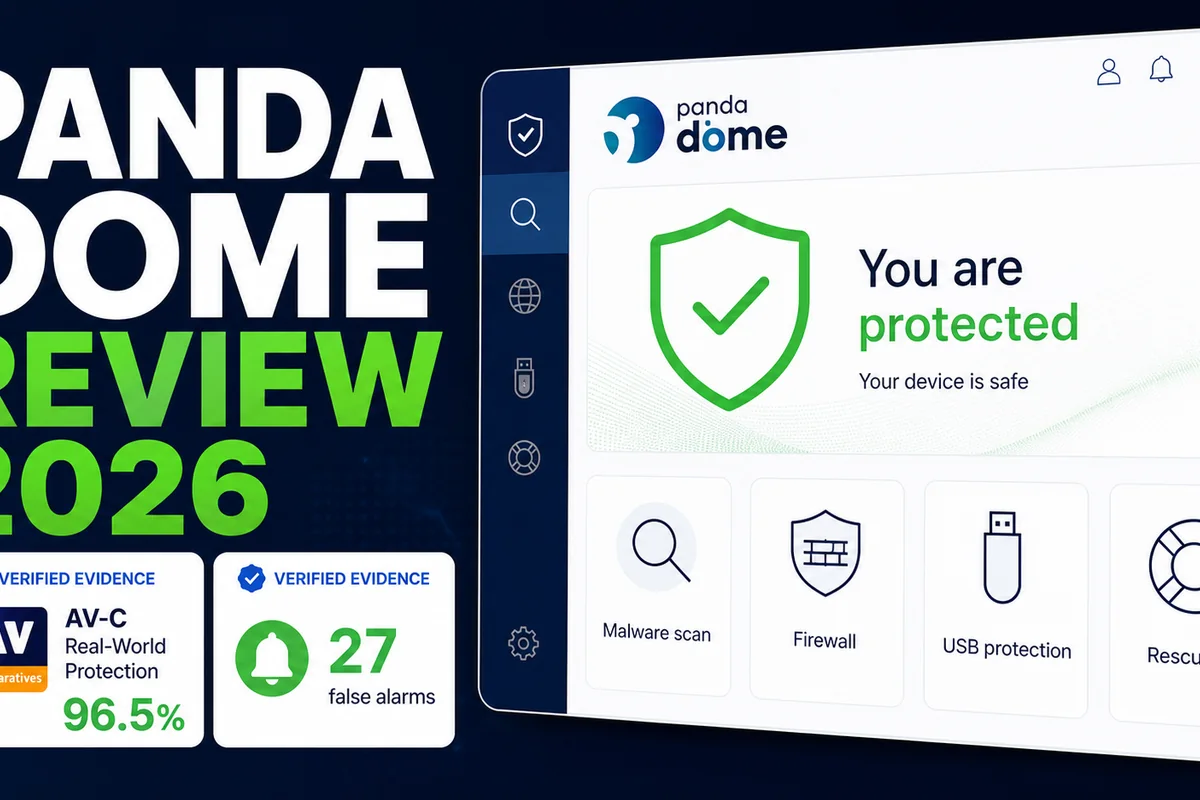
Our verdict: Panda Dome is easier to like as a toolbox than as a protection recommendation. The free Windows product, Rescue Kit, USB controls, flexible device counts and Premium VPN all solve real problems. But the current evidence is uncomfortable: Panda blocked 386 of 400 attacks in AV-Comparatives' February–May test, allowed 14 compromises and raised 27 false alarms. In the March file test, 83 cases compromised the system and 54 clean files were flagged. Its decent 11.1 performance impact and SE Labs AAA badge don't cancel those misses. We rate Panda Dome 6.4/10.
- Genuine free Windows and Android antivirus, with a current Mac-free offer also advertised in some regions
- Useful Rescue Kit and USB protection for Windows
- Five paid configurations from one device to an unlimited household license
- Premium includes an unlimited VPN for up to five devices
- Strong 99.82% execution detection on modified APT samples
- Reasonable 11.1 impact score in the April 2026 performance test
- Only 96.5% current real-world protection, with 14 compromised cases
- 27 false alarms in the real-world test and 54 in the file test
- Only 88.2% online file detection before execution-stage defenses
- Current AV-TEST evidence ends in October 2024, not February 2026
- Many headline extras are Windows-only
- Official pages conflict over Free Mac availability and OS minimums
Panda Dome at a glance
Panda Dome is Panda Security's consumer product family for Windows, macOS, Android and iOS. It ranges from a free antivirus to Premium, a large bundle with antivirus, anti-ransomware controls, VPN, password management, breach monitoring, patch management and premium support. Panda Security is a WatchGuard brand, but Panda Dome isn't the same product as WatchGuard Endpoint Security, EDR, MDR or the old Panda Adaptive Defense business line.
The product's biggest appeal is choice. You can buy one, three, five or ten devices, or select an unlimited-household configuration in supported stores. You can also choose a one-, two- or three-year term. That flexibility is useful, but it makes a single “Panda price” misleading. Plan, country, term, device count, tax, promotion and renewal rate all change the bill.
| Buyer question | Current answer |
|---|---|
| Is Panda Dome good? | Feature-rich, but current protection and false-alarm results trail the leaders. Our score is 6.4/10. |
| Is there a free version? | Yes for Windows and Android. Panda also advertises Free Mac Antivirus on a current Mac page, although the main comparison table still says Free is Windows/Android. |
| Best current lab result? | 99.82% detection when modified APT samples were executed; SE Labs also awarded AAA with 97% Total Accuracy. |
| Worst current lab result? | 96.5% real-world protection with 14 compromises and 27 false alarms; 83 compromises and 54 false alarms in the file test. |
| Does it include a VPN? | All paid plans advertise 150MB/day. Premium removes the daily limit and supports country selection on up to five devices. |
| Are all features cross-platform? | No. Firewall, Wi-Fi protection, anti-ransomware, parental control, file encryption/deletion, cleanup and update manager are marked Windows-only in the comparison table. |
| Does it support old Windows? | Panda documents very old versions, including XP SP3. That doesn't make an end-of-life operating system safe. |
| Current editorial rating? | 6.4/10 from one named editor, not a customer aggregate. |
The recovered page scored an old plan against an expired 2021 price and wrapped it in copied reader-review UI. We removed the Offer, the purchase redirect and the implication of a crowd rating. The only score on this page is our current editorial judgment.
2026 lab scorecard: broad evidence, weak current balance
Panda isn't untested. AV-Comparatives entered Panda Dome Advanced 23.0 in its current consumer series, SE Labs entered Panda Dome 23.0.0 in Q1, and AV-Comparatives included it in a separate APT coverage study. The results show a cloud-heavy engine that often recovers at execution but produces too many misses and false alarms before that point.
| Independent test | Submitted product/scope | Panda result | Editorial reading |
|---|---|---|---|
| AV-C Real-World Feb–May 2026 | Dome Advanced 23.0, Windows 11, 400 cases | 96.5%; 386 blocked, 14 compromised; 27 FP; Tested | Near the bottom of the field and downgraded for false alarms. |
| AV-C Malware March 2026 | Dome Advanced 23.0, 10,030 files | 56.1% offline; 88.2% online detection; 99.17% final; 83 compromised; 54 FP; Tested | Large cloud/execution recovery, but weak initial classification and too many final misses. |
| AV-C Performance April 2026 | Dome Advanced 23.0, low-end Windows PC | AV-C 85; Procyon 93.9; impact 11.1; Advanced | Respectable middle-of-field system impact. |
| SE Labs Jan–Mar 2026 | Dome 23.0.0, 100 attacks and 680 legitimate items | 97 protected, 3 compromised; 94% Protection, 99% Legitimate, 97% Total; AAA | Better than AV-C real world, but still three successful incidents. |
| AV-C APT Coverage 2026 | Original and modified documented APT tools, offline/online/follow-up/execution | Modified online 34.8%; modified execution 99.82% | Excellent late-stage behavior can't be read as 99.82% whole-product protection. |
| AV-TEST Sep–Oct 2024 | Panda Dome 22.03, Windows 11 | 6/6 Protection, 5.5/6 Performance, 6/6 Usability | Valid historical context, not a 2026 test. |
No single percentage is “Panda's detection rate.” Each test measures a different stage and workload. Buyers should care about the pattern: Panda benefits enormously from internet connectivity and later behavior defenses, performs reasonably, and handles most legitimate activity at SE Labs—but its current comparable protection and false-positive outcomes are weaker than leading alternatives.

Real-world protection: 14 compromises and 27 false alarms
The AV-Comparatives February–May 2026 Real-World Protection Test exposed all enabled protection layers to 400 malicious websites and downloads on Windows 11. Panda Dome Advanced blocked 386. Fourteen test systems were compromised, producing a 96.5% protection rate.
That was third-cluster performance. Kaspersky protected 99.8%, Bitdefender 99.5%, Avast/AVG/Norton 99.3%, and Microsoft Defender/TotalAV 99.0%. Only VIPRE at 96.0% and Quick Heal at 92.0% protected fewer cases. The field difference looks small as a percentage, but 14 compromises versus one to four is material when every case is a realistic attack attempt.
Panda also raised 27 false alarms. The test average was eight; Microsoft raised none, ESET two and Kaspersky/VIPRE three. AV-Comparatives explicitly downgraded Panda because its false-alarm count was above average, leaving it at Tested rather than the award implied by protection alone.
A false positive isn't harmless. It can block an installer, remove a legitimate tool, interrupt work or train a user to approve every alert. This is why we don't praise 96.5% while treating 27 clean-item mistakes as a footnote. Protection and correct classification are the same user decision.
File protection: strong recovery at execution, weak classification
The March 2026 Malware Protection Test is a tougher explanation of Panda's cloud dependence. Offline detection was 56.1%. With the cloud available, detection rose to 88.2%. After files were allowed to execute and all protection layers could respond, final online protection reached 99.17%.
Final protection is the practical headline, but the raw count still matters: 83 of 10,030 malicious files compromised the system. Panda also misclassified 54 clean files, the highest count in that test and a category AV-Comparatives described as “remarkably many.” The final award was Tested.
The separate APT Detection Coverage study found the same shape. Panda classified only 32.1% of original samples offline and 91.6% online. For modified samples, online on-demand detection was just 34.8%. Yet execution detection reached 99.91% for originals and 99.82% for modified files.
That's a real strength: behavior and execution monitoring can catch threats static/reputation checks miss. It isn't permission to advertise “99.82% protection” in general. The APT study used documented toolsets, including older campaigns, and measured phases separately. Panda itself told the lab that some missed samples were associated with campaigns active mainly from 2010 to 2016. We treat the result as evidence of late-stage resilience, not a substitute for the current real-world outcome.
SE Labs: AAA with three successful compromises
SE Labs' January–March 2026 test used a mixture of public malware and more targeted attacks. Panda Dome detected 99 of 100 attacks, blocked 97 and was compromised three times. It earned 94% Protection Accuracy, 99% Legitimate Accuracy and 97% Total Accuracy, qualifying for AAA.
The 99% legitimate score is useful counterevidence to AV-Comparatives' high false-alarm counts. The tests aren't directly comparable: SE Labs used 680 legitimate objects and applies prevalence-weighted scoring; AV-Comparatives used different clean sets and workflows. The correct conclusion is variability, not that one lab invalidates the other.
SE Labs' narrative says two targeted attacks breached Panda while the detailed product table records three compromises overall. We use the detailed total and don't relabel every incident as targeted. This kind of table-text reconciliation is exactly why a badge by itself isn't enough.
The 17.5/18 AV-TEST score is from October 2024
Several 2026-labeled pages state or imply that Panda scored 17.5/18 at AV-TEST in February 2026. That's wrong. The linked Panda Dome 22.03 report covers September and October 2024. It awarded 6/6 for Protection, 5.5/6 for Performance and 6/6 for Usability.
It remains valid historical evidence and a useful check that Panda can produce a well-tuned build. It isn't current-year proof. Panda/WatchGuard doesn't appear in AV-TEST's April 2026 home-product set, and the old Panda Security manufacturer archive is older still. Our scoring therefore weights current AV-Comparatives and SE Labs evidence more heavily.
The recovered indexed version of this page contained the false February 2026 date. We didn't preserve it simply because search engines had already indexed it. A restored article must become more accurate than the version it replaces.
Performance: respectable, not impact-free
Panda Dome Advanced's April 2026 AV-Comparatives performance result was solid. Its AV-C task score was 85, UL Procyon Office score 93.9 and total impact 11.1. That placed Panda tenth of 19 by impact, between Bitdefender at 9.6 and Microsoft Defender at 12.9, and earned Advanced.
This doesn't support the common “zero impact” claim. The lab's task matrix found a mix of very fast and slower operations, and individual results depend on storage, CPU, software, scan state and cache. It does support a more useful statement: Panda isn't among the current performance laggards, but ESET, Norton, Avast/AVG and several others did better in the same setup.
A PassMark consumer benchmark ranked Panda Dome Free second of eleven overall with 65 points. It tested version 22.03 in November 2024 and was commissioned by WatchGuard. We disclose the funding and age; it's useful product-specific context, not independent 2026 confirmation.
We didn't invent an idle-RAM number or a full-scan time for this review. Those figures vary too much by system and file set. Use the trial checklist below to measure boot, file copies, development tools, games, video calls and battery life on the computer that matters.
Panda's current “100% detection” claim is footnoted to 2020
The official consumer homepage currently says “100% Detection rate” and “100% virus detection with minimal device impact.” Its own footnote cites AV-Comparatives' Real-World Protection Test from November 2020. That result is historical marketing, not a current measurement.
The comparable February–May 2026 real-world result is 96.5%, with 14 compromises and 27 false alarms. Product pages are allowed to preserve past awards; buyers shouldn't be expected to notice a six-year-old footnote in a feature grid. We date the claim explicitly and score the current submitted build.
This doesn't prove deceptive software or unsafe ownership. It proves why every performance claim needs a product, test, date and denominator. A current-year page that repeats “100%” without those fields would be less useful than the vendor page.
Free, Essential, Advanced, Complete and Premium compared
Panda's paid plans build in layers. Essential covers the antivirus core and small VPN allowance. Advanced is the first tier with advertised anti-ransomware and parental control. Complete adds data/password and cleanup tools. Premium adds the unlimited VPN, patch manager, deeper breach monitoring and premium support.
| Plan | Main additions | Important limit | Best fit |
|---|---|---|---|
| Free | Windows/Android antivirus; Windows USB protection, Rescue Kit and gaming mode; free VPN allowance in current portfolio | Main comparison says Windows/Android, while a current Mac page advertises a separate Free Mac Antivirus | One device and a buyer willing to verify regional installer scope |
| Essential | Antivirus, firewall/Wi-Fi, anti-phishing, dark-web email check, gaming mode, 150MB/day VPN | Firewall and Wi-Fi rows are Windows-only; VPN allowance is tiny | Basic paid Windows protection with flexible seats |
| Advanced | Everything in Essential plus anti-ransomware and parental control | Both added rows are marked Windows-only in the main comparison | Windows household that will test content filtering |
| Complete | Adds password manager, cleanup, file encryption and secure deletion | Cleanup and file tools are Windows-only; password manager is a separate account workflow | Windows user who will actually use the data tools |
| Premium | Adds unlimited Premium VPN, update manager, Dark Web Monitor and 24/7 Premium support | VPN is limited to five devices; update manager is Windows-only | Buyer valuing VPN/password bundle more than top-tier lab protection |
“Unlimited devices” isn't a business fleet license. Panda limits it to reasonable home use and one customer in one household. A freelancer, charity or company should verify commercial licensing rather than stretching a consumer term.

Security and recovery tools: Rescue Kit is the standout
Panda's Windows protection includes real-time scanning, scheduled/on-demand scans, malicious-site and phishing blocking, USB-device controls and gaming/multimedia mode. Advanced adds protection aimed at ransomware and other advanced threats. The firewall component supplements Windows networking controls, but a suite firewall doesn't secure an unpatched router or replace careful public-network settings.
The most distinctive utility is Rescue Kit. It can create a bootable rescue USB and invoke Panda Cloud Cleaner for a Windows computer that can't start normally or needs a second-opinion cleanup. That's useful operationally, but it should be prepared from a clean computer before an emergency and kept updated. A rescue scanner isn't a substitute for tested offline/versioned backups.
USB protection can prevent automatic execution and scan removable media. It helps in shared-office, school, repair and family environments where flash drives still move files. It can't make an unknown drive safe to open, and it doesn't protect against firmware-level attacks.
Complete's file encryption and secure deletion can help with local Windows files. Confirm the recovery/export workflow before entrusting the only copy of data to a vendor tool. Encryption without a recovery plan can turn a forgotten credential or failed disk into permanent loss.

VPN and password manager: useful only at the right tier
The included VPN on non-Premium plans is a trial-sized privacy tool: 150MB per day, automatic connection to an “optimal” server and no country selection. That may cover a short login on public Wi-Fi, but it's too small for routine video, large downloads, operating-system updates or all-day browsing.
Premium removes the daily limit, allows country selection and can be used on up to five Windows, Android, Mac and iOS devices. Five VPN installations can be fewer than the antivirus device count, including an “unlimited” household plan. Count people and active phones/laptops before treating the VPN as household-wide.
We didn't repeat the recovered page's claim that the service runs on a named third-party VPN platform. The current consumer help page confirms limits and device count but doesn't establish that processing relationship. A VPN recommendation needs current protocol, ownership, jurisdiction, logging and audit evidence, not a recycled implementation claim.
Panda Dome Password Manager is included with Complete and Premium. Current support documents a web console plus Chrome, Firefox and Edge extensions and an Android 10+ app. The master password can't be recovered or reset, so create an emergency plan and test export/import before moving every credential. The official support area also documents migration from an older manager, a reminder that password products can change underneath a long antivirus subscription.
Parental control needs a checkout-level scope check
The Advanced page describes parental control as a Windows-only content-filtering feature. The broader parental-control page also describes Panda Dome Family with Android/iOS profiles, app and time controls, location, geofences and a panic button. That page says parental control is included in Advanced, Complete and Premium while selling Panda Dome Family separately.
Those statements can describe different modules, platforms or regional entitlements. Don't buy Advanced because a search snippet promises a complete cross-platform family suite. At checkout and during the refund window, verify the exact child-device platforms, parent console, app/time limits, location features, number of children/devices and whether Family requires a separate license.
Parental controls process especially sensitive data: child profiles, installed apps, usage and potentially precise location. Use the minimum permissions that solve the family need, disclose monitoring appropriately and protect the parent account with two-factor authentication.
Windows, Mac, Android and iOS aren't feature-equivalent
| Platform | What Panda currently offers | What to verify |
|---|---|---|
| Windows | Fullest antivirus and toolset: firewall/Wi-Fi, anti-ransomware, USB/Rescue Kit, parental content control, cleanup, encryption/deletion, update manager by tier | False positives, Windows Security registration, old-OS messaging and app/game compatibility |
| macOS | Malware scanning, quarantine, web/phishing protection and plan-dependent VPN/password/support; current page advertises Free Mac Antivirus | Actual regional free installer, real-time behavior, supported macOS release and missing Windows-only extras |
| Android | Free scanning, privacy auditor, optimization and anti-theft/location features; VPN by entitlement | Device-admin/location/app-list permissions, ads in free service and OS minimum |
| iOS/iPadOS | Web/privacy/anti-theft or family functions and VPN rather than traditional full filesystem antivirus | Exact plan entitlement and which protection acts outside the Panda app |
Panda's own current documentation conflicts. The main Free page says Windows and Android; its Mac landing page repeatedly offers Free Mac Antivirus. One help page lists Android 6+, macOS 10.10+ and iOS 13+, while marketing copy sometimes shows Android 5+ and iOS 11+. Treat the installer and account entitlement served to your region as the operational truth and preserve a screenshot/order record.
The help page even lists Windows XP SP3, Vista, 7 and 8/8.1. Compatibility doesn't mean those systems receive security patches from Microsoft. Run a supported operating system. Antivirus can't repair an end-of-life browser, kernel or network stack, and recommending XP in 2026 would be irresponsible even if the installer launches.
Pricing: flexible, promotional and highly regional
On July 14, 2026, the English/US downloads page showed the following one-device, one-year snapshot. Panda may serve a different currency or campaign based on locale, cookies and reseller. These figures are evidence of the current storefront, not a promise or structured Offer.
| Plan | Displayed first-year price | Displayed standard price | Value decision |
|---|---|---|---|
| Essential, 1 device/1 year | $34.99 | $49.99 | Hard to justify on protection alone versus the built-in Windows baseline. |
| Advanced, 1 device/1 year | $41.99 | $59.99 | Small upgrade if Windows anti-ransomware/content control is the goal. |
| Complete, 1 device/1 year | $53.99 | $89.99 | Value depends on using password, cleanup and file tools. |
| Premium, 1 device/1 year | $56.00 | $139.99 | Promotion is attractive for VPN users; displayed standard price is a large jump. |
The closest gap in that snapshot is between Complete and Premium. For a first-year buyer, a few dollars added unlimited VPN, patch management, breach monitoring and premium support. The displayed standard-price gap was much larger. Compare the actual renewal amount and device configuration shown in the cart, not just the landing-page percentage.
Monthly plans advertise a first month free and then a recurring monthly charge. Annual and multi-year plans may lower the first-term price. The right calculation is total cost over the intended ownership period, including tax and expected renewal—not “60% off.”

Renewal, cancellation, refund and support
My Panda is the account center for devices, license transfers, invoices/payment details and automatic renewal on online purchases. Panda says you can use Manage product → Cancel subscription to stop online auto renewal. That cancellation prevents the next term; it doesn't automatically refund the current order, and protection continues until the paid period ends.
Panda promises a 30-day refund path for online purchases through customer service. Its termination terms say support or technical-assistance products aren't refundable once used and subscription cancellation takes effect at the end of the current billing period. Retailer/app-store purchases may follow the seller's process.
Uninstalling Panda doesn't cancel billing. Cancel first, save confirmation and the next-billing date, then remove the product. Likewise, canceling doesn't uninstall or activate a replacement antivirus. Treat subscription and protection as separate checklists.
Panda's official consumer support hub offers a web form, forum and a 24/7 “free diagnosis” partner phone path, while Premium specifically includes premium technical support. Don't assume every tier includes unlimited 24/7 remediation. Confirm the domain, provider, country, language, scope and remote-support terms before granting screen control; search results for Panda support currently include unrelated PDFs that impersonate help pages.
Who owns Panda Security—and what results don't transfer
WatchGuard acquired Panda Security in June 2020. WatchGuard's endpoint platform then integrated Panda business technology into WatchGuard Cloud. Vector Capital became WatchGuard's majority owner in 2022, with IPW retaining an interest.
Panda Dome remains a consumer brand and product ladder. WatchGuard Endpoint Security, EPP, EDR, MDR, Adaptive Defense, Patch Management and other business services have different clients, policies, consoles, support and licensing. A current WatchGuard enterprise result can't fill a Panda Dome consumer test gap.
Ownership is a disclosure, not a malware score. It matters for account relationships, product direction and privacy review, but current submitted consumer results still carry more weight than a parent company's enterprise awards.
Privacy: cloud security requires meaningful telemetry
Panda's consumer privacy terms describe broad categories used across its services: IP, cookie/mobile/device and advertising identifiers; carrier, hardware and operating-system details; installed applications; URLs or domains visited; product/app/network usage; crash, authentication and session logs; and location for anti-theft or family functions.
Mobile features can add installed-app and app-usage data, contacts for call blocking, camera use during an anti-theft action and analytics/advertising data in the free service depending on feature and platform. A password manager necessarily processes credential data to deliver the service. The policy also describes vendors, resellers/distributors, support/payment providers and transfers connected with corporate transactions or legal requests.
This doesn't mean every Panda installation collects every field. The active product, permissions, features, jurisdiction and consent choices determine actual processing. It does mean “all work happens in the cloud, therefore nothing is collected” would be false.
Use a unique My Panda password and 2FA, give devices neutral names, decline unused location/contact/camera permissions, remove old devices, and review free-app advertising settings. Before submitting a false-positive sample, check whether its file name, path or content reveals confidential work.
High false alarms change how Panda should be deployed
Current community reports include repeated URL alerts immediately after boot and uncertainty about whether Panda's real-time protection remained active. These are individual cases, not proof of a universal defect. The lab's 27 and 54 false-alarm totals make the underlying workflow important enough to test.
| Symptom | What to check | Safe response |
|---|---|---|
| Clean installer/tool is quarantined | Official source, code signature, hash, prevalence and multi-engine context | Keep quarantined; submit through support; add the narrowest temporary exception only after verification. |
| Same URL alert repeats after boot | Browser history/extensions, startup tasks, DNS/proxy, alert URL and process | Don't simply allow it; collect evidence and ask support whether it's a false positive or background process. |
| Windows says no antivirus is active | Windows Security provider status, Panda service/update state and Event Viewer | Reconnect/update/reboot once; restore Defender or another known-good product if protection remains absent. |
| Application or game stops working | Exact protection module, signed process and event time | Test one narrow exception; never exclude the whole Downloads, user profile or system drive. |
| Old operating system “is supported” | OS vendor security-update status, not just Panda installer requirements | Upgrade the OS. Don't treat Panda as virtual patching for XP/Vista/7/8. |
| Free Mac download differs from plan table | Region, installer package, entitlement and live protection status | Verify before relying on it; keep macOS built-in protections active until Panda registers correctly. |
Panda's Android help tells users who believe a detection is safe to contact Technical support so it can be added to the Collective Intelligence database. That's safer than teaching users to suppress alerts by habit. Keep a log of every exclusion and remove it after a corrected definition arrives.
How to evaluate Panda Dome during the refund window
- Choose a supported operating system. Ignore the fact that Panda still lists end-of-life Windows versions. Patch the OS, browser, router and important apps first.
- Record the cart. Save plan, devices, term, currency, tax, first charge, renewal price, seller and 30-day deadline.
- Remove the previous real-time suite. Save its license and use its official uninstaller. Reboot before installing Panda.
- Protect the account. Use a unique password, enable 2FA and review device names and privacy permissions.
- Verify registration. Confirm Panda is updated and active in its dashboard and in Windows Security or the relevant platform permissions.
- Run one full scan. Review detections before deletion. False-positive handling is part of this product's evaluation, not an edge case.
- Exercise real work. Install signed software, build code, copy archives, attach USB drives, start games, browse and resume from sleep.
- Test harmless protection checks. Use EICAR and AMTSO pages, never live malware or a real credential.
- Verify tier extras. Check VPN allowance/device count, password export/recovery, Windows-only rows and any child-device entitlement you paid for.
- Make a decision early. If protection state, false positives or platform parity fail, request the refund before day 30, cancel renewal and activate a replacement.
After uninstalling, confirm Defender or the chosen replacement is active, firewall status is correct and the Panda browser extensions/VPN profiles are gone. Removal, renewal cancellation and refund are three separate actions.
Community signal: useful questions, no reliable consensus
A March 2026 r/antivirus thread describes Panda repeatedly flagging a URL after startup. It's tiny and inconclusive; it supports the startup/alert investigation checklist, not a claim that Panda commonly “goes crazy.”
Older r/antivirus and r/techsupport discussions question cloud dependence, false positives and whether Defender is the simpler choice. A 2026 MalwareTips amateur sample test criticized protection and scan speed. These sources don't use a representative threat set or reproducible comparative protocol, so they can't replace current lab data.
We excluded Trustpilot aggregates from the score, removed copied named testimonials and didn't turn a handful of posts into percentages. The defensible community conclusion is practical: Panda buyers should test false-positive handling, Windows Security state, renewal controls and region-specific product entitlements on their own account.
Who should choose Panda Dome—and who should skip it
| User profile | Decision | Why |
|---|---|---|
| Windows user wanting free real-time antivirus plus Rescue Kit/USB tools | Reasonable trial | The free utilities are useful, but compare false positives and protection with Defender/Avast. |
| Experienced user who wants granular plan/device choices | Shortlist | One to unlimited household devices and four paid tiers are unusually flexible. |
| Premium buyer who needs a five-device unlimited VPN | Price-check carefully | The first-year bundle can be attractive; renewal and antivirus evidence are the tradeoffs. |
| Evidence-first buyer seeking the strongest current protection | Skip | 96.5%, 14 compromises and high false alarms trail the leaders. |
| Developer, gamer or power user with uncommon clean tools | Trial cautiously | Current false-positive counts raise the cost of exclusions and interrupted work. |
| Mac-first household expecting feature parity | Compare alternatives | Many value features are Windows-only and Free Mac documentation conflicts. |
| User staying on XP/Vista/7/8 because Panda installs | Don't proceed | Antivirus can't replace operating-system security updates. |
| Small business or managed fleet | Use a business product | Consumer Dome and WatchGuard business endpoint products are different licenses and controls. |
Best Panda Dome alternatives in 2026
Microsoft Defender is the clean no-extra-cost baseline for a patched Windows 11 PC. In the same AV-Comparatives real-world test it protected 99.0%, allowed four compromises and produced zero false alarms. Panda has more free utilities and cross-platform plans; Defender has the stronger current protection/classification result. See our Microsoft Defender review.
Bitdefender is our better paid default for protection consistency. It reached 99.5% with two compromises and five false alarms in the same real-world cycle, plus a lower 9.6 performance impact. Its plan and renewal structure can still be confusing. Read the Bitdefender review.
ESET suits users who run development, administration or specialist tools and want fewer false alarms with granular control. It protected 98.5% with two false alarms and had a 4.2 impact score. Our ESET review explains the current plans and platform limits.
Norton 360 is the broader family bundle when VPN, password management, Windows backup and parental tools matter. Its current real-world result was 99.3% with three compromises and five false alarms; the tradeoff is renewal/upsell complexity. See the Norton review.
Avast Free Antivirus is the closest free Windows alternative with stronger current lab results: 99.3% and five false alarms in the current real-world test. Its privacy history, advertising and feature upsells still deserve scrutiny. Our Avast review covers those limits.
Intego is the Mac-first alternative when current Mac-specific evidence matters more than a Windows-led cross-platform feature list. Its own parity and value questions differ; read the Intego review.
Panda Dome frequently asked questions
Is Panda Dome antivirus good in 2026?
Panda Dome is feature-rich but not a current protection leader. AV-Comparatives measured 96.5% real-world protection with 14 compromises and 27 false alarms; its file test recorded 83 compromises and 54 false alarms. SE Labs was better at 97 protected of 100 and AAA. We rate Panda Dome 6.4/10.
Is Panda Dome Free really free?
Yes. Panda offers free Windows and Android protection. Its Windows free product includes real-time antivirus, USB protection, Rescue Kit and gaming mode. A current Panda Mac page also advertises Free Mac Antivirus, although the main comparison table still limits Free to Windows/Android, so verify the installer and entitlement served in your region.
Is Panda Dome better than Microsoft Defender?
Not on the current comparable protection result. Defender reached 99.0% with four compromises and zero false alarms in AV-Comparatives' February–May 2026 test; Panda reached 96.5% with 14 compromises and 27 false alarms. Panda offers more plan choices, cross-platform tools and Rescue Kit, but Defender is our stronger simple Windows baseline.
Does Panda Dome slow down a PC?
Panda was middle of the current field rather than slowest. AV-Comparatives measured an 11.1 impact score in April 2026, tenth of 19 and Advanced. That was worse than ESET, Norton, Avast/AVG and Bitdefender but better than Microsoft, Malwarebytes, TotalAV, VIPRE and Sophos in that setup.
Does Panda Dome include an unlimited VPN?
Only Premium includes the unlimited version. Other current paid plans advertise 150MB per day, automatic server selection and no country choice. Premium removes the daily cap, allows country selection and supports up to five Windows, Android, Mac and iOS devices—even when the antivirus license covers more devices.
Why does Panda's website say 100% detection?
The current official page's own footnote ties that 100% claim to AV-Comparatives' November 2020 Real-World Protection Test. It's historical. The comparable February–May 2026 result is 96.5%, with 14 compromises and 27 false alarms.
Who owns Panda Security?
WatchGuard Technologies acquired Panda Security in June 2020. Vector Capital became WatchGuard's majority owner in 2022, with IPW retaining an interest. Panda Dome remains the consumer line; WatchGuard enterprise endpoint, EDR and MDR tests and features don't automatically apply to Panda Dome.
How do I cancel Panda Dome and get a refund?
For online purchases, use My Panda → Products and Services → Manage product → Cancel subscription to stop automatic renewal. Panda advertises a 30-day refund window for online purchases through customer service. Uninstalling doesn't cancel billing, and cancellation normally leaves protection active to term end without refunding the current term.
Final verdict: strong toolbox, weak current protection balance
Panda Dome has more product character than many antivirus bundles. Free Windows protection is real, Rescue Kit is useful, USB controls solve a concrete problem, and the plan/device selector can fit anything from one laptop to a mixed household. Premium's five-device unlimited VPN and password manager can make the promotional price competitive.
The current protection record prevents a broad recommendation. Fourteen real-world compromises and 27 false alarms aren't “near-perfect” beside the 2026 field. The file test's 83 compromises, 54 false alarms and 88.2% online detection strengthen that concern. Strong 99.82% modified-sample execution detection shows capable late defenses; it doesn't erase failures that reached compromise.
Choose Panda only when its particular toolbox solves a real need and you're willing to test false positives, protection registration, platform parity and billing during the refund window. For the typical Windows buyer who simply wants the strongest current protection with fewer interruptions, Bitdefender, Norton, ESET or even the built-in Defender baseline make a better case.
Our final score is 6.4/10. That's one editorial rating, not a customer aggregate. Panda Dome is a flexible consumer security family with respectable performance and useful recovery tools, held back by weak current comparative protection and an unusually high false-alarm cost.