
Kaspersky Review 2026: Excellent Antivirus, Wrong Choice in the US
Kaspersky is technically one of the strongest Windows antivirus products we can measure: 18/18 at AV-TEST, 99.8% in AV-Comparatives' completed real-world cycle and 100% at SE Labs. That doesn't make it a valid US purchase. Sales, updates and Kaspersky Security Network operation for US persons have been prohibited since 2024.
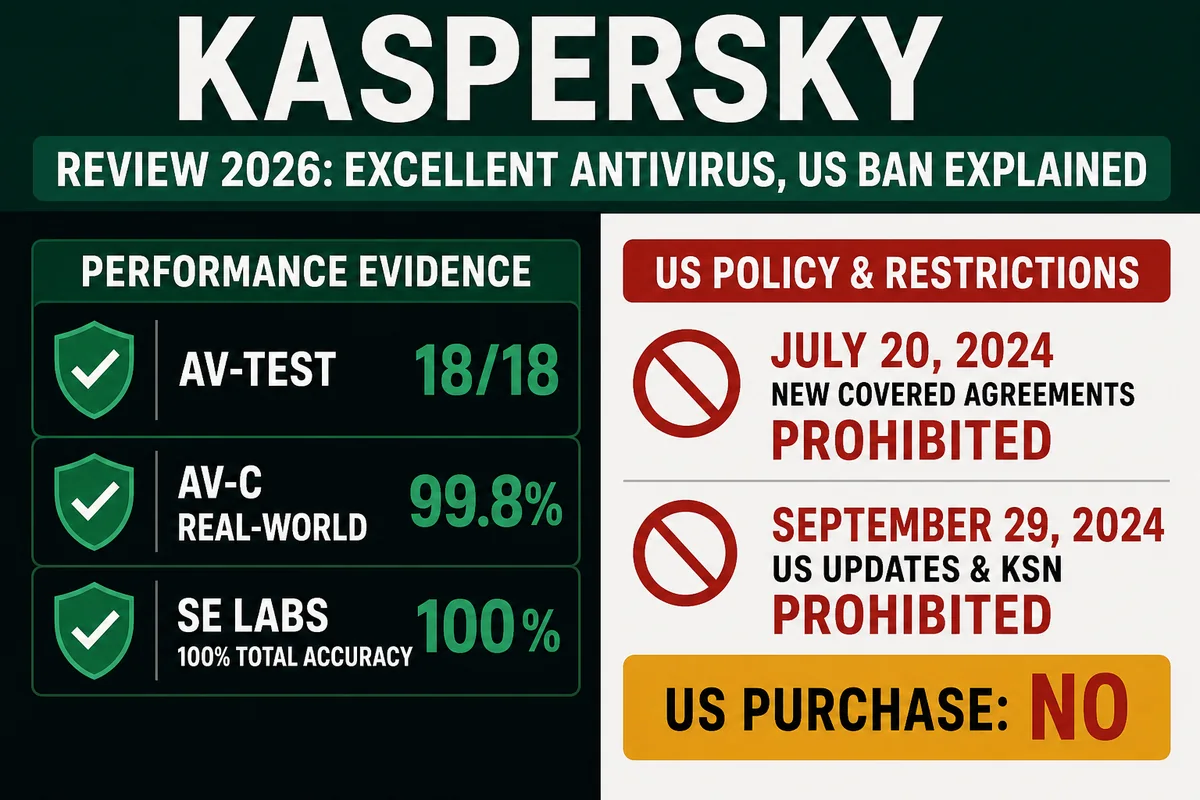
Our verdict: Kaspersky Premium is an excellent antivirus where it's lawfully sold, updated and permitted by the buyer's employer. The latest independent results combine first-place web protection, very few false alarms and the second-lowest measured performance impact. The hard stop is jurisdiction and supplier risk: a US person should move to Bitdefender, ESET, Norton or Microsoft Defender, not hunt for a foreign key or a site claiming to sell “US Kaspersky.” Outside the US, the product earns 8.4/10, conditional on your threat model and policy obligations. For US purchase viability, the answer is simply no.
- Best raw result in the completed February–May real-world test
- Only one compromise across 400 live-web cases
- Just two false alarms in the 10,030-file malware test
- Second-lowest April 2026 performance impact
- Strong firewall, payment and ransomware controls on Windows
- No legitimate sale, signature update or KSN operation for US persons
- Moscow headquarters and unresolved supplier-governance concern
- Introductory prices rise sharply at renewal
- Features and even app-store availability vary by region
- iOS protection isn't a full Windows-style antivirus scanner
Kaspersky in 2026 at a glance
The current home line is Kaspersky Standard, Plus and Premium. “Kaspersky Anti-Virus,” “Internet Security,” “Total Security” and Security Cloud still appear on old boxes, keys, account pages and search results, but they aren't the cleanest way to compare a new subscription. Standard is the security core. Plus is the useful bundle for someone who wants the unlimited VPN and password manager. Premium adds identity/support services whose availability and value depend heavily on country.
On Windows, the product combines signatures, cloud reputation, web filtering, exploit and behavior monitoring, ransomware defense, a two-way firewall and application control. Those layers matter because the current tests don't measure one scanner in isolation. They measure whether the entire installed product stops an attack before the test system is compromised.
The product question has two answers. Technically, Kaspersky is outstanding. Operationally, it's unusable as a responsible US recommendation and a more complicated vendor-risk decision elsewhere. An antivirus runs with deep system privileges, inspects files and traffic, and depends on constant trusted updates. That makes supplier jurisdiction more important here than it would be for a simple photo editor.
Kaspersky independent lab results in 2026
Kaspersky's current result set is unusually consistent. It led the finished AV-Comparatives live-web cycle, tied the top file-protection cluster, placed second for low system impact, earned AV-TEST's full 18 points and completed every SE Labs attack without a protection or legitimate-item error.
| Independent test | Product / period | Verified result | Decision value |
|---|---|---|---|
| AV-TEST Windows 11 | Premium 21.24 May–Jun 2026 | 18/18 Top Product 6 protection 6 performance 6 usability | The newest two-month certification: 100% in both protection sets and no false warnings or blocks. |
| AV-Comparatives Real-World | Premium 21.24 Feb–May 2026 | 399/400 blocked 99.8% protection 1 compromised 3 false alarms Advanced+ | Completed 400-case web/download attack cycle; best raw protection result in the group. |
| AV-Comparatives Malware | Premium 21.24 Mar 2026 | 92.1% offline detection 97.8% online detection 99.97% final protection 3 compromised / 2 FP | Shows the value of cloud and post-detection defenses; only two clean files were misclassified. |
| AV-Comparatives Performance | Premium 21.24 Apr 2026 | AV-C 90 Procyon 96.5 Impact 3.5 Advanced+ | Second-lightest combined impact on the lab's low-end Core i3/8GB/SSD PC. |
| SE Labs Home Anti-Malware | Kaspersky Premium Jan–Mar 2026 | 100% protection 100% legitimate accuracy 100% total accuracy AAA | Current general and targeted attack-chain evidence with clean-item handling. |
The completed AV-Comparatives real-world figure is the headline to use, not an earlier partial result: 399 attacks blocked, one compromise and no user-dependent prompt. Three clean sites/files were blocked. The Advanced+ award reflects both protection and false-alarm performance.
The March file test used 10,030 samples. Kaspersky's 92.1% offline detection isn't a failure; it shows that the product relies on an online reputation and behavior pipeline. With the internet available, online detection rose to 97.8% and final protection to 99.97%. Three samples still compromised the PC. A review that calls 99.97% the “detection rate” erases the most useful part of the result.

What Kaspersky's perfect-looking scores do and don't prove
In AV-TEST's May–June cycle, Kaspersky recorded 100% in both months against the zero-day/web/e-mail set and 100% in both months against the widespread reference set. The lab recorded no false website blocks, software detections, warnings or action blocks for Kaspersky. That's excellent consumer-protection evidence, but “18/18” is a category score, not a promise that no future threat can pass.
SE Labs adds a different signal. Its attack chains include targeted techniques, and Kaspersky protected against every general and targeted case while allowing every legitimate application/site in the set. This is stronger evidence than a vendor claim because the attack selection and scoring are controlled outside Kaspersky.
None of these labs is designed to answer whether a government could compel a vendor, whether build infrastructure is immune to a future supply-chain attack, or whether an organization should accept a supplier headquartered in a particular jurisdiction. They install a released product and measure its behavior against attacks and clean objects. That's why a technical verdict can't settle the US policy question.
Is Kaspersky safe to use in 2026?
For a US person: no, it isn't a responsible operational choice. The product can't lawfully receive the signature, codebase and cloud-network service on which current protection depends. Even if an old executable still opens, a green status screen isn't evidence of a supported defense.
For a buyer outside the US: technically strong, conditionally recommendable. Check local law, official availability, employer policy, client contracts and sensitivity of the data on the device. A home gaming PC in a supported UK market has a different risk profile from a journalist covering Russian intelligence, a defense supplier, a government employee, a sanctions-compliance team or someone who crosses US-person boundaries.
The US Commerce Department based its decision on the Russian government's capability and capacity to influence Kaspersky and the privileged access antivirus software has to sensitive data. Kaspersky disputes the determination and points to transparency controls. We don't pretend a consumer review can adjudicate intelligence evidence that isn't public. We can state the policy accurately and avoid using high malware scores as a substitute answer.
“Safe” also includes ordinary product behavior. Kaspersky decrypts or inspects traffic for web protection, places drivers deep in Windows, updates automatically and may upload suspicious-object metadata or samples under cloud settings. Those are normal antivirus powers, but normal doesn't mean trivial. Review privacy/KSN settings, disable components you don't need and never install a second real-time suite with overlapping firewall, HTTPS or behavior hooks.
The Kaspersky US prohibition, without the vague headlines
The Bureau of Industry and Security's current Kaspersky FAQ supplies the dates and scope:
| Date | Rule | What a consumer should do |
|---|---|---|
| July 20, 2024 | Kaspersky prohibited from entering new covered ICTS agreements with US persons. | Don't buy a new key, use a foreign checkout or trust a reseller claiming a US workaround. |
| September 29, 2024 | Signature/codebase updates and KSN operation prohibited in the US or on a US person's IT system. | Old installed software isn't a current supported antivirus; replace it. |
| September 29, 2024 | Resale, covered integration and licensing for resale/integration prohibited. | A white-label or renamed offer doesn't evade the covered-supplier rule. |
| Current | End users aren't penalized merely for leaving the product installed, but BIS says they assume the risks. | Removal is a security decision, not an admission that the user committed an offense. |
The Commerce Department determination is broader than “US government computers.” It covers consumer cybersecurity and antivirus transactions for US persons. It also lists specific exclusions for purely informational threat-intelligence, training and consulting services; those exclusions don't restore consumer antivirus updates.
A search result, cached official US product page or checkout-looking page isn't enough to establish legal availability. Verify the exact host, country selector and transaction seller. A page promising a newly updated “Kaspersky USA 2026” download deserves suspicion, not a credit card.

Swiss data processing and Kaspersky Transparency Centers
Kaspersky's Global Transparency Initiative says cyberthreat-related data storage and processing for a number of regions moved to Zurich. The program also provides Transparency Centers where qualified stakeholders can examine source code, updates and processes. These are material controls and should be included in a fair review.
An independent governance signal exists too. The Tyrol Chamber of Commerce commissioned the TRACS 2025 study with MCI and AV-Comparatives to compare vendor disclosures, data practices and accountability mechanisms. Kaspersky's transparency program isn't just a marketing sentence.
Limits matter. “A number of regions” isn't every datum from every customer, and a source review under controlled access isn't public reproducible proof that coercion is impossible. Swiss processing doesn't move the company's headquarters out of Moscow or invalidate another country's legal risk assessment. The honest conclusion is that Kaspersky has built meaningful transparency controls and that substantial jurisdiction risk remains for some buyers.
For a normal supported-market household, local official availability plus strong independent technical tests may be enough. For regulated, cross-border or high-value work, ask the organization's security/legal team. A consumer editor shouldn't waive an employer's vendor-risk policy.
Kaspersky Standard vs Plus vs Premium: current UK price and renewal
Kaspersky has no legitimate current US consumer price. To make the commercial comparison concrete without inventing global pricing, we captured a supported-market snapshot from the official UK store on July 23, 2026. These are three-device, one-year auto-renewing configurations. Currency, tax, promotions and feature bundles vary by market.
| Plan | UK intro price 3 devices / 1 year | Displayed renewal | What changes |
|---|---|---|---|
| Kaspersky Standard | £15.99 | £45.99 | Core antivirus, ransomware/web/phishing, firewall, payment protection and performance tools. |
| Kaspersky Plus | £19.99 | £55.99 | Adds unlimited VPN, Password Manager, leak and password checks, plus privacy/storage tools. |
| Kaspersky Premium | £20.99 | £59.99 | Adds identity wallet, remote-access monitoring, premium/expert support and market-specific extras. |
At this snapshot, Premium costs only £1 more than Plus in the first term but £4 more at renewal. That makes Premium look like the easy choice for year one. It's only better value if you'll use the support/identity features and accept remote expert access when needed. Plus is the cleaner long-term bundle for most supported-market users who want the VPN and password manager. Standard is the rational choice if you already trust separate privacy tools.
The same official pages listed one-device entry prices and renewals of £14.99/£37.99 for Standard, £18.99/£49.99 for Plus and £19.99/£55.99 for Premium. Device selectors extended to ten devices on Standard/Plus and twenty on Premium. Never compare £15.99 for three devices against a competitor's five-device renewal and call it cheaper without normalizing term, device count and renewal.
The UK page also advertised a gift-card and a free year of Kaspersky Safe Kids with Premium. We exclude those from the core value calculation because they're temporary, market-specific extras. A child-safety feature included “for one year” isn't the same as permanent parental controls inside the base renewal.

Kaspersky features that actually change the buying decision
| Feature | Standard | Plus | Premium | Editorial note |
|---|---|---|---|---|
| Real-time malware, ransomware and web protection | Yes | Yes | Yes | The current lab-tested core; don't pay more for a claim that Premium has a different detection engine. |
| Two-way firewall and application control | Yes, platform-dependent | Yes | Yes | Useful on Windows; review prompts rather than defaulting to allow. |
| Online Payment Protection / Safe Money | Yes | Yes | Yes | Hardened banking path; still verify domain and transaction independently. |
| Unlimited VPN | No | Yes | Yes | The main reason to move from Standard; check location, protocol and streaming needs. |
| Password Manager | No | Yes | Yes | Convenient bundle, but dedicated managers can offer richer sharing/recovery workflows. |
| Data Leak Checker | Limited/market-dependent | Yes | Yes | A breach alert is a prompt to rotate credentials, not proof of identity theft. |
| Identity wallet / expert remote help | No | No | Yes | Premium's differentiator; support scope and availability vary by country. |
| Safe Kids | No base inclusion | No base inclusion | UK promotion: one year | Treat as a separate renewable service, not a permanent Premium entitlement. |
The Windows plan matrix confirms that all three tiers include quick, full, selective, removable-drive and background scans; File and Mail Anti-Virus; Safe Browsing; quarantine; vulnerability checks; and database/module updates. Plus and Premium are bundle decisions, not an excuse to imply Standard has weak malware defense.
Ransomware and behavior monitoring
Kaspersky watches application behavior and can block suspicious encryption or process activity. This reduces risk but doesn't replace an offline/versioned backup. A ransomware process that exploits an unknown path, stolen account or permitted remote tool can bypass a product-specific promise. Test recovery of documents, photos and business data before you need it.
Firewall and application rules
The configurable Windows firewall is a strength for experienced users and a source of friction for unusual games, developer tools, virtual machines and remote-access software. Before allowing a block, verify file signature, publisher, hash/reputation and expected network destination. Create the narrowest rule for the signed executable; never whitelist a downloads folder. If normal sites or certificates fail, use the dedicated website and SSL troubleshooting guide before disabling encrypted-traffic inspection globally. If normal sites or certificates fail, use the dedicated website and SSL troubleshooting guide before disabling encrypted-traffic inspection globally.
Gaming and Do Not Disturb
Do Not Disturb suppresses interruptions while a full-screen app is active. It doesn't turn the protection engine off. That's the right design: reduce pop-ups, not security. If a game anti-cheat conflicts with a security driver, update both products and use the vendor support channels rather than permanently disabling self-defense.
Kaspersky on Windows, Mac, Android and iPhone
The subscription is multi-platform, but the application isn't identical on each OS. Buy for the weakest required platform, not for the longest feature list on the Windows product page.
| Platform | Meaningful protection | Important limit |
|---|---|---|
| Windows | Full real-time file/web/mail/behavior stack, ransomware controls, firewall, scans, Safe Money and plan tools. | Deep system and HTTPS inspection can conflict with other security/network tools. |
| macOS | Malware and web/phishing protection plus plan privacy tools. | Firewall, application control, cleanup and payment behavior don't mirror Windows one-for-one. |
| Android | App/file malware scanning, web/link protection, privacy and plan-specific VPN/password features. | Kaspersky says its Android apps may be unavailable in Google Play in some regions; use only an official store/vendor route. |
| iOS/iPadOS | Weak-setting/security checks, phishing/malicious-link filtering, leak/privacy, VPN and password features by tier. | No Windows-style full filesystem or arbitrary-app malware scanner because iOS sandboxes apps. |
| Linux | Some global 2026 product pages now list consumer Linux support. | Not shown in every regional comparison; verify exact distribution, tier and country before paying. |
The official iOS documentation calls its link component a “Phishing & Malware Filter.” That doesn't mean it scans every installed app like Windows antivirus. It checks web/app network links and settings. Describe the function, not the marketing label.
For Android, app-store provenance matters. If the product is absent from your regional Play Store, don't download an APK from a search result, file mirror or forum attachment. Start at the official country page, check the certificate/publisher and keep Android/Google Play system updates current. Our Kaspersky Android review covers the current store restrictions, sideloading boundary and mobile-only features. Our Kaspersky Android review covers the current store restrictions, sideloading boundary and mobile-only features.
Is Kaspersky lightweight, and how should you install it?
Current evidence supports “lightweight” more strongly than the recovered page ever did. AV-Comparatives measured an impact score of 3.5 on its low-end Windows 11 system, second only to McAfee's 3.3. The AV-C task score was 90 and the independent Procyon Office score retained 96.5% of baseline. Follow the installation and setup guide for a clean baseline; if the app later becomes heavy or stops responding, use the high-CPU and not-working decision tree. Follow the installation and setup guide for a clean baseline; if the app later becomes heavy or stops responding, use the high-CPU and not-working decision tree.
AV-TEST again awarded 6/6 performance in May–June, but its subtests show why one badge shouldn't become “zero slowdown.” Popular websites were 12% slower on the standard PC and 10% on the high-end PC in the measured workload; common app launch showed 5% and 3% slowdown. Application installation was 22% and 15% slower, while downloads had no measured slowdown and file-copy effects were small. A particular browser extension, encrypted drive or developer workflow can still behave differently.
- Check country and policy first. Don't create an account or buy a key until the product is permitted and supported for you.
- Remove the old real-time antivirus. Use its official uninstaller, reboot and verify no filter/firewall drivers remain active.
- Download from the official regional account/store. Avoid “cracked,” repacked and reseller downloaders.
- Update before the first scan. Confirm databases, modules and the system clock are current.
- Review KSN/privacy choices. Read the exact data-processing statement shown for your region.
- Run one full scan. Schedule future work for idle time; don't publish invented scan-time comparisons.
- Open protection status. Confirm File, Web, Mail, behavior/ransomware and firewall components are active where applicable.
- Test essential apps. Banking, VPN, games, development, remote access and backup should work before the refund window closes.
Don't pair Kaspersky with another full real-time suite because a forum suggests “extra layers.” Two products can intercept the same file, TLS session, process or network event, causing deadlocks, slowdowns and inconsistent quarantine. A reputable on-demand scanner is a different category; keep it from enabling an overlapping real-time module.
Safe Money, VPN and Password Manager: useful or bundle padding?
Safe Money / Online Payment Protection
Safe Money opens supported payment sites in a protected browser context and checks the site's certificate/address. This is useful against local screen/process interference and simple phishing, but it can't fix a bank-transfer scam that the account owner authorizes. Verify the beneficiary and amount through a second channel for unusual payments; our Safe Money guide covers setup, browser states and certificate failures.
Kaspersky VPN
Plus and Premium include the unlimited VPN in the current UK comparison. “Unlimited” refers to data volume, not guaranteed access to every streaming service, country or network. Check the current location list, kill switch, split tunneling and the separate VPN privacy terms. Our Kaspersky VPN review tests that component as its own product rather than treating it as a free checkbox.
Kaspersky Password Manager
The manager covers basic vault, autofill and password-health needs and makes Plus convenient. A family or business should compare shared vaults, emergency access, passkey support, recovery design and independent security history with dedicated managers. The separate Kaspersky Password Manager review covers its regional limits and migration trade-offs; a small first-year bundle difference isn't the whole cost.
Premium remote support and identity wallet
Remote expert help can be valuable to a household supporting older relatives, but it expands the trust boundary. Start sessions only through the signed app or official account, watch the connection and end/remove remote-control tooling when finished. Kaspersky support won't require gift cards, cryptocurrency, a bank password or an unrelated “refund verification” screen share.

How US users should remove Kaspersky or an UltraAV transition
Kaspersky moved former US antivirus customers to UltraAV/Pango during the 2024 exit. That transition created understandable concern because users reported a replacement appearing through an update flow. Community history doesn't prove that UltraAV is malicious, but it does mean you must identify which security provider, VPN and billing account now exist rather than assuming “Kaspersky canceled everything.” The US ban and migration guide separates the legal dates, UltraAV transition and replacement sequence. The US ban and migration guide separates the legal dates, UltraAV transition and replacement sequence.
- Inventory the current providers. In Windows Security, open “Who’s protecting me?” and record Kaspersky, UltraAV, UltraVPN or other registered products.
- Save receipts and account details. Record the original seller, current renewal date and any migration email before uninstalling.
- Remove unwanted apps through Installed apps. Uninstall Kaspersky and any UltraAV/UltraVPN components you don't intend to keep; use the publisher's official cleanup tool only if normal removal fails.
- Reboot. Security-provider and network-filter changes often complete only after restart.
- Confirm Microsoft Defender resumes. Virus & threat protection should show Defender active, current and able to update.
- Update Windows and run a full scan. Add an on-demand second opinion if the old product had been stale for months.
- Install one chosen replacement. Download from its official site; confirm Defender steps back automatically when the new provider registers.
- Cancel billing with the actual seller. Uninstalling doesn't cancel Kaspersky, UltraAV, app-store, reseller or card recurring payments.
The BIS page links to a CISA consumer removal guide. Use that official route if account ownership or remnants are unclear, or follow our complete Kaspersky removal guide to verify services, filters and the replacement provider. Don't purchase a foreign Kaspersky key to “repair” a US installation: it doesn't restore a lawful US update and KSN service.
Kaspersky auto-renewal, cancellation and refunds
The current My Kaspersky cancellation guide uses “Cancel subscription” to turn off automatic renewal. Protection stays active to the end of the paid term. A refund is a separate request. The UK product page advertises a 30-day money-back guarantee, but eligibility and the request route depend on who sold the subscription; our cancellation and refund guide maps each seller path.
- Find the seller on the receipt/card statement. Kaspersky direct, Nexway, 2Checkout, an app store, ISP or reseller can have different controls.
- Open My Kaspersky > Subscriptions. Select the exact plan and choose Manage subscription.
- Turn off auto-renewal. Save the confirmation and check that the next billing date/status changed.
- Use the provider account if redirected. App Store, Google/other Android stores and external sellers must be canceled there.
- Request a refund separately. Submit it within the advertised window and keep the case/order number.
- Check companion products. A standalone VPN, Password Manager or Safe Kids subscription may renew separately from the security suite.
- Leave protection installed until replacement day. Canceling renewal doesn't require creating an unprotected gap.
- Inspect the next statement. Confirmation evidence matters more than the absence of the desktop icon.
UK three-device renewal in our snapshot increased from £15.99 to £45.99 for Standard, £19.99 to £55.99 for Plus and £20.99 to £59.99 for Premium. Set a reminder 35–45 days before expiration. That's early enough to compare the renewal, not just react after the charge attempt.
What current Kaspersky discussions can tell us
Recent non-US antivirus discussions still praise Kaspersky's lightness and protection while asking whether Standard is enough or another HIPS/firewall should run beside it. The controlled evidence supports the lightness; the correct overlap answer is usually one real-time suite, not two.
Plan discussions often reduce Premium versus Standard to “more features.” The real choice is sharper: Standard for core protection, Plus for VPN/password/privacy, Premium for region-specific identity and human support. A current legacy-name discussion shows why migration labels remain confusing.
US transition threads document surprise and distrust around UltraAV. They're useful evidence that migration communication and uninstall/billing clarity matter, but not controlled evidence about either engine's detection. A current game false-positive report similarly tells us to include a safe exception workflow; it can't estimate the false-positive rate. For that, use AV-TEST and AV-Comparatives.
Who should choose Kaspersky—and who shouldn't
| User | Recommendation | Reason |
|---|---|---|
| US person or US-based device | Don't use/buy | Updates and KSN can't lawfully be provided; strong historic/current foreign lab results don't fix support. |
| Government, defense, critical infrastructure or sensitive cross-border work | Choose another vendor | Policy, client and supplier-risk friction outweighs a small technical advantage. |
| Supported-market home Windows user | Strong conditional choice | Excellent current protection, low false alarms and low impact; verify local official store and employer rules. |
| Household wanting VPN and password manager | Plus is the likely fit | It adds the two bundle components most people will use without Premium's support/identity scope. |
| User supporting older relatives | Premium can fit | Official remote expert help may be valuable, provided the country service terms are clear. |
| Apple-only household | Compare carefully | The strongest independent evidence and deepest features are Windows-centric; iOS is web/privacy protection, not full antivirus. |
| User already satisfied with Defender and backups | No urgent need to switch | Defender is free and current; Kaspersky adds controls and lab advantages but also a new trust boundary. |
Best Kaspersky alternatives in 2026
For US readers, these are replacements, not merely competitors. For buyers elsewhere, they reduce geopolitical and supplier-policy friction while retaining current independent evidence. The full Kaspersky alternatives guide adds use-case routes, bundle-component replacements and a no-gap migration checklist. The full Kaspersky alternatives guide adds use-case routes, bundle-component replacements and a no-gap migration checklist.
| Alternative | Current real-world result | Choose it when | Trade-off |
|---|---|---|---|
| Bitdefender | 99.5%; 2 compromised; 5 FP | You want broad cross-platform protection and rich anti-scam/ransomware controls. | Higher April impact (9.6) and plan/VPN complexity. |
| Norton 360 | 99.3%; 3 compromised; 5 FP | You want an integrated US-friendly VPN, password and backup suite. | Renewal and tier/device entitlements need close reading. |
| ESET HOME Security | 98.5%; 6 compromised; 2 FP | You value control, low false alarms and low measured impact (4.2). | Less impressive current live-web raw protection than Kaspersky. |
| Microsoft Defender | 99.0%; 4 compromised; 0 FP | You want a free, supported Windows default with no renewal. | April impact 12.9 and fewer bundled privacy/support tools. |
| Avast Free | 99.3%; 3 compromised; 5 FP | You want a no-cost third-party engine with strong current results. | Upsell/privacy history and separate paid-suite complexity. |
Kaspersky's 99.8% versus Bitdefender's 99.5% is one additional blocked case in this 400-case cycle. That's useful evidence, not a reason to ignore country, support, renewal or trust. Repeat tests across time before treating a 0.3-point gap as a permanent engine ranking.
Frequently asked questions about Kaspersky
Is Kaspersky safe to use in 2026?
Kaspersky is technically excellent in current independent tests, but safety is country- and threat-model dependent. We don't recommend it to US persons because updates and Kaspersky Security Network operation are prohibited. Outside the US, verify official local availability, employer policy and supplier-risk requirements before choosing it.
Is Kaspersky banned in the United States?
Covered new transactions with US persons were prohibited from July 20, 2024. From September 29, 2024, Kaspersky could no longer provide antivirus signature/codebase updates or operate KSN in the US or on US persons' IT systems. End users aren't penalized merely for an installed copy, but BIS says they assume the risks.
Does Kaspersky still update in the United States?
No current legitimate Kaspersky consumer antivirus update service should be relied on for a US person. The BIS Final Determination prohibits signature and codebase updates and KSN operation from September 29, 2024. A program that still opens or a foreign activation key doesn't restore supported US protection.
Which Kaspersky plan is best: Standard, Plus or Premium?
Standard is best for core antivirus, firewall, web, ransomware and payment protection. Plus is the practical bundle for most eligible buyers who also want the unlimited VPN, Password Manager and leak/privacy tools. Premium is worth it only when its region-specific identity services, Safe Kids offer and expert remote support solve a real need.
How much does Kaspersky cost in 2026?
Kaspersky isn't a legitimate current US purchase and prices vary by country. On July 23, 2026 the official UK store showed three-device, one-year introductory/renewal prices of £15.99/£45.99 for Standard, £19.99/£55.99 for Plus and £20.99/£59.99 for Premium. Always verify the official local checkout.
Is Kaspersky better than Microsoft Defender?
Kaspersky led the latest completed AV-Comparatives real-world test at 99.8% and had a lower April performance impact than Defender. Defender remains the better choice for US users, costs nothing and avoids Kaspersky's supplier-policy problem. Outside the US, Kaspersky offers more controls and bundle features, but the decision isn't based on detection alone.
Does Kaspersky work on iPhone and Android?
Yes where the apps are officially available. Android can provide app/file malware scanning plus web and privacy tools. The iPhone/iPad app focuses on weak-setting checks, phishing/malicious-link filtering, VPN, leak and password features; it isn't a Windows-style full filesystem antivirus. Store availability can vary by region.
How do I cancel or uninstall Kaspersky?
Turn off auto-renewal in My Kaspersky or with the actual seller, then request any eligible refund separately. Uninstall the app through the operating system or official removal guide, reboot and confirm Microsoft Defender or your chosen replacement is active. Uninstalling doesn't cancel billing, and canceling renewal doesn't uninstall protection.
Final verdict: elite protection with a non-technical hard stop
Kaspersky's 2026 protection case is among the best we have reviewed. AV-TEST gave Premium 21.24 all 18 points. AV-Comparatives recorded 399 blocks in 400 live-web attacks, only one compromise, three false alarms and Advanced+. Its 10,030-file test ended at 99.97% final protection with only two false alarms. Performance impact was second-lowest, and SE Labs returned perfect protection and legitimate accuracy.
Those facts deserve a strong technical rating. They don't deserve a hidden US buy button. Antivirus depends on trusted updates and cloud classification; the US prohibition removes both from the legitimate operating model. US users should remove stale Kaspersky/transition remnants, confirm Defender, cancel billing with the actual seller and choose a supported alternative.
Outside the US, Kaspersky is a serious option for an ordinary home user whose local official store and employer allow it. Standard provides the full protection core. Plus is the sensible bundle for VPN/password needs. Premium is a support and identity decision, not a more powerful malware engine. Our 8.4/10 is explicitly conditional on lawful updates and an acceptable supplier-risk assessment.