
Trend Micro Review 2026: Fast, but Too Many False Positives
Trend Micro is legitimate, easy-to-use security software with excellent current performance and useful Pay Guard and Folder Shield tools. Protection is the problem: the completed real-world test ended at 98.3% with seven compromised systems and 83 false positives, while the latest Windows and Mac AV-TEST results both scored only 4.5/6 for protection.
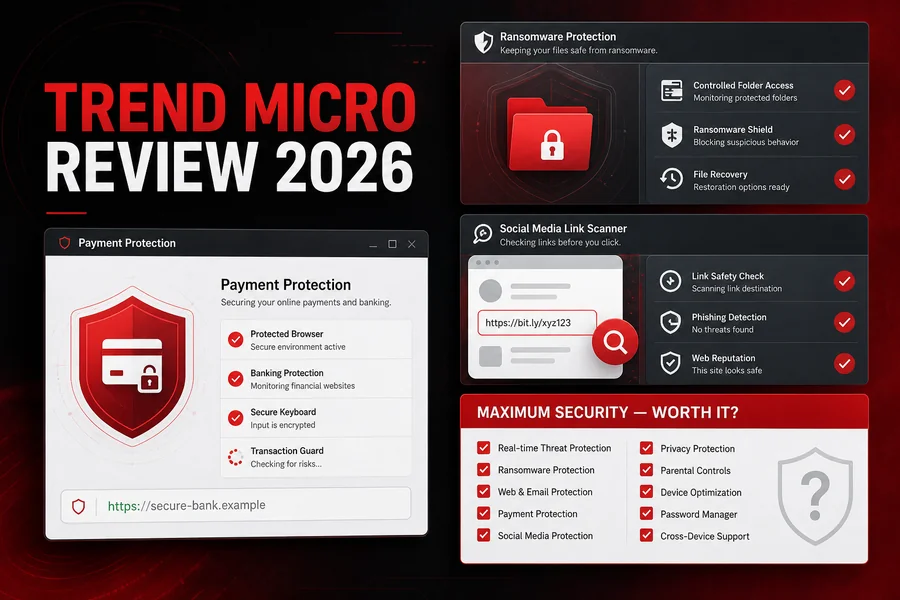
Our verdict: Trend Micro Maximum Security is pleasant to operate and fast enough for an older PC, but it isn't our default family recommendation in 2026. Internet Security 17.9 blocked 393 of 400 current web attacks and wrongly blocked 83 clean sites or files—the highest false-positive count in the field. The separate file test left 91 of 10,030 systems compromised. Existing users who value Pay Guard, Folder Shield and the five-device plan can reasonably stay after testing alerts. New buyers should compare Bitdefender, ESET, Norton and Defender first. The current balance earns 7.3/10.
- Fourth-best combined performance impact in April 2026
- Simple interface with useful default protection
- Pay Guard isolates banking and shopping activity
- Folder Shield adds controlled-folder ransomware defense
- Clear three-, five- and ten-device suite ladder
- 83 false positives—the completed real-world cycle's highest count
- 98.3% live protection and seven compromised systems
- 99.09% malware-file protection left 91 systems compromised
- Latest Windows and Mac AV-TEST protection both only 4.5/6
- Legacy Password Manager claims are obsolete after its 2025 shutdown
Trend Micro in 2026 at a glance
Trend Micro is a long-established security company, and its consumer software is legitimate antivirus—not spyware or a fake scanner. The current Windows generation is version 17.9. The consumer line begins with Antivirus+ Security, then Internet Security, Maximum Security and the ten-device Premium Security Suite. The names matter because device count, platform access, VPN, identity assistance and support change by tier.
Maximum Security is the useful center of this review. It covers up to five current Windows, Mac, Android, iOS and Chromebook devices according to the US product page and adds cross-platform/mobile access over the three-PC Internet Security tier. Premium Security Suite expands to ten and bundles VPN, identity services, ScamCheck and premium support. The malware engine isn't inherently stronger because the tier costs more.
The product's 2026 story is unusually split. Trend Micro is one of the fastest suites in AV-Comparatives' April workload. Yet the completed web-threat cycle produced the most false positives in the entire field, and its protection rate trailed the main products already completed in our review series. Both things are true; reducing the verdict to “lightweight” or “strong AI antivirus” hides the purchase risk.
Trend Micro lab results in 2026
Four current tests answer different questions. AV-TEST challenges the whole product against zero-day and widespread threats while measuring slowdown and false alarms. AV-Comparatives' real-world test begins with live web attack paths. Its malware protection test begins with malicious files already on the machine or removable/network storage. Its performance test times file and application tasks plus a standardized Office benchmark.
| Independent test | Product / period | Trend Micro result | Practical meaning |
|---|---|---|---|
| AV-TEST Windows 11 | Internet Security 17.9 January–February 2026 | 4.5/6 protection 6/6 performance 6/6 usability 16.5/18 | Fast and quiet in this set, but zero-day/widespread misses reduced protection. Trend Micro was absent from April. |
| AV-C Real-World Protection | Internet Security 17.9 February–May 2026 | 98.3% protected 393 blocked / 7 compromised 83 false positives Tested award | Good raw blocking, but below the leaders and the field's worst clean-site/file friction. |
| AV-C Malware Protection | Internet Security 17.9 March / 10,030 cases | 85.6% offline detection 93.4% online detection 99.09% final protection 8 FP / Tested | Cloud/execution layers helped, but 91 systems still ended compromised—the weakest result in the field. |
| AV-C Performance | Internet Security 17.9 April 2026 | Impact: 4.7 AV-C tasks 90 Office 95.3 | Fourth-best combined result of 20; a genuine current strength. |
| AV-TEST macOS | Antivirus 11.9 March 2026 | 4.5/6 protection 6/6 performance 6/6 usability 16.5/18 | The Windows protection dip wasn't an isolated platform story. |
The latest Windows AV-TEST score is 16.5/18, not an old perfect result
Trend Micro Internet Security 17.9 wasn't in AV-TEST's April 2026 Windows line-up. Its latest published cycle is January–February. It earned full performance and usability points, but protection fell to 4.5/6: zero-day protection was 98.5% and 98.9%, while widespread malware coverage was 99.0% and 100%. The product remained certified, but it was below the 17.5-point Top Product threshold.
Many ranking pages still quote perfect 2024/2025 scores. Those results are historically real and currently incomplete. Security products, samples and cloud systems change; a buying page dated 2026 must lead with the current dip. The March Mac test reached the same 16.5/18 split, including 4.5/6 protection, after years of stronger Mac cycles.
The completed real-world result is 98.3%, not the interim 99.5%
An interim February–March report showed Trend Micro blocking 99.5% of 200 cases and produced 34 false positives. Several new reviews still quote that favorable half-cycle. The completed February–May report doubled the sample to 400: Trend Micro blocked 393, seven were compromised, protection fell to 98.3%, and the false-positive count rose to 83.
AV-Comparatives put the protection result in cluster two. More than 50 false positives forces a Tested award under its ranking system, so the final label was Tested. The field average was eight false positives; Microsoft had zero, ESET two, Norton/Bitdefender/TotalAV five and Malwarebytes 39. False positives don't infect a PC, but blocking a clean business site, installer or niche tool 83 times destroys alert trust and can stop work.
The malware-file test is the larger efficacy concern
In the 10,030-case March test, Trend Micro recognized 85.6% without cloud access and 93.4% while connected. After every web, behavior and execution layer acted, final protection reached 99.09%; 91 systems were compromised. Eight clean-file false alarms were relatively moderate. The result earned only Tested and ranked last for final online protection.
Don't confuse 93.4% online detection with final protection: execution layers blocked many samples detected late. Conversely, 99.09% isn't “near perfect” when the same report's leading products left two or three systems compromised. Keep the device online, update version 17.9, maintain tested backups and don't use one antivirus result as permission to run unsupported software.

Trend Micro plans, devices, prices and renewal value
The current US home product catalog now publishes the same first-term and regular-price basis across its main plan cards. We checked the snapshot below on August 1, 2026. It isn't encoded as an Offer in our schema because location, account status, seller, term and the final cart can still change what a buyer pays.
| Current plan | Published scope | Observed first charge | Current regular price | Buy it for |
|---|---|---|---|---|
| Antivirus+ Security | 1 Windows or Mac device; verify the exact installer and activation receipt | $29.95 | $39.95/year | One supported computer with no household device sharing. |
| Internet Security | Up to 3 Windows devices; Pay Guard, parental, social and gaming controls | $59.95 | $79.95/year | A Windows-only household of up to three PCs. |
| Maximum Security | Up to 5 Windows, Mac, Android, iOS or Chromebook devices | $74.95 | $99.95/year | The balanced Trend Micro tier for a mixed-device household. |
| Premium Security Suite | Up to 10 devices + VPN, ID Protection, ScamCheck, identity-restoration benefits and premium support | $109.95 | $149.95/year | A qualifying US buyer who values the exact VPN, identity and support terms. |
Maximum Security is the balanced mixed-device tier within the brand. It costs $15 more for the first term and $20 more at the current regular rate than Internet Security, while expanding the map from three Windows PCs to five Windows, Mac, Android, iOS or Chromebook devices. Don't buy it for a “Password Manager” feature: the old Trend Micro Password Manager ended service in November 2025. Current US/Canada customers use ID Protection instead.
Premium Security Suite isn't simply “Maximum with better antivirus.” It adds a separate VPN app, identity monitoring/restoration/insurance subject to eligibility and terms, ScamCheck and premium assistance. Count each service at what you'd otherwise pay. A household already using a trusted VPN and password manager may gain little. Insurance isn't prevention and doesn't cover every loss; read the exclusions and enrollment requirements before valuing the headline $1 million limit.
Antivirus+ needs extra checkout care because the shop's current feature card says PC and Mac while the official product family describes it as Windows PC protection and separately sells Antivirus for Mac. The activation receipt is authoritative. Don't buy a code for the wrong product expecting it to activate the existing app; Trend Micro says a different plan can require uninstalling and installing the matching application.

Protection features: Pay Guard, Folder Shield and the core engine
| Feature | Current useful role | Plan/platform caution |
|---|---|---|
| Pay Guard | Protected environment for banking/shopping sessions | Desktop/mobile implementations differ; it can't validate a phishing domain or authorized scam payment. |
| Folder Shield | Blocks untrusted changes to selected local/cloud-synced folders | Can block new legitimate tools and doesn't replace versioned backup. |
| ID Protection | Credential, breach and identity-monitoring tools | Replaces the retired Password Manager; Maximum inclusion is US/Canada-specific. |
| Trend Micro VPN | Encrypted public-network connection across supported devices | Bundled in Premium Security Suite, not a reason to assume stronger antivirus. |
| ScamCheck | Checks suspicious messages, links and supported deepfake/video scenarios | Current inclusion varies by plan/region; classification isn't a guarantee that a request is genuine. |
Web Threat Protection and behavior monitoring
Trend Micro combines local scanning, cloud reputation and behavior analysis. Web Threat Protection checks destinations before or during navigation, which is relevant to phishing, malicious downloads and fake shopping pages. The high false-positive count suggests that its reputation policy can be too aggressive with less-known clean sites/files, so a warning needs verification rather than automatic obedience or dismissal.
The large offline/online detection gap in the malware-file test makes connectivity important. Keep cloud features and definitions current. Version 17.7 and earlier current-generation Windows builds are out of support; an active subscription should be upgraded to 17.9. A stale engine with a valid payment date isn't current protection.
Pay Guard: useful isolation, not a payment guarantee
Pay Guard launches a protected browsing environment for banking and shopping. Its value is reducing interference from local browser extensions, keylogging behavior and unwanted process injection around a financial session. Use it from a known clean shortcut, type or bookmark the bank domain, and keep MFA enabled. A secure window can't make a phishing domain legitimate or reverse a transfer you authorized under social pressure.
Pay Guard Mobile provides a related protected environment for supported Android banking, shopping and wallet apps. iOS works within Apple's different security model and shouldn't be presented as the same capability. No current independent lab score in this article is a direct Pay Guard certification; the feature's design value and the full-product malware results are separate evidence.
Folder Shield and ransomware protection
Folder Shield monitors protected folders and can stop unauthorized processes from changing valuable documents and photos, including selected cloud-synced folders. This is a useful controlled-folder layer against ransomware. It can also block a legitimate new editor, backup client or script until approved—especially important in light of the product's current false-positive record.
Folder Shield isn't versioned backup and shouldn't be described as universal ransomware rollback. If encrypted files synchronize to cloud storage or an attacker reaches logged-in backups, prevention alone may fail. Keep offline/immutable or separately authenticated versions and perform a restore test. Don't permanently allow an unknown process just because a deadline is urgent.
ScamCheck, Fraud Buster, ID Protection and parental controls
Current higher tiers emphasize scams: suspicious messages/links, unsafe sites and deepfake/video-call warnings on supported platforms. ID Protection replaces the retired Password Manager and adds credential management plus dark-web/identity monitoring. These tools can reduce exposure and improve response; a breach alert doesn't remove leaked data, and a scam classifier can't validate an investment or family-emergency claim on its own.
Parental web filters are household rules, not proof that a child can't bypass every platform control. Pair them with OS family accounts, device updates and age-appropriate conversations. Review what activity is visible and avoid confusing a consumer parental setting with an employer-managed Trend Micro enterprise agent.

False positives: the defining Trend Micro problem
Eighty-three wrongly blocked clean domains/files isn't an abstract lab penalty. It means the completed real-world cycle saw Trend Micro block legitimate content more than ten times the field average. False warnings can stop a niche utility, new site, internal business tool, installer or update. Repeated mistakes also teach users to click “allow” reflexively, weakening the protection when a real warning arrives.
The separate malware-file test recorded only eight false alarms, and AV-TEST recorded no usability errors in its set. The tests aren't contradictory: they use different clean samples and web/file workflows. Trend Micro's weakest accuracy behavior appears especially in current real-world reputation filtering, not necessarily every full-disk scan.
- Don't restore immediately. Record the exact URL/file, detection name, source and digital signature.
- Confirm the source. Re-download only from the developer's official HTTPS page or signed update channel.
- Check multiple signals. Inspect signature, hash reputation and vendor status; a multi-engine result is context, not a vote.
- Update and rescan. False positives can be corrected through cloud/signature updates.
- Submit the item to Trend Micro. Ask the software developer to do the same when a signed release is affected.
- Use the narrowest exception. Prefer one verified file/process/domain over a whole Downloads, user, project or network folder.
- Remove temporary exceptions. Re-test after the vendor correction and document why the exception existed.
A developer, system administrator or user of specialist unsigned utilities is the least suitable Trend Micro buyer right now. A mainstream household visiting well-known sites may see much less friction, but “it probably will not affect me” isn't a comparative advantage when ESET and Defender produced two and zero false positives in the same completed test.
Performance: one of Trend Micro's strongest current results
The April AV-Comparatives performance report is a genuine positive. Trend Micro scored 90 on the lab's file/application tasks and 95.3 in UL Procyon Office, giving a combined impact score of 4.7. Only McAfee (3.3), Kaspersky (3.5) and ESET (4.2) were lower. Norton followed at 5.3, Bitdefender 9.6 and Defender 12.9.
AV-TEST also awarded 6/6 performance, although its detailed result showed roughly 27–28% website-launch slowdown on both standard and high-end systems—similar to its then-industry average. Downloads, common application launches, installations and copies remained near the averages. This supports “low overall impact,” not “zero slowdown.”
A January community post blaming Trend Micro for a slow PC is useful only as a prompt to reproduce the workload. It doesn't overturn a controlled 20-product comparison. Conflicts with another real-time suite, an initial full scan, an outdated build, VPN/browser extensions or a failing disk can all change the experience.
- Record a baseline. Time browser launch, file copy, archive extraction, application install, game/build start and idle use.
- Run one primary antivirus. Verify Defender's provider state and remove a conflicting paid suite.
- Update to 17.9 and finish first scan. Initial classification isn't steady state.
- Repeat tasks at least three times. Compare medians, not one impressive or bad run.
- Test Pay Guard, VPN and browser extensions separately. They add different processes and network paths.
- Track clean-item blocks. Speed is irrelevant if the workflow can't run safely.
- Decide inside the 30-day store window. Keep the receipt and refund route for the actual seller.
Trend Micro on Windows, Mac, Android, iOS and Chromebook
One “five devices” label doesn't mean five identical antivirus engines. Internet Security is positioned for up to three Windows PCs. Maximum Security can allocate up to five devices across supported desktop/mobile platforms. Premium expands to ten. The activated apps and feature sets differ, and the current Windows/Mac protection scores should be judged separately.
| Platform | Current useful scope | Important limit or change |
|---|---|---|
| Windows 11 | Full version 17.9 antivirus, behavior/web/ransomware controls and Pay Guard | Older 17.7/17.0 unsupported; S mode requires a one-way exit for desktop install. |
| macOS | Antivirus/web/ransomware privacy features through current compatible app | March 2026 AV-TEST protection 4.5/6; don't inherit Windows claims. |
| Android | App/pre-install scanning, Web Guard, Pay Guard Mobile, SMS/Wi-Fi/app tools | Separate current trial is seven days; permissions/features vary by OS/vendor. |
| iOS/iPadOS | Web Guard, SafeSurfing, Fraud Buster, QR/calendar/Wi-Fi/privacy tools | No app scan since iOS 9; no conventional system-wide antivirus. |
| Chromebook | Trend Micro Security browser/Web Store protection on supported ChromeOS | Not equivalent to the Windows desktop engine; check current extension support. |
On Android, current help documents pre-install app checks, web protection, Pay Guard Mobile, SMS/MMS scam analysis, Wi-Fi checks, parental controls and app management. On iPhone/iPad, Apple's sandbox prevents one app from scanning other apps; Trend Micro removed App Scan starting with iOS 9 and says it has no plan to restore it. The useful iOS product is a web/link/scam/privacy layer.
Trend Micro's Lost Device Protection ended October 5, 2025 on Android and iOS. Use Apple Find My, Google's Find My Device Hub or the device maker's locator instead. Don't buy Maximum Security from an old comparison table promising remote lock/wipe through Trend Micro. Likewise, a Chromebook extension shouldn't be counted as a full desktop antivirus merely because it consumes one license slot.
Feature lifecycle, account branding and privacy checks
Password Manager is discontinued; ID Protection replaced it
The official support notice confirms that Trend Micro Password Manager reached end of service on November 16, 2025 and no longer receives updates or support. Current customers should export/migrate old vault data; the export remains available for a limited period and requires the vault password. The current replacement is ID Protection, included in Premium Security Suite and, for US/Canada customers, Maximum Security.
This distinction matters because some official comparison snippets and third-party reviews still say “password manager.” Buying a supported ID Protection entitlement isn't the same as continuing the retired standalone Password Manager. Confirm import/export, browser/mobile support, recovery behavior and whether the current plan/region includes it before moving credentials.
TrendLife Account is the current account name
Current support increasingly calls the login a TrendLife Account while stating that existing subscriptions and protection remain the same. Seeing `account.trendlife.com` from an official Trend Micro help page can therefore be legitimate. Still navigate from the official help/store rather than trusting an email link, and use a unique account password plus available MFA.
Review data collection per feature
Web, reputation, crash and scam-filter features can transmit URLs, device identifiers or diagnostic data as documented in platform disclosures. On iOS, Trend Micro's current disclosure lists scanned URL handling and device-associated analytics for Web Guard/SafeSurfing and related modules. Read the disclosure for the platform and disable optional telemetry/features whose benefit you don't need.
A community question about an employer-installed Trend Micro agent requiring an uninstall password concerns centrally managed enterprise software, not Maximum Security. An employer agent can be configured and monitored by the organization; a consumer subscription is controlled by the household account. Don't infer consumer spyware from enterprise administrative controls, and don't try to remove an employer security agent without authorization.
Trend Micro auto-renewal, cancellation and refund steps
Auto-renew is enabled on many direct purchases and is currently required in the standard retail-code activation flow unless support helps a user without a payment method. The first promotional price doesn't necessarily continue. Trend Micro says auto-renew usually receives a variable 10–15% discount, while separate online renewal promotions may be lower; the current process charges on the expiry day.
- Inventory every account and activation code. A new purchase doesn't cancel or extend the old subscription automatically.
- Open the official TrendLife Account. Find the exact serial number and choose Manage Subscription.
- Select Cancel Subscription. Continue through the explanation and feedback form, then choose Stop Auto Renew.
- Save proof. Keep screenshots/email, serial number, status and expiry date. If the control is missing or broken, contact support immediately.
- Check the seller. Apple, Google Play, Microsoft Store, Best Buy and retail purchases use seller-specific cancellation/refund routes.
- Don't uninstall as a billing action. Removing the app doesn't stop auto-renew.
- Request a refund separately. For a direct online purchase, use the official refund request and select the exact product/transaction.
- Allow processing time. Current help says 5–7 business days after refund confirmation.
The official online shop advertises a 30-day money-back satisfaction guarantee for purchases through that shop. Desktop trials provide all paid features for 30 days and then disable protection/features. Don't treat a trial as a permanent free antivirus. Android uses a separate seven-day current trial, and app-store refund rules differ.
Current help documents why a charge can still appear: cancellation in the wrong store/account, stopping one of several subscriptions, cancelling too late, sync delay, buying a new subscription without cancelling the old one, or simply uninstalling. This makes evidence and serial-number inventory more useful than an angry support exchange after the expiry date.
What current Trend Micro users report
Community discussion reinforces two measurable themes but doesn't quantify them. A January 2026 post described dramatic slowdown that disappeared after uninstalling. That's a reason to A/B test the exact PC, not proof that the product is generally heavy; Trend Micro's April combined impact was fourth best. Another household can have a conflict, failing drive or workload not represented in the lab.
An April AV-Comparatives results discussion cited Trend Micro's then-34 false positives from the interim report. The final count reached 83. This is a useful lesson in source timing: a current-looking forum post and review can be factually superseded within two months.
Account threads describe users unable to find or complete auto-renew cancellation. Trend Micro's current help now provides the TrendLife Account path and says to contact support when Manage Subscription is absent or broken. One thread can't establish a failure rate; it justifies saving proof and starting before the renewal day.
Enterprise subreddit complaints about Apex One, Vision One or employer agents shouldn't be copied into a consumer Maximum Security verdict. Those products have different administrators, policies, telemetry and removal controls. Community evidence is useful only after the exact product and version match.
Who should choose Trend Micro—and who shouldn't
- You already use it without disruptive false positives
- Pay Guard and Folder Shield fit your real banking/file workflow
- You need a fast suite on a supported lower-end PC
- Maximum Security's five-device map matches the household
- You'll test alerts, platforms and renewal within 30 days
- You want the strongest current independent protection record
- You use niche sites, unsigned tools, development builds or specialist installers
- You expect identical antivirus on iPhone and Windows
- You're buying for the discontinued Password Manager
- Defender already meets the need without another subscription
An existing Trend Micro household doesn't need to panic-uninstall solely because one cycle dipped. Confirm version 17.9, review alert history, test backup restoration and compare during the refund/trial window. If the product has never blocked clean work and Pay Guard/Folder Shield are used, switching has real migration cost.
A new buyer has less reason to accept the trade-off. Bitdefender led the current real-world rate at 99.5% with five false positives. ESET produced two false positives and a slightly better impact score. Defender matched or exceeded Trend Micro's current protection at no subscription cost and zero real-world false positives, though its configuration/support model differs. Norton offers a fuller family bundle with a strong current web result.

Trend Micro vs Defender, Bitdefender, ESET, Norton and McAfee
| Option | Current reason to choose it | Trade-off against Trend Micro | Read next |
|---|---|---|---|
| Trend Micro | 4.7 performance impact, Pay Guard, Folder Shield, simple five-device Maximum tier. | 98.3%/seven compromised/83 FP and weak malware-file result. | All antivirus reviews |
| Microsoft Defender | Built into Windows; 99.0% current web result, four compromised, zero FP. | 12.9 impact and fewer consumer support/bundle features. | Defender review |
| Bitdefender | 99.5% web protection, two compromised and five FP; deeper controls. | 9.6 impact; common Total Security VPN has a 200 MB/day/device cap. | Bitdefender review |
| ESET | 4.2 impact, two FP and granular controls. | 98.5% web protection/six compromised; can cost more per device. | ESET review |
| Norton 360 | 99.3% web result, five FP and strong family bundle/VPN/Windows backup. | Higher renewal and more upsell/module complexity. | Norton review |
| McAfee | Best 3.3 impact and flexible household bundles. | 98.5% web result; complex tier and eligibility ladder. | McAfee review |
No option wins every row. Trend Micro beats Defender and Bitdefender in the April impact score, but loses heavily on current false positives and final malware-file protection. The right comparison uses the same hardware, one registered real-time provider, the exact intended features and the long-term price rather than a generic “AI-powered” label.
Frequently asked questions about Trend Micro
Is Trend Micro good and safe in 2026?
Trend Micro is legitimate, safe security software from an established vendor, but its current protection results are mixed. Windows Internet Security 17.9 earned 16.5/18 at AV-TEST. It protected against 98.3% of 400 live web cases at AV-Comparatives, with seven compromises and 83 false positives. Performance was excellent at 4.7 impact.
Why did Trend Micro get so many false positives?
The completed AV-Comparatives real-world cycle recorded 83 wrongly blocked clean domains/files, the highest result in the field, likely reflecting aggressive web/file reputation decisions. The separate malware-file test had only eight false alarms and AV-TEST had none in its usability set, so the problem is especially visible in real-world URL/download filtering.
Is Trend Micro Maximum Security worth it?
Maximum Security is the balanced Trend Micro tier for a mixed household because the current US plan covers up to five Windows, Mac, Android, iOS or Chromebook devices for $74.95 first term against a $99.95 regular price. It's worth it for an existing user who values Pay Guard, Folder Shield and ID Protection and sees few false positives; new buyers should compare stronger current lab records first.
Does Trend Micro slow down a computer?
Its current controlled performance result is strong. Trend Micro's April 2026 combined AV-Comparatives impact score was 4.7, fourth best of 20, and AV-TEST awarded 6/6. Individual PCs can still slow during first scans, web launches, conflicts or specific workloads, so test after updating to 17.9 with only one real-time antivirus active.
Does Trend Micro still include a password manager?
The old Trend Micro Password Manager ended service on November 16, 2025 and no longer receives updates or support. Trend Micro tells customers to migrate to ID Protection, which includes credential and identity tools and is available in Premium Security Suite plus Maximum Security for US/Canada customers. Old vault data should be exported while that route remains available.
Does Trend Micro protect iPhones like a PC?
No. Apple's platform prevents a security app from scanning other apps, and Trend Micro removed iOS App Scan starting with iOS 9. Its iPhone/iPad value is Web Guard, SafeSurfing, Fraud Buster, QR/calendar/Wi-Fi and privacy tools—not a Windows-style system-wide malware scanner. Android supports app and pre-install scanning.
How do I cancel Trend Micro auto-renewal?
Sign in to the official TrendLife Account, open Manage Subscription for the exact serial number, choose Cancel Subscription, continue through the form and select Stop Auto Renew. Save confirmation. Uninstalling doesn't cancel billing; Apple, Google Play, Microsoft Store, Best Buy and retail purchases use their seller-specific route.
Can I get a refund from Trend Micro?
The official US online shop advertises a 30-day money-back satisfaction guarantee for direct purchases. Use the official refund request separately from stopping auto-renew; current help says allow 5–7 business days after confirmation. Retail and app-store purchases follow their seller's policy, so preserve the receipt and verify the exact transaction route.
Final verdict: fast and usable, but protection accuracy comes first
Trend Micro's strengths are current and measurable. Its 4.7 performance impact was fourth best in a 20-product comparison. Pay Guard and Folder Shield solve understandable banking and ransomware-control problems. Maximum Security is a coherent five-device tier, and the interface remains easier to operate than many sprawling suites.
The protection evidence is too weak for a broad recommendation. The completed live web cycle ended at 98.3%, seven compromises and 83 false positives. The 10,030-file test ended at 99.09%, leaving 91 systems compromised. Both Windows and Mac AV-TEST protection scores were 4.5/6. An interim 99.5% headline and old perfect scores shouldn't hide those results.
Bottom line: existing users can keep Trend Micro when version 17.9 is current, clean work isn't being blocked and Pay Guard/Folder Shield have real value. New buyers should trial it only after comparing Bitdefender, ESET, Norton and Defender. Don't buy for the retired Password Manager, don't count iOS as a full antivirus engine, and document auto-renewal by serial number.
Continue your antivirus comparison
Compare the current shortlist in our best antivirus software guide, browse every restored antivirus review, read Trend Micro versus Norton, and see how we separate completed lab cycles, product claims and community signals.