
Best Android Antivirus in 2026: 5 Useful Picks
Bitdefender Mobile Security is our best paid Android antivirus, Norton is the better one-phone or household bundle, and Avast One Mobile is the strongest ad-supported free choice. Sophos Intercept X is the clean free alternative. Google Play Protect should stay enabled on every certified device, but its latest lab score still leaves room for a second layer when you sideload apps or support a high-risk user.
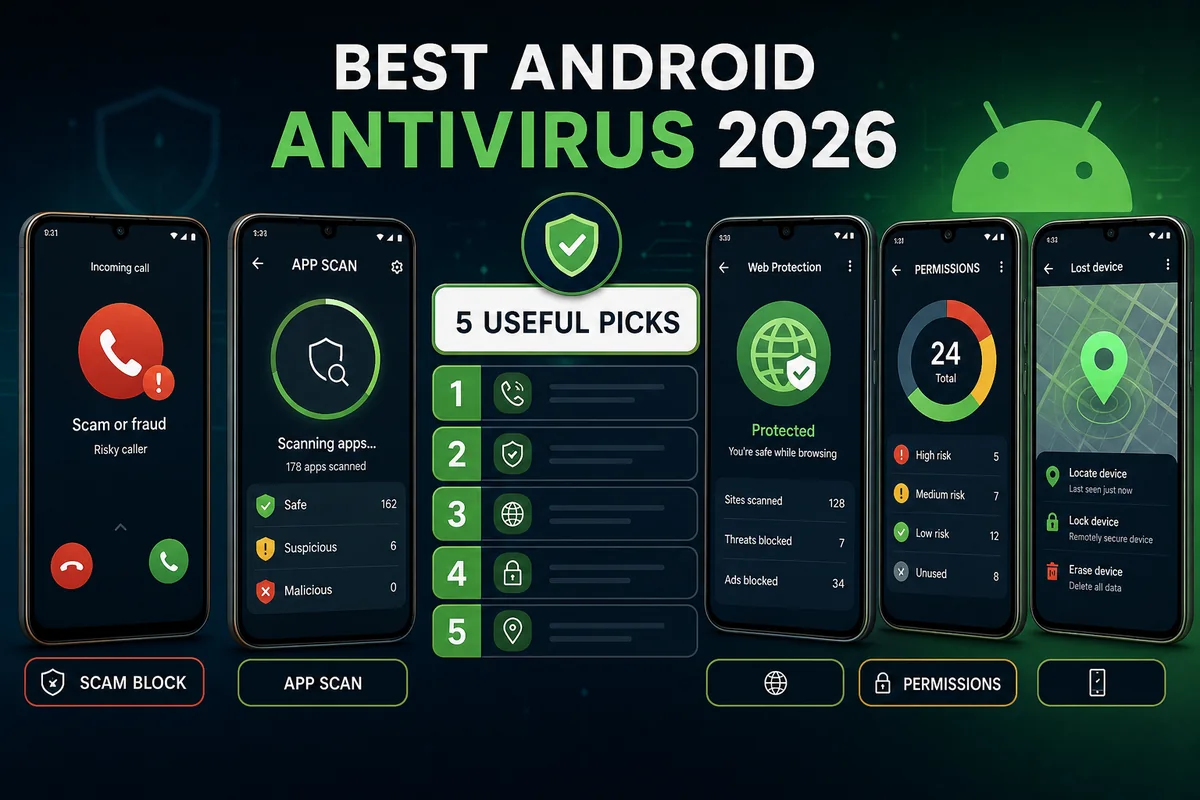
Quick answer: keep Google Play Protect on, install system/security updates, prefer Play Store apps and review Accessibility, Device admin, notification and VPN permissions. Add Bitdefender Mobile Security when you want the strongest current paid combination of app scanning, web/scam defenses, App Lock and anti-theft. Use Avast One Mobile for free real-time protection if ads/upgrade prompts are acceptable, or Sophos Intercept X for a free no-seat-limit toolkit. Antivirus can't make a rooted, unsupported or already account-compromised phone trustworthy.
The five Android security choices worth considering
The current lab field is crowded at the top: four third-party picks below earned the same 6/6/6 AV-TEST score in May. The order therefore also considers independent full-test history, free/paid boundaries, scam and web protection, permissions, plan clarity and whether the extras solve a phone-specific risk. Play Protect is included as the built-in baseline, not presented as a separate app purchase.
Bitdefender Mobile Security
On-install/on-demand scanning, App Anomaly Detection, web/scam protection, App Lock and anti-theft in a focused one-account product with a no-card trial.

Norton Mobile Security / Norton 360
Current full-mark Android protection with App Advisor, Safe Web, Wi-Fi and scam/SMS defenses. Buy standalone for one phone or Deluxe when other devices need coverage.

Avast One Mobile Free
Free real-time malware scanning, Web Guard, Wi-Fi checks and Avast Assistant. Premium adds App Lock, unlimited photo protection, VPN and advanced SMS/call/email guards.

Sophos Intercept X for Mobile
Free unmanaged malware/PUA, web, device, network, authenticator and secure-QR tools for personal Android devices. It isn't managed through the Sophos Home dashboard.
Google Play Protect
Preinstall and periodic app checks, warnings/removal, privacy alerts and permission resets on certified Google Play devices. Keep it enabled even with another antivirus.
Android antivirus comparison: current tests and plan limits
| Choice | May 2026 AV-TEST app | Protection | Performance | Usability | Commercial boundary |
|---|---|---|---|---|---|
| Bitdefender | Mobile Security 3.3 | 6 | 6 | 6 | $17.99 first-year one-account snapshot; 14-day trial |
| Norton | Norton 360 26.6 | 6 | 6 | 6 | $19.99 first year / $29.99 renewal for one Android device |
| Avast | Antivirus & Security 26.6 | 6 | 6 | 6 | Free core with ads; paid app/VPN/advanced scam modules |
| Sophos | Intercept X for Mobile 9.7 | 6 | 6 | 6 | Free unmanaged edition; Home support tied to Premium customers |
| Play Protect 51.2 | 5.5 | 6 | 5 | Built in on certified Google Play devices |
The May 2026 AV-TEST product records are the newest public Android results available when this page was rebuilt. AV-TEST scores protection, performance and usability up to six points each. Equal 18/18 totals mean the other buying boundaries matter; they don't prove every app has identical detection, permissions or scam filtering.
What the latest independent Android tests prove—and don't prove
AV-TEST's May records give Bitdefender 3.3, Norton 360 26.6, Avast 26.6 and Sophos 9.7 full marks. Google Play Protect 51.2 earned 5.5 for protection, 6 for performance and 5 for usability. That's much stronger than Play Protect's poor historic scores, but still not a tie with the leading third-party apps in this cycle.
The AV-Comparatives Mobile Security Review 2026, published June 17, tested Android 16 in May on genuine phones using 3,156 malicious APKs and 500 clean apps. Bitdefender blocked 100% with two false positives; Kaspersky 99.9% with one; Avast, AVG and Norton 99.6% with two each; and Google Play Protect 98.9% with eight. The five third-party products received the lab’s 2026 Approved Mobile Product award; Google didn't.
The two current labs answer slightly different questions. AV-TEST scores protection, performance and usability for named app versions; AV-Comparatives runs a larger malicious-app set and a separate 500-app false-positive check. Bitdefender leads both current layers. Play Protect is materially better than its historic record, but its 98.9% and eight false positives still trail every third-party participant in the AV-Comparatives cycle.

Do Android phones need antivirus if Play Protect is on?
Most careful users on a supported, Play Protect-certified phone don't need to panic-install a third-party antivirus. Android isolates apps in sandboxes, requires permissions for sensitive data and services, uses verified boot and distributes monthly security bulletins. Google Play Protect checks Play Store apps before download, periodically scans the device and also scans apps installed from other sources. It can warn, disable or remove a harmful app and reset permissions on supported versions.
That baseline is strongest when the phone still receives operating-system and vendor security patches, bootloader/root state is intact and the user installs from reputable stores. The July 2026 Android Security Bulletin is the practical reminder: antivirus signatures don't patch framework, kernel, media or vendor-component vulnerabilities. If the device maker stopped updates, replacing the phone is often a better security purchase than another scanner.
A third-party app has a stronger case when APKs are sideloaded, several family members accept prompts, a child/older relative needs scam friction, the phone lacks Google services, business/client files arrive, or you want web/SMS/link reputation and account-breach tools in one place. Even then, leave Play Protect enabled. The layers have different telemetry and detection paths.
Android antivirus runs as an app under Android's security model. It can inspect installed apps/APKs and accessible files, watch installs and use browser/accessibility/VPN-style services for web filtering when permission is granted. It can't magically read every other app's private sandbox, validate every bank transfer, patch the OS or guarantee recovery from a malicious app already holding Accessibility or Device admin control.

Detailed verdicts: which Android user each pick fits
1. Bitdefender Mobile Security — best focused paid app
Bitdefender is the cleanest paid recommendation because both current layers support it: 6/6/6 in May 2026 and 100% with two false positives in the 2026 AV-Comparatives full test. On-install and on-demand scanning are the core. App Anomaly Detection watches for suspicious behavior after installation; Web Protection and Scam Protection cover risky pages/messages; App Lock adds local access control; anti-theft can locate and lock through Central.
The official US page exposed $17.99 for the first year, one account, plus tax, and a 14-day no-card trial. It requires Android 7+ and an active internet connection. The included VPN is capped at 200 MB/day, so it isn't an unlimited mobile-data tunnel. Test remote commands, App Lock and scam filtering on the actual phone: Android maker power restrictions and permission changes can affect background services.
2. Norton Mobile Security — best when scam tools or a bundle matter
Norton 360 26.6 earned 6/6/6 in AV-TEST’s May 2026 cycle. In AV-Comparatives’ separate May test, Norton blocked 99.6% of 3,156 malicious apps and raised two false positives among 500 clean apps. That's strong direct evidence, but it isn't the same result as Bitdefender’s 100% in that sample.
The standalone US offer was $19.99 for the first year and $29.99 renewal for one Android phone. App Advisor, Safe Web, Wi-Fi alerts, Safe SMS and Scam Protection are the reason to choose it over a bare scanner. If Windows, Mac or iOS devices also need coverage, Norton 360 Deluxe's $49.99 first-year five-device plan can be better value—but compare its $124.99 listed renewal and remember features differ by operating system.
3. Avast One Mobile Free — best broad free choice with ads
Avast's Android app has current direct evidence: Antivirus & Security 26.6 earned 6/6/6, while AV-Comparatives measured 99.6% protection and two false positives in its May 2026 test. The free Avast One transition keeps real-time malware scanning, Web Guard, Wi-Fi checks and Assistant. The official minimum is Android 8.
The boundary is the product. Premium Security or Ultimate adds features such as App Lock, unlimited protected photos, VPN and advanced SMS/call/email scam guards. The free version is supported by advertising and upgrade prompts. Avast's verified FTC data-sale order also remains a trust factor. Strong malware results don't erase it; the history doesn't change the measured detection.
4. Sophos Intercept X — best free toolset without paid device seats
Sophos Intercept X for Mobile 9.7 has a remarkably stable AV-TEST record and again earned 6/6/6 in May. The free unmanaged app provides application/PUA reputation, web filtering, device/security advice, a secure QR scanner and authenticator tools. Sophos says personal users can install it on as many mobile devices as needed without consuming Sophos Home Premium seats.
That also explains the limit: mobile devices don't appear in the Sophos Home dashboard, and ordinary free users don't receive the same support entitlement as Sophos Home Premium customers. Business-managed Intercept X/Sophos Mobile is a different service. The latest AV-Comparatives full consumer report didn't include Sophos, so we don't invent a second percentage beside its current AV-TEST score.
5. Google Play Protect — non-negotiable baseline, not an upsell
Play Protect scans Play Store and sideloaded apps, checks periodically, issues privacy alerts and can disable/remove harmful software. It works without installing another security vendor and has improved dramatically over its 2019–2022 lab history. For a careful user on an updated Pixel or another certified device, it can be sufficient alongside safe app sources and account security.
The latest 5.5/6 protection and 5/6 usability scores stop us from calling it the strongest scanner. Keep it on with another product rather than choosing one or the other. Some Android-derived devices and newer Huawei models lack Google Play services/Play Protect; verify the store, update path and built-in scanner instead of assuming the colorful Android logo means Google's protections are present.
What Android antivirus can stop—and the threats it can't solve alone
Malicious APKs and droppers
On-install scanning can block a known malicious app or suspicious behavior. It's most valuable before granting Accessibility, Device admin, SMS, notification or overlay access.
Phishing and scam links
Web/SMS reputation adds a warning, but new domains and real compromised accounts can evade lists. Verify money, crypto, account-recovery and remote-support requests independently.
Banking trojans
Detection may catch the app or overlay behavior. Antivirus can't recover credentials or tokens already stolen; use a clean device to reset passwords, revoke sessions and call the bank.
Stalkerware
A scanner can flag known monitoring apps, but removal may alert an abuser. If personal safety is involved, use a safe device and a qualified domestic-violence/stalkerware support plan.
Unpatched vulnerabilities
Only OS, Google Play system and vendor updates close code flaws. Antivirus can sometimes block exploit payloads but can't turn an unsupported phone into a patched one.
Account takeover and SIM swap
Use passkeys/security keys where possible, a carrier account PIN and recovery-code hygiene. A green malware scan doesn't prove Google, email, bank or messaging accounts are secure.
Android security-app permissions: what to inspect before tapping Allow
A mobile security app may legitimately request broad visibility, but each permission creates responsibility. Malware scanning needs installed-app/file access available to the Android version. Web filtering may use Accessibility or a local VPN profile. SMS/call scam protection needs message/call access. Anti-theft may request location, camera and device-admin capabilities. App Lock can require display-over-other-apps or accessibility functions.
| Permission/service | Possible legitimate purpose | Question before allowing |
|---|---|---|
| Accessibility | Web/app/scam monitoring, App Lock | Can it read screen content or act on your behalf, and can a narrower mode work? |
| Local VPN | Route traffic through on-device web filtering | Is traffic sent to vendor servers, and can it coexist with your real VPN? |
| SMS/call/notifications | Detect scam texts, links and calls | What message metadata/content is processed, retained or uploaded? |
| Device admin / anti-theft | Remote lock or wipe | Have you tested removal and a lost-device command before relying on it? |
| Files/photos/apps | Scan APKs/storage; protect a vault | Does it need all files or only selected media under the current Android API? |
| Location/camera | Locate a lost phone or capture tamper evidence | Can the feature be left off until needed, and how is data secured? |
Install only from the vendor's verified Play listing. A fake “antivirus” can request the same powerful permissions. Review the developer, app name, download route, data-safety disclosure and support domain; don't follow an ad or pop-up telling you the phone is infected.

How to secure an Android phone in the right order
- Check support and patch level. Settings → About/Security shows Android and security-update dates; wording varies by maker.
- Enable Play Protect. In Google Play, open Play Protect settings and keep app scanning on, including improved detection where offered.
- Update apps and Google Play system components. Reboot after important OS/vendor updates.
- Remove unknown sources. Review which apps may install other apps. Disable the privilege after a necessary sideload.
- Audit special access. Accessibility, Device admin, notification access, VPN, overlays and unrestricted battery use deserve more scrutiny than a normal camera prompt.
- Set a strong screen lock and Find My Device. Add a SIM/carrier PIN, protect notification previews and record recovery codes outside the phone.
- Choose one mobile security app if needed. Run its first update/scan, configure web/scam modules and test battery for several days.
- Back up and test recovery. Confirm photos/files, authenticator transfer, password-manager access and a remote lost-device path.
What to do if an Android phone may already be infected
Disconnect from untrusted networks if the phone is sending messages, displaying overlays or moving money. From another clean device, contact the bank/carrier when financial or SIM risk exists; change the primary email/Google password, revoke suspicious sessions and secure recovery methods. Don't perform account recovery inside a device that still displays an unknown overlay or remote-control session.
On the phone, inspect recently installed apps, Play Protect findings and special permissions. Revoke Accessibility/Device admin before uninstalling a malicious app; Safe mode can help when ordinary removal is blocked. Run the chosen reputable scanner, but preserve screenshots and transaction/message evidence first when fraud, abuse or business data is involved.
A clean scan isn't proof the phone is clean after a confirmed banking trojan, root exploit or persistent remote-control compromise. Back up irreplaceable non-executable data, factory-reset from recovery/Settings, update before restoring and reinstall apps manually from trusted stores. Restore accounts only after credentials and sessions were reset from a clean device.

Strong Android products not in the five picks
AVG AntiVirus Free
AVG 26.6 earned 6/6/6 in May 2026 and matched Avast at 99.6% with two false positives in AV-Comparatives’ 2026 mobile test. AVG and Avast are both Gen Digital products and the report says the Android apps appear identical in functionality. Ranking both would create fake variety; choose the interface and promotion/privacy settings you prefer.
ESET Mobile Security
ESET Premium 11.0 reached 99.6% with zero false positives in the 2025 AV-Comparatives test. It's credible, especially for an existing ESET household, but it was absent from the current May 2026 AV-TEST consumer list. We prefer products with a current direct layer for this page rather than borrowing ESET's Windows/Mac result.
Kaspersky Premium for Android
Kaspersky remains technically strong where supported, including 6/6/6 in March 2026. It isn't a US recommendation because the US Commerce prohibition blocks covered transactions and updates/KSN operation for US persons. A mobile security app without lawful continuous updates isn't a viable US choice.
How we chose the best Android antivirus
We reviewed the Google-style first page for best Android antivirus, free Android antivirus, Play Protect sufficiency and sideloading/scam variants. Competitors consistently put Bitdefender first and emphasize malware scores, VPN, anti-theft and battery. Gaps included old 2021 lab citations, paid features labeled free, duplicate Avast/AVG engines, no permission audit and weak separation between Android patching and antivirus.
We checked AV-TEST's May 2026 manufacturer records, AV-Comparatives’ June 2026 Mobile Security Review, Google Play Protect documentation, Android's July 2026 bulletin, current vendor plans/support and community questions about battery and necessity. Current evidence receives more weight; older evidence is labeled. We don't import Play Store ratings or vendor user counts into schema.
Frequently asked questions about Android antivirus
What is the best antivirus for Android in 2026?
Bitdefender Mobile Security is our best paid Android pick because it earned 6/6/6 in AV-TEST's May 2026 record and 100% with two false positives in AV-Comparatives’ May 2026 mobile test. Norton is best for scam tools or a multi-device bundle, Avast for ad-supported free protection and Sophos for a free unmanaged toolkit.
Do I need antivirus on an Android phone?
A careful user on a supported, patched, Play Protect-certified phone who installs only trusted Play Store apps may not need another real-time scanner. Third-party antivirus is more useful for sideloading, higher-risk users, phones without Google services, extra web/SMS scam filtering or centralized household support.
Is Google Play Protect enough?
It's a useful built-in baseline and should remain enabled. In May 2026, Play Protect 51.2 scored 5.5/6 for protection, 6/6 for performance and 5/6 for usability, below the 6/6/6 third-party leaders. Whether that gap justifies another app depends on sideloading, patch status and user risk.
What is the best free Android antivirus?
Avast One Mobile is our broad free pick because its current Android app earned 6/6/6 and Avast reached 99.6% with two false positives in AV-Comparatives’ May 2026 mobile test. It includes ads and paid upsells. Sophos Intercept X is the cleaner free alternative with no mobile seat limit.
Can Android antivirus remove malware?
It can detect and uninstall many known malicious apps or APKs, often after privileged access is revoked. It can't guarantee recovery after a root exploit, banking-trojan credential theft or remote-control compromise. Secure accounts from a clean device and factory-reset when trust can't be restored.
Will Android antivirus drain the battery?
The leading products earned 6/6 performance in May 2026, and AV-Comparatives found only minor battery influence for every tested product in its 2026 average-use simulation. Real impact varies with phone, first scan, storage, VPN/web filtering and manufacturer background rules. Test during the trial and inspect Android battery stats.
Does antivirus make sideloading APKs safe?
No. It adds another reputation/behavior check but can't prove an APK safe or remove the risk of a dangerous Accessibility, overlay, notification or device-admin permission. Prefer a verified developer/store, validate signatures where documented and disable Install unknown apps afterward.
Can I use two antivirus apps on Android?
One third-party real-time security app plus Play Protect is enough. Two third-party apps duplicate scanning, notifications, web-filter/VPN services and battery exemptions, and may conflict. If you want a second opinion, run an on-demand scanner temporarily without enabling another persistent layer.
Bottom line
Bitdefender is the best focused paid Android antivirus, Norton the bundle/scam choice, Avast the broad free option, Sophos the free toolkit and Play Protect the built-in layer that never gets switched off. The test field is strong enough that permissions, support, free boundaries and billing decide almost as much as the top protection score.
The more important order is patch, Play Protect, safe app source, special-permission audit, strong screen/account security and backups—then antivirus. If the phone no longer receives security updates or a banking trojan already stole credentials, buying another scanner isn't the fix.