
McAfee Review 2026: Fast Lab Results, Messy Pricing
Current McAfee is much better than its old “heavy preinstalled antivirus” reputation suggests. It scored 18/18 at AV-TEST and led AV-Comparatives’ April performance test. The harder decision is commercial: five-device and household plans, changing first-term offers, a large renewal step, regional identity benefits and paid add-ons make the checkout more complicated than the protection itself.
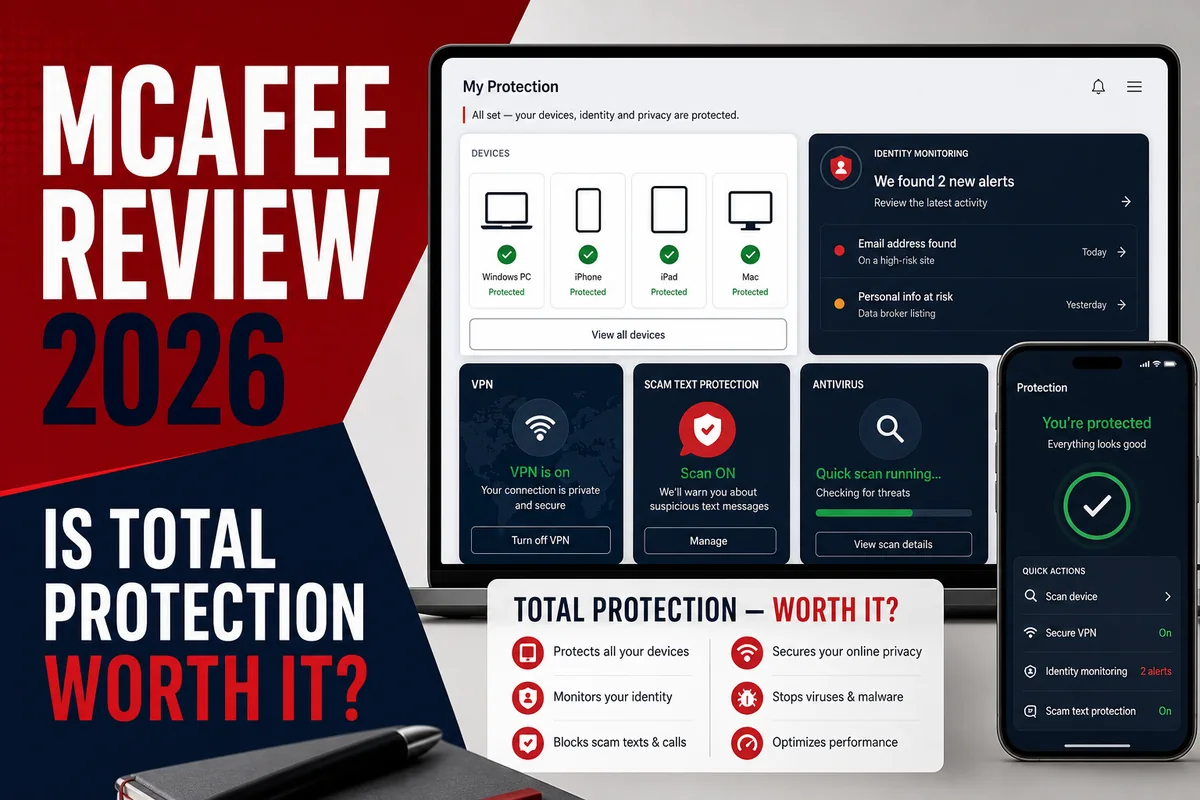
Our verdict: McAfee is safe, legitimate and technically competitive in 2026. It earned a perfect 18/18 from AV-TEST and the lowest impact score in AV-Comparatives’ April low-end-PC test. The completed February–May web-threat result was a good, not leading, 98.5%, and March offline detection fell to 86.1% before cloud and execution layers raised online protection to 99.97%. Essential is a sensible five-device bundle when the price is clear. Premium and Advanced make sense only when their unlimited-household, cleanup and identity services match a real need. The result is a conditional recommendation: strong protection and unusually low measured task impact, but only good value when the plan, renewal and identity benefits fit the household.
- Perfect current AV-TEST protection, performance and usability result
- Lowest April AV-Comparatives impact score on its low-end Windows 11 rig
- Five-device Essential and household-unlimited McAfee+ options
- Useful antivirus, firewall, web protection, VPN and scam-warning layers
- Advanced identity/cleanup services for eligible US households
- 98.5% completed real-world result trailed the leading group
- Offline detection was only 86.1% in the March malware test
- Introductory prices can rise sharply at renewal
- Plan names, entitlements and regional identity features are difficult to compare
- Community complaints repeatedly focus on add-on prompts and billing UX
McAfee in 2026 at a glance
McAfee’s consumer product is no longer one simple “antivirus” box. The current US store combines device security with privacy, scam detection and identity services. Basic protects one device. Essential protects five. McAfee+ Premium, Advanced and Ultimate expand to supported personally owned household devices under a fair-use policy, then add progressively deeper data cleanup, transaction/credit monitoring, restoration assistance and insurance-like identity benefits.
You may still see Total Protection, LiveSafe, AntiVirus Plus and Internet Security in retail listings, an existing account or support documentation. Those names aren't proof that a license is fake, but they don't map neatly to the current landing-page tiers. Check the exact device allowance and entitlement in the official account before comparing a retail key with McAfee+ Advanced or assuming an old LiveSafe feature survived unchanged.
The protection engine is the most straightforward part. McAfee Total Protection is tested frequently by AV-TEST and AV-Comparatives. Its current scores support using it as a normal primary antivirus. The bundle doesn't justify calling every identity or cleanup tool essential, and no current lab result validates renewal handling, customer support or upsell design. Those are separate buying questions.
McAfee lab results in 2026
The four most useful current measurements answer different questions. AV-TEST checks protection, everyday performance and false alarms over two months. AV-Comparatives’ real-world test follows threats delivered from the web. Its malware test begins with files already present on disk or shared media and exposes cloud dependence. Its performance report measures common tasks plus an Office benchmark on a low-end PC.
| Independent test | Product / period | McAfee result | What it means |
|---|---|---|---|
| AV-TEST Windows 11 | Total Protection 1.37 May–June 2026 | 6/6 protection 6/6 performance 6/6 usability 18/18 | A perfect current result across all three categories. |
| AV-C Real-World Protection | Total Protection 1.35–1.38 February–May 2026 | 98.5% protected 394 blocked / 6 compromised 4 false alarms | Good web-threat protection, but behind the 99.0–99.8% leading cluster. |
| AV-C Malware Protection | Total Protection 1.36 March 2026 / 10,000 cases | 86.1% offline detection 99.2% online detection 99.97% online protection 14 false alarms | Cloud and execution-time defenses materially improved the final online outcome. |
| AV-C Performance | Total Protection 1.37 April 2026 | Impact: 3.3 AV-C 90 / Procyon 96.7 | Lowest combined impact in this low-end Windows 11 test. |
The completed real-world cycle matters more than a partial headline
Several April reviews cite McAfee’s 100% February–March AV-Comparatives result. That shorter factsheet was accurate when published. The completed February–May report added 200 cases and changed the answer: six of 400 systems were compromised, leaving 98.5% protection. McAfee shared that result with ESET and K7, behind Kaspersky, Bitdefender, Avast, AVG, Norton, Microsoft, TotalAV, F-Secure and Malwarebytes in this one cycle.
That doesn't make 98.5% weak or prove the same hierarchy will repeat. Four hundred cases leave room for normal sampling movement. It does mean a current review shouldn't keep the earlier 100% as if the test stopped in March. McAfee received an Advanced award rather than the leading Advanced+ group.
86.1% offline detection is a warning about context, not the final protection rate
The March test used 10,000 malicious files and measured stages separately. McAfee recognized 86.1% in the offline detection scan. With connectivity, initial detection rose to 99.2%. After the lab allowed products to use all prevention and execution layers, online protection reached 99.97%: only three test systems were compromised. Fourteen clean files generated false alarms.
This makes McAfee a poor product to judge from one isolated number. “86.1% protection” would be false because the metric was offline detection. “99.97% catches everything” would also hide the product’s dependence on reachable reputation/cloud services. Keep the PC online for updates and cloud checks, but retain layered controls and offline backups for the exact moment connectivity or a vendor service fails.
The old heavy-McAfee story no longer fits the latest controlled test
AV-Comparatives tested common file, application, download and browsing tasks plus UL Procyon Office on an Intel Core i3 PC with 8 GB RAM and an SSD. McAfee’s 3.3 impact score led the April field, ahead of Kaspersky 3.5, ESET 4.2, Norton 5.3 and Defender 12.9. AV-TEST independently gave performance 6/6.
That's strong current evidence. It isn't a promise that a first full scan, old spinning disk or huge developer/game directory will be invisible. PCWorld’s 2026 hands-on review still found notable slowdowns on some workloads. Treat reputation and lab score as hypotheses, then measure the exact PC during the refund period.

McAfee Total Protection and McAfee+ plan map
The current US Total Protection page sells device security inside a much larger service ladder. “More expensive” doesn't mean a stronger antivirus engine in every row. The upper tiers mainly buy household scope, cleanup, financial monitoring, restoration help and larger identity coverage.
| Current tier | Device / person scope | What changes | Who it's for |
|---|---|---|---|
| Basic | 1 supported device 1 user | Core antivirus, web/scam protection, VPN and identity monitoring in the current store presentation. | One PC with no household requirement. |
| Essential | Up to 5 devices 1 adult | Core multi-platform security, VPN, Scam Protection, identity monitoring and alerts. | Best straightforward household-device value. |
| McAfee+ Premium Individual | Supported household devices under fair use 1 adult | Scans-only Personal Data and Online Account Cleanup plus broader privacy tools. | A user who wants household scope and can perform removals personally. |
| McAfee+ Advanced Individual | Supported household devices under fair use 1 adult | Personal-info removal, bank/card monitoring, one-bureau credit features, restoration support and up to $1M identity theft coverage where eligible. | US identity-service buyer, not merely an antivirus upgrader. |
| McAfee+ Ultimate Individual | Supported household devices under fair use 1 adult | Up to $2M identity coverage, three-bureau/daily credit features, investment/401(k) monitoring and McAfee Assist where eligible. | A buyer who can use the specific financial/identity services. |
| Family variants | Typically 2 adults plus up to 4 children under 18 | Extends plan-specific monitoring/cleanup to a defined family scope; not every benefit duplicates for six adults. | A US household that has verified every covered person and feature. |
“Unlimited devices” is bounded. McAfee’s terms limit it to supported devices you own for personal, non-commercial household use and apply fair use. It isn't an endpoint-security license for a business, a rental fleet, clients or everyone in an extended family. Family identity coverage also follows named adults/children, not the number of laptops.
LiveSafe remains relevant to existing subscribers and retail-card owners, but it's no longer the cleanest reference point for a new US comparison. Read our McAfee LiveSafe history and migration guide before assuming an old unlimited-device key equals the current Advanced feature set.
McAfee price, renewal and refund terms
McAfee uses introductory pricing and client-rendered offer objects. Campaign, browser, region and checkout path can change what appears. On July 23, the official US search-rendered pages exposed a $29.99 Basic first-year hero, a $39.99 first-term/$109.99 renewal trial conversion, $49.99 against $149.99 for Premium Individual and $89.99 against $199.99 for Advanced Individual. Ultimate prices weren't consistently exposed in the accessible source, so we won't invent them.
| Offer observed July 23, 2026 | First term | Displayed/current renewal context | Read before buying |
|---|---|---|---|
| Basic hero | $29.99 / first year | Checkout-controlled | One-device value can disappear if a second device is added later. |
| 5-device free-trial conversion | $39.99 | $109.99/year in current legal terms | The trial isn't a permanent free McAfee edition. |
| Premium Individual campaign | $49.99 | $149.99 displayed reference/renewal value | Buy for household/privacy scope, not a presumed stronger engine. |
| Advanced Individual campaign | $89.99 | $199.99 displayed reference/renewal value | Verify US eligibility for credit, coverage and restoration services. |
| Ultimate / Family | Check current cart | Check current account/cart | Don't value identity benefits you can't enroll in or don't need. |
The current US legal terms are more important than a coupon headline. McAfee says the first charge covers the chosen first term. Thirty days before expiry, it renews annually at the renewal price then in effect until canceled, with a Vermont opt-in exception. Pricing may change with advance notice. The full-refund window is 30 days after an initial purchase and 60 days after an auto-renewal charge.
The Virus Protection Pledge isn't broad cyber insurance. On an eligible paid, supported device, McAfee offers expert virus removal or a refund of the current-term subscription if it can't remove the virus. Eligibility includes active protection before infection and, for qualifying free benefits, auto-renewal with a valid payment method. It doesn't reimburse damaged files, business interruption or the cost of rebuilding the PC. Backups remain your responsibility.

Antivirus, firewall and web protection
Real-time and on-demand scanning
McAfee combines signatures, reputation/cloud lookups, heuristics and behavior/execution controls. Real-time scanning inspects files as they arrive or execute; quick, full and scheduled scans cover existing files. The lab gap between 86.1% offline detection and 99.97% final online protection demonstrates why one on-demand scan isn't the whole product.
Keep automatic updates and cloud connectivity enabled. Run an initial full scan after installation, then allow real-time protection and scheduled maintenance to carry most of the workload. A clean scan doesn't prove a suspicious file is safe; check its source, signature, reputation and behavior. A detection doesn't prove malware either—false positives happen, and McAfee logged 14 in the March clean-file set.
Firewall and vulnerable connections
On Windows, McAfee’s firewall manages network access and applies safer defaults than teaching a non-specialist to approve raw port prompts. A firewall can't make remote desktop exposed to the internet safe, patch an abandoned router or protect an account after a user approves a fraudulent sign-in. Keep the OS/router patched, disable unused remote services and use MFA/passkeys.
WebAdvisor, anti-phishing and Scam Detector
Web protection checks risky sites, search links and downloads. Scam Detector extends the current pitch to suspicious messages, links, QR codes and AI/deepfake-style social engineering on supported devices. This is useful friction, not authority. A new impersonation domain or real-looking voice/video can precede a reputation block. Verify payment, password-reset and investment requests through a separately found official channel.
Unexpected “McAfee renewal” messages are themselves a common scam lure. A February r/McAfee thread documents fake $300–$500 renewal emails and calendar items that direct victims to remote-access phone support. Never call the number in an unsolicited invoice. Sign into the official account directly and use the support route linked from mcafee.com.
Ransomware protection and the limits of coverage
McAfee monitors files and behavior for ransomware and can block malicious encryption. Some upper US identity packages advertise ransomware expense coverage subject to terms, eligibility and exclusions. Neither feature is the same as restoring every file. Keep versioned, isolated backups and test a restore. Don't place the only backup in a permanently mounted folder that ransomware or a stolen cloud session can rewrite.

VPN, password manager, cleanup and identity features
Secure VPN
The current Basic/Essential/McAfee+ presentation includes Secure VPN, with the exact number of activations tied to plan and auto-renewal conditions. VPN encrypts the route between the device and provider, which is useful on untrusted Wi-Fi and for reducing local-network exposure. It doesn't make a phishing login safe, remove tracking from an account or make illegal downloads anonymous.
Before treating it as a paid bundle advantage, test the required country/streaming service, speed, kill-switch behavior and every supported platform. A household that already has a preferred audited VPN may be paying twice. A user who only wants malware protection should compare Essential with Defender/ESET instead of valuing an unused VPN at its list price.
Password manager and Protection Score
McAfee’s current pages still reference a password manager/True Key in product and trial feature matrices. Availability can depend on subscription and platform. PCWorld’s 2026 review found its password-manager experience unreliable enough to hurt the bundle verdict. Export/import and recovery deserve a real test before moving a vault. Never choose a weak master password merely because the suite prefilled a score.
Protection Score is a checklist and prioritization tool, not an independent measurement of whether the PC is safe. It can be useful when it identifies missing MFA, exposed data or unprotected devices. It shouldn't pressure a buyer into purchasing every cleanup/identity feature to reach a cosmetically perfect number.
Personal Data Cleanup and Online Account Cleanup
Premium typically scans for broker listings and unused accounts; Advanced/Ultimate advertise progressively deeper removal. A scan isn't removal. Full-service removal isn't permanent erasure: brokers can reacquire data, public records remain and some sites have lawful retention. Review which adults, countries and sources qualify and whether a recurring manual follow-up is required.
Identity monitoring, credit and restoration
Advanced and Ultimate are primarily identity products layered onto antivirus. In eligible US plans, Advanced advertises bank/card alerts, one-bureau/monthly credit features, restoration and up to $1M identity theft coverage. Ultimate advertises up to $2M, three-bureau/daily monitoring, investments/401(k) alerts and setup assistance. Family variants extend only the features and people specified in their plan.
Coverage isn't cash automatically paid after any scam. Read the policy, eligibility, deductibles, exclusions and reimbursement categories before pricing it. Freeze credit at the bureaus when appropriate, use transaction alerts and protect the email/mobile accounts that reset financial passwords. Monitoring reports an event; it can't prevent every account takeover.
Performance: how to test McAfee on your own PC
McAfee earned the best combined result in AV-Comparatives’ April performance report and 6/6 from AV-TEST. Those results justify a fresh trial even for someone who removed an older heavy build years ago. They don't justify installing it beside another real-time antivirus or ignoring a workload-specific slowdown.
- Record the clean baseline. Note boot time, browser launch, a large file copy, archive extraction, game/build startup and idle behavior before installing.
- Remove or disable the prior real-time suite correctly. Two file-system filters can create duplicate scans, conflicts and misleading CPU results.
- Update McAfee, then run one full scan. The first scan may be heavier while files and caches are classified; measure repeat behavior separately.
- Repeat the same tasks. Compare medians, not one run, and distinguish active scanning from idle impact.
- Inspect exact paths before excluding them. Build caches and game libraries can be large, but scripts, mods and downloaded tools can execute code.
- Test VPN and browser protection independently. Slow browsing may be VPN routing, extension filtering, DNS or antivirus—not one combined “McAfee is slow” cause.
- Review alerts and add-on prompts. Decide whether the interface is acceptable before the initial refund window ends.
- Verify billing. Confirm device entitlements, first-term receipt, auto-renewal state and calendar reminder in My Account.
If the exact PC remains slow after updates and the first scan, don't tune security by excluding the entire user profile or drive. Capture the process/path, remove conflicts, schedule full scans and ask support for a narrow fix. Defender, ESET and Norton are easy comparison installs if McAfee’s strongest controlled result doesn't repeat for the workload.

McAfee on Windows, macOS, Android, iOS and ChromeOS
McAfee’s current system-requirements page lists Windows 10 RS5 and later on x64, Windows 11 on ARM64, macOS 13+, Android 10+, iOS 16+ and ChromeOS 102+. The Windows hardware minimum is 2 GB RAM, 1.3 GB free storage and a 1 GHz processor. Minimum support isn't a recommendation for comfortable full scans on old hardware.
| Platform | What McAfee can provide | Important limit |
|---|---|---|
| Windows 10/11 | Full antivirus/scanning, firewall, web protection, VPN and plan-specific privacy/identity tools. | Windows 10 normal support has ended; antivirus doesn't replace OS security updates. |
| macOS 13+ | Mac malware/web protection, VPN and supported account/privacy services. | Windows-only controls and test scores can't be copied to macOS. |
| Android 10+ | App/malware scanning, safe browsing/Wi-Fi/VPN and supported scam/identity layers. | Permissions and features vary by Android version/device maker. |
| iOS 16+ | Safe browsing, Wi-Fi/VPN, breach/identity and scam-related tools where supported. | iOS doesn't allow Windows-style system-wide antivirus scanning. |
| ChromeOS 102+ | Supported web/mobile-style protection and account features. | Not equivalent to the Windows Total Protection application. |
The current mobile page explicitly says Android and Apple features differ. McAfee markets the iOS product under “Mobile Security and Antivirus,” but its useful iPhone functions are web, network, privacy, identity and scam protections rather than conventional full-device file scanning. Compare outcomes, not the shared word “antivirus.”
What current McAfee users praise—and complain about
McAfee’s community reputation lags its current lab results. In a May r/antivirus discussion of the 3.3 performance score, users were openly surprised that McAfee beat Kaspersky and ESET. That reaction is useful: old builds and preinstalled trials shaped a durable “heavy” label. It isn't valid evidence against the 2026 measurement, and the one lab cycle isn't proof every PC will feel fast.
The sharper current complaints concern commercial UX. A June renewal discussion describes a high LiveSafe charge followed by a prompt to buy PC Optimizer. Other discussions criticize desktop offers, account navigation and uncertainty about whether auto-renewal was disabled. These anecdotes don't establish a universal billing failure. They do show why a review must expose renewal terms and why the buyer should save confirmation instead of treating checkout as a one-time event.
Preinstalled trials and partner promotions create a second reputation problem. A late-July report about McAfee ads delivered through LG’s monitor software isn't evidence that McAfee antivirus installed itself, but it explains why users struggle to identify who generated a prompt. Browser scams exploit the same confusion. Treat an expired-trial banner, an OEM offer and a fake browser notification as three different things; verify the sender before clicking or calling.
A July 30 discussion about McAfee on new laptops shows that OEM bundling and uninstall prompts still dominate first impressions. Decide whether to activate the trial; otherwise uninstall it cleanly and confirm Microsoft Defender real-time protection, firewall and updates are active. Don't leave two suites half-enabled.
Who should buy McAfee—and who should choose another suite
- You want current lab-tested protection across several household devices
- You value the excellent April low-end-PC performance result
- Essential’s five-device antivirus/VPN/web bundle fits the actual household
- You can use eligible US cleanup, monitoring and restoration services
- You'll manage renewal and verify every entitlement
- You only need strong built-in Windows protection for $0
- You work offline often and prioritize high local detection
- You dislike in-app sales prompts or subscription ladders
- You already pay for a preferred VPN/password/identity service
- You want simple, predictable renewal pricing over a low introductory offer
Essential is the sensible default for a buyer with two to five devices. Basic can be cheaper for one PC, but it becomes poor value when the second endpoint arrives. Premium isn't automatically “better antivirus”; it's a household/privacy upgrade. Advanced and Ultimate are identity-service decisions whose value depends on US eligibility, covered people and whether the household will complete enrollment.
McAfee vs Norton, Bitdefender, Defender, ESET and Malwarebytes
| Option | Choose it for | Main trade-off against McAfee | Read next |
|---|---|---|---|
| McAfee Essential | Five-device antivirus, web/scam protection and VPN with excellent current task impact. | Plan/renewal complexity and 98.5% completed real-world result. | McAfee vs Norton |
| Norton 360 Deluxe | Clear five-device family bundle with parental tools and Windows cloud backup. | Higher documented renewal and an Avast-based engine with more promotion complaints. | Norton review |
| Bitdefender | Higher 99.5% current web-threat result and strong default protection. | April impact 9.6 versus McAfee’s 3.3; VPN cap on common Total Security tier. | Bitdefender review |
| Microsoft Defender | Built-in Windows protection with $0 renewal and zero false alarms in the current real-world test. | April impact 12.9 and no McAfee-style household VPN/identity bundle. | Defender review |
| ESET Essential | Granular controls, low false alarms and less bundle-first design. | 98.5% current web result also; first-device pricing and VPN limits can be less attractive. | ESET review |
| Malwarebytes | Familiar remediation and cleanup workflow. | Current impact 17.6 and 39 real-world false alarms versus McAfee 3.3/four. | Malwarebytes review |
McAfee’s current differentiator is the combination of strong lab protection, very low measured task impact and multi-device/identity packaging. Bitdefender has the stronger completed real-world number. Defender is the rational free baseline. ESET offers more technical control and fewer real-world false alarms. Norton is the more coherent family bundle when its backup and parental tools matter.
Frequently asked questions about McAfee
Is McAfee good and safe in 2026?
Yes. McAfee is legitimate security software with strong current evidence: 18/18 at AV-TEST, 98.5% in AV-Comparatives’ completed February–May real-world test and the lowest 3.3 impact score in its April performance report. It isn't perfect: six real-world cases compromised the test PC, and offline detection was 86.1% before cloud/execution layers improved the final result.
Does McAfee slow down a PC?
Not much in the latest controlled tests. McAfee ranked first in AV-Comparatives’ April 2026 low-end-PC performance cycle with impact 3.3, and AV-TEST awarded 6/6 for performance. A first full scan, older disk or unusual game/developer workload can still feel heavier, so repeat your own baseline tasks during the refund period.
Which McAfee plan is best?
Essential is the best default for most buyers because it protects up to five devices with core antivirus, web/scam protection, VPN and identity monitoring. Premium is mainly an unlimited-household/privacy upgrade. Advanced and Ultimate earn their higher price only when eligible cleanup, credit, transaction, restoration and identity-coverage services will actually be used.
How much does McAfee cost and renew for?
Prices vary by campaign and checkout. On July 23, 2026, official US pages exposed a $29.99 Basic first-year hero, $39.99 first-term/$109.99 renewal trial conversion, $49.99/$149.99 Premium campaign and $89.99/$199.99 Advanced campaign. The legal terms say renewal uses the price then in effect, so save the current cart and verify My Account.
Can I cancel McAfee auto-renewal and get a refund?
McAfee says auto-renewal can be changed in My Account. Its current US terms provide a full refund when requested within 30 days of initial purchase or 60 days of an auto-renewal charge. Turning auto-renewal off can end eligibility for free qualifying benefits such as the Virus Protection Pledge, so confirm what changes and save the cancellation confirmation.
Is McAfee better than Microsoft Defender?
McAfee is better when you want a multi-device VPN, scam/identity tools and its excellent current 3.3 task-impact result. Defender is better for a no-cost, built-in Windows baseline with no subscription. Defender reached 99.0% and zero false alarms in the current real-world test; McAfee reached 98.5% with four false alarms but performed better in April’s controlled task-impact score.
Does McAfee protect iPhone and Android?
Yes, but differently. Android can receive app/malware scanning plus safe-browsing, Wi-Fi, VPN and identity features. On iPhone, McAfee provides web, Wi-Fi/VPN, scam and identity protections where supported; iOS doesn't allow the same system-wide file scanning used on Windows. Current minimums are Android 10+ and iOS 16+.
Is McAfee’s Virus Protection Pledge a full data guarantee?
No. On eligible paid, supported devices, McAfee offers expert virus removal or a refund of the current-term subscription if removal fails. Eligibility and qualifying auto-renewal conditions apply. The pledge doesn't pay for lost files or replace a versioned, isolated and restore-tested backup.
Final verdict: excellent current speed, conditional bundle value
McAfee has earned a fresh evaluation. AV-TEST’s 18/18 and AV-Comparatives’ 3.3 impact score directly contradict the lazy claim that every current McAfee installation is slow or ineffective. The completed 98.5% real-world result is solid but not leading, and the 86.1% offline detection rate makes cloud/execution context essential. That's a credible primary antivirus, not an automatic winner.
The bigger weakness is shopping clarity. Current Basic, Essential and McAfee+ tiers mix device security with privacy, credit and identity services; campaign pricing can leap at renewal; “unlimited devices” is household fair use; and many high-tier benefits require US eligibility and enrollment. An Advanced or Ultimate buyer who never completes cleanup/monitoring setup is paying identity-suite prices for the same core antivirus decision.
Bottom line: choose Essential when you want current, low-impact protection across five devices and will use its VPN/web/scam layers. Choose Premium for household device scope and privacy scans. Choose Advanced/Ultimate only for named, eligible identity benefits. Choose Microsoft Defender if you want a strong free Windows baseline, Bitdefender for the higher current real-world protection result, or ESET for more granular controls and a less bundle-first experience.
Continue your antivirus comparison
Compare the current shortlist in our best antivirus software guide, browse the product directory, read McAfee versus Norton or Bitdefender versus McAfee, and see how we separate lab results, recovered observations and community evidence.