
Best Free Antivirus Software in 2026: 5 Honest Picks
Avast One Free is the strongest fully documented third-party free choice, while Microsoft Defender is the quieter answer for most updated Windows 11 PCs. AVG, Bitdefender Free and Avira remain useful alternatives—but their shared engines, lab-test boundaries and upgrade limits matter more than a generic “100% free” badge.
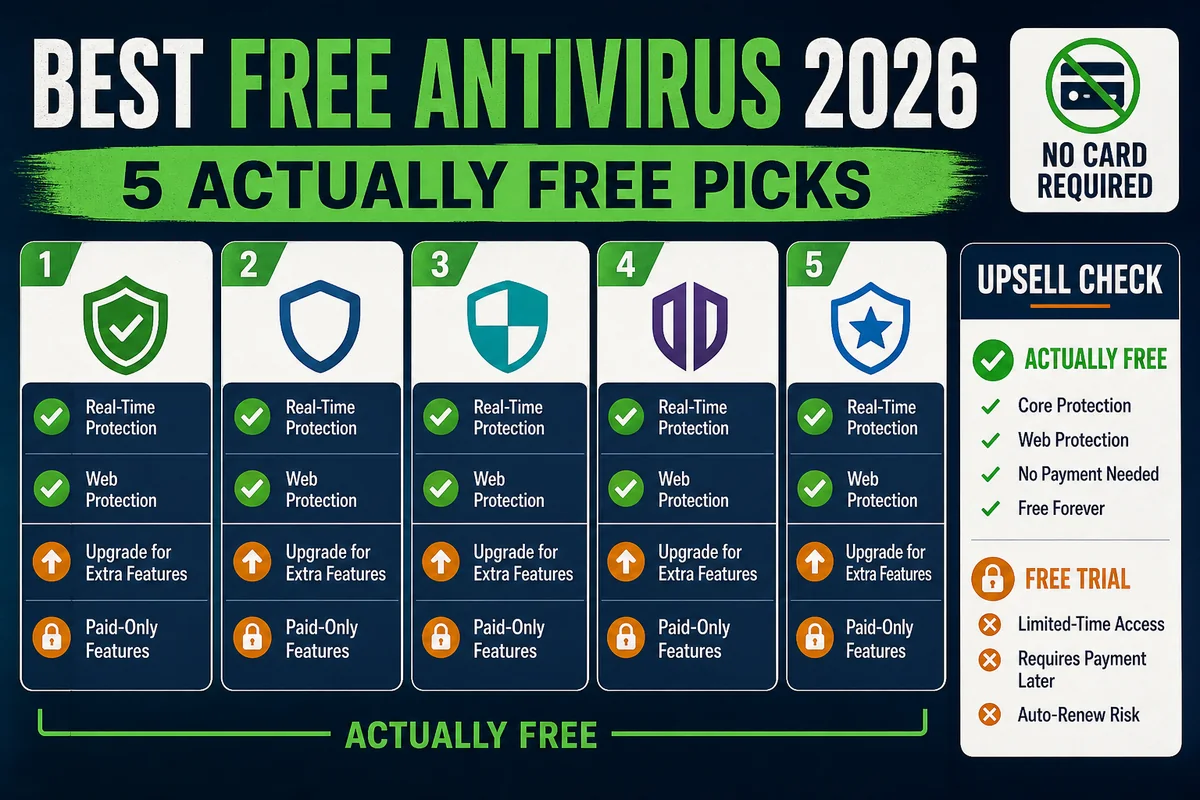
Quick answer: install Avast One Free if you want a third-party Windows antivirus with directly tested current protection, web and ransomware shields, and you accept upgrade prompts. Keep Microsoft Defender if you want no extra download, no separate account and no subscription marketing. Choose AVG only if you prefer its interface: AV-Comparatives says it uses Avast technology, and the two products posted identical current results.
The five free antivirus products worth considering
“Free” means an ongoing $0 tier with real-time malware protection, not a 30-day trial and not a scanner that cleans only after you run it. We also distinguish direct evidence from inherited evidence. Avast Free, AVG Free and Microsoft Defender appear by name in current public tests. Current Bitdefender and Avira lab rows usually name paid editions, so those results support the underlying vendors but don't prove that every paid feature exists in the free app.

Avast One Free
The clearest combination of a verified permanent free tier, direct current lab coverage, real-time file and web shields, ransomware protection and cross-platform apps.
Microsoft Defender Antivirus
Already active in supported Windows, with excellent current protection and false-positive results. It's the sensible default when you don't need a separate security suite.

AVG AntiVirus Free
Directly tested, strong and free, but not an independent detection alternative to Avast. Choose it for the product experience—not because two brand names mean two engines.
Bitdefender Antivirus Free
A quiet Windows option centered on real-time protection. Its current free product exists, but the major 2026 public lab rows name Bitdefender Total Security, so we don't copy paid-suite scores onto it.

Avira Free Security
Real-time antivirus plus a browser extension, password manager, updater, tune-up tools and a limited VPN. Useful if you want those extras, less appealing if you want a lean antivirus-only install.
Free antivirus comparison: protection, limits and best use
| Product | Real-time free protection | Direct 2026 free-tier lab row? | Main advantage | Main compromise |
|---|---|---|---|---|
| Avast One Free | Yes | Yes | Strong evidence plus web/ransomware shields | Upsells and material privacy history |
| Microsoft Defender | Yes | Yes | Built in, quiet, zero AV-C false alarms | Windows only; fewer suite extras |
| AVG AntiVirus Free | Yes | Yes | Same current protection result as Avast | Shared Avast technology; upsells |
| Bitdefender Antivirus Free | Yes | No—the public row names paid Total Security | Minimalist real-time protection | Few extras; thinner direct evidence |
| Avira Free Security | Yes | No—the AV-TEST row names Internet Security | Many free utilities | Bundle can feel promotional |
| Panda Dome Free | Yes | AV-C names Panda Free | USB tools and rescue kit | 96.5% protection and 27 false alarms in current AV-C test |
| Malwarebytes Free | No | Not applicable | Good second-opinion cleanup | Free tier doesn't prevent future attacks |
| Sophos Home | No for new users | Current SE Labs tests Premium | Existing grandfathered accounts remain | New users get a 30-day trial |
The ranking is Windows-first because that's where full consumer antivirus scanning and the strongest public lab coverage exist. On iPhone, security apps can't scan the operating system like a Windows antivirus; a “free iPhone antivirus” is normally a bundle of safe-browsing, breach-monitoring, VPN or account tools.
What the latest free-antivirus lab tests say
AV-TEST's March–April 2026 Windows 11 cycle gave Avast Free 26.2/26.3, AVG AntiVirus Free 26.2/26.3 and Microsoft Defender 4.18 the maximum 6 points each for Protection, Performance and Usability. That's unusually clean direct evidence: the free products are named, versions are listed and all three categories are visible. Avira's 17.5-point row names Internet Security, while Bitdefender's 18-point row names Total Security; neither should be silently relabeled as the free tier.
AV-Comparatives' February–May 2026 Real-World Protection Test used 400 live cases. Avast One Free and AVG Free each blocked 397 and allowed three systems to be compromised: 99.3% protection with five false alarms. Microsoft blocked 396 and allowed four compromises: 99.0% with zero false alarms. Panda Free blocked 386 and allowed 14 compromises: 96.5%, with 27 false alarms. The lab placed Avast, AVG and Microsoft in its top statistical protection cluster; Panda landed in the third.
The separate April 2026 AV-Comparatives Performance Test gave Avast and AVG a 5.5 impact score and Microsoft 12.9 on a low-end Core i3 Windows 11 PC; lower is better. This doesn't mean Defender will feel slow on every PC. It means Avast and AVG produced less measured impact across that lab's file-copying, archiving, installing, launching, browsing and PCMark workload.
| Directly named product | Protection | Compromised | False alarms | Performance impact |
|---|---|---|---|---|
| Avast One Free 26.1–26.4 | 99.3% | 3 of 400 | 5 | 5.5 |
| AVG Free 26.1–26.4 | 99.3% | 3 of 400 | 5 | 5.5 |
| Microsoft Defender 4.18 | 99.0% | 4 of 400 | 0 | 12.9 |
| Panda Free 23 | 96.5% | 14 of 400 | 27 | 11.1* |
*The protection report directly names Panda Free, but the performance report names Panda Dome Advanced. We show the 11.1 result only as vendor context, not as a free-tier benchmark. AV-Comparatives also discloses that AVG uses Avast technology; identical results shouldn't be read as independent confirmation from two unrelated engines.
SE Labs' January–March 2026 Home Anti-Malware report adds attack-chain evidence. Avast Free and Microsoft Defender both received AAA awards, 100% protection ratings and 100% total accuracy; Avast's legitimate-software rating was 99%, while Microsoft's was 100%. Panda Dome earned 94% protection and 97% total accuracy, but the report doesn't label that row “Panda Free,” so we don't transfer it to the no-cost edition.

How we ranked free antivirus without rewarding marketing
35% direct protection evidence
Current public results matter most when the lab names the exact free product. A paid-suite score earns context, not a copied badge.
20% false positives and impact
Blocking legitimate software and slowing normal work are real costs even when the download price is zero.
15% free-tier honesty
The product must provide ongoing real-time protection without a card or automatic conversion into a paid subscription.
15% useful protection layers
Web, phishing and ransomware defenses count. Cleanup, duplicate finders and driver updaters don't substitute for prevention.
10% friction and privacy
Account requirements, ads, upgrade prompts, telemetry controls, ownership and material enforcement history affect the recommendation.
5% platform fit
Windows gets priority because the search intent is full antivirus. Cross-platform apps help only when their features match the platform.
We don't rank by the number of green checkmarks on a vendor page. A limited VPN can be useful on airport Wi-Fi, but it doesn't make a product better at stopping malware. Likewise, a free “PC optimizer” may add notifications without improving security. Core protection, accuracy and an honest product boundary come first.

Detailed verdicts: which free antivirus fits your PC?
1. Avast One Free — best third-party free protection
Avast is first because the evidence and the current product line up. Official support says the free Avast One installation includes Avast Free Antivirus by default. The free core includes antivirus scans, File Shield, Web Shield, ransomware protection and quarantine; paid modules add broader device, privacy and performance features. That's a meaningful free antivirus, not a trial disguised as one.
The lab picture is strong across three methods: 6/6/6 at AV-TEST, 99.3% with five false alarms at AV-Comparatives, and an AAA award with 100% protection and total accuracy at SE Labs. No one test proves universal protection, but the agreement makes Avast easier to recommend than a free tier represented only by a paid cousin.
- You want a directly tested third-party free antivirus.
- You value web and ransomware shields beyond basic file scanning.
- You want apps outside Windows as well.
- You dislike upgrade prompts or extra security dashboards.
- You prefer the least intrusive Windows setup.
- Avast's prior browsing-data case is disqualifying for you.
The privacy caveat isn't rumor. In 2024, the US Federal Trade Commission said Avast and its Jumpshot subsidiary sold detailed browsing data collected from 2014 to 2020 without adequate notice and consent. The order banned sale or licensing of browsing data for advertising and required a $16.5 million payment. Current malware scores and historical data practices are different questions; a responsible recommendation shows both.
2. Microsoft Defender — best quiet default
Microsoft Defender Antivirus is part of Windows Security and turns on automatically when no other registered antivirus is active. Microsoft documents real-time protection, quick/full/custom scans, cloud-delivered updates, Windows Firewall, SmartScreen, potentially unwanted app controls and device-security status in one built-in interface. If you uninstall a third-party antivirus, Defender normally turns itself back on.
Its latest results overturn the old page's claim that Defender “rarely scores high.” It earned full AV-TEST category scores, zero false alarms in AV-Comparatives and a perfect SE Labs legitimate-software rating. Avast blocked one additional case in AV-Comparatives, but both sat in the same top statistical cluster. For many people, avoiding another account, dashboard and upgrade funnel is worth more than that one-case difference.
Keep Defender if your Windows 11 installation is patched, you use reputable browser protection, maintain versioned or offline backups and avoid cracked software. Choose another product when you need a cross-platform family console, different web filtering across browsers or support tools that are easier for a less technical relative to use.
3. AVG AntiVirus Free — strong, but not independent from Avast
AVG's current free download page explicitly promises real-time protection against viruses, infected emails and scam websites. It matched Avast in the current AV-TEST and AV-Comparatives figures, including the same 5.5 performance-impact score.
The reason AVG ranks below Avast is differentiation, not weak protection. AV-Comparatives says AVG uses Avast technology, and both brands belong to Gen Digital. A household doesn't gain layered security by running them together; it creates the same problems as any two competing real-time products. Pick the interface and notification style you prefer, and install only one.
4. Bitdefender Antivirus Free — clean and narrow
Bitdefender retired its legacy Free Edition at the end of 2021, then launched a new free Windows product in March 2022. The vendor's official replacement notice still identifies Bitdefender Antivirus Free for Windows as the migration path, and current support articles continue to list Antivirus Free among installed products.
It's attractive when you want real-time protection without a suite of cleanup and privacy modules. The evidence limitation is equally important: the April AV-TEST and current AV-Comparatives rows name Bitdefender Total Security, not Antivirus Free. Core technology may overlap, but paid layers and default configuration can change outcomes. We therefore recommend Bitdefender Free as a minimalist alternative, not as the “99.5% winner” claimed by transferring a paid test.
5. Avira Free Security — most free utilities
Avira says its no-cost Windows bundle includes real-time antivirus, a browser safety extension, a password manager, software updater, tune-up tools and 500 MB per month of VPN traffic. The vendor also says Avira Free Antivirus and Avira Free Security are now the same all-in-one product name. This is useful when you genuinely need several of those tools.
It's less compelling if your goal is one quiet malware engine. Some protections, including broader web/email and advanced ransomware features, remain in Pro or Prime tiers. AV-TEST's April row names Avira Internet Security and scored it 6 for Protection, 5.5 for Performance and 6 for Usability. That supports the vendor's current competence, but it isn't a direct Free Security result.
Panda Dome Free — available, but current accuracy trails
Panda's official free tier provides Windows real-time malware and spyware protection, scheduled and on-demand scans, USB protection and a rescue kit. Those are useful features. The current direct lab result is the reason it misses the top five: 96.5% protection, 14 compromised cases and 27 false alarms in AV-Comparatives. Panda can still suit an old workflow that depends on its USB rescue tools, but we would start with Avast, Defender or AVG for a new installation.
Free scanners, expired products and trials that aren't primary antivirus
Malwarebytes Free is a cleanup tool, not always-on prevention
Malwarebytes' own comparison says the free version scans and cleans malware, while Premium provides ongoing real-time protection against malware, ransomware and online threats. That makes Malwarebytes Free useful as a second-opinion scanner after suspicious behavior. It shouldn't replace Defender, Avast or another real-time product.
Sophos Home Free is closed to new users
Sophos support says the company changed Home Free into a 30-day Home Premium trial for new accounts. Grandfathered accounts that switched to Free before November 11, 2021 can retain the old license, but a new visitor can't reproduce that offer. The old page's “Sophos Home Free” recommendation has therefore been removed from the ranked list.
TotalAV Free is too ambiguous for the primary list
TotalAV advertises a free download, while its help center documents real-time protection as a product feature and current independent labs test TotalAV Premium. The public free-page copy doesn't make the lasting free real-time boundary as clear as Avast, AVG or Microsoft do. Until that boundary is explicit and independently tested under the free product name, we treat TotalAV Free as a scanner/upgrade funnel rather than a primary recommendation.
Kaspersky Free isn't a universal current option
The old Kaspersky Security Cloud Free recommendation is no longer reliable across markets, and US downloads and updates are unavailable because of 2024 Commerce Department restrictions. A regional product that a reader can't legally download or keep updated isn't a global “best free antivirus,” regardless of Kaspersky's strong paid-product lab results elsewhere.
Comodo, Adaware and ZoneAlarm are specialist alternatives
Comodo appeals to users who specifically want containment and sandbox-style controls. ZoneAlarm's current free offering is more firewall-led, with a Windows product line that differs from the old Kaspersky-engine description. Adaware has limited recent public consumer-test coverage. They may fit a specialist requirement, but they don't have the same direct, current, reproducible evidence as our top three.
Free vs paid antivirus: when paying is actually worth it
Free antivirus can match paid software for core malware detection. Avast Free, AVG Free and Microsoft Defender all earned full AV-TEST scores in April. Payment usually buys more devices, a family dashboard, unlimited or higher-cap VPN, parental controls, identity monitoring, cloud backup, premium support and fewer locked buttons—not a magic second definition of “virus.”
Stay free when
- You use one updated Windows 11 PC.
- You already own a password manager and backup system.
- You can recognize upgrade prompts and verify downloads.
- You don't need household controls or identity recovery.
- You accept community support and self-service documentation.
Consider paid protection when
- One plan must cover Windows, Mac and mobile devices.
- Children or relatives need remote management and support.
- A bundled VPN, backup or parental control replaces another bill.
- You need anti-scam or identity features specific to your country.
- The renewal price is clear and the extras will be used.
Don't pay because an installer reports vague “privacy issues” or “performance problems” during a marketing scan. Ask whether the finding is a real security vulnerability, then compare the exact annual renewal—not only the first-year discount. Free antivirus becomes expensive when it nudges you into a bundle you don't understand.
Best free antivirus by platform
Windows 11: Defender first, Avast when you want more visible layers
Start with Microsoft Defender unless a concrete need sends you elsewhere. It's integrated, current and well tested. Avast One Free is the best third-party step when you want its web/ransomware shields and accept a more commercial interface. AVG is an interface alternative, not an extra layer to install beside Avast.
Windows 10: antivirus can't replace operating-system support
Regular Windows 10 support ended October 14, 2025, although eligible devices can use Microsoft's Extended Security Updates. Avast says it continues to support Windows 10, and other vendors may do the same, but an antivirus can't patch vulnerabilities in an unsupported operating system. Upgrade to Windows 11 where hardware permits or enroll in an official supported update path.
macOS: free security is narrower and evidence differs
Avast One and Avira offer free Mac apps, but Windows lab results don't transfer to macOS. Gatekeeper, XProtect, browser safety and application provenance remain central. See our Mac antivirus guide for Mac-specific evidence rather than choosing from a Windows table.
Android: use Play Protect, then add a product for a defined need
Google Play Protect is built into certified Android devices. Avast, AVG, Avira, Bitdefender and Panda offer mobile apps, but feature sets and ad models differ. Sideloading, accessibility permissions and fake apps are the bigger decision context. Our Android antivirus guide treats those separately.
iPhone and iPad: there's no full-device antivirus scan
iOS app sandboxing prevents consumer security apps from scanning every other app and system file. Products marketed as iPhone antivirus generally provide safe browsing, breach alerts, scam filtering, VPN or account monitoring. Use iOS updates, passcodes, two-factor authentication and careful profile/app installation as the foundation; see our iPhone security guide.

How to install free antivirus safely
- Use the vendor's exact domain. Search ads and look-alike download sites can distribute unwanted software. The buttons on this page go to official vendor or support pages.
- Confirm the product name says Free. “Free download” can mean a paid trial. Read what happens after 7 or 30 days and whether a payment method is required.
- Remove the previous real-time antivirus. Windows normally registers one primary product. Two active engines can compete for file and network hooks.
- Review optional components. Decline browser changes, cleanup tools or VPN modules you don't want. Fewer installed components are easier to maintain.
- Update before the first scan. Let definitions and program modules finish updating, then run a quick scan and a full scan when the machine can be left alone.
- Check Windows Security status. Confirm the installed provider is active and that firewall, tamper protection and potentially unwanted app controls haven't been disabled.
- Keep a second-opinion tool on demand only. Malwarebytes Free can help investigate a suspect PC, but don't enable another real-time trial beside your chosen antivirus.
If malware may already have stolen passwords or browser sessions, a clean scan isn't the end of the incident. Disconnect the device, use a clean device to change important passwords, revoke sessions, check email forwarding and payment accounts, and restore or reinstall when integrity is uncertain.

What current users say about free antivirus
Recent r/antivirus, Windows and tech-support discussions don't produce one crowd winner. Defender plus an on-demand Malwarebytes scan is a common low-friction setup; Bitdefender Free, Avast and AVG recur when people want a third-party product. The recurring objections are equally consistent: Avast/AVG upgrade prompts, Bitdefender account and false-positive complaints, and distrust of Defender after a personal miss.
Those threads are useful for building a trial checklist, not for calculating detection rates. A user who downloads cracks faces a different risk from someone who uses a patched work laptop. Anonymous anecdotes also omit settings, versions and whether two security products conflicted. We use community signals to identify friction, then rely on reproducible labs and official product documentation for factual claims.
Frequently asked questions about free antivirus
What is the best free antivirus in 2026?
Avast One Free is our best third-party free antivirus because the permanent free tier is documented and the exact free product earned 6/6/6 at AV-TEST, 99.3% protection with five false alarms at AV-Comparatives, and an AAA award at SE Labs. Microsoft Defender is the better choice for many users who want quiet protection already built into Windows 11.
Is Microsoft Defender good enough by itself?
Yes for many updated Windows 11 PCs. It earned 6/6/6 at AV-TEST in April 2026, blocked 99.0% of AV-Comparatives' 400 live cases with zero false alarms, and received a SE Labs AAA award. It doesn't replace backups, updates, unique passwords or safe download habits.
Is Avast Free better than AVG Free?
Their current protection evidence is effectively tied. AV-Comparatives says AVG uses Avast technology, and both posted 99.3% protection, five false alarms and a 5.5 performance-impact score. Choose the interface and feature presentation you prefer; don't install both.
Is Bitdefender Antivirus Free still available?
Yes. Bitdefender replaced its discontinued legacy Free Edition with a newly architected Antivirus Free for Windows in March 2022, and current support material still names it. The important caveat is that major 2026 public lab rows name paid Bitdefender Total Security, so those exact scores shouldn't be copied onto the free edition.
Does Malwarebytes Free provide real-time protection?
No. Malwarebytes says its free desktop version scans and cleans existing malware, while Premium provides ongoing real-time protection. Use Free as an on-demand second opinion, not as the only antivirus on a PC.
Can I use two free antivirus programs together?
Don't run two full real-time antivirus products together. They can conflict over files, network traffic and quarantine actions. Use one primary real-time product; a separate on-demand scanner is reasonable only when its always-on trial features are disabled.
Does free antivirus have ads or collect data?
Many free products show upgrade prompts or promote paid modules, and all security software processes some device and threat telemetry. Review the current privacy policy and settings. Avast's historical browsing-data case is material and disclosed on this page; Defender avoids a separate antivirus vendor account but remains part of Microsoft's Windows telemetry ecosystem.
Do I need free antivirus on a Mac, Android phone or iPhone?
The answer depends on the platform. Macs and Android devices can benefit from security tools for defined risks, but Windows lab results don't apply to them. iPhone security apps can't scan the entire operating system like Windows antivirus; they mainly provide safe browsing, breach, scam, VPN or account features.
Choose protection for the device you actually use
Compare all antivirus reviews, see the best paid and free antivirus picks, or continue with guides for Windows, Mac, Android, iPhone and malware removal.
Editorial note: Product availability, official feature boundaries and public laboratory results were rechecked July 23, 2026. We don't accept vendor user counts, star widgets or “award-winning” badges as substitutes for current named-product evidence. Offers and product names can change; verify the free tier before installation.