
Best iPhone Security Apps in 2026: 5 Honest Picks
No App Store “antivirus” can crawl every app and system file on an iPhone like a Windows scanner. Norton is our best paid scam/web-security app, Bitdefender the simpler low-cost alternative, Avast One Mobile the strongest free option, and McAfee the better identity/privacy bundle. Apple's own updates, sandbox, Stolen Device Protection and account controls remain the essential fifth choice—and the only layer that can patch iOS itself.
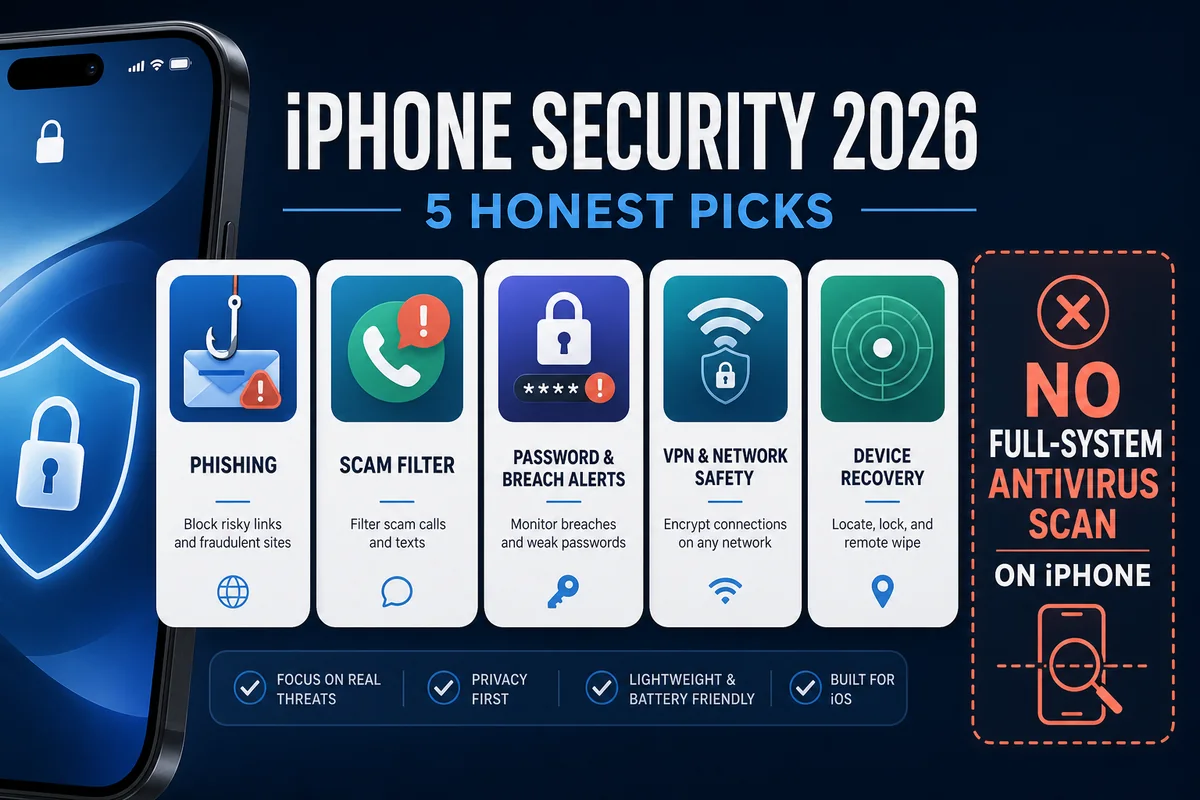
Quick answer: update iOS first, use a strong device passcode, Apple Account two-factor authentication, Stolen Device Protection, Find My and passkeys. Add Norton Mobile Security for iOS when Safe Web, Safe SMS, Wi-Fi alerts and scam guidance solve a real risk. Choose Bitdefender Mobile Security for a cheaper focused web/privacy layer, or Avast One Mobile for free Web Guard, Wi-Fi checks and breach alerts. None performs a full-system virus scan or proves that an iPhone is free of mercenary spyware.
The five iPhone security choices that deliver real value
We rank outcomes, not the word “antivirus.” On iOS, useful third-party apps filter dangerous links, analyze scam messages, check security settings, monitor breached accounts, warn about networks and provide a VPN or identity service. They don't inspect another app's private container or Apple-signed system code. We found no current AV-TEST or AV-Comparatives iOS consumer-antivirus test, so there are no legitimate malware-detection percentages to paste into these cards.

Norton Mobile Security for iOS
Safe Web, Safe SMS, Wi-Fi Security, Device Security and AI-assisted Scam Protection in a clear one-device plan. Norton 360 adds VPN and dark-web tools.
Bitdefender Mobile Security for iOS
Web Protection, Security Scan, Account Privacy and a 200 MB/day VPN allowance in a one-account plan for iOS 14 or later.

Avast One Mobile Free for iOS
Free Web Guard, Wi-Fi checks, Avast Assistant, one-email breach monitoring and a limited photo vault. Advanced call/SMS/email guards and unlimited vault are paid.

McAfee Privacy & Security for iOS
System/update checks, safe browsing, scam tools, identity monitoring and VPN. McAfee explicitly labels antivirus as Android-only on its current mobile page.
Apple iOS security, Safety Check and Lockdown Mode
Code signing, sandboxing, OS security updates, Stolen Device Protection, Find My and account controls. Lockdown Mode is for the small group at risk of sophisticated targeted attacks.
iPhone security app comparison: what each choice can actually do
| Choice | Web/scam layer | Breach/identity | VPN | Device malware scan | Best fit |
|---|---|---|---|---|---|
| Norton Mobile Security | Safe Web, Safe SMS, Wi-Fi, Scam Protection | Higher 360 tier adds dark-web tools | Norton 360 for Mobile, not basic Mobile Security | No full-system scan | One user who wants paid scam friction |
| Bitdefender iOS | Web Protection and security configuration scan | Account Privacy breach check | 200 MB/day included | No full-system scan | Focused, lower-cost paid protection |
| Avast One Free | Web Guard and Assistant free; advanced guards paid | One email free; five paid | Paid tier | No full-system scan | Best no-cost app |
| McAfee iOS | Safe browsing and Scam Detector | Monitoring/cleanup varies by plan | Free/paid entitlement varies | System/update scan only | Existing McAfee household/identity buyer |
| Apple built-ins | Safari/Messages/App Store and OS security controls | Apple Account alerts, Safety Check | iCloud Private Relay isn't a general VPN | System-enforced security, not an App Store scan | Every supported iPhone |
Critical evidence boundary: AV-TEST and AV-Comparatives publish Windows, macOS and Android consumer-antivirus tests, but we found no equivalent current iOS antivirus test. A vendor's 100% Android result or 6/6 Windows score doesn't become an iPhone score because the same subscription includes an iOS app.
Why an iPhone antivirus can't run a Windows-style virus scan
Apple's runtime security documentation explains that iOS apps run in a sandbox with declared entitlements and platform code-signing controls. An App Store security app doesn't receive unrestricted permission to crawl other apps' private containers or replace Apple's system security services. That's good isolation—but it makes the usual desktop “scan every executable and process” product claim impossible.
Security apps can inspect data the user shares with them, check known account breaches, assess settings, filter network traffic or links using supported extensions/VPN configurations, warn about risky Wi-Fi and analyze text/images the user submits. They can check for signs such as an outdated OS or a suspicious profile. They can't certify every byte of the kernel, baseband, another app or a sophisticated exploit chain.
This distinction prevents two opposite mistakes. “iPhones cannot get malware” is false: Apple regularly fixes exploitable vulnerabilities, including sandbox escapes, and highly targeted spyware exists. “Install antivirus and scan the whole phone” is also false under normal iOS rules. Patching and reducing attack surface do more against device exploits; a security app mainly helps with phishing, scams, unsafe links, exposed accounts and network/privacy decisions.
Apple's built-in iPhone security matters more than any antivirus label
Apple's current security releases list shows why updates lead the plan. iOS 26.5.1 was listed June 1, 2026 for the newest iPhone family, while Apple also expanded availability of iOS 18.7.7 in April for devices on the older supported branch. Install the newest security release your exact iPhone offers; a third-party app can't deliver those fixes.
Use a strong six-digit-or-longer passcode that isn't reused as a PIN elsewhere, Face ID/Touch ID, Apple Account two-factor authentication and Find My. Turn on Stolen Device Protection. Apple's March 2026 guidance lets users require the additional security delay “Always,” not only away from familiar locations. When combined with locked apps, protected apps can require biometrics without passcode fallback away from familiar locations.
Safety Check on iOS 16+ can review people/apps receiving data, connected Apple Account devices and privacy permissions, or perform an Emergency Reset. It's especially relevant for coercive control or unwanted sharing. Apple explicitly advises considering personal-safety consequences before changing access; use a safe device and specialist support when an abuser may react.
Lockdown Mode isn't “maximum antivirus” for everyone. Apple calls it an extreme optional mode for the very small group who may face sophisticated targeted mercenary spyware. It restricts attachments, complex web technologies, invitations, wired connections and configuration profiles, with real feature tradeoffs. High-risk journalists, activists, executives, officials or abuse targets should consider it with expert guidance; ordinary users shouldn't turn it on because an ad claimed the iPhone is infected.
Detailed verdicts: when each iPhone security option is worth it
1. Norton Mobile Security for iOS — strongest paid scam-first option
Norton's current standalone app focuses on outcomes iOS permits: Scam Protection, Safe SMS, Safe Web, Wi-Fi Security and Device Security. That makes sense for a person likely to open delivery, toll, bank or investment links on the phone. Norton Genie can offer guidance, but an AI label isn't authority; verify urgent payment/account requests using a separately found official channel.
The current US offer is clear: $19.99 for the first year, renewing at $29.99 for one iPhone or iPad, with a 60-day money-back guarantee under applicable terms. Norton 360 for Mobile adds Secure VPN and Dark Web Monitoring. Norton 360 Deluxe covers five mixed devices at $49.99 first year but lists a $124.99 renewal. Buy the bundle only when the other device seats and services will be used.
2. Bitdefender Mobile Security for iOS — lower-cost focused protection
Bitdefender provides Web Protection, Security Scan, Account Privacy and activity/incident insights. Its “scan” checks security/privacy configuration and exposed accounts; it isn't a malware scan of every installed app. Web Protection is the useful paid layer for users who open links across browsers/apps and want another reputation filter.
The official US page exposed $17.99 for the first year, one account, and requires iOS 14+ with internet access. The included VPN allowance is 200 MB/day—an emergency amount, not a general unlimited-VPN replacement. When a filtering feature installs a VPN configuration or network extension, check compatibility with the separate VPN/ad blocker you already use and review what traffic/metadata the provider processes.
3. Avast One Mobile Free — best free web, Wi-Fi and breach toolkit
Avast's new One app replaces the older Mobile Security/old One apps for new installs. The free tier includes Web Guard, Wi-Fi checks, Avast Assistant, breach monitoring for one email and a limited encrypted photo vault. It requires iOS 15+. Paid Premium expands to advanced SMS/call/email guards, monitoring up to five emails, unlimited vault and VPN-related features.
During setup, Avast asks for notifications and may request a VPN configuration for web protection. It also presents a tracking/data choice. Read each rather than tapping through. The FTC's final Avast order over browsing-data practices remains relevant trust history even though the product and privacy program have changed.
4. McAfee Privacy & Security — buy it for identity and VPN, not “iOS antivirus”
McAfee's current mobile page is unusually clear in one feature grid: “Antivirus” is Android-only; iOS gets a System Scan for software/security status, Safe Browsing, Scam Detector, VPN, Identity Monitoring and eligible cleanup services. That's the correct way to describe the iPhone product.
The free app advertises Wi-Fi Scan and a secure VPN for one device, while Basic/Essential/McAfee+ plans add broader cross-device and identity services. Exact offers are campaign- and account-dependent. The current minimum is iOS 16. McAfee is best for a household already using its VPN/identity service; installing it only to “scan for viruses” creates the wrong expectation.
5. Apple built-ins — the security layer no third-party app replaces
iOS updates, sandboxing, code signing, hardware-backed key protection, App Store review/notarization processes and system controls operate beneath ordinary apps. They aren't a reason to ignore scams; they're why an iPhone security app can't promise unrestricted scanning. Keep Automatic Updates on and verify the installed version after an urgent Apple advisory.
Stolen Device Protection, locked apps, Find My, Safety Check, strong passcode/biometrics, passkeys and two-factor account security prevent or contain more common iPhone losses than a decorative virus scan. Lockdown Mode is the specialized additional layer for targeted-spyware risk, not a daily default for most people.
What actually threatens an iPhone in 2026
Phishing, smishing and fake support
Texts, email, search ads, QR codes and compromised accounts lead to credential/payment theft. Link reputation can warn; only independent verification confirms the request.
Apple Account takeover
A stolen password, trusted-device approval or recovery method can expose backups, photos and Find My. Use passkeys/2FA, review devices and reject unknown sign-ins.
Passcode-assisted theft
A thief who observed the passcode may target account/password settings. Stolen Device Protection, locked apps and a longer passcode reduce the blast radius.
Malicious profiles and MDM
An unexpected configuration profile can alter network/trust/management behavior. Review Settings → General → VPN & Device Management and remove only what you understand.
Targeted spyware and zero-days
Rare exploit chains may require no normal app install. Update fast; preserve evidence; use Lockdown Mode and expert incident help when the risk is credible.
Unwanted sharing or monitoring
Location, Family Sharing, shared albums, forwarding or an account known to another person can look like malware. Safety Check addresses the sharing/account layer.
Review the security app before granting VPN, contacts or message access
| Request | Legitimate security use | Tradeoff to check |
|---|---|---|
| VPN configuration | Web filtering or encrypted VPN traffic | Whether it's a local filter or remote VPN, logging policy and conflict with another VPN |
| Notifications | Security, scam, breach and network alerts | Marketing frequency; sensitive alert text on the lock screen |
| Contacts/call identification | Label suspected scam calls | What contact/call data leaves the device and which premium tier applies |
| Message filtering/extension | Classify unknown or scam SMS | Which sender/message fields are visible or uploaded under Apple's extension rules |
| Photos | Import items into an encrypted vault | Whether originals remain in Photos/iCloud and how vault export/recovery works |
| Email/account monitoring | Check addresses against breach data | Address retention, marketing use, covered addresses and required verification |
Download from the verified App Store listing reached through the vendor's domain. A fake “Apple Security” pop-up in Safari can't scan the iPhone and shouldn't dictate an install, phone call or payment. Close the tab, clear suspect website data if needed and inspect subscriptions/profile/calendar entries from Settings.
Secure an iPhone in the right order
- Update iOS. Settings → General → Software Update; enable automatic download/install and security responses where shown.
- Strengthen device access. Use Face ID/Touch ID with a unique longer passcode; hide sensitive notification previews.
- Turn on Stolen Device Protection. Consider “Always” for the security delay and lock Mail, password, finance and authenticator apps.
- Review Apple Account security. Check trusted devices/numbers, recovery contacts/keys and two-factor authentication; reject unknown prompts.
- Enable Find My. Confirm Find My network and Send Last Location, then test the account route from another device.
- Audit profiles and sharing. Check VPN & Device Management, calendars, forwarding, Family Sharing and Safety Check.
- Install one security app only if it adds a needed outcome. Configure web/scam/breach features and decline irrelevant tracking or upsells.
- Back up and test recovery. Know whether iCloud or an encrypted computer backup contains the data and credentials needed after a reset.
What to do when an iPhone says it has a virus
A browser page or calendar alert saying “Your iPhone has 7 viruses” is almost always a scam notification, not a device scan. Don't call, install a remote-support/profile app, enter payment details or grant screen sharing. Close the tab, remove unknown calendar subscriptions/profiles, clear affected browser website data and check the App Store subscriptions list.
If you entered a password or card, use a different trusted device to change the account password, revoke sessions, secure recovery methods and contact the bank/card issuer. If someone controlled the screen, knew the passcode or added a profile, treat the Apple Account and every viewed secret as exposed. A web-protection app can block the next known URL; it can't undo the disclosure.
For an Apple threat notification, credible targeted-spyware concern, unexpected jailbreak/MDM state or unexplained persistence after updates, preserve the message/device evidence and contact Apple plus an appropriate specialist such as Access Now's Digital Security Helpline for civil-society risk. Don't erase first when forensic evidence or personal safety matters. Ordinary support can't confirm mercenary spyware with an App Store “scan.”
Free vs paid iPhone security: what is worth a subscription?
Avast One Free and McAfee's free base can add useful web, Wi-Fi, breach or limited VPN functions. Apple's built-ins provide the platform security at no extra cost. A paid app earns renewal only when its specific scam filter, multi-address breach monitoring, VPN, identity response or cross-device seats replace another service.
Don't pay for a vague “virus scan,” battery cleaner, memory booster or duplicate photo vault without understanding the exit path. iOS manages memory and app isolation; a third-party utility can't clean the kernel like a PC tune-up. Moving photos into a proprietary vault can complicate backup/export. A VPN changes who can observe network traffic; it doesn't make a phishing login safe.
Compare two-year cost. Norton standalone is $19.99 plus $29.99 listed renewal, or $49.98 before tax if unchanged. Bitdefender exposes a $17.99 first-year value but says renewal may be higher and can change. App Store subscriptions must be cancelled through Apple; deleting an app doesn't cancel billing.
Why we didn't rank “iPhone virus cleaners” and borrowed lab scores
Any app promising to inspect every installed iOS app, remove system malware, repair an iPhone kernel or use a desktop vendor's AV-TEST score as proof deserves skepticism. The sandbox prevents the claimed full scan, and a Windows/Android test evaluates a different executable, platform and attack set.
Lookout and Trend Micro can offer legitimate web, identity, lost-device or privacy features, but they didn't displace the four current app choices plus Apple's baseline. TotalAV and other bundles may provide web/VPN tools, yet current first-page “iOS antivirus” rankings often substitute desktop brand reputation for an iPhone-specific evidence boundary. This page prefers fewer defensible choices.
Jailbreaking changes the threat model by weakening Apple's code-signing/sandbox assumptions and enabling non-App-Store software. A security app can't restore the original trust boundary. Back up needed data, return to an official supported iOS build and change exposed credentials from a clean device.
How we chose the best iPhone security apps
We checked the Google-style first page for “best antivirus for iPhone 2026,” “does iPhone need antivirus,” free iPhone security and Norton/Bitdefender/Avast/McAfee variants. Competitors increasingly admit that full-device scanning is unavailable, but several still publish “virus detection” columns or transfer Android/desktop lab performance.
We verified iOS capabilities against Apple Platform Security, current security releases, Stolen Device Protection, Safety Check and Lockdown Mode. Vendor pages/support established exact iOS features, system minimums, free/paid boundaries and reproducible US prices. We weight phishing/scam prevention, account recovery, privacy transparency, subscription clarity and cross-device value—not a nonexistent iOS malware score.
Frequently asked questions about antivirus for iPhone
What is the best antivirus for iPhone in 2026?
No App Store app is a traditional full-device iPhone antivirus. Norton Mobile Security is our best paid scam/web-security option, Bitdefender the lower-cost focused alternative, Avast One Mobile the best free app and McAfee the identity/VPN bundle. Apple's updated iOS security remains the essential base.
Can an iPhone antivirus scan every app for malware?
No. iOS sandboxing and entitlements prevent an ordinary App Store app from crawling other apps' private containers and system code like desktop antivirus. Security apps can filter links/traffic, check settings and breaches, analyze submitted content and provide VPN/scam/identity tools.
Do iPhones get viruses or spyware?
Ordinary self-spreading viruses are rare on non-jailbroken iPhones, but exploitable iOS vulnerabilities, malicious profiles, phishing/account takeover and highly targeted mercenary spyware are real. Update quickly. People at elevated targeted risk should consider Lockdown Mode and expert incident support.
What is the best free security app for iPhone?
Avast One Mobile is our free pick for Web Guard, Wi-Fi checks, scam guidance, one-email breach monitoring and a limited photo vault. It doesn't perform a full-system malware scan. Review its VPN configuration, tracking choice and paid-module prompts during setup.
Is Norton or Bitdefender better for iPhone?
Norton is better when Safe SMS, Scam Protection and Wi-Fi alerts justify $19.99 first year/$29.99 renewal. Bitdefender is the cheaper focused choice at a current $17.99 first-year snapshot with Web Protection, Security Scan, Account Privacy and 200 MB/day VPN.
How do I remove a virus warning from Safari on iPhone?
Don't call or install anything from the warning. Close the tab, clear the affected browser's website data, remove unknown calendar subscriptions or configuration profiles and inspect App Store subscriptions. If you entered credentials/payment, secure those accounts from another trusted device.
Should everyone turn on Lockdown Mode?
No. Apple designed Lockdown Mode for the very small number of people who may face sophisticated targeted cyberattacks. It intentionally restricts messages, web features, invitations, connections and profiles. Most people gain more from prompt updates, strong account/device security and Stolen Device Protection.
Does deleting an iPhone security app cancel the subscription?
No. App Store billing continues until cancelled under Settings → your name → Subscriptions. Direct-vendor subscriptions may require the vendor account. Cancel through the seller, save confirmation and separately remove any VPN configuration or extension left in Settings.
Bottom line
The best “iPhone antivirus” is an honest security stack: current iOS, strong passcode/biometrics, Stolen Device Protection, secure Apple Account, Find My, Safety Check when relevant and fast action on suspicious messages. Norton, Bitdefender, Avast or McAfee can add scam, web, breach, VPN or identity value—but none replaces the platform.
Buy the outcome you can name, not a virus-scan animation. If your risk is targeted spyware, a $20 consumer app isn't an incident-response plan. Update, use Lockdown Mode when appropriate, preserve evidence and get qualified help.