
PC Matic Review 2026: 100% Protection, 12 False Blocks
PC Matic aced its last AV-TEST protection result, but default-deny allowlisting blocked 12 of 30 legitimate actions. The new Windows v6 hasn't yet repeated that test.
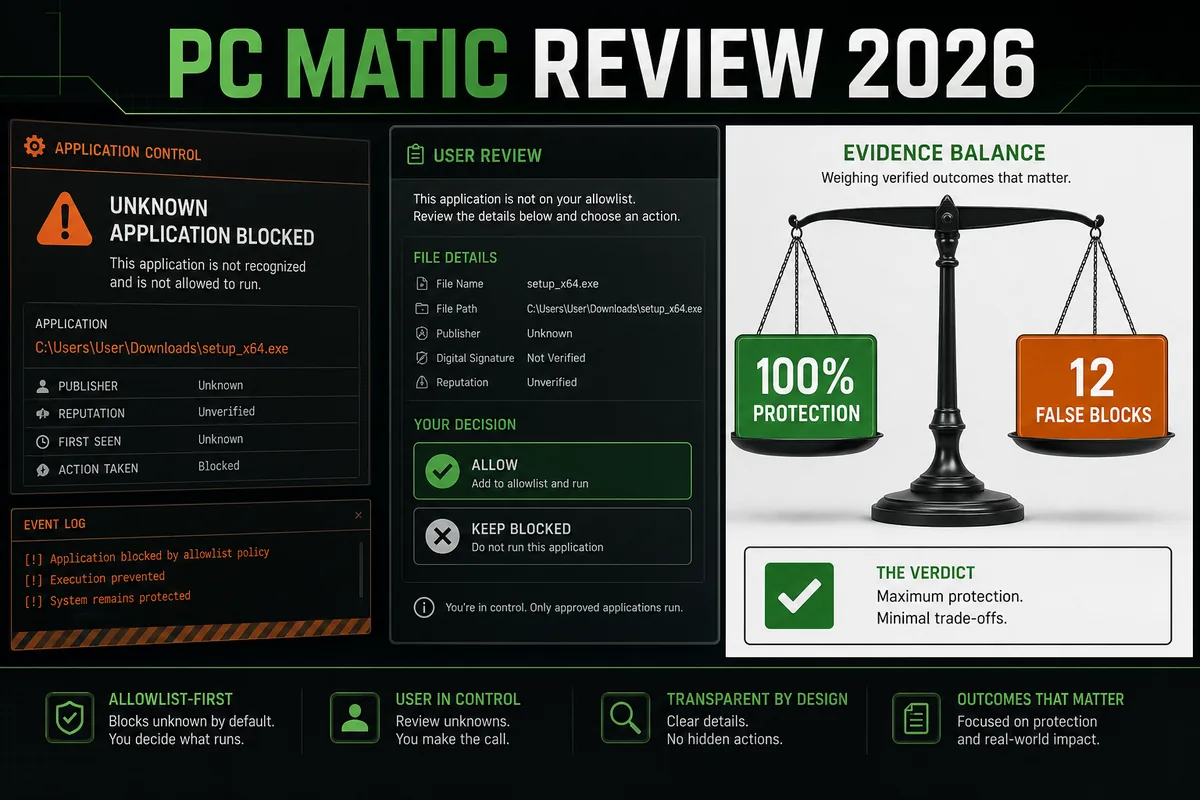
Our verdict: PC Matic is legitimate US-developed security software with a technically serious default-deny layer. In AV-TEST’s March–April 2024 Windows test, Application Allowlisting 3.0 stopped 100% of both zero-day and prevalent malware sets and earned 6/6 for performance. The cost of that caution was operational: it scored 4/6 for usability and falsely blocked 12 of 30 legitimate actions in the largest install/use set. PC Matic v6 arrived for Windows 10/11 in May 2026, so the old score is strong historical evidence—not a test of today’s rebuilt app. The current antivirus card is $50 for the first year and five devices, but VPN renewal copy needs careful checkout verification and renewals are non-refundable. We rate PC Matic 7.1/10: compelling for households comfortable verifying unknown software, less suitable for anyone who needs uncommon apps to run without interruption.
- 100% protection in both AV-TEST malware sets in March–April 2024
- Perfect 35/35 in two 2024 advanced attack cycles
- Default-deny blocks unknown executables before classification
- Perfect 6/6 lab performance category in the last standard test
- Five-device antivirus plan at $50 for the first year
- US-based company, development and support with direct account controls
- Windows v6 launched in May 2026 and has no current independent result
- 12 of 30 legitimate actions blocked in the largest AV-TEST set
- No current PC Matic entry in 2026 AV-TEST, AV-Comparatives or SE Labs consumer sets
- Official VPN inclusion/renewal footnote is commercially ambiguous
- Renewals are final and non-refundable under the current refund policy
- v6 and feature parity don't extend equally across Mac, Android and iOS
PC Matic at a glance
PC Matic combines conventional malware scanning with SuperShield, a global application allowlist that denies unknown software by default. That reverses the usual consumer-antivirus decision. A conventional product tries to identify bad files while allowing everything else; PC Matic asks whether an executable or script is known good before it runs. This can stop a new malicious program before a signature exists, but it can also delay a new legitimate utility, game mod, driver or specialist business app.
The current product line is in transition. PC Matic released a rebuilt Windows 10/11 v6 in May 2026 with one interface for security, VPN, privacy and performance functions. Other platforms still use their own apps and protection models. The consumer storefront sells three annual bundles plus separately renewing privacy/support services.
| Buyer question | Evidence-checked answer |
|---|---|
| Is PC Matic legitimate? | Yes. PC Matic Inc. was founded in 1999 and publishes current product, legal, support and privacy documentation. |
| Does it stop malware? | The pre-v6 Application Allowlisting 3.0 product reached 100% in AV-TEST’s last standard result and 35/35 in two ATP cycles. |
| What is the main trade-off? | Default-deny can block safe unknown software; the last test recorded 12 false blockages among 30 legitimate actions in one set. |
| Has PC Matic v6 been independently tested? | We found no current major-lab result for the Windows v6 released in May 2026. |
| Current base price? | $50 first year for five devices; the card shows $60 as the comparison price. |
| Is Lifetime still sold? | No new Lifetime sale since March 2026. Existing Lifetime customers retain coverage. |
| Platforms? | Windows, Mac, Android and iOS apps exist, but v6 is Windows 10/11 and iOS acts as a content blocker. |
| Our rating? | 7.1/10 from one editor, not a customer-review aggregate. |
The recovered page used a seven-person 8.9 aggregate and an expired 2021 $50 Offer. We removed both. Our rating is one editorial judgment, while current prices remain dated text because the storefront, promotion, tax and renewal can change.
AV-TEST: perfect protection, excellent speed, weak usability
The latest standard home-Windows result is AV-TEST’s March–April 2024 report for Application Allowlisting 3.0 on Windows 11. It's a strong but unusually polarized result.
PC Matic detected 100% of 316 zero-day web/email samples in both months and 100% of 19,228 recent widespread samples. It earned 6/6 Protection. It also earned 6/6 Performance, beating the displayed category averages in website launch, downloads, program launch/install and file-copy tasks. “6/6 performance” doesn't mean zero overhead: for example, AV-TEST measured 12% website-launch slowdown on both standard and high-end PCs, versus 23% and 21% category averages.
Usability fell to 4/6. PC Matic made no website false warnings, but the lab recorded a small number of safe-file detections and multiple legitimate-action blocks. The largest displayed set shows 12 blocks among 30 legitimate install/use actions in April. That isn't a cosmetic penalty; it predicts the exact daily trade-off of strict allowlisting.
| AV-TEST measure | PC Matic result | Meaning |
|---|---|---|
| Zero-day web/email protection | 100% March; 100% April | All 316 current attack samples were stopped across the cycle. |
| Widespread malware | 100% March; 100% April | All samples in the 19,228-file reference set were detected. |
| Protection score | 6/6 | Perfect category score for the tested 3.0 build. |
| Performance score | 6/6 | Lower impact than displayed industry averages across the test tasks. |
| Largest legitimate-action block set | 12/30 | Strict default-deny interrupted safe activity until classification/allowing. |
| Usability score | 4/6 | A persistent weakness across PC Matic’s recent AV-TEST history. |
| Total | 16/18 | Certified, but below AV-TEST’s 17.5 Top Product threshold. |
Several competing reviews call this a Top Product result; the raw threshold contradicts that claim. Six plus six plus four is 16, and AV-TEST states that Top Product starts at 17.5. The page displayed by PC Matic can legitimately show certification and older awards, but this specific April 2024 standard report wasn't a 17.5-point Top Product outcome.

Advanced attack tests were a genuine PC Matic strength
AV-TEST’s Advanced Threat Protection program follows ransomware and data-stealer attack chains instead of counting files alone. In the January–February 2024 cycle, PC Matic was one of eight consumer products that detected and stopped every attacker in the first two steps. It earned the full 35/35 across five ransomware and five data-stealer scenarios.
The March–April 2024 ATP cycle repeated that 35/35 result. AV-TEST’s later endurance summary records PC Matic at 70/70 across 20 attacks in those two cycles. This is precisely where default-deny can shine: an unapproved payload doesn't need to be recognized as a named family to be prevented from executing.
Those tests are excellent evidence for the 2024 Application Allowlisting generation. They don't justify “PC Matic has never missed malware,” and they don't certify v6. Ten scenarios per cycle test depth, not the full diversity of consumer threats, browser scams, malicious documents, mobile apps and future Windows releases.
The new v6 has no current independent test
PC Matic doesn't appear in AV-TEST’s current 2026 home-Windows set, AV-Comparatives’ 2026 consumer Main-Test Series or current SE Labs home reports. AV-Comparatives has an old single-product SuperShield 2.0 report, but it belongs to an earlier generation and mainly illustrates the longstanding allowlist/false-alarm tension.
This timing matters more than a routine missed quarter. PC Matic says v6 was rebuilt from the ground up and integrates previously separate functions. A large interface and component transition can improve protection and usability, or introduce new behavior. The April 2024 score belongs to Application Allowlisting 3.0; it should remain in the review as the best historical proof, with an explicit request for a v6 retest.

How SuperShield’s default-deny allowlist works
PC Matic’s SuperShield explanation says it maintains a global list of trusted applications, digital signatures and publisher certificates. A program not yet analyzed and approved is blocked by default and submitted for research/categorization. The user can allow it immediately when they know it's safe.
That last sentence carries the risk. “Unknown” is a classification state, not evidence of malware. A brand-new open-source release, privately signed utility, niche accounting package or game anti-cheat update may be unknown. Allowing everything that produces an inconvenient alert destroys default-deny’s advantage; refusing everything can stop legitimate work.
- Read the exact file path, publisher/signature and process that launched it.
- Confirm you initiated the install/update from the official developer channel.
- Check the file hash or signed release notes where the vendor publishes them.
- Wait for PC Matic classification when the software is non-urgent or uncertain.
- Use “Always Allow” only for a verified file/publisher, never because a popup is annoying.
PC Matic’s legacy support article says unknown programs are blocked and can be added to the allowlist. v6 may move the control, but the decision discipline remains the same.

False blocks are the cost of prevention—not fake malware detections
A false positive is often described as antivirus calling a clean file malicious. PC Matic’s default-deny behavior can be subtler: it may block a legitimate action because the executable isn't yet known good, without asserting a malware family. For the user, both can interrupt work; for a review, the distinction matters.
AV-TEST’s April 2024 12/30 block result is too large to wave away as a lab mismatch. It demonstrates that the protection policy can create friction under ordinary legitimate software activity. PC Matic argues that unknown files are researched and categorized, reportedly within about a day. A developer, gamer, accessibility-tool user or small business with custom software may encounter unknown releases more often than a household using mainstream signed apps.
That's why the best-fit decision is about workflow, not fear. A parent managing five ordinary family PCs may prefer a cautious stop-and-verify model. A developer compiling new binaries throughout the day will spend more time authorizing local work. Neither outcome makes the technology fraudulent; it changes whether the security control is usable.
PC Matic v6: a major Windows rebuild, not a cosmetic update
PC Matic released v6 on May 13, 2026 for existing Windows 10 and 11 subscribers at no additional software-upgrade cost. The vendor describes one integrated interface for antivirus, VPN, privacy tools and performance optimization, plus scam blocking, an enhanced firewall surface, file shredder, password generator and exposure scan.
The phrase “everything in one dashboard” doesn't mean every subscription unlocks every service. The dashboard can surface VPN, Privacy, Identity and Support while the plan determines access. The $50 Antivirus card differs from the $80 Antivirus+VPN tier and $180 family-identity tier; separate Privacy, Delist and Support Unlimited items still renew annually.
A vendor article calls v6 exclusive to Windows 10/11. Current support documentation for “PC Matic Basic” says updates for Mac, Android and iOS apps are coming later. Buyers should therefore treat v6 as the current Windows experience, not a synchronized cross-platform suite release. The new build also makes a fresh lab submission especially important.
An August 5 product update adds an important boundary to the word “free.” PC Matic now advertises a free Software Origin Scan, a free exposure report and an on-demand malware scan with quarterly cleanups. The vendor explicitly says that free malware scan is not continuous real-time protection. Buyers who want always-on SuperShield protection still need the appropriate paid subscription.
PC Matic price in August 2026: three annual bundles
The US consumer page still displayed the same three first-year offers when checked on August 7, 2026. Taxes may apply and campaigns can change, so we report them as a dated snapshot rather than volatile Offer schema.
| Plan | First year | Displayed comparison | Devices | Important additions |
|---|---|---|---|---|
| Antivirus | $50 | $60 | 5 | Real-time protection, scans/tune-up, scam/ad blocker, exposure/dark-web tools, 300MB/day free VPN wording. |
| Antivirus + VPN | $80 | $110 | 5 | Unlimited Standard VPN, 25GB backup, secure firewall, file shredder, limited phone support. |
| Antivirus + VPN + Family Identity | $180 | $210 | 10 | Upper-tier features plus fraud monitoring and advertised insurance/reimbursement benefits. |
The $50 price is competitive for five devices, especially if every device is an ordinary Windows/Mac/Android/iOS household endpoint. Value narrows if only one PC needs protection or if mobile features don't match desktop needs. Identity insurance and stolen-funds reimbursement have eligibility, documentation and benefit terms; a headline $1M isn't cash automatically paid after any scam.
All three cards advertise a 30-day money-back guarantee, but the detailed refund policy limits it to an eligible initial annual order. Renewals are final. Read the cancellation section before treating the guarantee as a risk-free renewal.
VPN and add-ons: the official renewal footnote needs clarification
The base card calls its included service “PC Matic Free VPN” and gives it a 300MB daily limit. The next tier advertises unlimited Standard VPN. Yet a footnote below the plan area says one year of PC Matic VPN is included at no added cost and the subscription automatically renews after that year at $80/year unless canceled. The visible wording doesn't cleanly identify which VPN entitlement/subscription that $80 renewal belongs to.
PC Matic also launched standalone VPN tiers in July 2026: its vendor announcement lists Standard at $30 first year/$50 renewal and Stealth at $80 first year/$100 renewal. Those figures make the consumer-page $80 footnote even more important to resolve rather than infer.
| Optional service | Displayed annual price | What to verify |
|---|---|---|
| PC Matic Privacy | $30 | Windows/browser coverage, scan/clean scope and separate renewal. |
| PC Matic Delist | $60 | Which brokers are covered, removal cadence and renewal. |
| Support Unlimited | $100 | 24/7 phone/chat/remote support; it doesn't include an antivirus license. |
| Standard VPN standalone | $30 first / $50 renewal | Server set, devices, streaming and relationship to bundled VPN. |
| Stealth VPN standalone | $80 first / $100 renewal | Kill switch, router option, multihop and exact device entitlement. |

PC Matic Lifetime is no longer sold to new buyers
Old reviews still lead with the Evergreen/Lifetime plan. PC Matic’s updated Lifetime support page says the company stopped offering it in March 2026. New buyers shouldn't search for an old $150 or $200 perpetual checkout.
Existing Lifetime customers remain covered and may transfer the license among devices with up to five active at once. Support can discuss an upgrade to ten. “Lifetime” remains subject to the license/product terms and supported platforms; it doesn't make an obsolete operating system safe or guarantee every future paid adjacent service.
If a reseller still advertises Lifetime, verify authorization and the exact license with PC Matic before payment. Current refund policy excludes some third-party fulfilled or bundled transactions.
Windows, Mac, Android and iOS don't receive the same PC Matic
The current requirements page lists Windows 11/10/8, macOS Sierra 10.12 through Tahoe 26, Android 4.4+ and iOS/iPadOS 13+. Another current install page recommends Windows 10/11 and says legacy Windows 7/8.1 updates will end. The current v6/basic overview is clearer: the new application is Windows 10/11, with other-platform updates still forthcoming.
| Platform | Current documented model | Review caution |
|---|---|---|
| Windows 10/11 | Current v6, SuperShield, scans and integrated dashboard/services. | Freshest product, but no independent v6 result yet. |
| Windows 8/8.1/7 SP1 | Conflicting legacy requirements/coverage pages. | Don't rely on EOL Windows; v6 isn't for these systems. |
| macOS 10.12–26 | Separate Mac app with SuperShield console documented. | No current AV-TEST/AV-C Mac result found and no v6 parity. |
| Android 4.4+ | App monitors installed applications/files and should remain running. | Very old Android versions are unsafe even if the app installs. |
| iOS/iPadOS 13+ | Safari content blocker; green state means content blocking enabled. | Not desktop-equivalent malware scanning. |
| Chromebook | Appears in an add-device navigator, but coverage page says antivirus unsupported. | Treat as unsupported until documentation is reconciled. |
One five-device license can cover a mixed family, but counting installations isn't the same as delivering equal protection. Choose the plan based on the weakest platform-specific capability you actually need.
Performance was excellent in 2024; test v6 on your workload
PC Matic’s last standard AV-TEST performance result deserves credit: 6/6 and better-than-average slowdowns across every displayed task. But that was Application Allowlisting 3.0, not v6. Vendor language such as “absolutely zero lag” is a claim, not a universal measurement.
Measure v6 after its first vulnerability scan and definitions/classification have settled. Compare restart, browser launch, a trusted app install, file copy, video call, game or creative workload and battery. More important than a scan duration is how often the allowlist interrupts legitimate software and how quickly classification resolves it.
Use the harmless official EICAR test file to check the expected download/scan path, not live malware. EICAR doesn't test default-deny zero-day logic, so also install one newly released but cryptographically signed legitimate tool you genuinely use and inspect the block/allow workflow.
Cancellation is easy; renewal refunds aren't
Auto-renewal is enabled by default. PC Matic’s current cancellation guide says to log in, open My Subscriptions and turn automatic renewal off. Access remains active through expiration and further charges should stop. Every VPN/add-on line should be checked separately.
The detailed refund policy is stricter than the storefront badge. An eligible initial annual subscription can receive a full refund when requested within 30 days of purchase. Renewal orders are final and non-refundable. After 30 days, third-party fulfilled/bundled orders and redeemed or already set-up services can also be excluded.
- Immediately after purchase, screenshot each subscription, renewal date and price.
- Resolve the VPN footnote and remove any service you didn't intend to create.
- Set an independent reminder at least a week before renewal.
- Turn off auto-renew and save the confirmation email; the license stays active to expiration.
- For an eligible initial refund, contact support inside 30 days with order email/number and request it explicitly.
- Expect support response within the stated 24 hours and 5–7 business days for a processed refund to post.
Don't wait for a renewal charge expecting another 30-day trial. The current specific policy says renewals don't qualify.
Privacy and company: transparent US processing, broad device telemetry
PC Matic Inc. was founded in 1999. Current leadership identifies Rob Cheng as founder and executive chairman and Shay Houser as CEO. Official pages say research, development and support are US-based. The privacy/contact address is in Sioux City, Iowa; terms use South Dakota governing law.
The current privacy policy took effect June 5 and was last updated June 29, 2026. For PC Matic Home and Pro, it lists device and machine identifiers, hostname, operating-system and hardware details, IP address and approximate location, installed-software inventory, application metadata and file names, security events, scan reports, diagnostics, performance telemetry, subscription validation and network configuration. It says the software scans files, processes, network settings and browsing history for security, but doesn't transmit the contents of personal documents, email or photos.
The same policy separates adjacent products instead of treating the bundle as one data flow. PC Matic VPN collects account and connection metadata, timestamps, device/app versions, the IP needed to establish a connection and diagnostics; PC Matic says it doesn't log browsing activity, website content or DNS queries. Delist and identity services necessarily request much more sensitive identity data, so they should be evaluated separately rather than assumed to inherit the antivirus data footprint.
This is broad cloud-security telemetry, not a minimal offline scanner. The useful improvement is specificity: the policy now distinguishes data merely accessed during a scan from data transmitted to PC Matic. A privacy-sensitive buyer should still review optional services one by one, especially Delist, identity monitoring and VPN, before enabling them.
Community signals: legitimate product, divided opinion on allowlisting
Recent PC Matic-specific Reddit discussion is modest and shouldn't be mistaken for a representative survey. A July 2026 r/antivirus question shows that old “scamware” claims still shape buyer anxiety, but the thread contains no evidence strong enough to settle product safety. A separate SuperShield block report describes repeated GoTo Meeting installer alerts; the practical response was to verify the file before allowing it. That behavior is consistent with default-deny, not proof that the installer or PC Matic itself is malicious.
Other threads label every block proof of poor antivirus or, conversely, treat a blocked unknown file as proof of malware. Neither is technically sound. Community anecdotes can't identify the file, signature, configuration or build, and they aren't representative satisfaction data.
We don't quote a named user or manufacture consensus. The community adds one practical test: if the person who will use the PC can't safely distinguish a legitimate unknown program from a risky prompt, someone trusted must manage the allowlist—or a less intervention-heavy product is safer in practice.
Who should choose PC Matic—and who should skip it
| User | Recommendation | Reason |
|---|---|---|
| Family with mainstream Windows apps | Consider | Five-device entry price and default-deny can be a strong fit when software changes are infrequent. |
| Caregiver managing relatives’ PCs | Consider with portal checks | Unknown executables stop by default, but VPN/subscription and allow decisions need management. |
| Developer, modder or niche-software user | Usually skip | New/local unsigned programs are likely to create repeated approval friction. |
| Evidence-first 2026 buyer | Wait or compare | v6 hasn't yet repeated the excellent 2024 independent tests. |
| Mixed iOS-heavy household | Compare alternatives | iOS is a content blocker, not desktop-equivalent real-time protection. |
| Existing Lifetime customer | Keep after v6/local QA | Coverage continues for up to five active devices; no new annual antivirus payment. |
| Buyer who may forget renewal | Use caution | Renewals are non-refundable; VPN/add-on lines require explicit verification. |
PC Matic alternatives with clearer current evidence
Bitdefender is the stronger all-round choice for current multi-lab validation, mature web/ransomware defenses and fewer default-deny interruptions. Its renewal and bundle tiers still need review.
ESET suits advanced users who want low impact, strong controls and excellent false-positive handling without blocking every unknown executable. It may include fewer consumer extras.
Norton 360 is the more coherent bundle when unlimited VPN, backup and family services are priorities. Compare the renewal, not just the first year.
Microsoft Defender is included with supported Windows and has far more current 2026 independent evidence. It lacks PC Matic’s global default-deny experience for home users but costs nothing extra and is less likely to interrupt niche apps.
Emsisoft is a useful Windows-focused alternative for buyers who value straightforward anti-malware and privacy over a broad identity/VPN suite. Its own current evidence limits and device coverage should be compared.
A safe 30-minute PC Matic v6 evaluation
- Record checkout: first price, renewal, device count, VPN entitlement and every separate subscription.
- Prepare Windows: update Windows 10/11, create recovery media/point and remove a conflicting real-time suite.
- Complete onboarding: run the required vulnerability/initial scan and confirm SuperShield is green/active.
- Harmless protection: try official EICAR and a recognized phishing-test page; never use live malware.
- Allowlist test: install a newly released trusted signed app and inspect the explanation, research and manual-allow path.
- Performance: compare restart, web, file copy, work app and battery behavior with your baseline.
- Platform check: verify what each Mac/Android/iOS device actually receives; don't count an iOS content blocker as desktop antivirus.
- Account check: match My Subscriptions with the saved basket and disable unwanted renewal immediately.
Keep PC Matic only if the household can manage unknown-app decisions, v6 stays stable and the complete renewal is clear. Use the initial 30-day window; it won't reopen for a renewal.
Frequently asked questions
Is PC Matic a legitimate antivirus?
Yes. PC Matic Inc. was founded in 1999, publishes current support/legal/privacy pages and has a long AV-TEST history. Its SuperShield combines malware scanning with global application allowlisting. Legitimacy doesn't eliminate false blocks, evidence age or subscription trade-offs.
How well did PC Matic perform in independent tests?
Application Allowlisting 3.0 detected 100% of both AV-TEST malware sets in March–April 2024, scored 6/6 for protection and performance, and earned 35/35 in two 2024 Advanced Threat Protection cycles. It scored only 4/6 for usability and blocked 12 of 30 legitimate actions in the largest displayed set.
Has PC Matic v6 been independently tested?
We found no current major-lab result for v6, which launched for Windows 10/11 in May 2026. The latest standard result covers Application Allowlisting 3.0 from 2024, so it's historical evidence rather than a certification of the rebuilt v6 app.
Why does PC Matic block legitimate programs?
SuperShield uses default-deny: an application not yet on the global allowlist is blocked while it's categorized. Unknown doesn't necessarily mean malicious. Verify the publisher, signature/source and hash before manually allowing a program; don't approve it only to dismiss an alert.
How much does PC Matic cost in 2026?
On August 7, 2026, the US page showed Antivirus at $50 first year for five devices, Antivirus+VPN at $80 for five, and the ten-device family-identity tier at $180. Comparison prices were $60, $110 and $210. Tax, campaign, renewal and eligibility can change, so save checkout.
Is PC Matic free?
PC Matic offers a free on-demand malware scan with quarterly cleanups, plus a Software Origin Scan and exposure report. Its August 2026 product update says the free malware scan isn't continuous real-time protection. Always-on SuperShield protection and the paid bundle features require an eligible subscription.
Does PC Matic still sell a Lifetime license?
No. PC Matic says new Lifetime subscriptions ended in March 2026. Existing Lifetime customers remain covered and can keep up to five active devices, with a possible ten-device upgrade through support.
How do I cancel PC Matic and get a refund?
Open My Subscriptions and turn automatic renewal off; access continues to expiration. The current policy allows a full refund for an eligible initial annual order requested within 30 days. Renewals are final and non-refundable, and some third-party or already redeemed/set-up services are excluded.
Is PC Matic better than Microsoft Defender?
PC Matic adds a consumer default-deny allowlist, five-device management and optional privacy/VPN services. Defender is included with supported Windows, has current 2026 lab coverage and is less likely to block uncommon legitimate software. PC Matic is better only when the household values default-deny enough to manage its interruptions and renewal.
Final verdict: strong prevention, real friction, missing v6 proof
PC Matic’s protection record is better than dismissive search results suggest. The exact product tested in 2024 stopped every AV-TEST sample, earned perfect performance, and blocked all 20 ransomware/data-stealer attack chains across two ATP cycles. Default-deny is a credible way to stop novel executables.
The same evidence explains why it isn't for everyone. A 4/6 usability score and 12/30 legitimate-action blocks are substantial. The current Windows v6 is a major 2026 rebuild without a product-specific independent result. Add ambiguous VPN renewal copy and non-refundable renewals, and the buyer must verify both software and subscription behavior.
Our score is 7.1/10. PC Matic is a sensible controlled trial for a mainstream Windows household that wants five-device default-deny protection and can manage occasional blocks. Developers, specialist-software users and evidence-first buyers should start with Bitdefender, ESET, Norton or Microsoft Defender until v6 proves itself in current labs.