
Spybot Review 2026: €18.99 Home, No Current Lab Test
Spybot 2.9 remains a legitimate Windows anti-spyware tool. Free is useful for manual cleanup, but only paid editions add antivirus and live protection—and neither has current major-lab proof.
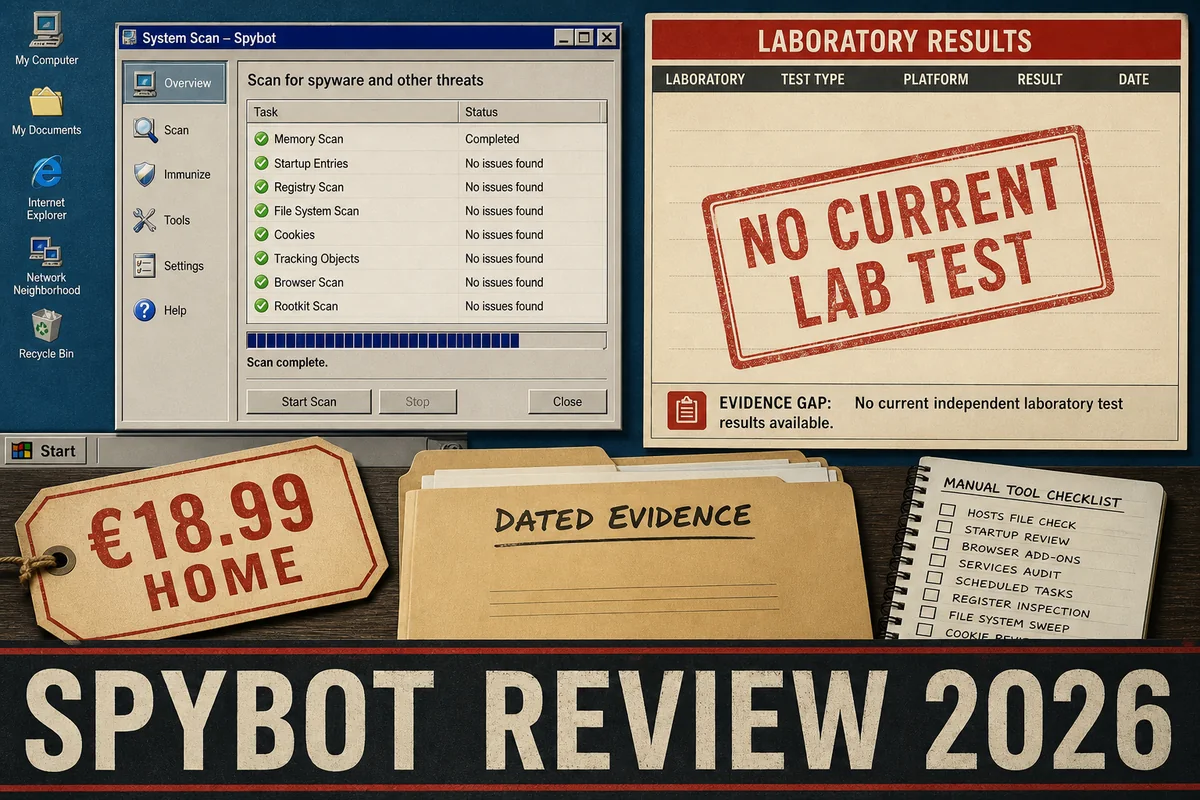
Our verdict: Spybot Search & Destroy is safe to download from Safer-Networking and still has a defensible niche: its Free edition can run manual anti-spyware/PUP scans and apply browser/hosts-file Immunization beside an active antivirus. It's not a complete free antivirus. Home (€18.99/year) and Professional (€29.99/year) add an antivirus engine, live protection and automatic updates, but we found no current independent result for the 2.9 branch in the major consumer labs. The direct AV-TEST report most often cited is from 2017 and tested legacy version 1.6.2, not 2.9. Strict no-refund sales copy and dated documentation further reduce confidence. We rate Spybot 5.7/10: consider Free for a specific second-opinion cleanup or Immunization use case; choose a currently tested suite for primary protection.
- Legitimate, long-running Irish security vendor with direct downloads
- Free anti-spyware, adware/PUP cleanup and Immunization tools
- Home and Professional prices are low for one Windows PC
- Paid editions add real-time protection and multiple daily updates
- Professional includes useful registry, startup, shredder and Anti-Beacon tools
- Privacy policy gives unusually concrete purchase/update-link disclosures
- No current major-lab result found for Spybot 2.9
- Free edition isn't a full antivirus and has no live protection
- Windows-only; no current macOS, Android, iOS or Linux app
- Official compatibility/support pages contain legacy and inconsistent copy
- Two real-time engines can conflict, according to Spybot's own FAQ
- Sales terms say downloadable purchases are non-refundable
Spybot Search & Destroy at a glance
Spybot began as a specialist response to early adware and tracking software. That history still shapes the product. It looks for spyware, adware, keyloggers, browser hijackers, potentially unwanted programs and other privacy-invasive items; it also offers Immunization, a preventive blocklist applied to browsers and parts of Windows. The paid editions combine those tools with a third-party antivirus engine and real-time monitoring.
The current official download page labels the product Spybot 2.9, while the vendor's official file directory lists installer 2.9.85.5 dated June 24, 2026. The vendor remains Safer-Networking Ltd. in Greystones, Ireland. It isn't a fake “Spybot” download or rogue cleaner. The real buying question is narrower: does its 2026 evidence and workflow justify using it as a primary security product?
| Buyer question | Evidence-checked answer |
|---|---|
| Is Spybot legitimate? | Yes. Safer-Networking publishes the product, support, legal and privacy pages and hosts direct ad-free downloads. |
| Is Spybot Free a full antivirus? | No. The vendor reserves Anti-Virus, Live Protection and automatic signature updates for paid editions. |
| Current version? | The official file directory lists installer 2.9.85.5 from June 24, 2026; the newest detailed public changelog we found still covers 2.9.82. |
| Current independent result? | No current Spybot 2.9 result found in AV-TEST, AV-Comparatives or SE Labs consumer sets. |
| Price? | Free by donation; Home €18.99/year; Professional €29.99/year, checked August 9, 2026. |
| Platforms? | Windows. The vendor compatibility page says no macOS or Linux version; no mobile Search & Destroy app is offered. |
| Refund? | The sales terms say downloadable products aren't refundable and online download orders can't be cancelled. |
| Our rating? | 5.7/10 from one editor, not a customer-review aggregate. |
The recovered page displayed a 7.5 crowd score, four “reviews,” a $15.99 price and an Offer that expired in 2021. We removed all of them. Current prices are dated editorial text, not structured Offer data, because tax, currency, quantity and renewal conditions can change.
Spybot Free vs Home vs Professional
Spybot's names are easy to misread. “Search & Destroy” describes the product family, not a guarantee that every edition supplies continuous antivirus. The official edition comparison places anti-spyware, Immunization, startup tools and rootkit scanning in the Free tier. Antivirus, Live Protection, automatic updates, scheduling and the protected repair environment belong to the licensed tiers.
| Capability | Free | Home | Professional |
|---|---|---|---|
| Annual price checked August 9, 2026 | Free / donation | €18.99 | €29.99 |
| Anti-spyware and adware/PUP cleanup | Yes | Yes | Yes |
| System Immunization | Yes | Yes | Yes |
| Antivirus engine | No | Yes | Yes |
| Real-time Live Protection | No | Yes | Yes |
| Automatic signature updates / scheduling | Manual | Yes | Yes |
| Anti-Beacon Plus | No | No | Yes |
| Registry repair, secure shredder, script/CLI tools | Limited/no | Limited/no | Yes |
| Priority support | No | No | Yes |
Home is the only sensible paid comparison for a typical single Windows PC: it adds the prevention layer most readers mean by “antivirus.” Professional is for a user who specifically wants Anti-Beacon Plus, detailed startup/registry controls, a shredder or command-line tools. Those tools can be valuable, but changing startup entries and the registry without understanding the rollback path can break a working system.
Family Pack and business editions exist, but the checkout composition varies by node and edition. We don't convert their variable baskets into one headline price. A family with Windows, Mac, Android and iPhone devices shouldn't buy on the word “Family”: Search & Destroy itself is Windows-only.

Spybot 2.9.85.5 is available—but its public changelog lags
The public download page still uses the branch label Spybot 2.9, but the vendor's official update directory lists installer 2.9.85.5, modified June 24, 2026. That's the most current first-party installer evidence we found. The newest detailed public Search & Destroy changelog still stops at 2.9.82, so we don't invent what changed between those builds.
The 2.9.82 notes document full Windows 11 support, Brave and Vivaldi coverage, updated browser and Edge handling, an updated antivirus engine, newer secure communication/database libraries, revised licence management and fixes for the installer, Live Protection and uninstall process. Those are documented 2.9.82 changes, not claims about unlisted 2.9.85.5 internals.
Installer 2.9.85.5 is enough to reject claims that Search & Destroy hasn't shipped anything since 2021. It isn't a transparent release history: the public product page omits the full build, and the detailed changelog lags behind the file directory. The directory also lists definition packages updated July 8, 2026, which demonstrates distribution activity but doesn't establish detection quality, false-positive behavior or engine changes. Separate Anti-Beacon and Identity Monitor releases don't silently advance Search & Destroy.
Signature updates are a different layer from application updates. The Home page says licensed editions download new signatures multiple times per day. Free users must update manually before scanning. A signature feed can stay current while the interface/engine branch ages, and the reverse is also possible. A useful review must report both rather than equating “update succeeded” with a freshly independently tested product.
No current major-lab result for Spybot 2.9
We checked AV-TEST's June 2026 home-Windows set, AV-Comparatives' April 2026 consumer performance report and the current SE Labs home-antimalware results by product and vendor name. Spybot doesn't appear in those current sets. That absence doesn't prove weak protection—labs test selected participants and configurations—but it removes the best reproducible basis for comparing malware blocking, false alarms and performance with products that do participate.
The distinction is important because Safer-Networking describes its paid engine as award-winning and points to the engine's use in other products. Results don't transfer automatically between licensees. A shared engine can be configured with different signatures, cloud lookups, web filters, behavior rules, update timing, exclusions and response logic. We only credit a product-specific result to the named product/build tested.
| Evidence source | Current Spybot 2.9 result? | What it supports |
|---|---|---|
| AV-TEST home Windows, June 2026 | No result found | No current protection/performance/usability score to cite. |
| AV-Comparatives performance report, April 2026 | No result found | No current real-world, malware, performance or false-positive comparison. |
| SE Labs home reports | No result found | No current total-accuracy result for the product. |
| AV-TEST remediation report, 2017 | No; tested 1.6.2.46 | Historical cleanup evidence only, not a 2.9 score. |
| Vendor feature pages | Current commercial claims | Features, prices and intended operation—not comparative effectiveness. |
| User reviews/forums | Self-selected anecdotes | Troubleshooting patterns and usability questions, not detection rates. |
This is the largest reason our score stops at 5.7. An inexpensive antivirus can be good; without a current product-specific test, a buyer must perform more local validation and accept more uncertainty than with Bitdefender, ESET, Norton or Microsoft Defender.

The 2017 AV-TEST result is poor—and too old to grade Spybot 2.9
The most precise public Spybot result we found is AV-TEST's May 2017 comparative remediation report. It used 21 malicious files on Windows 7 and tested whether products could remove active components and remnants from already infected systems. Spybot received 25 of 63 points in each part, 50/126 total; the report says more than half of the samples weren't cleaned.
That sounds decisive until the appendix is read: the tested program was Spybot Search & Destroy 1.6.2.46, even though the modern product family had already moved on. It was a cleanup test of an old build, not a prevention test of Home/Professional 2.9 on Windows 11. We include it because it corrects cherry-picked claims, then quarantine it from the current score.
The correct conclusion isn't “Spybot 2.9 cleans only 40%” or “Spybot failed AV-TEST in 2026.” Neither statement follows. The result establishes that a named legacy version performed poorly in that specific 2017 remediation method, while the present version remains unverified by a comparable current public test. Missing evidence is uncertainty, not permission to recycle an old percentage.
Spybot Free is an anti-spyware scanner, not primary antivirus
Spyware is malware, but product labels describe protection scope. Spybot Free scans for anti-spyware rules, adware, tracking components, keyloggers, rootkits, unwanted browser changes and related PUPs. It also applies preventive Immunization. What it doesn't provide is the paid antivirus engine, Live Protection watching newly created/running processes, or automatic antivirus signature updates.
That makes Free a possible second-opinion or cleanup tool after Microsoft Defender or another full antivirus has handled continuous protection. Run it on demand, update it first and review every detection before fixing. Tracking cookies are privacy residue, not evidence that an attacker controls the PC. A PUP classification can reflect bundling or unwanted behavior rather than a credential-stealing Trojan.
Don't disable Defender merely because Spybot Free is installed. Conversely, don't assume two scanners double protection. Free's manual scan and Immunization are a different conflict profile from paid Spybot Live Protection. If you enable paid real-time protection, decide which single real-time engine owns the endpoint.

Immunization blocks known sites and trackers—but can affect browsing
System Immunization is Spybot's distinctive feature. It applies known-bad or unwanted entries through browser settings, cookies/plugins and Windows mechanisms such as the hosts file so requests are prevented before a download or tracker loads. This can add a useful static layer against known domains, especially for an old browser profile with accumulated unwanted components.
The trade-off is administrative. Hosts-file and browser blocklists can produce false blocks, stale entries or confusing diagnostics. Spybot's own knowledge base contains entries for favourite sites being blocked, Internet programs slowing after a hosts file is inserted and incomplete Immunization. Community posts also report Microsoft Defender flagging hosts-file modifications as `SettingsModifier:Win32/HostsFileHijack`; the alert can describe a deliberate privacy change, but the user must verify the actual file/change rather than dismiss every hosts alert.
- Create a restore point or at least export the hosts file/browser settings before the first Immunization.
- Update Spybot, apply Immunization, restart the browser and test sign-in, payments, Microsoft/Steam/cloud apps and sites you rely on.
- If something breaks, undo the relevant Immunization category rather than disabling security broadly.
- Inspect the hosts file and Defender alert path; confirm the change belongs to Spybot and not unrelated malware.
- Reapply after updates only when the rollback remains documented.
Immunization isn't real-time malware analysis. It blocks known destinations/configurations, while a malicious file delivered from a new domain or removable drive still requires an antivirus layer.

Scanning, updates and Live Protection
The Start Center exposes system scan, Immunization and update status. File Scan targets selected files or folders; Rootkit Scan looks for hiding techniques; Quarantine preserves a recovery path for removed items. Paid editions add scheduled scans/updates and a protected repair environment. Professional adds deeper registry/startup and command-line controls.
Before every manual Free scan, use Update and confirm completion. Spybot's own 2.x FAQ requires updating before a system scan. If updates fail, retry the updater as administrator and check its log; don't trust an old database because the interface opens successfully.
Home enables Live Protection by default. It monitors newly created and running processes and blocks malicious ones before launch according to the vendor. That's the product's primary prevention claim, but it lacks a current independent false-positive/detection measurement. Keep Quarantine and notifications visible during a trial, and verify signed legitimate applications rather than automatically excluding anything that's interrupted.
Scan time claims in ranking pages are mostly from old builds and different disks. We don't invent a “we tested 500GB in 15 minutes” number. Modern SSD speed, archive depth, Defender coexistence, first-run cache and selected rootkit/AV modules all change the result; measure your own repeatable folder and workload.
Windows 11 is documented, but support pages mix versions
The 2.9.82 release note explicitly says full Windows 11 support, and the official directory now serves installer 2.9.85.5. The vendor's compatibility table lists Windows 10, 8.1, 8 and 7 as fully functional, but labels itself legacy and omits Windows 11. It says macOS and Linux are unsupported. The 2.x FAQ mixes 2.7.64 filenames, 2.8 first-install instructions and 2.9 pages, while directing Vista/XP users to old 2.4. Check the actual About build before following a filename-specific fix.
| Platform | Official evidence | Recommendation |
|---|---|---|
| Windows 11 | Explicitly added in Spybot 2.9.82. | Supported, but test current Windows build and security-center registration. |
| Windows 10 | Listed fully functional on the legacy compatibility page. | Supported while Windows itself remains supported for that edition/device. |
| Windows 8.1 / 8 / 7 | Listed fully functional by Spybot. | Don't treat app compatibility as OS security; these Windows versions are end-of-life. |
| Vista / XP | Only old Spybot 2.4 is documented. | Don't reconnect an obsolete OS for ordinary use; migrate instead of adding a scanner. |
| macOS / Linux | Official page says no supported version. | Choose a native current product. |
| Android / iOS | No Search & Destroy mobile edition in the product set. | Don't count the licence as mobile coverage. |
The FAQ also warns that another antivirus with real-time or Live Protection may conflict with Spybot Live Protection and recommends disabling one of the two real-time layers. This is the safe rule. Two low-level engines can race for files, duplicate alerts, degrade performance or cause install/update failures. Using Spybot Free as a closed, on-demand scan after updating is different from running two resident engines.
Performance is unverified, so measure the whole workflow
Without a current product-specific performance test, no honest review can promise that Spybot is light or heavy on every Windows 11 PC. The vendor FAQ estimates roughly 500MB for Search & Destroy plus another 500MB for +AV. Disk footprint isn't CPU, memory, I/O or boot impact.
Record idle memory/CPU after restart, browser launch, a representative file copy, app installation, a video call/game/work project and a full scan. Repeat once after caches and signatures settle. For Professional, also test any registry/startup change with a rollback. For paid Home/Professional, compare Defender's state and Windows Security provider registration so one real-time engine—not zero or two—remains active.
Use the harmless official EICAR test file to verify the expected download/file alert path. EICAR isn't proof of real-world detection and says nothing about phishing, scripts, exploits or false positives. Never download live malware to a normal PC, and never judge a product from a single synthetic file.
Spybot price in August 2026: cheap, annual and usually one node
On August 9, 2026, the official comparison displayed Home at €18.99 and Professional at €29.99, including tax, for a 12-month subscription. The pages say Safer-Networking will remind the buyer before renewal. Currency can switch to USD for US/Canadian buyers under the EULA, and quantity changes the basket.
These are low sticker prices. Value is still not price divided by features. Microsoft Defender is included with supported Windows and has current lab results. Home adds a second commercial engine but lacks a current Spybot-specific benchmark. Professional's €11 premium makes sense only if Anti-Beacon Plus and the advanced tools will be used safely; standalone Anti-Beacon Plus is currently €19.99/year, so Professional can be the cheaper combined route for one PC.
Save a screenshot/PDF of the basket, licence node count, currency, tax, renewal date and reminder language. We deliberately don't add Offer structured data because a search result can outlive the checkout. The recovered $15.99 card was already wrong.
Assume the Spybot download is non-refundable
The clearest commercial rule is the Terms & Conditions of Sale: downloadable products aren't refundable, customers should evaluate free software before buying, and online orders programmed for immediate download can't be cancelled. That's far stricter than the 30- or 60-day guarantees common among larger consumer suites.
A separate private-user EULA contains a seven-day cancellation clause. We won't invent which document controls a specific digital checkout, country or moment of consent. The prudent buyer should treat the prominent sales-page no-refund rule as operative and obtain written support clarification before payment if cancellation rights determine the purchase.
The EULA also says Safer-Networking has no contractual obligation to provide regular updates, even though paid product pages advertise automatic signature updates. That clause is another reason to buy only a one-year term, confirm renewal reminders and test the current update path before relying on the product.
- Use Free on the exact Windows PC first and confirm updates, scan, Immunization and uninstall behavior.
- Ask support in writing whether the planned Home/Professional order is refundable in your jurisdiction and how renewal is stopped.
- Save checkout, terms version, receipt and licence email.
- Set an independent reminder well before the anniversary; don't rely only on the promised email.
- Don't pay through an unknown download portal or reseller to obtain an apparently lower price.
Privacy: restrained app telemetry claims, identifiable licence records
Safer-Networking Ltd. is based in Greystones, County Wicklow, Ireland and publishes a GDPR-oriented privacy policy. Its plain-language section says the company doesn't rent or sell personally identifying information. Server logs are described as anonymized/separated and erased automatically after 14 days.
A purchase isn't anonymous. The policy says the company stores the entered order information, IP address, date/time, payment-provider transaction IDs and a generated licence file containing the buyer's email address and unique ID. If a reseller is used, its identifying ID is stored. This data supports licensing, payment and misuse prevention.
Spybot itself can open vendor links in the default browser. Those visits send the Spybot version and the position in the application from which the link was opened so the website can show relevant content. The policy says this adds no personal transfer beyond ordinary web connection data. Signature update locations are controlled by Safer-Networking. Voluntarily submitted malware samples are stored separately from the related personal/contact data.
That's more specific than many old antivirus privacy pages. It doesn't make every optional product private by default: Identity Monitor sends entered emails/usernames to Have I Been Pwned for lookup, and Anti-Beacon intentionally alters telemetry settings in other software. Read the separate product policy before using those functions.
Support exists, but documentation needs consolidation
Free users have the knowledge base, FAQ, community forum and support form. Home adds email support; Professional advertises priority support. The current support form accepts the product/version, Windows version, issue description and attachments up to the displayed limit, which is useful for logs and screenshots.
The documentation is deep but uneven. The compatibility page labels itself legacy; the 2.x FAQ mixes 2.7.64 filenames, 2.8 first-install instructions and 2.9 pages; and the official file directory now exposes 2.9.85.5 while the detailed changelog stops at 2.9.82. Old screenshots and reviews also remain embedded on current sales pages. That doesn't make the software unsafe, but it increases the chance a buyer follows instructions for the wrong build.
When troubleshooting, include the exact program build from About, Windows build, edition, active security providers, update-log timestamp, detection rule/path and a screenshot. Don't post personal email, licence file or a full diagnostic log publicly before redacting identifiers. Use the vendor form for licence recovery and false positives.
Community opinion is mostly nostalgia and edge cases—not a benchmark
An August 2026 r/antivirus discussion includes a user who leaves Defender active and opens Spybot only for manual scans. An older incomplete-Immunization report illustrates the rollback problem. These self-selected reports identify workflows worth testing; they don't measure defect prevalence or detection rate.
Self-selected review platforms display positive long-term stories, but many refer to old releases and don't separate Free from +Antivirus. Likewise, a forum claim that “Defender caught something Spybot missed” lacks sample, build, protection layer and configuration. We don't turn these anecdotes into an aggregate rating or quote a named user as representative.
The directional consensus is still useful: Spybot has retained goodwill as a focused cleanup/privacy utility, while experts hesitate to recommend it as sole protection because current comparative evidence is missing. That maps closely to the product facts rather than proving them.
Who should choose Spybot—and who should skip it
| User | Recommendation | Reason |
|---|---|---|
| Windows user wanting an occasional spyware/PUP second opinion | Try Free | Manual scan and cleanup can complement an active primary antivirus. |
| User specifically wanting hosts/browser Immunization | Try Free carefully | Distinctive feature, but document rollback and test sites/apps afterward. |
| Buyer seeking primary antivirus | Usually skip paid editions | Spybot 2.9 lacks current product-specific major-lab proof. |
| Power user who wants Anti-Beacon and registry/CLI tools | Consider Professional | Low €29.99 price if the advanced tools are genuinely needed and backups exist. |
| Mixed Windows/Mac/mobile household | Skip | Search & Destroy is Windows-only and family packaging doesn't add platform parity. |
| Buyer who requires a money-back trial | Skip | Sales terms call downloadable products non-refundable. |
| PC already running another paid real-time suite | Free on-demand only, if needed | The official FAQ warns two resident protection engines can conflict. |
Spybot alternatives with clearer evidence
Microsoft Defender is the default primary layer for a supported Windows 11 PC. It's integrated, free and represented in current independent tests. Add a separate on-demand scanner only for a defined second-opinion need.
Malwarebytes is the more familiar modern choice for PUP/adware cleanup and a second opinion. Its Free edition is also manual, while Premium adds real-time layers; compare current lab scope and renewal before treating it as a perfect substitute.
Bitdefender is the stronger paid choice when current multi-lab malware protection, web defense and cross-platform coverage matter more than Spybot's specialist tools. It costs more after promotion and has its own renewal/bundle complexity.
ESET suits a technical Windows user who wants granular controls, low false-positive handling and current product-specific evidence without a large identity/VPN bundle.
Emsisoft is a focused Windows anti-malware alternative with a clearer contemporary product experience. It also has limits in platform coverage and current lab breadth, so read the evidence dates rather than transferring reputation.
For browser hardening, a maintained content blocker, DNS reputation layer and browser's own tracking controls may be easier to audit/undo than a large hosts file. They don't replace antivirus either.
A safe 30-minute Spybot evaluation
- Use the official source: download Spybot 2.9 only from Safer-Networking's ad-free mirrors; verify the publisher signature before running it.
- Create rollback: make a restore point and preserve the hosts file/browser settings before Immunization or registry/startup changes.
- Choose the role: with Free, leave Microsoft Defender active. With paid Live Protection, don't run a second resident engine.
- Update first: run Update, confirm the log/date and only then perform System Scan and an intentional folder scan.
- Review findings: separate tracking cookies/PUPs from active malware; quarantine first when available instead of permanently removing an uncertain item.
- Test Immunization: apply it, restart browsers and check sign-ins, payments, cloud clients, Steam/Microsoft services and important sites; undo the responsible category if broken.
- Harmless alert test: use EICAR to verify the intended protection path; never use live malware and never infer a detection rate from EICAR.
- Performance: measure idle, restart, browser, file copy and your main workload before/after; inspect Windows Security providers.
- Paid decision: ask about refund/cancellation in writing, save the basket and set a renewal reminder before buying Home or Professional.
Keep Free only if it finds a useful, explainable role without breaking browsing. Buy Home/Professional only if the current build is stable on the exact PC, one resident engine remains active and the no-refund uncertainty is acceptable.
Frequently asked questions
Is Spybot Search & Destroy still safe in 2026?
Yes, when downloaded from Safer-Networking's official mirrors. The official directory currently lists installer 2.9.85.5 and the vendor publishes support, legal and privacy documentation. Avoid unrelated “Spybot” download sites, verify the signed publisher and remember that legitimacy doesn't equal current independent proof.
Is Spybot Free a complete antivirus?
No. Spybot Free provides anti-spyware/adware/PUP scanning, Immunization, startup and rootkit tools, but the official comparison reserves the antivirus engine, Live Protection, automatic signature updates and scheduling for Home and Professional. Keep Microsoft Defender or another primary real-time antivirus active.
How much does Spybot cost in 2026?
On August 9, 2026, the official comparison displayed Home at €18.99 and Professional at €29.99 for a 12-month subscription, including tax; Free is donation-supported. Currency, quantity and tax can change, so save the checkout and renewal date.
Has Spybot 2.9 been independently tested?
We found no current Spybot 2.9 result in AV-TEST, AV-Comparatives or SE Labs consumer sets. AV-TEST's 2017 remediation report tested legacy version 1.6.2.46, which scored 50/126; that historical cleanup result must not be presented as a score for current 2.9.
Can Spybot run with Microsoft Defender?
Spybot Free can be used as a closed, on-demand second scanner while Defender remains the real-time layer. Spybot's own FAQ warns that paid Live Protection can conflict with another resident antivirus and recommends disabling one real-time engine. Confirm Windows Security shows exactly one active provider.
What does Spybot Immunization do?
Immunization applies known-site/tracker blocks through browser and Windows mechanisms such as the hosts file. It can prevent known unwanted connections but may also block legitimate sites or trigger a hosts-file alert. Back up settings, test important services and undo only the responsible category if needed.
Does Spybot work on Mac, Android, iPhone or Linux?
No Search & Destroy edition is documented for those platforms. The official compatibility page says macOS and Linux are unsupported, and the product set has no Search & Destroy mobile app. The 2.9.82 changelog explicitly documents Windows 11 support, and the current official installer is 2.9.85.5; older Windows compatibility doesn't make an end-of-life OS safe.
Can I get a refund for Spybot?
Assume no. The current sales terms say downloadable products aren't refundable and immediate online download orders can't be cancelled. A separate private-user EULA contains a seven-day clause, so obtain written clarification for your country before paying rather than relying on an assumed guarantee.
Final verdict: useful free specialist, weak case for paid primary protection
Spybot deserves a more precise answer than “obsolete” or “still the best.” It's a legitimate, maintained-enough Windows utility with a distinctive anti-spyware and Immunization toolkit. Free can be valuable when a user specifically wants manual PUP/adware cleanup or a static browser/hosts blocklist beside Microsoft Defender.
The paid case is much weaker. Home and Professional are inexpensive and add the features required for primary antivirus, but current effectiveness, false alarms and performance aren't represented in the major labs we checked. The often-cited 2017 failure belongs to version 1.6.2 and can't grade 2.9; it also can't fill the evidence gap. Windows-only coverage, conflicting legacy documentation and a strict no-refund policy add practical risk.
Our score is 5.7/10. Use Free as a deliberate secondary tool, not a replacement for real-time antivirus. For paid primary protection, choose Microsoft Defender, Bitdefender, ESET, Norton or another product with current product-specific results, then revisit Spybot when the 2.9 branch receives a transparent independent test.