
ESET Review 2026: Excellent Control, Complicated Plans
ESET remains one of the best choices for people who want a quiet, configurable security product instead of a lifestyle bundle. Its current protection and performance are strong. The 2026 buying decision is complicated by device-based pricing, different subscription and app names, a three-device VPN allowance on many Premium plans, and ransomware recovery reserved for Ultimate.
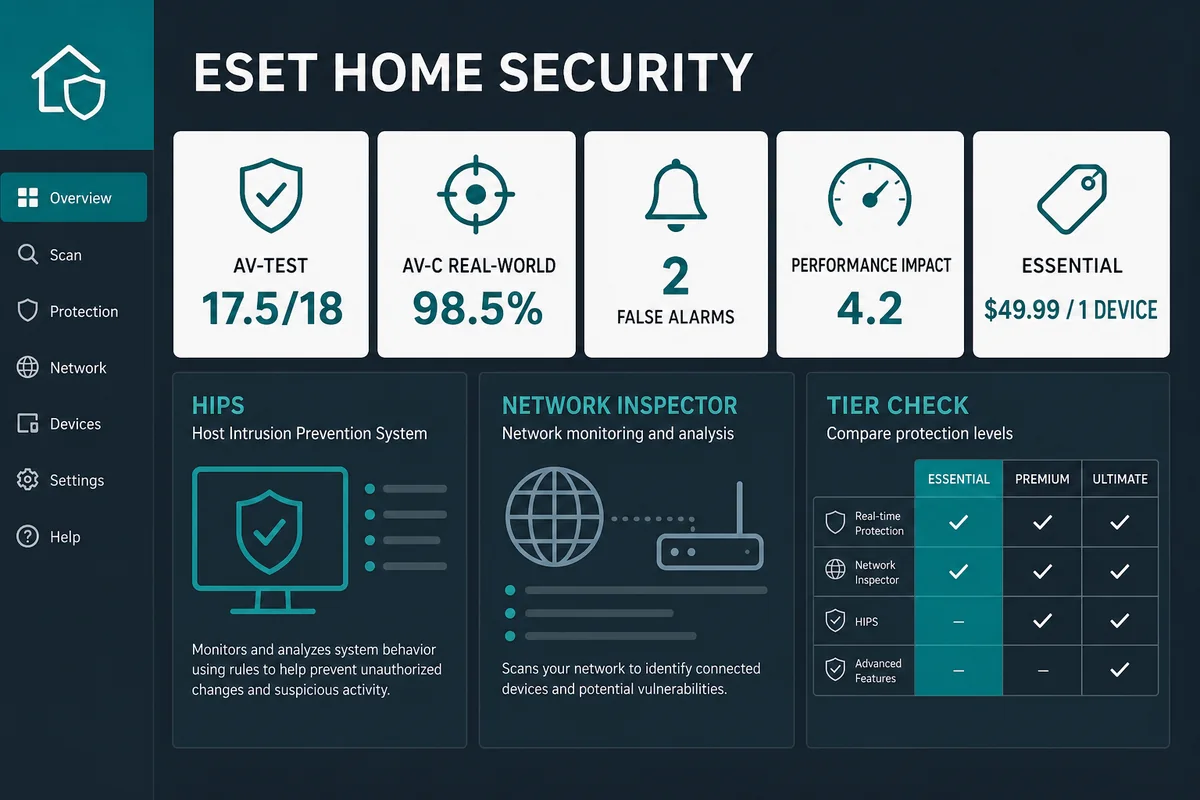
Our verdict: ESET HOME Security is safe and technically excellent, but “ESET is always the lightest and catches everything” is too simple. April AV-TEST gave it 17.5/18, while AV-Comparatives measured a low 4.2 impact score and 98.5% protection in its completed real-world cycle. HOME Security Essential is the best value for most buyers who want firewall, banking, network and anti-theft controls. Premium makes sense for LiveGuard, Folder Guard, encryption and VPN. Ultimate is expensive and earns its price only when ransomware remediation, wider VPN access and eligible US identity services matter. Our editorial score is 8.8/10.
Need a different ESET task? The complete ESET guide hub routes review, plans, setup, banking, troubleshooting, firewall and HTTPS, Android, VPN, password migration, billing and removal without mixing their steps.
- Full protection/usability marks in current AV-TEST cycle
- Only two false alarms in the latest 400-case AV-C real-world test
- Low 4.2 performance impact on AV-Comparatives' low-end PC
- Excellent granular controls, HIPS, firewall and network inspection
- Flexible device counts instead of one fixed household bundle
- Essential trailed the top real-world group at 98.5%
- Ultimate alone includes automatic ransomware remediation
- Premium VPN can cover fewer devices than the security subscription
- Password Manager ended new sales; the standalone Android Parental Control app and portal ended
- Advanced controls can create prompts or weaken protection when misconfigured
ESET HOME Security at a glance
ESET sells subscription tiers called HOME Security Essential, Premium and Ultimate. Those subscriptions activate platform-specific applications. A Windows installation may still identify itself as ESET Internet Security, ESET Smart Security Premium or ESET Security Ultimate. NOD32 Antivirus remains available separately for people who want the core Windows/macOS engine without all HOME features. The subscription name, installed-app name and familiar “NOD32” engine name are related but not interchangeable.
ESET is based in Bratislava, Slovakia and isn't part of Gen Digital's Norton/Avast/AVG/Avira group. That makes it a meaningful alternative for someone seeking different corporate ownership and a different engine. Its product identity is also distinct: fewer bundled storage/identity/family services than Norton, but much deeper Windows control than many one-click suites.
The best current plan depends on the protection layer you actually need. Essential already includes real-time antivirus, anti-phishing, secured banking/browsing, firewall, Network Inspector, webcam/microphone controls and anti-theft where supported. Premium adds ESET LiveGuard cloud sandboxing, Folder Guard, encryption and VPN. Ultimate adds Ransomware Remediation, expanded VPN/router capabilities, privacy tools and identity protection in eligible markets.
ESET lab results in 2026
Current tests cover two different retail points. AV-TEST evaluated ESET Security Ultimate 19.0/19.1. AV-Comparatives used HOME Security Essential 19.x in its real-world and performance work. That distinction is valuable: the expensive tier earned strong AV-TEST marks, while the least expensive HOME tier still received current web-threat, malware and speed scrutiny.
| Independent test | Product / period | ESET result | What it tells us |
|---|---|---|---|
| AV-TEST Windows 11 | Security Ultimate 19.0/19.1 March–April 2026 | 6/6 protection 5.5/6 performance 6/6 usability 17.5/18 | Top Product result, but not the perfect 18/18 some summaries imply. |
| AV-C Real-World Protection | HOME Security Essential 19.x February–May 2026 | 98.5% protected 394 blocked / 6 compromised 2 false alarms | Very low false-alarm burden, but six web-delivered cases succeeded and ESET sat in the second protection cluster. |
| AV-C Malware Protection | HOME Security Essential 19.0 March 2026 / 10,000 cases | 96.4% offline detection 96.7% online detection 99.93% online protection 16 false alarms | Behavior/execution layers materially improved the outcome; local detection wasn't the final result. |
| AV-C Performance | HOME Security Essential 19.1 April 2026 | Impact: 4.2 AV-C 90 / Procyon 95.8 | Third-lightest combined result in this cycle, behind McAfee and Kaspersky. |
Protection and false alarms pull in different directions
ESET blocked fewer real-world cases than Kaspersky, Bitdefender, Avast, AVG, Norton, Microsoft and TotalAV. It also generated only two false alarms—better than every product except Defender and Total Defense. Someone installing niche utilities or in-house software may prefer that restraint. Someone who wants the highest raw result from this one cycle will prefer Kaspersky or Bitdefender. The 400-case sample is too small to claim a permanent hierarchy from a one- or two-case gap.
The March malware test explains ESET's layered model
Initial online detection was 96.7%, but final online protection reached 99.93%. HIPS, behavior monitoring and other execution layers prevented most of what initial scanning didn't label. Sixteen false alarms in the separate clean-file set aren't trivial, though still within the lab's “many” range rather than the worst group. Don't confuse that 10,000-malware test with the two false alarms from the separate 400-case real-world study.
“ESET is always the lightest” is now too broad
The April impact score of 4.2 is excellent. McAfee scored 3.3 and Kaspersky 3.5 in the same low-end test, while Norton, Avast and AVG were close behind ESET. Product versions and workloads change. The honest claim is that ESET remains in the lightest current group—not that it must win every performance chart.

ESET Essential vs Premium vs Ultimate
The official 2026 HOME Security page lets US buyers choose one to ten devices for Essential/Premium. Ultimate starts at five devices in the current source. Feature names marked Premium or Ultimate are the clearest way to understand the upgrade, because old ESET Internet Security and Smart Security Premium reviews no longer map cleanly to today's subscription.
| Tier | Key additions | Best fit | Important limits |
|---|---|---|---|
| Essential | Core antivirus, Ransomware Shield, HIPS, firewall, anti-phishing, secured banking/browsing, webcam/mic, Network Inspector, anti-theft. | Windows-focused users who want strong configurable security without VPN/identity extras. | No LiveGuard premium, Folder Guard, Secure Data encryption, VPN or automatic ransomware remediation. |
| Premium | Essential plus LiveGuard cloud analysis, Folder Guard, Secure Data encryption and unlimited-traffic VPN. | Users who will configure stronger file/folder controls or need a modest VPN allowance. | For subscriptions covering up to 10 devices, VPN is only up to three devices; no Ransomware Remediation. |
| Ultimate | Premium plus Ransomware Remediation, Website Settings Review, Metadata Cleanup, wider VPN/router scope and eligible identity protection. | Five-plus-device household that values recovery and US identity services. | Starts at $179.99/5 devices in current US source; identity features are country-specific. |
| NOD32 Antivirus | Core antivirus/antispyware, Ransomware Shield, HIPS, SysInspector, anti-phishing and gamer controls. | One Windows or Mac user who wants ESET's engine with fewer HOME layers. | No HOME-tier firewall, safe banking, Network Inspector, webcam, VPN or identity features. |
Password Manager isn't a normal new Premium feature
Older reviews list ESET Password Manager as a reason to buy Premium. ESET's current HOME help says new sales ended October 21, 2025. Customers who activated an eligible annual subscription before that date may continue to activate and use it until the applicable subscription period ends. A new July 2026 buyer shouldn't count it in the package and should choose a standalone password manager if needed.
The standalone Android Parental Control app ended June 30, 2026
ESET discontinued its standalone Parental Control for Android app and web portal on June 30, 2026. The same official notice says the Windows Parental Control feature continues in ESET Security Ultimate, Smart Security Premium and Internet Security. That's narrower than saying every ESET parental-control function ended: verify the installed Windows product and platform instead of relying on an old bundle table.
Unlimited VPN traffic isn't unlimited VPN devices
Premium advertises unlimited traffic, but the device allowance is separate. ESET says Premium subscriptions protecting up to 10 devices provide VPN for up to three devices; larger Premium subscriptions can reach five. Ultimate provides up to 10 VPN devices when the security subscription protects up to 10, or up to 25 for larger configurations. Count the people and endpoints that need VPN before paying.
ESET current US pricing and renewal caveats
ESET's July 23 US page embeds one-year device prices rather than a single plan sticker. Essential was $49.99 for one device, $59.99 for three, $69.99 for five and $94.99 for ten. Premium was $79.99, $89.99, $99.99 and $124.99 for the same device counts. Ultimate began at five devices for $179.99 and reached $204.99 for ten.
| Plan / one year | 1 device | 3 devices | 5 devices | 10 devices |
|---|---|---|---|---|
| HOME Security Essential | $49.99 | $59.99 | $69.99 | $94.99 |
| HOME Security Premium | $79.99 | $89.99 | $99.99 | $124.99 |
| HOME Security Ultimate | Not offered | Not offered | $179.99 | $204.99 |
These are a current source snapshot, not a permanent price promise. ESET states that displayed pricing is valid for the first term and that future price is subject to change, with an advance email. Unlike Avast/AVG/Norton pages that expose a specific renewal amount, the current ESET page doesn't give us one stable renewal number to publish. Check the order screen and subscription account before renewal.
Device flexibility is a genuine advantage. Moving Essential from one to five devices adds $20, rather than multiplying the one-device price. Premium adds $30 over Essential at one/five devices. Ultimate adds $80 over five-device Premium. That last step needs a concrete recovery/VPN/identity justification.
ESET advertises a 30-day free trial without a credit card and a 30-day return policy. Auto-renew can be disabled in Subscription Management without ending protection early; service continues until expiration. Extra devices can be added on a prorated basis. Regional licenses, taxes and identity-service eligibility can change the offer, so buy from the correct country store.

ESET protection: HIPS, LiveGrid, LiveGuard and safe banking
LiveGrid and layered detection
ESET combines signatures, machine learning, cloud reputation through LiveGrid, exploit defense, behavior monitoring and HIPS. Current lab results show why the layers matter: initial detection didn't reach the final 99.93% online protection figure. Keep cloud reputation and module updates working; a disconnected or heavily excluded machine isn't the lab setup.
HIPS is powerful—and easy to misuse
The Host-based Intrusion Prevention System monitors process behavior and can enforce detailed rules. In Automatic mode, ESET makes most decisions quietly. Smart/Interactive modes can expose more prompts. A technical user may value application/process control; a normal household can train itself to click Allow on every interruption and end up less protected.
Don't copy a “maximum security” HIPS ruleset from a forum without understanding its processes, paths and update behavior. Start with defaults, export configuration before experiments and change one rule at a time. A vendor update can legitimately change a signed executable's path or behavior.
Potentially unwanted/unsafe application settings need context
ESET distinguishes malware, potentially unwanted applications, potentially unsafe administrative tools and suspicious applications. The current support guide exposes separate reporting/protection controls. An aggressive setting can flag remote administration, password recovery or bundled installers; disabling the category entirely can hide adware and low-quality software. Review the exact detection and source instead of using a global exception.
Firewall and Network Inspector
Essential includes a two-way firewall and Network Inspector on supported Windows configurations. Automatic filtering is the sensible default for most people. Interactive firewall mode may produce the burst of prompts described in community reports, especially after installation or an application update. Use it only if you can identify processes, ports and destinations.
Network Inspector can inventory devices and router weaknesses. An unknown name isn't proof of an intruder: private MAC addresses, smart TVs and guests often have poor labels. Match the device in the router, patch firmware, remove default credentials and disable exposed administration. ESET can't make an unsupported router secure through a scan.
Safe Banking, anti-phishing and browser controls
Safe Banking/secured browsing isolates or hardens supported financial sessions. Anti-phishing blocks known fraudulent sites. These layers reduce risk but can't validate every newly created impersonation domain or prevent an authorized bank transfer to a scammer. Use bookmarks, unique passwords, passkeys/MFA and transaction alerts.

ESET ransomware protection: prevention isn't remediation
All current tiers include Ransomware Shield, which monitors behavior and blocks suspected encryption activity. Premium adds Folder Guard so only trusted applications can modify selected folders. Ultimate adds Ransomware Remediation, which ESET describes as automatically creating backups during an attack and restoring data when encryption slips through.
That distinction triggered current community criticism because users assumed “ransomware protection” included rollback at lower tiers. ESET didn't remove all ransomware defense from Essential/Premium: Shield prevention remains. It did reserve an additional recovery layer for Ultimate. Marketing and reviews should say exactly which one they mean.
| Layer | Essential | Premium | Ultimate | What it can't promise |
|---|---|---|---|---|
| Ransomware Shield | Yes | Yes | Yes | Perfect recognition of every new technique. |
| Folder Guard | No | Yes | Yes | That every legitimate editor/backup tool works without testing. |
| Ransomware Remediation | No | No | Yes | Recovery after disk failure, account takeover or damage outside its backup scope. |
| Independent backup | Your responsibility | Must be versioned, isolated and restore-tested. | ||
Even Ultimate doesn't replace a normal backup. Recovery copies created during an attack live inside the same operating environment and depend on the feature's detection/timing. Maintain at least one versioned backup that malware and a stolen cloud account can't rewrite. Restore a file before you need it.

Performance and recommended ESET configuration
AV-Comparatives' 4.2 impact score and 95.8 Procyon Office score support ESET's low-impact reputation. AV-TEST's 5.5/6 performance mark adds a useful counterweight: it was very good, not perfect, under that lab's workloads. The two results are compatible because protocols, tasks and scoring differ.
A recovered editorial log from the lost June page claimed 90–120 MB idle memory and 8–14% scan CPU on one mid-range i5 laptop. That observation is plausible and useful as a trial reference, but it isn't a controlled promise for current 19.1 builds, your file set or your device. We give independent lab measurements more weight.
- Remove another real-time antivirus. Don't force two file-system filters to inspect every action.
- Install the right activated product. Confirm the HOME tier and device entitlement in ESET HOME instead of judging the installed app name alone.
- Keep LiveGrid, modules and OS updates current. Cloud reputation and behavior layers are part of the tested outcome.
- Leave HIPS and firewall on Automatic initially. Switch modes only with a defined rule-management goal.
- Enable PUA reporting deliberately. Review borderline detections; don't globally disable them after one bundled installer.
- Test Folder Guard if Premium/Ultimate. Verify trusted editors, sync and backup tools can write before broad rollout.
- Use Gamer Mode thoughtfully. Suppress interruptions during fullscreen work, but don't postpone updates and scans forever.
- Keep exclusions narrow. Never exclude Downloads, a whole drive, scripts or a full user profile to chase benchmark numbers.
Developers and gamers should test a build tree/game library rather than trusting the brand's historic “lightweight” label. If scanning causes a spike, identify the exact path, schedule heavy scanning and consider the narrowest reviewed exception. Dependency folders and mods can execute code; convenience changes the threat boundary.
ESET on Windows, macOS, Android and iOS
ESET HOME Security protects Windows, macOS and Android with platform-specific applications. The same subscription count doesn't make features identical. Windows receives the richest HIPS/firewall/banking/folder/remediation stack. macOS has antivirus, web/email, anti-phishing and firewall capabilities with relevant VPN/identity additions. Android includes app scanning, anti-theft, App Lock, Payment Protection and anti-phishing depending on tier.
ESET doesn't provide antivirus for iPhone or iPad. Its official page says selected privacy and identity features can be used on iOS; the VPN supports iOS 13+ and ESET HOME itself supports iOS 16+. That isn't system-wide malware scanning. If iPhone security is central to a bundle comparison, evaluate account/web/VPN services rather than pretending any vendor scans iOS like Windows.
Essential/Premium can be purchased for a flexible device count. VPN allowances are their own count. A five-device Premium security subscription can therefore protect five endpoints but offer VPN activation for only three. Ultimate covers up to 10 VPN devices when purchased for up to 10 protected devices. Router VPN requires compatible OpenVPN/WireGuard client hardware and sufficient CPU; it isn't a universal one-click feature.
ESET NOD32 supports current Windows 10/11 and macOS 13+ according to the official page, but some Windows-on-ARM features are limited. Windows 10 normal support has ended; antivirus can't replace operating-system patches. Use consumer ESU only as a short transition and move to a supported OS.
What current ESET users praise—and question
Current r/antivirus discussions still praise ESET for low background impact, granular settings and an interface that doesn't constantly sell unrelated utilities. People choosing between ESET and Bitdefender often frame ESET as the control/lightness option. The April performance test supports “light group,” though it doesn't support the absolute claim that nothing else can be lighter.
The criticism is unusually specific. March discussions objected to Ransomware Remediation sitting only in Ultimate, and a plan-review thread complained that a multi-device Premium subscription could provide VPN for fewer devices. Others report firewall prompts; those are often associated with interactive rule mode or initial learning rather than proof that every default install is noisy. Support satisfaction varies.
False-positive discussions also need proportional treatment. ESET generated only two in the current real-world study but 16 in the separate malware-test clean set. Current r/ESET posts show specific detections later corrected. One incident isn't the product's general rate; the two lab protocols aren't interchangeable. Submit a suspected false positive and use a narrow temporary exception only after independent verification.
Who should use ESET—and who should choose another suite
- You value low impact and very few real-world false alarms
- You want HIPS, firewall and detection controls you can inspect
- You prefer security-first software over a broad lifestyle bundle
- You need a flexible one-to-ten-device Essential/Premium license
- You want a non-Gen-Digital engine and owner
- You want a strong permanent free tier such as Defender or Avast
- You need simple parental controls—the ESET feature has ended
- You expect VPN on every device in a Premium multi-device plan
- You want ransomware rollback without paying for a five-device Ultimate plan
- You want the simplest one-click family dashboard and support bundle
For a technically comfortable Windows user, Essential is the clear recommendation. Premium is worthwhile when LiveGuard, Folder Guard, encryption or three-device VPN access changes the workflow. Ultimate is a niche purchase: a five-device minimum at $179.99 can make sense for a US household using identity recovery and up to 10 VPN endpoints, but it's poor value as a generic “best protection” badge.
ESET vs Bitdefender, Defender, Norton, Avast and Malwarebytes
| Option | Choose it for | Main trade-off against ESET | Read next |
|---|---|---|---|
| ESET Essential | Granular, low-impact paid protection with flexible device counts. | No permanent free tier; no Premium/Ultimate recovery/privacy additions. | ESET vs Bitdefender |
| Bitdefender | Higher 99.5% current real-world result and smoother defaults. | More product/plan complexity; current impact 9.6 versus ESET 4.2. | Bitdefender review |
| Microsoft Defender | Strong built-in Windows protection for $0 with zero current real-world false alarms. | Fewer guided HIPS/network controls and no ESET-style multi-platform plan. | Defender review |
| Norton 360 | VPN, password manager, parental tools and Windows cloud backup in one bundle. | Higher renewal, promotion complaints and less control-focused interface. | Norton review |
| Avast Free | Excellent no-cost engine and easy dedicated dashboard. | Product offers and specific FTC/privacy trust history. | Avast review |
| Malwarebytes | Familiar cleanup and second-opinion workflow. | 98.8% current real-world protection but 39 false alarms and impact 17.6. | Malwarebytes review |
ESET's clearest edge isn't the highest single protection percentage. It's the combination of low task impact, low real-world false alarms, deep controls, independent ownership and flexible device pricing. Bitdefender wins the current raw web-threat comparison; Defender wins free simplicity; Norton wins bundle breadth.
Frequently asked questions about ESET
Is ESET good and safe in 2026?
Yes. ESET is legitimate security software with strong current evidence: 17.5/18 at AV-TEST, a low 4.2 AV-Comparatives performance-impact score and 98.5% protection with only two false alarms in the February–May real-world test. It's best for users who value low impact and granular control.
Which ESET plan is best: Essential, Premium or Ultimate?
Essential is the best value for most buyers because it includes core antivirus, firewall, anti-phishing, safe banking, network and privacy controls. Premium adds LiveGuard, Folder Guard, encryption and VPN. Ultimate adds ransomware remediation, wider VPN/router features and eligible identity protection, but begins at five devices and a much higher price.
Is ESET NOD32 Antivirus still available?
Yes. ESET still sells NOD32 Antivirus separately. Its technology also sits at the core of HOME Security plans. NOD32 provides core antivirus, HIPS, Ransomware Shield and anti-phishing, but HOME Essential adds firewall, safe banking, Network Inspector, webcam, anti-theft and other layers.
Is ESET the lightest antivirus?
ESET remains in the lightest current group, but it didn't win every 2026 test. AV-Comparatives measured impact 4.2 in April, third behind McAfee at 3.3 and Kaspersky at 3.5. AV-TEST gave ESET 5.5/6 for performance. Test the exact workload rather than relying on an absolute reputation.
Does ESET Premium include VPN on every protected device?
Not necessarily. ESET says Premium subscriptions protecting up to 10 devices provide VPN for up to three devices; larger Premium configurations can reach five. Ultimate provides VPN for up to 10 devices when protecting up to 10. “Unlimited” describes traffic, not automatically the number of VPN activations.
Does ESET protect against and recover from ransomware?
All HOME tiers include Ransomware Shield prevention. Premium adds Folder Guard. Automatic Ransomware Remediation with attack-time backup and restoration is Ultimate-only. None replaces an independent, versioned and restore-tested backup that malware or a stolen account can't rewrite.
Does ESET include Password Manager and parental controls?
A normal new July 2026 purchase shouldn't count on Password Manager: new sales ended October 21, 2025, though eligible older annual subscriptions may retain it for their period. The standalone Parental Control Android app and web portal ended June 30, 2026, but ESET says the Windows Parental Control feature continues in Security Ultimate, Smart Security Premium and Internet Security.
Does ESET have antivirus for iPhone and iPad?
No. ESET explicitly says it doesn't provide an iOS antivirus solution. Selected privacy and identity features can work on iPhone/iPad, and ESET VPN supports compatible iOS versions. That isn't the same as Windows/macOS/Android malware scanning.
Final verdict: buy ESET for control, not for every extra
ESET remains one of the strongest paid choices for a technically comfortable user. Current evidence is nuanced but favorable: 17.5/18 at AV-TEST, 98.5% real-world protection with only two false alarms, 99.93% final online malware protection and an excellent 4.2 impact score. The product rewards careful configuration without forcing a VPN, cleanup utility and identity service into the base price.
The 2026 lineup needs sharper shopping. Essential is $49.99 for one device or $69.99 for five in the current US source and contains the features that define ESET. Premium costs $30 more at those counts, but its VPN may cover only three devices. Ultimate begins at $179.99 for five and reserves automatic ransomware remediation and eligible identity services. Password Manager shouldn't appear on a normal new-client feature list; the standalone Android Parental Control app and portal ended, while the named Windows feature continues.
Bottom line: choose HOME Security Essential for low-impact, low-false-positive, configurable security. Upgrade to Premium only for LiveGuard, Folder Guard, encryption or its VPN allowance. Buy Ultimate only when recovery, expanded VPN/router use and eligible US identity services justify the five-device price. Choose Defender for free simplicity or Bitdefender when the current raw protection lead matters more than ESET's control and lighter impact.
Continue your antivirus comparison
Compare the current shortlist in our best antivirus software guide, browse the product directory, read ESET versus Bitdefender, or see how we separate lab results, recovered tests and community evidence.