
PCProtect Review 2026: €99 Price, Old Lab Evidence
PCProtect is active, legitimate security software with a transparent 2026 price matrix. Its latest product-specific controlled test is from October 2023—and it missed 59 of 1,930 malicious files.
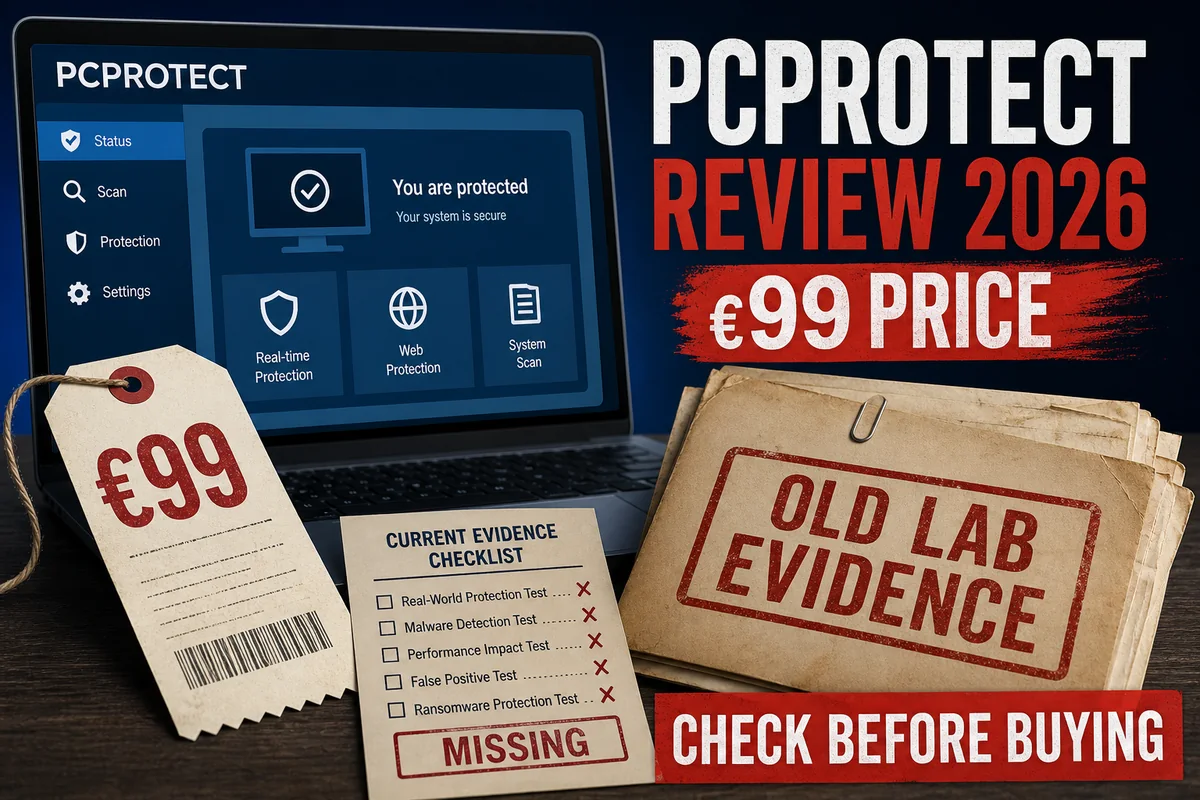
Our verdict: PCProtect is a real antivirus product, not an imaginary download or a protection score borrowed from another brand. Its latest product-specific Virus Bulletin test detected 96.94% of the malicious set, missed 59 of 1,930 files and made zero false alarms across 100,000 clean files. The problem is time: that test ran in October 2023, Virus Bulletin now marks PCProtect “not currently certified,” and we found no current PCProtect result from AV-TEST, AV-Comparatives or SE Labs. The official 2026 matrix lists PC Protect Premium at €99/year for three devices; VPN, unlimited protection and other services can renew separately. We rate it 6.2/10. Existing users can keep it if the exact renewal and local behavior work for them, but a new full-price buyer has better-documented choices.
- Current storefront, legal pages, support center and exact 2026 subscription matrix
- Real-time antivirus, WebShield and scheduled/on-demand scanning for desktop
- Zero false alarms across 100,000 clean files in both 2023 VB100 cycles
- Excellent 99.69% detection in the July 2023 VB100 test
- Portal-based subscription management and documented refund windows
- Official disclosures explain the Avira scanning and VPN-provider relationships
- No current 2026 product-specific result from a major independent lab
- Latest VB100 test missed 59 of 1,930 malicious files and received grade B
- Virus Bulletin lists PCProtect as not currently certified
- €99 annual base price covers three devices, while important extras can bill separately
- Official Windows and Mac requirement pages don't fully agree with the storefront
- Windows on ARM is explicitly unsupported
PCProtect at a glance
PCProtect is consumer security software sold through Total Security entities, now part of the Point Wild group. The current storefront calls the product PC Protect Security 2026, while the binding subscription matrix names the new-purchase base plan PC Protect Premium. That naming difference is less important than the entitlement: the current EUR matrix says three devices, with monthly, biannual and annual billing choices.
The product advertises real-time desktop antivirus, WebShield filtering, deep and custom scans, scheduled scanning, cloud classification, tune-up tools and gaming mode. A broader help page also discusses multi-device protection, breach monitoring, VPN, password, ad-blocking and mobile features. Those entries aren't proof that every service is included. The pricing matrix and terms identify many of them as independent subscriptions.
| Buyer question | Evidence-checked answer |
|---|---|
| Is PCProtect legitimate? | Yes. It has an active 2026 storefront, current legal/support pages, an exact price matrix and historical product-specific lab tests. |
| How current is the lab evidence? | The newest controlled product-specific result we found was Virus Bulletin in October 2023. |
| How did it perform? | 96.94% detected, 59 of 1,930 malicious files missed and zero false alarms across 100,000 clean files. |
| Is it currently VB100-certified? | No. The Virus Bulletin archive marks PCProtect not currently certified, status last updated April 23, 2024. |
| Current base price? | €9.99 monthly, €59 biannual or €99 annual for three devices in the 2026 EUR matrix. |
| Is the VPN included? | Don't assume so. Safe Browsing VPN is listed as a separate €99/year additional service. |
| Platforms? | Windows and macOS are the desktop focus; help also mentions iOS, Android and Fire HD. Feature parity varies. |
| Our rating? | 6.2/10 from one named editor, not a customer-review aggregate. |
The recovered page answered a 2022 question with a dollar-denominated Offer that expired in 2021. We removed that Offer, the old affiliate route and the stale product-year framing. A current review should tell a buyer what can be verified today and put an explicit date beside every volatile commercial fact.
PCProtect’s two 2023 VB100 results tell different stories
The latest product-specific controlled test we found is Virus Bulletin’s October 2023 PCProtect report. PCProtect v5.23.174 ran on Windows 10 Pro N under VB100 methodology 1.4. It detected 1,871 of 1,930 malicious Windows files, missed 59 and achieved 96.94%. It made no false alarms across 100,000 clean files and passed with detection grade B.
Three months earlier, the result was much stronger. The July 2023 PCProtect report tested v5.22.37. It detected 2,241 of 2,248 malicious files, missed seven, scored 99.69% and again made zero false alarms across 100,000 clean files. That produced grade A+.
| VB100 measure | July 4, 2023 | October 4, 2023 |
|---|---|---|
| Product build | PCProtect v5.22.37 | PCProtect v5.23.174 |
| Malicious cases | 2,248 | 1,930 |
| Detected | 2,241 | 1,871 |
| Missed | 7 | 59 |
| Detection rate | 99.69% | 96.94% |
| Clean cases | 100,000 | 100,000 |
| False alarms | 0 (0.000%) | 0 (0.000%) |
| Grade / result | A+ / pass | B / pass |
The later deterioration deserves weight, but it shouldn't be oversimplified as a measured 2023 “engine decline.” The malicious sets differed, threat prevalence changes and VB100’s test is file-focused rather than a full attack-chain simulation. The precise conclusion is narrower: PCProtect passed both cycles and showed excellent clean-file handling, but the two detection outcomes were inconsistent enough that we want newer, repeated evidence before calling protection top-tier.
A VB100 pass also wasn't synonymous with perfect protection. Under methodology 1.4, the product needed at least 75% detection and no more than 0.05% false alarms. PCProtect comfortably passed, but a minimum certification threshold doesn't erase 59 missed files. Our rating uses the raw counts, age and evidence breadth—not the pass badge alone.

PCProtect isn't currently certified—and has no current major-lab score
The Virus Bulletin product archive lists PCProtect under Protected.net as not currently certified, with status last updated April 23, 2024. That phrase doesn't mean the application failed every subsequent test. It means buyers can't treat the 2023 certificate as a current certification.
We also found no PCProtect entry in AV-TEST’s current Home Windows results, AV-Comparatives’ current consumer series or SE Labs’ current home anti-malware reports. Lab absence isn't proof of poor protection; vendors and labs choose participation. It's an evidence gap. The responsible answer to an absent score is “not currently demonstrated here,” not a guess.
This boundary corrects two opposite search-result errors. Older reviews sometimes say PCProtect has never been tested; that ignores Virus Bulletin. Other pages claim excellent current protection by referring to TotalAV or Avira; that assigns evidence to a product the lab didn't name. PCProtect has historical evidence, but not enough current evidence for a 2026 protection leadership claim.
The Avira relationship is disclosed, but Avira scores don't transfer
PCProtect’s current third-party disclosure lists Avira Operations GmbH for scanning data for malicious or suspicious content. The page says no personal data is transferred for that function and that the data is stored and processed in the European Union. That's solid evidence of a current Avira scanning-processor relationship.
It doesn't establish that PCProtect is “just Avira,” uses an identical build or inherits Avira’s score. A consumer suite can add its own cloud lookup, URL filtering, behavior decisions, quarantine, remediation, defaults and release cadence around a scanning service. Virus Bulletin tested PCProtect builds and recorded PCProtect outcomes. Those are the numbers this review uses.
The same rule applies to TotalAV and Scanguard. Corporate relationships and shared service providers are relevant when comparing account systems, billing design and privacy. They aren't a shortcut around product-specific testing. If a comparison page says PCProtect catches 100% because a sibling brand did, ask for the report that names PCProtect and its tested build.
What PC Protect Premium actually does
The current official pricing page centers on real-time malware protection, WebShield filtering, scheduled and on-demand deep scans, custom scans, tune-up tools and a gaming mode. Real-time protection and WebShield are identified as desktop features. Cleanup can be convenient, but it shouldn't be counted as another malware-defense layer, and speed improvements depend on what the tool finds.
PCProtect’s feature help adds advanced cloud scanning and remediation, manual/scheduled scan controls, breach monitoring and related account services. The distinction between capability and entitlement matters. A tool can exist in the PCProtect ecosystem while requiring an additional subscription. Use the final order summary and the subscription matrix—not the navigation menu—to decide what your plan includes.
| Capability | What current documentation supports | Buyer check |
|---|---|---|
| Real-time antivirus | Core desktop protection in PC Protect Premium | Verify it's active after installation and that no conflicting real-time suite remains. |
| WebShield | Desktop filtering for malicious/phishing web destinations | Check browser support, extension state and whether HTTPS filtering changes local behavior. |
| Deep/custom/scheduled scans | Advertised core scanning controls | Run a first full scan, then schedule it when the device is normally on. |
| Cloud scanning/remediation | Documented in help; Advanced Cloud Scanning also appears as a priced service | Confirm the exact base entitlement before assuming the paid add-on is included. |
| Tune-up/startup tools | Advertised utilities with conditional benefit | Review every deletion; cleanup isn't a substitute for backup or malware prevention. |
| Gaming mode | Advertised to reduce interruptions | Confirm protection remains active rather than disabling essential layers. |
| Breach monitoring | Available in the wider account/service set | A warning identifies exposure; it can't remove leaked data or replace a password change. |
PCProtect’s strongest feature case is simplicity: one interface for basic antivirus, web filtering and routine scans. Its weakest case is bundle clarity. Buyers who need VPN, passwords, family coverage or identity features should calculate the final basket rather than treating the help-center feature list as a single suite.
VPN, unlimited devices and other services can bill separately
The current subscription matrix is unusually valuable because it names and prices separate services. Safe Browsing VPN is €99/year, as is Unlimited Protection. Advanced Cloud Scanning is €45/year; Total Password is €99; Family Protection 5 is €69; Identity Theft Protection is €80; Ad Block Pro is €59. Device and optimizer services have their own prices too.
A shared account doesn't merge those lines into one subscription. Current terms say services and add-ons may be billed, canceled, terminated and refunded independently. Canceling the antivirus doesn't automatically cancel the VPN. Uninstalling an app changes neither subscription. A buyer who sees “VPN” or “password” in the dashboard should verify whether it's included, a trial or a separately renewing purchase.
| Additional service | 2026 EUR annual matrix price | Entitlement note |
|---|---|---|
| Unlimited Protection | €99 | Additional service; don't confuse with the three-device base plan. |
| Safe Browsing VPN | €99 | Separate service unless the final checkout explicitly bundles it. |
| Advanced Cloud Scanning | €45 | Separately priced despite cloud scanning language in feature help. |
| Total Password | €99 | Separate password-management subscription. |
| Family Protection 5 | €69 | Check whether “5” describes covered profiles/devices in your order. |
| Smartphone Optimizer 1 | €20 | Mobile utility, not desktop malware coverage. |
| Home Protection 3 | €49 | Separate service; verify the exact scope in checkout. |
| Additional Device 1 | €40 | One-device extension to the base entitlement. |
| Identity Theft Protection | €80 | Availability and benefits can vary by region. |
| Ad Block Pro | €59 | Ad blocking isn't equivalent to antivirus or phishing protection. |
At matrix prices, PCProtect plus VPN would total €198/year before any other service. Add unlimited protection and the list-price basket reaches €297/year. A promotion may lower the first charge, but it doesn't make those lines one contract. Save the basket, the order confirmation and the portal’s next-charge screen.

Windows, Mac and mobile support: verify the exact installer
Current official materials don't align cleanly. Storefront footnotes say Windows 7+ and macOS 10.13+. The system-requirements page oddly lists Windows 7 SP1, 8, 8.1 and Server 2016/2019 while omitting Windows 10 and 11—even though the 2023 lab used Windows 10. The same help page explicitly says ARM-based Windows devices aren't supported.
For Windows, the page lists 2GB RAM, 1.5GB free disk, administrative rights, internet access and an old Pentium 4/Athlon 64 performance floor. For Mac, it lists Catalina 10.15 through Tahoe 26, Intel Core 2 Duo or Apple M1+, 2GB RAM, 1.5GB disk, Safari 13.1.2+ and possible Rosetta 2 installation. Storefront and support version floors differ, so neither should be copied into a simple “works everywhere” claim.
Feature help also mentions iOS, Android and Fire HD. Mobile availability doesn't imply desktop-equivalent real-time scanning; platform security models and app permissions differ. Check the app-store listing, current OS requirement, device count and the precise feature before paying. Don't keep Windows 7 or 8 online because the antivirus vendor still names it—unsupported operating systems remain a structural security risk.
Performance and protection should be tested safely on your device
PCProtect’s current major-lab performance data is too thin for a universal CPU, memory or battery claim. The old recovered article and competing reviews quote scan times from different builds, devices and years. Those numbers aren't transferable to a 2026 laptop. What matters is the change from your own clean baseline after the current installer, definitions and web component are active.
Measure restart time, browser launch, a trusted application install, a large local file copy and the first versus second full scan. Watch for overlapping real-time engines, because running two third-party antivirus suites can cause more slowdown and instability than either product alone. On a laptop, include unplugged battery behavior and video-call responsiveness.
For a harmless protection check, use the official EICAR anti-malware test file. It's designed to trigger antivirus without containing live malware. Test the normal download path, on-demand scan and quarantine/restore flow. Never download active malware to prove a point, and don't disable browser or operating-system safety controls to recreate an old reviewer’s experiment.
Historical hands-on evidence can guide the checklist, not determine the verdict. A 2022 review reported that four EICAR downloads passed real-time checks and were later found on demand. That behavior may have changed across many product versions. If the current PCProtect build doesn't intercept the official test in the protection path you expect, ask support for the intended configuration or use another product.

PCProtect price in 2026: €99/year for three devices
The official subscription pricing matrix, effective January 5, 2026, identifies the base new-purchase plan as PC Protect Premium for three devices. Its EUR rows list €9.99 monthly, €59 biannual and €99 annual. The quarterly cell is blank. Those are regular matrix prices, not a promise that every visitor will see the same promotional checkout, currency or tax.
The annual term is slightly cheaper than twelve monthly charges (€119.88) but requires a longer commitment. The six-month term annualizes to €118. The appropriate comparison isn't just first charge: divide the complete recurring basket by covered devices and include the services you'd actually keep.
| Base plan term | 2026 EUR matrix price | Effective annual amount | Practical trade-off |
|---|---|---|---|
| Monthly | €9.99/month | €119.88 over 12 months | Shortest commitment; 14-day refund window applies to monthly plans. |
| Biannual | €59/6 months | €118 if renewed twice | Longer commitment without the annual discount. |
| Annual | €99/year | €99 | Lowest regular annualized base cost; 30-day refund window. |
The matrix also contains legacy/reactivation rows. PC Protect Security from 2024–2025 lists four devices and up to €149/year; PC Security from 2019–2024 lists three devices and up to €149/year. Those plans aren't new-purchase offers, but they explain why an existing customer can see a different renewal, device count or product label. The portal and confirmation for that specific account outrank a generic review table.
Promotions and renewal: record the amount before paying
PCProtect supports introductory campaigns, while subscriptions auto-renew at the current regular rate unless canceled. A first-period discount should be treated as a temporary acquisition price. The decision price is the next charge shown in checkout, the confirmation email and My Subscriptions. If those disagree, resolve it with support while the refund clock is still open.
Current terms say annual and multi-year renewal notice may be sent up to 30 days before renewal; monthly plans don't receive the same notice. They instruct customers to cancel at least one day before the billing-cycle end, and a trial should be canceled at least 24 hours before it expires. Set an independent calendar reminder rather than relying on a message surviving spam filters.
The checkout risk comes from multiplication, not one surprising number. Antivirus, VPN, unlimited devices, password management and identity services can each have a cycle and renewal. A unified account may show them together, but each line needs its own keep/cancel decision. Compare the full second-period total with Microsoft Defender, which is included with supported Windows, and with the renewal price of a genuinely bundled suite.
- Capture currency, tax, first charge, billing term and regular renewal.
- List the base device count and every additional service.
- Open My Subscriptions immediately and match each next date/amount.
- Set reminders seven days before the earliest cancellation/refund deadline.
- Recheck the portal before the renewal notice period, not on renewal day.
How to cancel PCProtect and request a refund
PCProtect’s billing flow distinguishes auto-renewal cancellation from service termination and refund. Turning off renewal prevents a future charge but normally leaves paid access active through the term. It doesn't itself return money. Uninstalling the app isn't a billing instruction.
The current refund guide provides 30 days from initial purchase or renewal for annual and biannual plans. Monthly, quarterly and add-on services receive 14 days. A refund request requires termination of the relevant service, and approved termination ends access. App-store purchases use the store’s own process.
- Sign in to the account portal and screenshot every active service, next date and amount.
- Turn off renewal for each line you don't want, including VPN, device and identity/password services.
- If money back is required, contact support and explicitly request termination plus refund for each named service.
- Save the case number, chat/email transcript and final subscription state.
- Allow the stated processing time—typically 24–48 hours, potentially up to ten working days—and verify the original payment method.
- Only then uninstall from devices and confirm no unwanted subscription remains.
A renewal charge can have its own eligible 30-day window for an annual/biannual service, according to the current guide. Act promptly and identify the exact line. “Cancel my PCProtect account” can be ambiguous when one login contains several independent services.
Who owns PCProtect?
Current terms and privacy pages identify Total Security Limited and/or Total Security US LLC and affiliates as the relevant entities, and say Total Security is part of Point Wild. Point Wild announced the Pango Group–Total Security merger and group rebrand on December 12, 2024.
The wider group includes several consumer-security and privacy brands. That context explains why PCProtect, TotalAV and Scanguard can share account patterns, support language or third-party services. It doesn't prove that every build, default, checkout entitlement or independent result is identical. A review should name the exact product under test and the exact service on the receipt.
Ownership is relevant to contractual responsibility, privacy and product continuity. It isn't a malware-detection percentage. The clear buyer model is: PCProtect is the product brand; Total Security entities operate the contract/privacy relationship; Point Wild is the parent group; product-specific evidence and account-specific subscription lines decide the recommendation.
Privacy: what PCProtect and its service providers disclose
The PCProtect privacy policy, effective November 28, 2025, says account/payment data can include name, email, phone, password, address and payment details. Automatically collected data can include browser, IP address, pages and activities, device type, date/time and cookies or pixels. Mobile location may be supplied depending on device settings.
Uses include service delivery, account/payment administration, security, product analysis, advertising and marketing. The policy describes desktop alerts, live chat, email and opted-in SMS, and says chat transcripts can be retained. It also describes Meta/Google-related technology and server-side audience matching in which email or phone identifiers are hashed before transfer, with opt-out controls.
The third-party list provides service-level detail:
- Avira Operations GmbH: scanning for malicious or suspicious content; the disclosure says no personal data is transferred for that function and processing is in the EU.
- NortonLifeLock Ireland Limited: VPN service and joint-controller processing of connection, usage, error, product and IP data.
- Breach-search provider: requested checks use partial email/password hashes and can involve processing in Australia.
- Password, identity, support, payment, crash, analytics and advertising providers: further processors vary by enabled service and region.
This disclosure doesn't justify calling the antivirus spyware, and it rules out a careless “collects nothing” promise. Use a unique account password, enable available account security, opt out of unwanted marketing, minimize mobile permissions and install only services you intend to keep. VPN privacy should be assessed from the VPN-specific provider/data terms, not from the antivirus badge.
Community evidence is too sparse for a PCProtect consensus
PCProtect-specific discussion on Reddit and technical forums is small, mostly old and frequently merges PCProtect with TotalAV or Scanguard. Posts raise worries about potentially unwanted behavior, alerts, affiliate marketing or cancellation. They're directional anecdotes, not a representative satisfaction study and not a malware benchmark.
We found no credible basis for quoting a named user, assigning a crowd score or claiming that “the community agrees” on current protection. The practical concerns are already testable through stronger sources: the official matrix proves that add-ons can be separate, the terms prove that services need individual management, and the Virus Bulletin reports show the exact historical detection results.
Community reports still help shape a safer trial. Save the checkout before installing, inspect the portal immediately, use the official EICAR file, check browser changes, confirm uninstall behavior and request cancellation in writing. If a current build behaves like a potentially unwanted application on your system, remove it and choose a clearer alternative; don't wait for an online argument to settle the label.
Who should choose PCProtect—and who should skip it
| User | Recommendation | Reason |
|---|---|---|
| Existing PCProtect user with a stable renewal | Keep after verification | If current protection works, performance is comfortable and the exact renewal is fair, migration isn't urgent. |
| New buyer at €99/year | Compare first | Several similarly priced products have broader 2026 product-specific lab coverage. |
| User sensitive to false positives | Consider cautiously | Both 2023 VB100 cycles recorded zero false alarms, but the evidence is old. |
| Microsoft 365 / ordinary Windows user | Start with Defender comparison | Built-in protection may cover the core need without another renewal. |
| Windows on ARM owner | Skip | The current PCProtect requirement page says ARM Windows is unsupported. |
| Family wanting antivirus + VPN + passwords | Usually skip | Those services can form separate subscriptions and a high combined annual total. |
| Evidence-first buyer | Choose a current multi-lab product | The latest exact-product result is October 2023 and PCProtect isn't currently VB-certified. |
| User who dislikes subscription management | Skip | Every additional service needs an explicit entitlement, renewal and cancellation check. |
PCProtect’s best case is continuity for an existing user who understands the account and likes the application. Its weakest case is a new full-price multi-service purchase. The interface may be simple, but the evidence and subscription math aren't simple enough to recommend on brand familiarity alone.
PCProtect alternatives with stronger current cases
Bitdefender is our evidence-first all-round alternative. It has broader current lab coverage, mature web/ransomware defenses and clearer product tiers. Its first-year and renewal prices still require checking, but the protection case doesn't rely on a 2023 archive.
ESET suits users who value low system impact, detailed controls and a long record of low false positives. It may bundle fewer consumer extras; that's an advantage when the goal is predictable endpoint protection rather than a stack of separate services.
Norton 360 is a better bundle comparison when VPN, backup and family features are genuinely required. Verify renewal and region-specific features, then compare one complete Norton tier with the full PCProtect basket—not just the antivirus headline.
Microsoft Defender is the no-extra-cost baseline on a supported Windows PC. It integrates with Windows and has current independent coverage. PCProtect must justify €99 through preferred usability, web filtering or utilities that solve a real problem.
TotalAV is the most relevant related-brand alternative and has broader current independent evidence. It needs the same strict renewal/add-on inspection. Shared ownership isn't a reason to buy either one; use the exact checkout, device entitlement and product-specific result.
Scanguard currently has a product-specific 2026 SE Labs result, which gives it a stronger evidence timeline than PCProtect. Its separate subscription model remains similar enough that price and add-on scrutiny still matters.
A safe 30-minute PCProtect evaluation
- Before payment: capture the final currency, tax, term, renewal, device count and every additional service.
- Before installation: update the operating system, create a recovery point where appropriate and remove a conflicting third-party real-time suite.
- After installation: verify definitions, real-time protection and WebShield; inspect browser extensions, startup entries and permissions.
- Protection check: use only the official harmless EICAR file and recognized phishing-test pages—not live malware.
- Performance check: compare restart, browser, trusted file copy, application install and first/second scan behavior.
- False-positive check: open specialist software you trust and investigate any alert before adding an exclusion.
- Account check: open My Subscriptions and match every next charge to the saved order.
- Decision: keep it only if the layers work, the system remains comfortable and the complete renewal is competitive.
If the product fails one of those checks, cancel each unwanted line inside the applicable 14- or 30-day window, request termination/refund in writing and preserve confirmation. Deleting the app first can make the evidence harder to collect and doesn't stop billing.

Frequently asked questions
Is PCProtect a legitimate antivirus?
Yes. PCProtect has an active 2026 storefront, current Total Security/Point Wild legal documents, a detailed subscription matrix, billing support and historical product-specific Virus Bulletin tests. Legitimacy doesn't guarantee top-tier current protection or good value, so verify the exact subscription and evidence age.
How well did PCProtect perform in independent tests?
In October 2023, Virus Bulletin recorded 1,871 of 1,930 malicious files detected (96.94%), 59 missed and zero false alarms across 100,000 clean files, for grade B and a pass. In July 2023 it detected 99.69%, missed seven and also had zero false alarms. We found no current 2026 major-lab result for the exact product.
Is PCProtect currently VB100-certified?
No. Virus Bulletin’s product archive marks PCProtect “not currently certified,” with status last updated April 23, 2024. That doesn't prove a later failure; it means the 2023 pass shouldn't be presented as current certification.
Does PCProtect use Avira’s antivirus engine?
PCProtect’s official third-party disclosure says Avira Operations GmbH scans data for malicious or suspicious content. This establishes an Avira processing relationship, but not identical products or transferable lab scores. PCProtect should be judged by reports that name PCProtect.
How much does PCProtect cost in 2026?
The official 2026 EUR matrix lists PC Protect Premium for three devices at €9.99 monthly, €59 biannual or €99 annual. Location, currency, tax and introductory campaigns can change the checkout. Save the regular renewal shown in the order and portal.
Is the PCProtect VPN included with Premium?
Don't assume it is. The official matrix lists Safe Browsing VPN as a separate €99/year additional service. A shared login doesn't merge subscriptions, so check the final basket and My Subscriptions for a separate VPN charge and cancellation control.
How do I cancel PCProtect and get a refund?
Use the account portal to turn off renewal for every unwanted service. For money back, explicitly request termination and refund for each eligible line. The current window is 30 days for annual/biannual initial purchases or renewals and 14 days for monthly, quarterly and add-on services. App-store purchases follow the store process.
Is PCProtect better than Microsoft Defender?
PCProtect offers a separate interface, WebShield and tune-up/account services, and its two 2023 tests had zero false alarms. Microsoft Defender costs nothing extra on supported Windows and has much more current independent evidence. PCProtect is the better choice only if its current local behavior and complete renewal solve a need Defender doesn't.
Final verdict: legitimate software, but 2026 evidence is missing
PCProtect is easier to verify than the current search results imply. The product is actively sold, the 2026 matrix clearly names a three-device €99 annual base plan, legal/refund pages are current, and Virus Bulletin tested the exact product twice in 2023. Both tests had zero false alarms, and the July detection result was excellent.
The latest exact-product result is the problem: October 2023 detection fell to 96.94%, with 59 of 1,930 malicious files missed. Virus Bulletin now marks PCProtect not currently certified, and no current AV-TEST, AV-Comparatives or SE Labs PCProtect result fills the gap. Avira and related-brand results can't do that job.
Our score is 6.2/10. PCProtect can remain a reasonable choice for an existing user who has a fair renewal, clean local behavior and no unwanted add-ons. For a new buyer spending €99 on the base plan—or €198 with the listed VPN—we would choose a product with current multi-lab proof and a more predictable complete bundle.