
Best Anti-Spyware Tools in 2026: 5 Safe Picks
Malwarebytes Free is our easiest manual spyware cleaner, Bitdefender Total Security the stronger full-time prevention choice, and Microsoft Defender Offline the best built-in option for a Windows threat that keeps returning. Emsisoft Emergency Kit and ESET Online Scanner are useful second opinions. If the suspected monitoring is stalkerware installed by a partner or ex, safety planning comes before deletion.
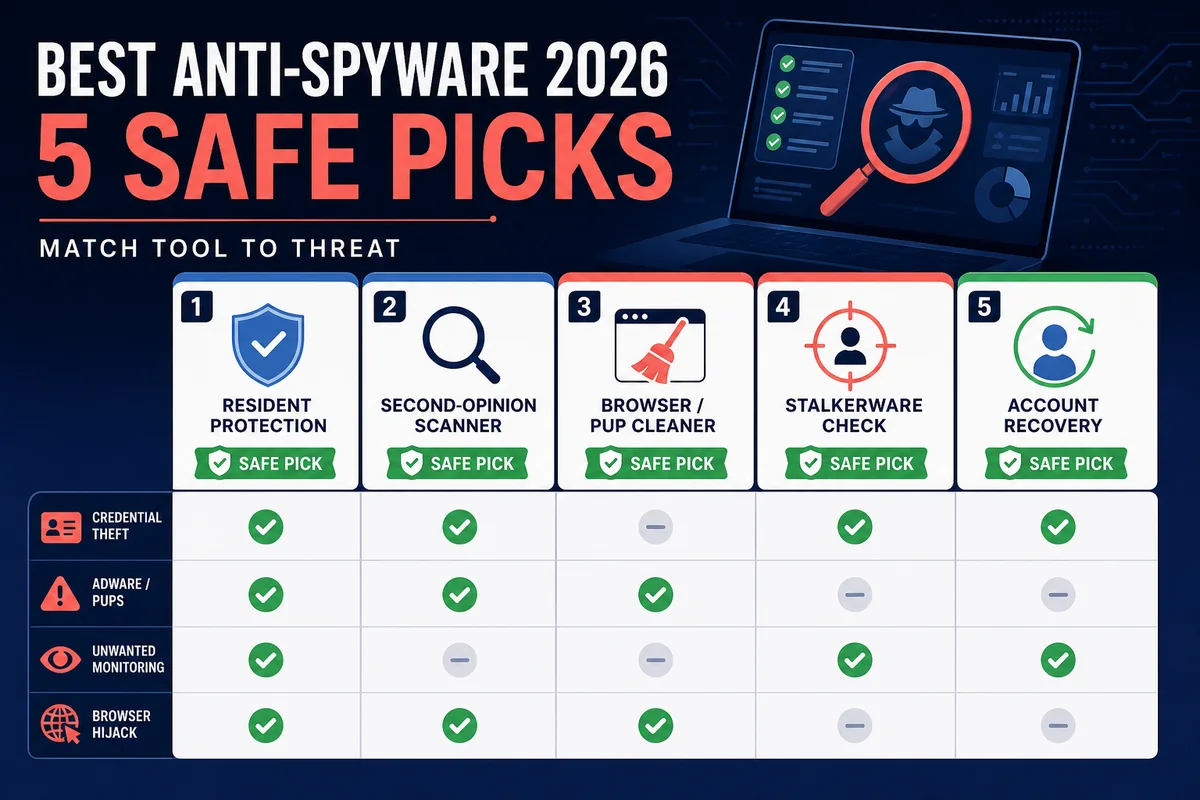
Quick answer: use Malwarebytes Free when you want a straightforward manual scan for spyware, adware and potentially unwanted programs. Keep one real-time antivirus—Windows Security or a paid product such as Bitdefender Total Security—for prevention. If a Windows detection returns after reboot, run Microsoft Defender Offline before piling on more scanners. After an information stealer, clean the computer and separately revoke sessions and change credentials from a trusted device. For partner surveillance, read the stalkerware safety section before touching the suspected phone.
The five anti-spyware tools we would use—and the job for each
Modern security products rarely use a separate “anti-spyware engine.” The same signatures, behavior monitoring, web filtering and cloud reputation systems handle password stealers, keyloggers, remote-access trojans, adware and other malware. That makes the tool's operating mode more useful than the label on the box: resident prevention, manual cleanup, restart-based scanning or portable second opinion.

Malwarebytes Free
An approachable Quick or Custom scanner for spyware, adware, browser hijackers and broader malware. Cleanup is free; continuous malware, ransomware, exploit and web protection are paid.

Bitdefender Total Security
A full resident security suite with current independent Windows evidence, behavioral monitoring, web protection and ransomware controls. Better for preventing a compromise than adding a second cleanup scanner after it.

Microsoft Defender Offline
Restarts a Windows 10 or 11 PC into a trusted scanning environment so persistent malware has less opportunity to hide or interfere. Included with Windows Security.

Emsisoft Emergency Kit
A folder-based Windows toolkit with graphical and command-line scanners, quarantine and cleanup. Useful from a clean USB drive; not resident anti-spyware.

ESET Online Scanner
A free Windows launcher that downloads current detection data and can scan for malware, spyware and unwanted applications alongside an existing antivirus.
Anti-spyware comparison: prevention, cleanup and offline scanning
| Tool | Main role | Real-time prevention | Offline/portable | Best use | Critical limit |
|---|---|---|---|---|---|
| Malwarebytes Free | Manual second opinion and cleanup | Paid only | No | Spyware, adware, PUP and browser cleanup | Free tier doesn't watch continuously |
| Bitdefender Total Security | Resident prevention suite | Yes | No | One primary paid security layer | Not a forensic incident-response tool |
| Defender Offline | Restart-based hidden-threat scan | Defender provides resident layer separately | Outside normal Windows | Threat returns after reboot | Windows only; PC restarts |
| Emsisoft Emergency Kit | Portable manual scanner | No | Portable folder/USB | Technician or clean USB second opinion | Current program build isn't freshly dated |
| ESET Online Scanner | One-time or monthly manual scan | No | No; needs Windows launcher/data | Different-engine full scan | “Online” doesn't mean browser-only |
A second-opinion scanner should complement one resident antivirus, not compete with another real-time suite. “Free” describes the checked home-use role, not every business license or support service.
What “spyware” covers in 2026—and why the distinction changes the fix
Information stealers
Steal browser cookies, passwords, autofill data, crypto-wallet material and system details. Removing the executable doesn't cancel sessions or undo data theft.
Keyloggers and screen capture
Record input or images locally and send them out. Assume credentials typed while the device was compromised may be exposed.
Remote-access trojans
Give an attacker interactive control, file access or webcam/microphone capability. A successful scan doesn't prove the operator never created another foothold.
Adware and browser hijackers
Change search, add extensions, push notifications and collect browsing behavior. Annoying symptoms may be narrow, but bundled installers can bring broader risk.
Commercial stalkerware
Secretly monitors a partner or family member's phone, often after physical access. Removal is a personal-safety decision, not merely a cleanup task.
Legitimate remote tools misused
Remote support, parental controls, device management, forwarding and shared accounts can become surveillance without installing obvious malware.
The phrase “spyware scanner” is therefore not enough to choose a workflow. A browser hijacker usually calls for extension and notification cleanup plus a broad scan. An infostealer calls for device containment, session revocation and credential recovery. A work endpoint calls for the employer's security team. Suspected intimate-partner monitoring calls for a safer device and a safety plan before any visible change.

What the current antivirus labs prove—and what they don't
AV-Comparatives' February–May 2026 Real-World Protection Test used 400 malicious web and download cases on patched Windows 11. Bitdefender Total Security 27.0 blocked 398, a 99.5% protection rate, with five false alarms. Microsoft Defender blocked 396, 99.0%, with zero false alarms. Malwarebytes Premium blocked 395, 98.8%, but produced 39 false alarms and was downgraded to the Standard award.
AV-TEST's March–April 2026 Windows 11 cycle awarded Bitdefender Total Security 6/6 for protection, performance and usability. Those results support Bitdefender as a broad primary security product. They don't show “99.5% spyware removal,” don't test the free Malwarebytes scanner, and don't measure whether a cleaned information-stealer victim revoked every stolen web session.
Cleanup comparisons are especially difficult: samples damage different settings, active malware may block tools, and reversing a file doesn't reverse disclosure. We rank these products by documented operating role, update mechanism, platform scope, current lifecycle, independent prevention evidence where relevant and the recoverability of their workflow. We don't convert a vendor's generic detection claim into a universal anti-spyware percentage.

Detailed verdicts: where each tool earns its place
1. Malwarebytes Free — best first manual cleanup for most people
Malwarebytes is easy to recommend for a home user who can still boot normally and wants a second opinion. Its current Free-versus-Paid matrix keeps Quick and Custom scans free on Windows and Mac. Quarantine and cleanup make it useful for spyware, adware and potentially unwanted programs without forcing a subscription.
The boundary matters. Scheduled threat scans, real-time malware/ransomware protection, exploit protection and web protection require a paid plan. Free isn't “install and forget” protection. On a normally functioning PC, keep Microsoft Defender or another primary antivirus active, update it, run its full scan, then run Malwarebytes Free sequentially as a second opinion.
Malwarebytes Premium is a real resident antivirus, but the latest independent result is mixed: good 98.8% real-world protection paired with 39 false alarms in the AV-Comparatives cycle. That's why this page awards Malwarebytes the manual-cleanup role and Bitdefender the resident-prevention role instead of pretending one brand wins every job.
2. Bitdefender Total Security — strongest prevention choice in this shortlist
Bitdefender combines signatures, cloud reputation, Advanced Threat Defense behavior monitoring, web attack prevention and ransomware layers. Its current 18/18 AV-TEST result and 398 of 400 AV-Comparatives blocks provide better evidence for a permanent layer than a product page saying “anti-spyware.” It can detect and quarantine spyware families as part of the wider malware stack.
It's still not a forensic guarantee. A serious information stealer may have already exported cookies before the alert. A remote-access intruder may have added an account or changed cloud settings. Bitdefender can help prevent and remove code; account recovery and incident scoping remain separate jobs. Review the renewal price, disable extras you don't need and don't run it in real time beside another third-party antivirus.
3. Microsoft Defender Offline — the better move when spyware persists
Malware that starts with Windows can hide files, inject into processes or interfere with scanners. Defender Offline restarts the PC and scans from outside the ordinary Windows kernel. Microsoft specifically points users toward the offline option when the same malware keeps returning. Save open work, connect the laptop to power, open Windows Security → Virus & threat protection → Scan options, select Microsoft Defender Offline scan and confirm.
After Windows returns, open Protection history and inspect the exact threat, action and path. A clean offline scan reduces uncertainty; it doesn't establish that no data left the device. If the computer handled a password manager, employer access, banking, tax records or crypto, perform account containment from another trusted device and consider a clean reinstall or professional response.
4. Emsisoft Emergency Kit — a useful clean-USB toolkit
Emsisoft's current Emergency Kit page documents a portable graphical scanner, command-line scanner, quarantine/removal and repair of some malicious settings. It extracts to a folder rather than registering as a permanent protection suite, and it can update the program and detections before a scan. That makes it practical for a household technician or a clean USB drive.
The current page still labels the program build 2025.7.0.12683, released June 27, 2025. The kit can download newer detection updates, but the visible program-build date is less reassuring than an actively refreshed executable release. Download only from Emsisoft, update before use, preserve logs and quarantine before permanent deletion. The free license is for personal use; businesses should check Emsisoft's terms and use an approved response tool.
5. ESET Online Scanner — a current different-engine full scan
ESET's current scanner documentation says it can run free alongside existing antivirus software and detect viruses, trojans, spyware, phishing and other threats. It supports scan logs, quarantine restoration, custom targets and an optional monthly periodic scan. That's a sensible different-engine check after the primary antivirus has updated and scanned.
“Online Scanner” is legacy naming: it downloads a Windows launcher and detection data, needs administrator permission for full capability and isn't a browser-only service for an iPhone or Chromebook. The monthly option is still a scheduled manual-style check, not continuous protection. ESET's old SysRescue Live is end-of-life; don't download it from an archive because an old guide recommends it.
Signs of spyware: useful clues without treating every glitch as proof
| Signal | Could indicate | Common benign explanation | Next check |
|---|---|---|---|
| New browser extension, redirects or notification spam | Hijacker, adware or unwanted bundle | Extension installed during legitimate software setup | Review browser extensions, site notifications and installed apps; then scan |
| Unknown startup item or process | Persistence or remote tool | Driver, updater or OEM utility | Check publisher, signature and install date before deleting |
| Account logins from unknown devices | Stolen password or session cookie | VPN exit, mobile network or stale device label | Review session details from a clean device; sign out unknown sessions |
| Camera/mic indicator or permission use | Misused app or remote access | Browser call, voice assistant or conferencing app | Review OS privacy activity and permissions |
| Battery/data spike on a phone | Monitoring app or persistent network traffic | OS update, cloud backup, poor signal or aging battery | Check per-app battery/data usage and account sharing |
| A partner knows exact private details or location | Stalkerware, shared account, location sharing or physical access | No safe assumption | Use a safer device and survivor-support guidance before changing anything |
A single symptom isn't a diagnosis. High CPU can be an update; a strange IP can be a carrier gateway; a browser redirect can be a bad notification permission. Record the time and exact alert, preserve screenshots or logs, and confirm with multiple independent signals. Don't upload confidential work files to random “online scanners.”
Safe Windows spyware-removal workflow
- Contain without destroying evidence. Disconnect Wi-Fi/Ethernet if active theft or remote control is plausible. Photograph the alert and note the detection name, file path and time. On a managed work device, stop and contact IT/security.
- Use a clean device for urgent accounts. Secure primary email, password manager, financial and work accounts elsewhere. Don't type replacement credentials into the suspected computer yet.
- Update the existing antivirus. Reconnect only long enough to update when safe, then run a full scan. Quarantine rather than manually deleting unfamiliar system files.
- Scan outside Windows if it returns. Save work and run Defender Offline when the detection reappears, cleanup fails or a hidden boot/startup component is plausible.
- Run one second opinion. Choose Malwarebytes Free, ESET Online Scanner or Emsisoft Emergency Kit. Don't run several active scans simultaneously. Save the log and restart if asked.
- Repair the access path. Remove an unwanted extension, fake notification permission, pirated installer, exposed remote desktop or reused password. Otherwise reinfection is predictable.
- Decide whether to reinstall. Prefer a clean OS reinstall from trusted media after confirmed infostealer/RAT activity, administrator compromise, disabled security controls, ransomware or unexplained persistence.
- Patch and monitor. Update the OS, browser, document reader and other exposed apps; re-enable security; watch account sessions and financial activity.
Don't use registry cleaners, cracked “spyware removers” or downloads from mirror sites. A fake cleanup utility can be the second infection. Download by typing the vendor's known domain or following the verified links above.

After an infostealer: removal is only half the recovery
Information stealers target browser cookies and tokens as well as saved passwords. A session cookie may let an attacker remain signed in without re-entering the old password or MFA code. That's why “I changed the password” isn't a complete response. From a separate trusted device, secure the primary email and password manager first, then banking, work, social, shopping and crypto accounts.
Review active devices and sessions, revoke anything unfamiliar, use “sign out everywhere” where available, remove unknown recovery email/phone/passkeys/app passwords/OAuth access, change unique passwords and enable phishing-resistant MFA or passkeys. Google's account guidance shows each recent device or session and lets the user sign it out. Microsoft's sign-out-everywhere control can take up to 24 hours and excludes Xbox consoles, which require a separate step.
Change passwords only after urgent containment and preferably after the device is rebuilt or judged clean; otherwise a keylogger may collect the new secret. Notify the employer if any work session, VPN token, source-code access or company password was present. Contact banks through independently found official numbers, freeze or replace exposed cards where advised, preserve wallet seed phrases offline and move cryptocurrency only with expert help if the original wallet material may be stolen.

Suspected stalkerware: don't rush to uninstall it
Safety can be more urgent than device cleanup
Removing monitoring software, resetting a phone, changing a shared password or researching abuse on the suspected device may alert the person monitoring it and can escalate harm. Use a safer device—one the other person has never accessed—to contact a trusted advocate and build a personal safety plan.
The FTC's current stalkerware guidance says to consider leaving the suspected phone behind when seeking help and to speak with a domestic-violence advocate before removing stalkerware. The Coalition Against Stalkerware's survivor guidance likewise warns that detection or major changes may be visible to the abuser and recommends building the plan with a safer device and specialist support.
Monitoring may also come from shared Apple/Google accounts, location sharing, family plans, message forwarding, a cloud backup, a known passcode, mobile-carrier access or a legitimate management app—not a detectable spyware binary. Preserve evidence before resetting if that's safe. A factory reset or replacement phone may remove device-level software, but don't restore every app/settings backup blindly, and create the new account credentials on a safer device.
If there's immediate danger, contact local emergency services when safe. In the United States, the FTC links to the National Domestic Violence Hotline and the National Network to End Domestic Violence; in another country, use a reputable local survivor-support organization from a safer connection. This page can't make a safety decision for an individual situation.
Windows, Mac, Android and iPhone need different anti-spyware plans
Windows 10 and 11
Use one resident antivirus, full scan, Defender Offline for persistence and one manual second opinion. Reinstall after a serious stealer, RAT or administrator compromise.
See the Windows antivirus guidemacOS
Update macOS; review login items, extensions and configuration profiles; run a current manual scan. Erase/reinstall from Recovery when administrator-level compromise remains plausible.
See the Mac security guideAndroid
Review Play Protect, apps installed outside Google Play, Accessibility, Device Admin, notification access and VPN permissions. Update OS/security patches; use survivor-safety steps for partner monitoring.
See the Android security guideiPhone
An App Store antivirus can't scan every app container. Update iOS; use Safety Check, review account devices/profiles/sharing and consider Lockdown Mode only for credible targeted-spyware risk.
See the iPhone security guideDedicated anti-spyware names we didn't rank
| Tool or claim | Why it isn't a top pick here | Safer current route |
|---|---|---|
| SUPERAntiSpyware Free | A long-running dedicated scanner, but we found less current independent public evidence than for the broader tools above. The name isn't proof of superior spyware detection. | Malwarebytes Free or ESET Online Scanner as a manual second opinion |
| Spybot Search & Destroy | Historically important for browser-era spyware; current Windows security and threat models are much broader. Old familiarity isn't a current efficacy test. | One supported resident antivirus plus a current scanner |
| Norton Power Eraser | Norton discontinued it April 30, 2026 and says it's no longer supported or functional. | Defender Offline, Malwarebytes Free, ESET Online Scanner or Emsisoft Emergency Kit |
| ESET SysRescue Live | End-of-life since September 29, 2023; its databases are outdated and official download removed. | ESET Online Scanner or a clean Windows reinstall/recovery path |
| “Free online spyware scan” websites | A page can't deeply scan a modern computer without a trusted local component. Some pages are lead forms or fake alerts. | Download a signed scanner from the vendor's official domain |
Norton's Power Eraser retirement notice and ESET's SysRescue Live notice are explicit. Don't obtain either from an archive or download portal because an older top-ten article still includes it.
What current community reports add
Current r/antivirus and r/techsupport discussions repeatedly pair the built-in Microsoft Defender real-time layer with Malwarebytes Free, ESET Online Scanner or Emsisoft Emergency Kit for a manual second opinion. They also warn that serious information-stealer or remote-access cases deserve a reinstall rather than endless scans. This is useful evidence that the workflow is understandable and commonly used; it isn't a controlled comparison of detection rates.
Community posts also show why vague symptoms require care: users frequently mistake browser notification spam for a system infection, confuse normal startup services with spyware or believe a clean scan revokes stolen sessions. We use those recurring questions to shape the troubleshooting sections. We don't copy anonymous claims, vote totals or a single scan screenshot into the product ranking.
Anti-spyware FAQ
What is the best free anti-spyware tool in 2026?
Malwarebytes Free is the easiest broad manual scanner and cleaner for most home users. Its current feature matrix keeps Quick and Custom scans free on Windows and Mac, while real-time malware, ransomware, exploit and web protection are paid. Use it as a second opinion beside one resident antivirus, not as a free continuous-protection replacement.
Does Windows Defender remove spyware?
Yes. Microsoft Defender Antivirus detects spyware and other malware as part of Windows Security. Run an updated full scan first. If a threat returns or may hide while Windows runs, save work and use Microsoft Defender Offline, which restarts and scans outside the normal Windows environment.
Can I run Malwarebytes Free with Microsoft Defender?
Yes. Keep Defender as the real-time provider and run Malwarebytes Free manually as a sequential second opinion. Avoid enabling two full resident antivirus suites because their file, process and network hooks can conflict. Don't run simultaneous scans, and review quarantine results before permanent deletion.
How do I know if spyware stole my passwords?
A scanner usually can't prove which data already left the device. Treat a confirmed information stealer, keylogger or remote-access trojan as possible credential and session theft. From a trusted device, secure email and password-manager accounts first, revoke sessions, remove unknown recovery/OAuth access, change unique passwords and enable strong MFA or passkeys.
Will changing my password stop an infostealer?
Not by itself. A still-infected device can capture the new password, and stolen session cookies may keep an attacker signed in. Contain and clean or rebuild the device, then revoke active sessions and change credentials from a trusted device. Review recovery methods, app passwords and connected applications as well.
Should I uninstall stalkerware as soon as I find it?
Not automatically. Removal or a factory reset may alert an abusive partner and escalate risk. Use a safer device to contact a survivor-support advocate, make a personal safety plan and preserve evidence when safe. The FTC and Coalition Against Stalkerware both put safety planning before visible device changes.
Can an online scanner detect spyware without a download?
Not deeply on a modern PC. ESET Online Scanner, for example, downloads a signed Windows launcher and detection data. A web page alone can't inspect protected processes and files. Avoid pages that show instant fake infection counts or demand payment before identifying a signed local tool.
When is a clean reinstall safer than another scan?
Prefer a clean reinstall after confirmed information-stealer or remote-access activity, ransomware, administrator-level compromise, disabled security controls, work or crypto credential exposure, unexplained persistence, or when you can't establish what changed. Back up essential non-executable documents carefully and reinstall apps from official sources.
Verdict: choose the response, then the anti-spyware tool
For routine home cleanup, start with the updated resident antivirus and use Malwarebytes Free as the easiest manual second opinion. Choose Bitdefender Total Security when you want a stronger paid prevention layer backed by current independent Windows evidence. Use Defender Offline when the threat persists, Emsisoft Emergency Kit when portability matters and ESET Online Scanner when you want a current alternative engine without a subscription.
The purchase decision is the small part of a serious spyware incident. An information stealer requires session and credential recovery. A remote-access compromise may justify a clean reinstall and professional investigation. Suspected partner surveillance requires a safer device, specialist support and a safety plan before removal. No “100% spyware removal” badge replaces those decisions.
For broader cleanup tools, continue with our malware removal guide. To choose a permanent layer, compare the best free antivirus products or complete internet security suites. Our Malwarebytes, Bitdefender, Microsoft Defender, Emsisoft and ESET reviews cover each product in more depth.