
Scanguard Review 2026: 98% Protected, 2 Compromises
Scanguard earned a current SE Labs AAA award and made no mistakes across 680 legitimate items. Two web-download attacks still compromised the test system, and the wider lab record is thin.
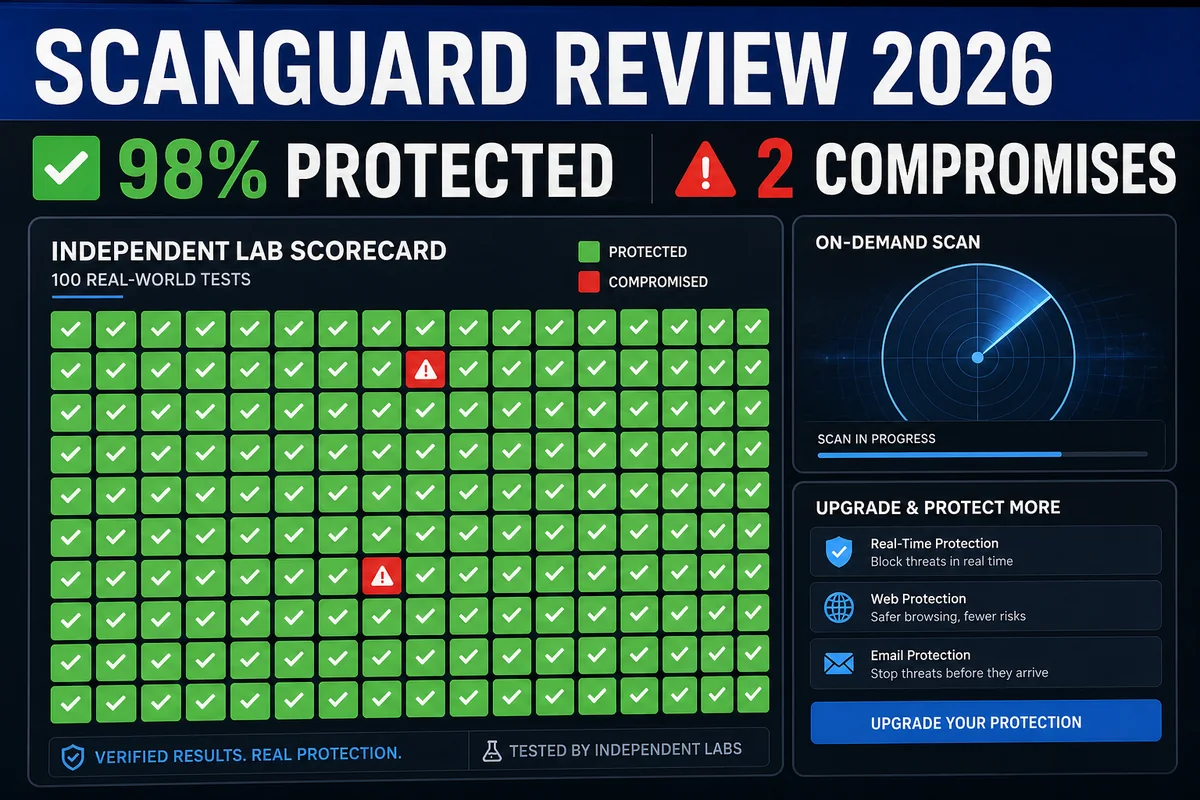
Our verdict: Scanguard is legitimate security software with a credible current result, not an untested mystery app. In SE Labs' January–March 2026 test, Scanguard Essential Antivirus protected against 98 of 100 attacks, stopped every targeted attack and correctly handled all 680 legitimate applications and sites. The caution is equally concrete: two web-download attacks compromised the system, its weighted Protection Accuracy was 95%, and Scanguard has no current result in the AV-TEST or AV-Comparatives consumer sets. Premium was displayed at €99/year in our Europe-localized check, while VPN and other extras can be separate renewable subscriptions. We rate it 7.2/10: credible, usable and worth a controlled trial, but not as evidence-rich or commercially simple as the leaders.
- Current SE Labs AAA award rather than an old or borrowed result
- Protected 98 of 100 realistic attacks, including all 25 targeted cases
- No false classifications across 680 legitimate applications and websites
- Real-time desktop antivirus, WebShield, cloud classification and scheduled scans
- Online portal exposes next payment date and amount
- Thirty-day refund window for annual/biannual terms when the service is properly terminated
- Two successful web-download compromises in the current test
- No current Scanguard entry at AV-TEST or AV-Comparatives
- VPN, unlimited devices and other extras may renew as separate subscriptions
- Localized pricing and promotions make old review prices unreliable
- Official platform and requirement pages don't fully agree
- Windows on ARM is explicitly unsupported
Scanguard at a glance
Scanguard is a consumer security product sold by Total Security entities, which are now part of the Point Wild cybersecurity group. The current storefront centers on one paid name—Scanguard Premium—rather than the old Essential/Pro/Ultimate ladder repeated by many review sites. Its core pitch is desktop malware and phishing protection plus scanning, cleanup and breach-monitoring tools. Some surrounding services, including Safe Browsing VPN and Unlimited Devices, can be separate subscriptions.
The most important 2026 correction is independent evidence. Several high-ranking reviews still say Scanguard hasn't been tested by a lab, or use a 2022 Virus Bulletin result as the latest proof. That was true before SE Labs published its January–March 2026 Home Anti-Malware report. Scanguard now has a current, product-specific test. It's a good result, though not a perfect one and not a substitute for multi-lab consistency.
| Buyer question | Evidence-checked answer |
|---|---|
| Is Scanguard legitimate? | Yes. It has current legal entities, support/billing documentation and a 2026 SE Labs product-specific test. |
| How well did it protect? | 98 of 100 attacks protected; 97 blocked, one neutralized and two compromised. |
| Did it flag clean software? | No errors across 680 legitimate applications and websites in the current SE Labs test. |
| Is it tested by AV-TEST or AV-C? | Not in their current consumer sets. TotalAV and Avira results must not be transferred to Scanguard. |
| Current price? | The English official page rendered €99/year in our Europe-localized July 14 check. Currency, campaign and checkout can vary. |
| Is the VPN included? | Don't assume so. Current terms identify Safe Browsing VPN as a possible separately billed service. |
| Platforms? | Official materials mention Windows, macOS, iOS, Android and Fire HD, but feature parity and storefront availability differ. |
| Current rating? | 7.2/10 from one named editor, not a customer-review aggregate. |
The recovered page attached an expired 2021 Offer and a nine-person aggregate to a 2022 article. We removed both. A volatile checkout price is more honestly reported as a dated snapshot, and our score is an editorial assessment with a single-review count in structured data.
SE Labs 2026: a strong result with two successful attacks
SE Labs' January–March 2026 Home Anti-Malware report exposed ten Windows security products to 100 live public and targeted attacks. The test begins from realistic delivery points—malicious sites, downloads, email and exploit chains—rather than dropping every sample directly onto a scanner. It also checks whether products interfere with legitimate programs and URLs.
Scanguard Essential Antivirus detected 98 attacks, blocked 97, neutralized one and was compromised twice. It protected against 73 of 75 general attacks and all 25 targeted attacks. Across the 680-item legitimate set, it made no classification errors. SE Labs awarded it AAA.
| SE Labs measure | Scanguard result | What it tells a buyer |
|---|---|---|
| Protection count | 98/100 | Two attacks achieved compromise; 98 were blocked or neutralized. |
| General attacks | 73/75 | Both misses came from the broad public/web set. |
| Targeted attacks | 25/25 | All targeted scenarios were stopped in this cycle. |
| Protection Accuracy | 378/400 = 95% | Weighted scoring rewards earlier/cleaner blocking more than late neutralization. |
| Legitimate Accuracy | 680/680 = 100% | No legitimate application or URL was wrongly handled. |
| Total Accuracy | 1,058/1,080 = 98% | Combined protection and legitimate handling. |
| Award | AAA | A high-cycle award, not a guarantee against every future threat. |
SE Labs recorded Scanguard 5.24.38 at the start and 6.6.51 at the end. The report's opening build row contains `Error` in two definition fields; the final row identifies Virus Definition 8.20.74.170 and Remediation Definition 1.0.2512.2988. That build detail matters because a lab score belongs to the submitted product and configuration, not every product owned by the same group.

Why 98 protected and 95% Protection Accuracy are both correct
A reader can reasonably wonder why Scanguard stopped 98% of attacks but received a 95% Protection Accuracy rating. The protection count treats a clean block and a later successful neutralization as protected outcomes. The weighted accuracy score distinguishes how far the attack progressed. Blocking the malicious URL before execution earns more than letting components run and cleaning them after behavior is observed.
The two compromised cases were web-download threats. SE Labs' commentary says Scanguard missed two of the public malware downloads while completing all targeted scenarios. That pattern is narrower than “failed against advanced attacks,” but it's still relevant to an ordinary home user: web downloads are exactly how many consumer infections begin. The result supports a good rating, not the claim that detection is flawless.
No controlled test recreates every device, update state, region or threat. A single quarter also can't show consistency. We therefore read the result as strong evidence that the current Windows product can stop realistic attacks and avoid false alarms, balanced by proof that two threats escaped and by the absence of corroborating current results from two other major labs.
Scanguard is absent from current AV-TEST and AV-Comparatives sets
Scanguard doesn't appear in AV-TEST's current Home Windows results, and it isn't in AV-Comparatives' current consumer Main-Test Series. That's an evidence-coverage limitation, not proof that the product is unsafe. Labs choose participants and vendors choose testing programs; absence provides no score.
The mistake in several reviews is to fill that gap with a result from a related name. AV-Comparatives currently tests TotalAV, and Avira appears in other lab programs. Those results belong to the submitted builds named in the reports. Even if two products share code, infrastructure or ownership, packaging, web protection, configuration, remediation and update cadence can change the outcome.
Older Virus Bulletin evidence remains useful as history, and older hands-on reviews can reveal UI or billing friction. Neither is a current protection benchmark. Our verdict gives more weight to the 2026 SE Labs report and current legal/storefront pages than to a review whose year in the headline changed while its tested product didn't.

The Avira relationship is real, but Avira scores don't transfer
Scanguard's current third-party disclosure lists Avira Operations GmbH for scanning data for malicious or suspicious content. It says no personal data is transferred for that operation and that the data is stored and processed in the European Union. This is stronger evidence than visual similarity or affiliate speculation: Scanguard itself discloses Avira's processing role.
It still doesn't prove that Scanguard is “just Avira” or that it deserves Avira's lab score. A consumer suite can combine a detection service with its own cloud, URL filter, behavior layer, quarantine, remediation, defaults and release cycle. SE Labs tested the resulting Scanguard product and recorded Scanguard builds. That's the result we use.
The same restraint applies to TotalAV and PCProtect. Related ownership and familiar interfaces are relevant when comparing support, billing and product positioning. “Clone” is too imprecise for a technical verdict unless the vendor or reproducible binary analysis establishes identical components and configuration. Buyers need the operational conclusion: compare their checkout bundles and current lab records separately.
What Scanguard Premium includes—and what “free” means
The current official pricing page describes Premium as a desktop-centered security product. It advertises real-time malware, spyware and phishing protection; WebShield filtering; on-demand and scheduled scans; cloud threat classification; junk/startup cleanup; and email breach monitoring. The footnotes correctly narrow real-time threat protection and WebShield to desktop platforms.
A separate official page still carries the heading `SCANGUARD ANTIVIRUS 2019` under a 2026 footer. It describes a free diagnostic smart scan that finds malware, potentially unwanted applications and privacy/performance issues, then offers Premium for automatic real-time blocking. We treat that page as documentation drift, not a current plan sheet. The safe distinction is simple: a free scan can identify issues on demand; Premium is the product positioned for always-on blocking.
| Capability | Current evidence | Check before paying |
|---|---|---|
| Real-time antivirus | Advertised for desktop Premium | Confirm the device count and each supported desktop OS at checkout. |
| WebShield | Desktop phishing/scam/malicious-download filtering | Confirm browser/extension requirements and avoid assuming iOS parity. |
| Cloud scanning/remediation | Documented in feature help | Requires internet for updates/cloud classification. |
| Scheduled/on-demand scan | Documented | Run only harmless test files; don't use live malware. |
| Cleanup/startup tools | Advertised, with conditional speed benefit | Review proposed deletions; cleanup isn't malware protection. |
| Breach monitoring | Email leak search/alerts | It warns about exposure; it can't remove leaked data. |
| Free smart scan | Stale official page documents diagnostic scanning | Don't assume real-time remediation is free. |
Feature names inside the help center aren't a purchase receipt. Current terms classify several headline tools as possible add-on services. Screenshot the final basket, record every subscription line and confirm which device receives which feature.
VPN, Unlimited Devices and other add-ons can bill separately
Scanguard's feature help describes Safe Browsing VPN, Total Adblock and other tools alongside antivirus capabilities. The binding commercial detail sits in the current terms: Safe Browsing VPN, Unlimited Devices, Family Protection, Home Protection, Additional Device, AdBlock Pro, Password Vault, Advanced Cloud Scanning, Identity Protection, Smartphone Optimizer and Priority Support are among services that may be sold separately.
Each service can have its own subscription, billing cycle, renewal and cancellation. A unified login doesn't merge them into one contract. Canceling antivirus doesn't automatically cancel VPN or Unlimited Devices; refunding one doesn't necessarily refund the others. This is the single most important checkout risk because an attractive first-period antivirus price can coexist with separately renewing extras.
The VPN has another transparent technical boundary. The third-party disclosure says NortonLifeLock Ireland Limited provides VPN services incorporated into Total Security products. Total Security and NortonLifeLock act as joint controllers for connection, usage, error, product and IP-address data associated with those services. This disclosure is more useful than an unsupported promise of anonymous or no-log browsing.

Windows, macOS, iOS, Android and Fire HD: availability isn't parity
Scanguard's feature help lists Windows, macOS, iOS, Android and Fire HD. The current pricing page foregrounds Windows, macOS and iOS, while its footnotes say real-time protection and WebShield are active on desktop platforms. Those statements can all be true: a brand can have a mobile app without giving it the same antivirus stack or entitlement as the desktop product.
The current system-requirement page needs caution. Its Windows list names Windows 7 SP1, 8, 8.1 and Server 2016/2019 but omits Windows 10 and 11. The storefront separately says Windows 7+. More usefully, the help page explicitly says Scanguard isn't supported on ARM-based Windows devices. Its Mac list is much fresher: Catalina 10.15 through Tahoe 26, Intel Core 2 Duo or Apple Silicon M1+, with possible Rosetta 2 installation.
We wouldn't install a security suite on Windows 7/8 merely because a vendor page lists it. Microsoft support status is the first boundary; antivirus can't replace operating-system security updates. Windows 11 on x64 and a currently supported macOS release are the sensible desktop targets. For iOS, Android and Fire HD, verify the current app-store listing, required OS version, device permission list and the exact paid entitlement.
| Platform | What is currently clear | What remains buyer-verifiable |
|---|---|---|
| Windows x64 | Core desktop antivirus/WebShield; 2GB RAM and 1.5GB disk documented | Exact supported Windows 10/11 builds, license/device count |
| Windows ARM | Explicitly unsupported | Choose a product with native ARM support |
| macOS | Catalina–Tahoe and Intel/Apple Silicon listed | Rosetta need, feature parity, current storefront entitlement |
| iOS/iPadOS | Current storefront advertises app-based security features | Which tools are included; don't expect desktop-style file scanning |
| Android/Fire HD | Feature help lists availability | Current app listing, permissions, real-time scope and plan inclusion |
Performance: the current lab doesn't publish a speed score
SE Labs measures protection and legitimate handling, not the everyday speed tasks used in AV-Comparatives' Performance Test. Because Scanguard is absent from the latter, there's no current independent launch/copy/install/browse impact score to quote. Claims such as “zero slowdown” or exact CPU percentages from old reviewers can't be generalized to the 2026 build.
A useful local trial is safer and more relevant. Record idle memory after startup, browser responsiveness, a large trusted-folder copy, a clean application install and the duration of the first full scan. Repeat after definitions settle and reboot. Compare against the same machine before installation, and don't run two real-time antivirus engines together unless both vendors explicitly support that setup.
Cleanup tools deserve their own baseline. Deleting temporary files may reclaim storage, especially on an older low-capacity machine, but it doesn't make the antivirus engine lighter. Review every proposed item before deletion and keep system/application backups. The official pricing footnote itself says responsiveness improvements are conditional.
Scanguard price: record the checkout, not an old review
On July 14, 2026, Scanguard's English pricing page rendered €99/year in our Europe-localized session. Other visitors may receive another currency, term or introductory campaign. That's why this page doesn't publish Offer schema: a search-engine price that outlives the session would be more misleading than useful.
Scanguard supports monthly, quarterly, biannual and annual billing. Its promotional-pricing explanation says an introductory discount applies to the first billing period; renewal uses the regular rate shown at checkout and in the order confirmation. The online portal displays the next payment date and amount. High-ranking pages still quote $9, $29 or $99 based on old app/site flows; none of those figures should replace today's final order summary.
| Cost element | Action before purchase |
|---|---|
| Introductory amount | Record currency, tax, billing period and whether the discount is one-time. |
| Regular renewal | Capture the exact amount/date from checkout and confirmation; recheck in the portal. |
| Device count | Confirm base entitlement; Unlimited Devices may be a separate subscription. |
| VPN/identity/adblock/password | Check whether each is included or appears as a separately renewing line. |
| App-store purchase | Understand that billing, cancellation and refund route may be controlled by Apple/Google. |
| Renewal notice | Keep your account email current and set an independent calendar reminder. |
Value depends on the final basket. At €99 for base antivirus, Scanguard competes with deeply tested suites and with Microsoft Defender at no extra charge. At a genuine introductory price, it can be reasonable for a one-year controlled trial—provided you're comfortable with the displayed renewal and have removed unwanted add-ons.
How to cancel Scanguard and request a refund correctly
Cancellation and refund are different operations. Scanguard says to use the online portal and open My Subscriptions. Turning off auto-renewal prevents a future charge but normally leaves the paid service active until the end of its term. It doesn't automatically terminate service and doesn't generate a refund.
For a refund, the relevant service must be terminated and a request submitted inside its eligibility window. The current refund guide gives annual and biannual subscriptions 30 days from initial purchase or renewal; monthly, quarterly and add-on services have 14 days. If approved, access ends immediately. Purchases made through an app store follow the store's process.
- Sign in and screenshot every active subscription, next date and amount.
- Turn off renewal for each service you don't want—including every add-on.
- If requesting money back, contact support and explicitly request termination plus refund for each named service.
- Save the case number, confirmation and final portal state.
- After refund confirmation, check the payment method and remove the application from each device.
Uninstalling doesn't cancel billing. Canceling the antivirus doesn't automatically cancel the VPN. This sounds repetitive because it's where avoidable subscription disputes happen.

Who owns Scanguard?
Scanguard's current terms and privacy policy identify Total Security Limited, Total Security US LLC and affiliates, and say Total Security is part of Point Wild, formerly Pango. Point Wild announced the Pango Group–Total Security merger and new group name on December 12, 2024.
The announcement describes a broad cybersecurity portfolio including TotalAV, Hotspot Shield, UltraAV, Betternet and others. That common corporate layer explains shared services and makes related-brand comparison reasonable. It doesn't make every product one executable, one entitlement or one independently tested result.
Corporate ownership isn't a protection score. It matters for contractual responsibility, privacy, support and product continuity. The safest buyer model is: Scanguard is the product name; Total Security entities are the contract/privacy operators; Point Wild is the parent group; each product's current checkout and lab record must be evaluated on its own.
Privacy: what Scanguard and its processors disclose
The current privacy policy says account and payment data can include name, email, phone, password, address and payment details. Automatically collected data can include browser, IP address, pages and activities, device type, time/date and cookie or pixel data. Mobile devices may provide location depending on settings.
Uses include delivering the service, account/payment administration, security, product analysis, advertising and marketing. The policy describes desktop alerts, live chat, email and opted-in SMS; chat transcripts can be retained. It also describes Google/Meta-related advertising technology and server-side audience matching in which identifiers such as email or phone are hashed before transfer, with opt-out controls.
The third-party list adds useful service-level detail:
- Avira Operations GmbH: scanning for malicious/suspicious content; the disclosure says no personal data is transferred and processing/storage is in the EU.
- NortonLifeLock Ireland Limited: VPN service and joint-control processing of connection, usage, error, product and IP data.
- haveIbeenpwned operator: requested breach searches using partial email/password hashes in Australia.
- Support, crash and payment providers: several processors in the UK, US, EU, India, Australia and New Zealand depending on function.
This isn't a reason to call antivirus spyware, and it isn't compatible with a blanket “collects nothing” promise. Use a unique account password, enable any available two-factor protection, opt out of marketing you don't want, minimize mobile permissions, and install only the platform features you'll use.
Community signals: billing suspicion outweighs current product evidence
Scanguard-specific community discussion is small, old and unusually entangled with TotalAV and PCProtect. Reddit threads often call the products clones, allege aggressive affiliate marketing or describe billing and alert frustration. Those posts are useful warnings to inspect checkout and renewal details; they aren't a representative user study, a malware test or proof of current corporate conduct.
We found no credible basis for reproducing a named-user quote or converting those threads into a numerical satisfaction score. The current official terms already verify the practical risk without relying on anecdotes: promotions can renew at regular price, and add-ons remain separate subscriptions until individually canceled.
The 2026 SE Labs result also prevents a lazy community verdict. Whatever a user thinks of the marketing, Scanguard protected 98 attacks in a controlled current test and made zero mistakes on the legitimate set. A useful review can hold both facts: the product has credible protective capability, and the subscription stack demands careful management.
Who should choose Scanguard—and who should skip it
| User | Recommendation | Reason |
|---|---|---|
| Windows x64 user who values low false alarms | Consider a controlled trial | 680/680 legitimate handling is excellent; verify performance locally. |
| Evidence-first buyer | Compare before buying | SE Labs is current, but Bitdefender/ESET/Norton have broader current lab coverage. |
| Microsoft 365/low-risk Windows user | Compare with Defender first | Built-in protection may cover the core need without another renewal. |
| Windows on ARM owner | Skip | Current Scanguard help explicitly says ARM Windows is unsupported. |
| Family wanting one predictable bundle | Usually skip | Unlimited Devices, VPN and family tools may be separate subscriptions. |
| Mac/iPhone/Android mixed household | Verify every device | Availability is documented, but base entitlement and feature parity are unclear. |
| Buyer who dislikes renewal management | Skip | Multiple cadences and independent add-ons require active account control. |
Scanguard's strongest case isn't “best antivirus overall.” It's a simple desktop interface backed by one strong current attack-chain result and unusually clean legitimate handling. That can be enough for a buyer who likes the application and carefully controls the order. It isn't enough to outrank products with equally strong protection and broader evidence.
Scanguard alternatives with clearer strengths
Bitdefender is our stronger evidence-first all-rounder: latest AV-TEST and AV-Comparatives coverage, mature ransomware/web defenses and a clearer path from entry antivirus to multi-device suite. It can be heavier and its own renewal needs checking, but its result history is broader.
ESET suits an experienced Windows user who prioritizes low system impact, detailed controls and consistently low false positives. Its bundles can feel less generous, yet the product boundary is clearer than a base subscription surrounded by many add-ons.
Norton 360 is a better family bundle when VPN, backup and broader extras are genuinely wanted. Check introductory and renewal prices, but compare the single bundle against Scanguard's final basket rather than comparing only headline antivirus prices.
Microsoft Defender is the baseline for a supported Windows PC. It costs nothing extra, integrates with the operating system and has broad current lab coverage. Scanguard must earn its place through a preferred interface, WebShield behavior, cleanup/breach tools or a price you consider fair.
TotalAV is the most relevant related-brand comparison. It currently has broader lab evidence, but its own renewal/add-on rules need the same scrutiny. Don't buy either because a comparison site ranks one first; compare the exact checkout, device entitlement and independent product-specific result.
A safe 30-minute Scanguard evaluation
- Before payment: capture the final price, renewal, term, tax, device count and every add-on.
- Before installation: update the operating system, create a restore/recovery point where appropriate and remove a conflicting real-time suite.
- After installation: verify definitions, real-time protection and WebShield are active; inspect startup items and permissions.
- Protection check: use the harmless EICAR test file from its official site and known phishing-test pages—not live malware.
- Performance baseline: compare restart, browser, trusted file copy, application install and scan time.
- False-positive check: open trusted specialist software you actually use and test exclusions only when you can verify the file.
- Account check: sign in to the portal and match every subscription and next charge to the saved order.
- Decision: keep it only if protection layers work, the machine remains comfortable and the renewal is worth the exact bundle.
If you reject it, cancel each unwanted subscription before its deadline, request termination/refund where eligible, save confirmation, then uninstall. Don't assume deleting the app changes billing.
Frequently asked questions
Is Scanguard a legitimate antivirus?
Yes. Scanguard is sold by Total Security entities within Point Wild, publishes current legal and billing documentation, and Scanguard Essential Antivirus was independently tested by SE Labs in January–March 2026. Legitimacy doesn't make every price or add-on a good value, so verify the final checkout and renewal.
How well did Scanguard perform in independent tests?
SE Labs recorded 98 of 100 attacks protected, with 97 blocked, one neutralized and two compromised. Scanguard stopped all 25 targeted attacks and 73 of 75 general attacks, handled all 680 legitimate items correctly, scored 95% Protection Accuracy and 98% Total Accuracy, and received AAA.
Does Scanguard use Avira's antivirus engine?
Scanguard's third-party disclosure says Avira Operations GmbH scans data for malicious or suspicious content. That establishes a current Avira processing relationship, but it doesn't prove identical products or allow Avira's lab scores to be assigned to Scanguard. Use Scanguard's own SE Labs result.
Is Scanguard the same as TotalAV or PCProtect?
They're related through Total Security/Point Wild and may share services or design patterns, but current evidence doesn't justify treating every build, feature, entitlement or lab score as identical. Compare each product's checkout, terms and product-specific test result separately.
How much does Scanguard cost in 2026?
On July 14, 2026, the official English page rendered €99/year in our Europe-localized session. Price, currency, promotion, tax and term can vary. Promotional pricing applies to the first period and renews at the regular rate shown at checkout and in the order confirmation, so save both.
Is Scanguard's VPN included with Premium?
Don't assume it is. Current terms list Safe Browsing VPN among services that may be sold as separate subscriptions, and each service can renew and require cancellation independently. The final checkout and portal subscription list determine what your account includes.
How do I cancel Scanguard and get a refund?
Use My Subscriptions in the online portal and cancel every unwanted service separately. Turning off auto-renewal alone doesn't create a refund. For eligible refunds, terminate the relevant service and submit a request within 30 days for annual/biannual plans or 14 days for monthly, quarterly and add-on services. App-store purchases use the store process.
Is Scanguard better than Microsoft Defender?
Scanguard offers a separate interface, WebShield, cleanup and breach tools and had an excellent zero-error legitimate result at SE Labs. Microsoft Defender is included with supported Windows, has broader current lab coverage and no separate antivirus renewal. Scanguard is better only if its added tools, interface and exact price solve a need you have.
Final verdict: credible protection, narrower proof and complicated extras
Scanguard's current protection story is better than the search results suggest. It has a real 2026 SE Labs test, protected 98 of 100 attacks, stopped every targeted scenario, handled all 680 legitimate items correctly and earned AAA. Reviews that still call it untested are outdated.
The same report prevents an inflated verdict: two web-download attacks compromised the system, and the weighted Protection Accuracy was 95%. No current AV-TEST or AV-Comparatives Scanguard result shows whether that performance repeats under another methodology. Add a localized €99/year display, separately renewable extras and conflicting platform documentation, and the buying decision becomes less clean than the interface.
Our score is 7.2/10. Scanguard is safe enough to evaluate and defensible for a buyer who likes it, records the full order and needs its desktop tools. For the strongest evidence-to-price balance, we would still start with Bitdefender, ESET, Norton or Microsoft Defender and ask Scanguard to win a real trial rather than a marketing comparison.