
AVG Antivirus Review 2026: Excellent Free Engine, Familiar Trade-Offs
AVG AntiVirus Free delivers the same top-tier detection pattern as Avast without charging for the core engine. Its 2026 lab record is excellent and its performance impact is low. The harder decision is whether AVG's paid features justify a renewal, and whether you can live with offers that AVG says can't be fully disabled in the free app.
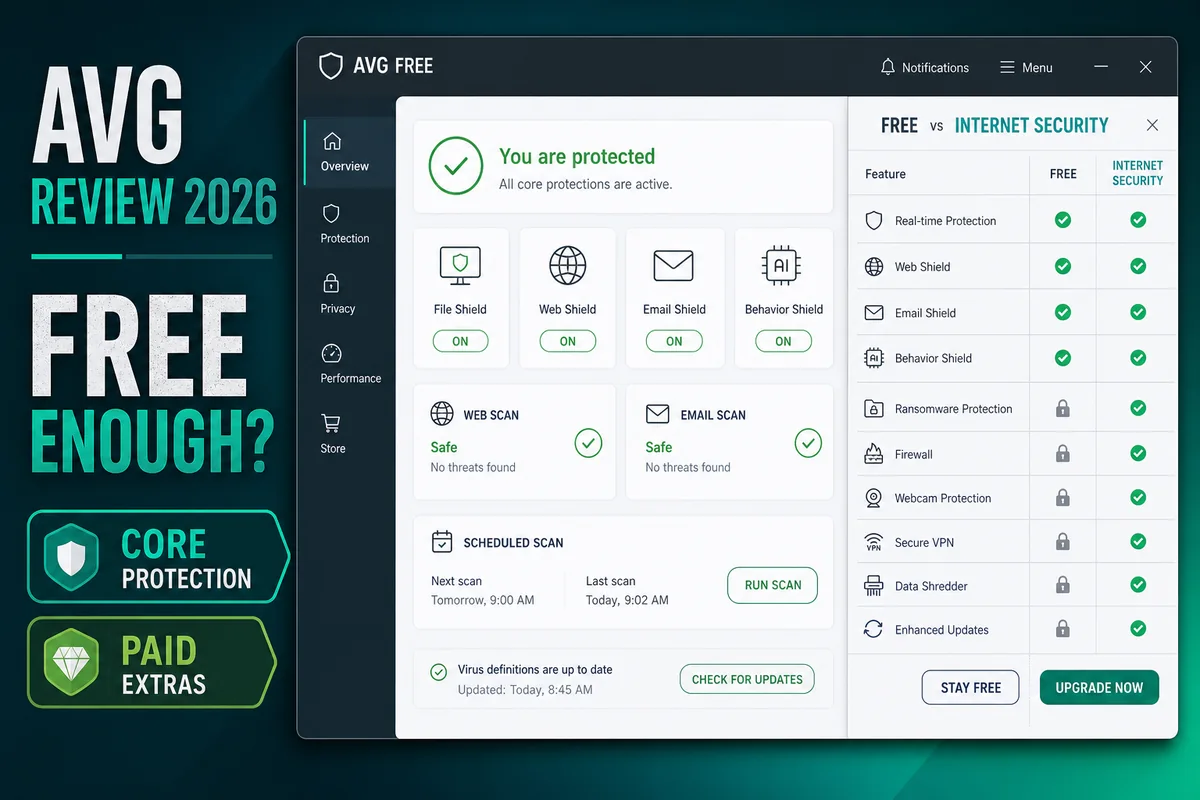
Our verdict: AVG AntiVirus Free is safe, capable and worth considering in 2026. It earned 18/18 at AV-TEST and protected 397 of 400 systems in AV-Comparatives' completed February–May real-world test. Choose it when you want strong free Windows protection with configurable scans, network inspection and a dedicated dashboard. AVG Internet Security is a reasonable upgrade only if its firewall, remote-access, webcam, browser-data and fake-site controls solve a real need across several devices. AVG Ultimate is a VPN-and-maintenance bundle, not “more detection.” Our score is 8.5/10; that's one editorial assessment, not a customer aggregate.
Need a different AVG task? The complete AVG guide hub routes review, plans, setup, troubleshooting, Web Shield, privacy, browser, VPN, Android, utilities, billing and removal without mixing their steps.
- Perfect April AV-TEST score and strong current AV-Comparatives results
- Free File, Behavior, Web and Email shields with real-time protection
- Custom scans, CyberCapture, Rescue Disk and Network Inspector
- Low 5.5 impact result on AV-Comparatives' low-end test PC
- Ten-device Internet Security and Ultimate options
- Free-tier product offers can't be fully disabled
- AVG and Avast share an engine, owner and nearly identical current lab data
- Internet Security displays VPN and TuneUp that require separate subscriptions
- Introductory prices rise materially at renewal
- Gen Digital/Avast privacy history remains a reasonable trust consideration
AVG Antivirus at a glance
AVG sells three main consumer choices. AntiVirus Free provides the core malware engine and several practical Windows tools. Internet Security adds premium attack, privacy and network controls. Ultimate combines Internet Security with AVG Secure VPN, AVG TuneUp and AntiTrack in the current US store. Other AVG products—Driver Updater, BreachGuard, Secure Identity and specialist mobile apps—can be separate purchases.
The free product isn't an expiring detection demo. AVG says it activates automatically after installation, although it may ask for free reactivation after 12 months. The main File, Behavior, Web and Email shields run in real time, and the independent labs test the free Windows build. Paying expands features and device/platform rights; it doesn't replace a weak signature database with a strong one.
AVG Technologies was acquired by Avast in 2016, and AVG now sits with Avast, Norton and Avira under Gen Digital. The March 2026 AV-Comparatives report explicitly says AVG and Norton use the Avast engine. That's why AVG, Avast and Norton often post identical malware figures. It doesn't make the finished apps identical: interfaces, extra layers, plan terms, alerts and support experience can still differ.
AVG independent lab results in 2026
Several high-ranking AVG reviews still quote the February AV-TEST cycle, where AVG received 17.5/18. That was accurate then, but it's no longer the newest result. AVG AntiVirus Free 26.2 and 26.3 reached 18/18 in April. The complete AV-Comparatives real-world cycle also extends through May rather than stopping at the February–March factsheet.
| Independent test | Period / build | AVG result | Decision value |
|---|---|---|---|
| AV-TEST Windows 11 | March–April 2026 Free 26.2 / 26.3 | 6/6 protection 6/6 performance 6/6 usability | Top Product result with full marks under the lab's default-setting protocol. |
| AV-C Real-World Protection | February–May 2026 400 cases | 99.3% protected 397 blocked 3 compromised 5 false alarms | Strong URL/payload defense, matching Avast and Norton in protection and false alarms. |
| AV-C Malware Protection | March 2026 10,000 cases | 96.3% offline detection 98.7% online detection 99.97% online protection 9 false alarms | Cloud and execution-time layers materially improved final protection. |
| AV-C Performance | April 2026 Low-end Windows 11 PC | Impact: 5.5 AV-C 90 / Procyon 94.5 | One of the lighter results; this measures task impact, not detection. |
The results are excellent, not flawless
AVG blocked 397 of the 400 real-world cases and left three test systems compromised. Five clean cases generated false alarms. Kaspersky and Bitdefender blocked more in that cycle, while Defender produced fewer false alarms. A 99.3% result supports recommending AVG; it doesn't support promising that a free antivirus makes unsafe downloads harmless.
Why three malware percentages belong in the table
Offline detection shows what AVG recognized without cloud connectivity. Online detection adds current cloud classification. Online protection adds behavior and other execution-time defenses that can prevent infection after initial recognition misses a file. Reporting only 96.3% makes AVG look weaker than the tested outcome; reporting only 99.97% hides its cloud dependence and nine false alarms.
Run AVG with current definitions and all core shields active if you want a setup close to the lab default. Passive Mode, broad exclusions or a permanently isolated PC create a different protection state. No score covers stolen passwords, weak MFA, unpatched software or the ability to restore encrypted files.

AVG Free vs Internet Security vs Ultimate
The useful plan question isn't “is paid antivirus more powerful?” It's which additional controls you'll configure and use. AVG's current Antivirus and Internet Security FAQ separates the free Core Shields from premium Remote Access Shield, Browser Defense, Webcam Protection, Sensitive Data Shield, Fake Website Shield and Data Shredder.
| Plan | Core job | What you're paying for | Who should choose it |
|---|---|---|---|
| AVG AntiVirus Free | Real-time malware, behavior, web and mail protection; scans and network checks. | $0. Product offers remain part of the free experience. | One or two Windows users who need strong protection, not a bundle. |
| AVG Internet Security | Free core plus premium remote-access, browser-data, webcam, sensitive-file, fake-site and firewall controls. | Up to 10-device subscription in the current store; platform features differ. | Households that will use the specific security layers across several devices. |
| AVG Ultimate | Internet Security plus Secure VPN, TuneUp and AntiTrack in the current store. | Higher renewal for privacy and maintenance tools, not a better tested engine. | People replacing separate VPN and maintenance subscriptions. |
The free tier is more complete than a scan-only tool
File Shield checks files before opening or changing. Behavior Shield watches running processes for suspicious actions. Web Shield inspects transferred web data, and Email Shield scans mail handled by desktop clients such as Outlook or Thunderbird; webmail is covered through other web defenses. CyberCapture can hold rare files for cloud analysis. Quarantine isolates detected files. Rescue Disk creates bootable scanning media. Network Inspector checks the router, connected devices and visible weaknesses.
Internet Security isn't AVG Ultimate Lite
Internet Security can show AVG Secure VPN and AVG TuneUp inside the app, but AVG's own FAQ says those products require separate paid subscriptions. Don't mistake a tile in the dashboard for an included entitlement. The current store positions Ultimate as the bundle that includes Internet Security, VPN and TuneUp, with AntiTrack also shown in its feature comparison.
Multi-Device Internet Security covers up to 10 devices across Windows, Mac, Android and iOS, but “10 devices” doesn't mean every Windows feature appears on every platform. iOS can't receive a Windows-style system scanner or firewall. Confirm the exact Mac/mobile app and entitlement before buying for a mixed household.

AVG pricing, renewal and cancellation
On July 23, 2026, the official AVG US store showed Internet Security for 10 devices at $59.88 for the first year with a $99.99 annual renewal. Ultimate for 10 devices showed $59.88 for the first year and $149.99 at renewal. Offers, taxes and regional plans can change, so the dated comparison below isn't a price guarantee.
| Plan | July 23 US first year | Displayed renewal | Renewal increase |
|---|---|---|---|
| AntiVirus Free | $0 | $0 for the core app | No antivirus charge; offers remain visible. |
| Internet Security 10 devices | $59.88 | $99.99/year | $40.11 higher, about 67% above the first-year offer. |
| AVG Ultimate 10 devices | $59.88 | $149.99/year | $90.11 higher, about 150% above the first-year offer. |
The identical first-year promotion makes Ultimate look automatic, but the renewal tells the real story. At $149.99, VPN, TuneUp and AntiTrack must justify roughly $50 more per year than Internet Security. If you already have a VPN or use Windows maintenance tools, the bundle can duplicate spending.
AVG's billing FAQ says annual subscriptions can be charged up to 35 days before the next term. It also says an introductory discount applies only to the first subscription period and that AVG emails before payment. That means “cancel before expiration” can be too late; cancel before the Next charge date shown in the account.
A paid trial with a payment method converts on its final day unless canceled. Canceling renewal normally lets the paid product run until the current period ends; it isn't automatically a prorated refund. Purchases through Apple or Google follow their store flows. Keep the order email, record the next charge date and verify the status changes to Expiring after cancellation.

The AVG Free protection features that matter
Smart Scan mixes security and maintenance findings
Smart Scan checks for viruses, vulnerable software, browser add-ons, network weaknesses and performance items. That breadth is convenient, but it creates the product's most confusing sales moment. Malware is a security finding. Junk files, startup impact or a TuneUp recommendation are maintenance findings. Read the category before clicking a paid resolution button.

Core Shields cover files, behavior, web and desktop email
Keep all four core shields active. File Shield is the local gate; Behavior Shield is the execution-time safety net; Web Shield can stop malicious content before it lands; Email Shield works with messages handled by supported local mail clients. Gmail or Outlook.com in a browser isn't left unprotected—it passes through web layers rather than the desktop-client mail protocol scanner.
CyberCapture and cloud protection
CyberCapture can hold a rare suspicious file and send it to AVG's lab environment for analysis. That's useful for new, low-reputation executables, but uploading a file can have confidentiality implications. Don't submit proprietary documents, client data or sensitive binaries without checking policy and your organization's rules.
Ransomware Protection needs a backup beside it
AVG's Ransomware Protection identifies personal-data folders and controls untrusted changes. Test whether editors, backup tools and specialist applications can save correctly. Then maintain a disconnected or versioned backup. Anti-ransomware can block an attack; only a tested recovery copy answers what happens after encryption, deletion or account compromise.
Network Inspector finds questions, not always intruders
A network scan can identify router weaknesses and connected devices. Unknown labels are often a TV, phone using a private MAC address, printer or guest—not proof of compromise. Match IP/MAC details to your router, change default admin credentials, update router firmware and disable exposed remote administration before assuming the antivirus can repair every network risk.
Rescue Disk is a useful recovery option
A bootable scanner can inspect a Windows system without trusting every running process. Create Rescue Disk before an emergency, store it safely and refresh it when needed. For a suspected active compromise involving accounts or remote access, isolate the device and plan credential recovery from a clean system; an offline malware scan is only one part of incident response.
Which AVG Internet Security features can justify paying?
Enhanced Firewall and Remote Access Shield
Enhanced Firewall provides application-level network rules and blocks unauthorized communication. Remote Access Shield focuses on risky IP addresses, known remote-desktop vulnerabilities and brute-force attempts. These controls matter most when Remote Desktop or other services are intentionally exposed. The safer first move is still to disable unused remote access, patch the system and place required services behind a VPN or zero-trust gateway.
Browser Defense and Webcam Protection
Browser Defense limits which applications can access saved passwords and cookies. That's useful because stealing an authenticated browser session can bypass MFA. Webcam Protection controls untrusted camera access. Windows and macOS provide their own permission layers, so test whether AVG adds clearer visibility for your workflow rather than paying for a duplicate checkbox.
Sensitive Data and Fake Website shields
Sensitive Data Shield restricts access to documents AVG identifies as containing personal information. Fake Website Shield protects against malicious DNS redirection. Neither can verify a fraudulent seller or every new phishing domain. Use unique passwords, passkeys or MFA and type important financial addresses independently instead of trusting a link in a message.
Data Shredder has a narrower modern use
Secure overwrite is useful on some traditional hard drives and before certain disposal scenarios. On SSDs, wear leveling means overwriting a file doesn't guarantee every physical copy is touched. Full-disk encryption from the beginning, vendor secure erase and documented device-disposal procedures are stronger strategies than relying on a context-menu shred command.
These features can justify Internet Security for a Windows household that will configure them. They don't automatically justify Ultimate. VPN and TuneUp should be evaluated as standalone products with their own privacy, performance and renewal questions.
Performance: low lab impact, but scan timing still matters
AVG earned 6/6 for performance at AV-TEST in April. AV-Comparatives grouped AVG with Avast at a 5.5 total impact score: AV-C task score 90 and Procyon Office score 94.5. Only McAfee, Kaspersky, ESET, Trend Micro and Norton posted a lower impact number in that cycle. The no-security baseline scored 100 in Procyon, so 94.5 is light rather than literally free.
AVG offers Smart, Deep, file/folder, USB/DVD, boot-time and custom scans depending on the Windows build. A deep scan touches more data and may be visible on a large archive, development tree, game library or slow disk. The official FAQ correctly says impact depends on system configuration and simultaneous scans.
- Remove an old real-time antivirus first. Let Windows register one active provider rather than forcing two engines to inspect every file.
- Finish updates and the first scan. Measure normal use only after initial indexing and definition downloads settle.
- Create one relevant custom test. Time file copies, app launches, builds, sync and games on the same power mode.
- Use Do Not Disturb for fullscreen apps. It suppresses unnecessary notices; it shouldn't be treated as a promise to hide critical protection events.
- Audit exceptions. Remove broad Downloads, profile, drive or script exclusions. An exclusion is a security boundary, not a free speed tweak.
- Verify the active engine after uninstall. Open Windows Security and confirm Microsoft Defender has reactivated if AVG is removed.
AVG's Passive Mode keeps definitions and manual scanning available while disabling active shields and firewall. It can reduce conflicts when another antivirus is primary, but it doesn't mean two complete real-time engines are cooperating. If AVG is the product you rely on, ensure Passive Mode is off and the dashboard says the computer is protected.
Privacy settings and Gen Digital trust context
AVG is legitimate security software, not malware. It also belongs to a corporate group with a material privacy history. Gen Digital officially lists AVG beside Avast, Norton, Avira and other brands. The FTC's finalized 2024 order concerned Avast and Jumpshot browsing-data practices alleged from 2014 through 2020. It required a $16.5 million payment, deletion, consent and privacy-program measures and limits on selling/licensing browsing data for advertising.
That order matters when evaluating the owner of software with deep device access. It doesn't prove that today's AVG app sells browsing histories, and we found no primary basis for making that claim. A careful review should disclose the relationship without transplanting every allegation to a different current product.
AVG's current privacy-settings guide says users can disable suspicious-sample sharing, app-usage analytics and personalized discounts in the applicable Personal Privacy screen. It also states that offers can't be disabled in AVG AntiVirus Free. Paid editions expose more offer controls, including relevant AVG and third-party product offers.
- Open Menu → Settings → General → Personal Privacy. Read each control in the current build rather than following an old screenshot.
- Decide on suspicious-sample sharing separately. It can improve detection, but confidential files may need organizational rules.
- Disable optional app-usage analytics and personalized discounts if they don't match your preference.
- Review browser extensions. Install an AVG extension only when its specific protection earns the access it requests.
- Expect some free-tier offers. If that product design is unacceptable, Defender or another vendor is the cleaner answer.
Privacy is a selection criterion, not a substitute lab score. Someone can reasonably accept AVG's current controls and use its strong free engine. Someone else can reasonably choose Defender, Bitdefender or ESET because comparable protection exists without AVG's exact ownership and offer model.
What current AVG users praise—and complain about
Current community discussions match the controlled evidence on protection: AVG Free is usually treated as capable, and the recurring debate is whether it adds enough over Microsoft Defender. Users who prefer a dedicated app and more scan/network controls see value. Others regard a separate installer and account as unnecessary on an updated Windows 11 PC.
The repeated complaint is product messaging. A July 2026 Silent Mode thread described AVG suppressing routine maintenance notices while still surfacing security or product-related messages. Older 2026 threads complain that the app opens itself or promotes fixes. AVG's own support page provides the decisive context: offers can't be disabled in Free. We therefore treat this as a documented product trade-off, not just one unhappy post.
Community reports also help distinguish fake browser alerts from AVG itself. A webpage notification claiming “AVG found viruses” may be a scam sent through Chrome or Edge, even if AVG is installed. Check the notification source, open AVG from the Start menu and inspect its event history. Never call a number or buy a subscription from a browser toast.
Who should use AVG—and who should choose an alternative
- You want excellent current Windows protection for $0
- You prefer AVG's scan controls and dashboard to Defender
- Network Inspector and bootable Rescue Disk are useful to you
- You can distinguish security alerts from maintenance sales
- You accept that some free-tier offers can't be disabled
- You want the quietest built-in free Windows baseline
- You already dislike Avast's engine, owner or product approach
- The Gen Digital/Avast trust history crosses your threshold
- You need parental controls, cloud backup or identity restoration in one suite
- You need business EDR, centralized policy and response—not a home app
Internet Security makes most sense for several active devices, especially Windows PCs where its premium layers are available. For one well-managed laptop, paying $99.99 at renewal for antivirus alone is weak value beside AVG Free or Defender. Ultimate needs a stronger test: will Secure VPN and TuneUp replace tools you already pay for, and will the $149.99 renewal remain competitive?
AVG vs Avast, Microsoft Defender, Bitdefender, Norton and ESET
| Option | Choose it for | Main trade-off against AVG | Read next |
|---|---|---|---|
| AVG Free | Configurable free protection with excellent shared-engine results. | Documented free-tier offers and Gen Digital overlap. | AVG vs Avast |
| Avast Free | The newest modular Avast One interface and scam-protection focus. | Same engine/owner and similar promotion/privacy questions. | Avast review |
| Microsoft Defender | No extra install, account, renewal or in-product offers. | Less guided dashboard; slightly lower 99.0% current real-world result. | Defender review |
| Bitdefender | Different engine, excellent protection and rich paid Windows controls. | Plan/renewal complexity and Total Security VPN cap. | Bitdefender review |
| Norton 360 | VPN, password manager, family tools and Windows cloud backup in one bill. | Higher renewal, upsell complaints and Avast engine relationship. | Norton review |
| ESET | Different corporate/engine choice, granular controls and low impact. | No permanent free tier and fewer lifestyle extras. | ESET review |
Avast is a preference change more than a technology escape. Defender is the cleanest free alternative. Bitdefender and ESET are more meaningful independent-vendor comparisons. Norton broadens the bundle but shares the engine relationship documented by AV-Comparatives. Choose on the whole product and second-year total, not logo familiarity.
Frequently asked questions about AVG Antivirus
Is AVG AntiVirus Free safe to use in 2026?
Yes. AVG is legitimate antivirus software and its free Windows build earned 18/18 at AV-TEST in April 2026. It also protected 397 of 400 systems in AV-Comparatives' February–May real-world test. Review current privacy settings and expect some free-tier offers, but those product concerns don't make AVG malware.
Is AVG Free really free?
The core real-time antivirus can be used without an antivirus subscription. It may request free reactivation after 12 months and promotes paid products. AVG's current support page says offers can't be disabled in AntiVirus Free, so free doesn't mean promotion-free.
Are AVG and Avast the same antivirus?
AVG and Avast are Gen Digital brands, and AV-Comparatives explicitly says AVG uses the Avast engine. Their current lab results therefore match closely. They aren't identical apps: interface, features, product packaging, notifications and support experience can differ.
Is AVG better than Microsoft Defender?
AVG recorded 99.3% protection in AV-Comparatives' current real-world cycle versus Defender's 99.0%, but AVG had five false alarms while Defender had zero. AVG offers more visible scans and network tools; Defender requires no separate app, account or offers. Both are credible, so choose the better workflow and trust fit.
Is AVG Internet Security worth paying for?
It can be worth it for a multi-device household that will use Enhanced Firewall, Remote Access Shield, Browser Defense, Webcam Protection, Sensitive Data Shield and Fake Website Shield. It's weak value if you only need malware protection, because AVG Free contains the tested core engine.
Does AVG Internet Security include VPN and TuneUp?
No. AVG's official FAQ says Secure VPN and TuneUp may appear inside Internet Security but require separate paid subscriptions. The current AVG Ultimate bundle includes Internet Security, Secure VPN and TuneUp, with AntiTrack shown in the store comparison.
How much does AVG renew for after the first year?
On our July 23, 2026 US-store check, 10-device Internet Security was $59.88 for the first year and $99.99 at renewal. Ultimate was $59.88 and renewed at $149.99. Prices can change; annual billing may occur up to 35 days before the next term, so use the account's Next charge date.
Can I turn off AVG popups and offers?
Do Not Disturb can suppress unnecessary notices during fullscreen apps, and paid editions expose notification and offer controls. AVG's privacy-settings guide says offers can't be disabled in AntiVirus Free. If a quiet, offer-free app is essential, Microsoft Defender or another vendor is a better fit.
Final verdict: strong free protection, limited reason to pay
AVG AntiVirus Free has the evidence needed for a confident technical recommendation: 18/18 at AV-TEST, 99.3% in the completed real-world cycle, 99.97% online malware protection and a low 5.5 performance impact. Its free Core Shields, CyberCapture, Network Inspector, custom scans and Rescue Disk make it more than a basic scanner.
The product decision is less impressive than the engine. Avast shares the same core and current results. Defender is already built into Windows without offers. AVG says Free offers can't be fully disabled. Paid pricing jumps from $59.88 to $99.99 for Internet Security and to $149.99 for Ultimate in the current US snapshot, while VPN and TuneUp shown inside Internet Security still require separate subscriptions.
Bottom line: install AVG Free when its dashboard and controls suit you better than Defender or Avast. Pay for Internet Security when premium remote-access, browser, webcam, fake-site and data controls have a named use across several devices. Buy Ultimate only if its VPN and TuneUp replace real spending. Choose another vendor when quiet operation or Gen Digital trust separation matters more.
Continue your antivirus comparison
Compare the current shortlist in our best antivirus software guide, browse the product review directory, read AVG versus Avast, or see how we separate lab tests, recovered evidence and community reports.