
ZoneAlarm Review 2026: Strong Firewall, Mixed Protection
ZoneAlarm NextGen is current and its two-way firewall remains distinctive. The harder question is whether one strong 2025 malware result offsets five misses, slow scans and thin major-lab coverage.
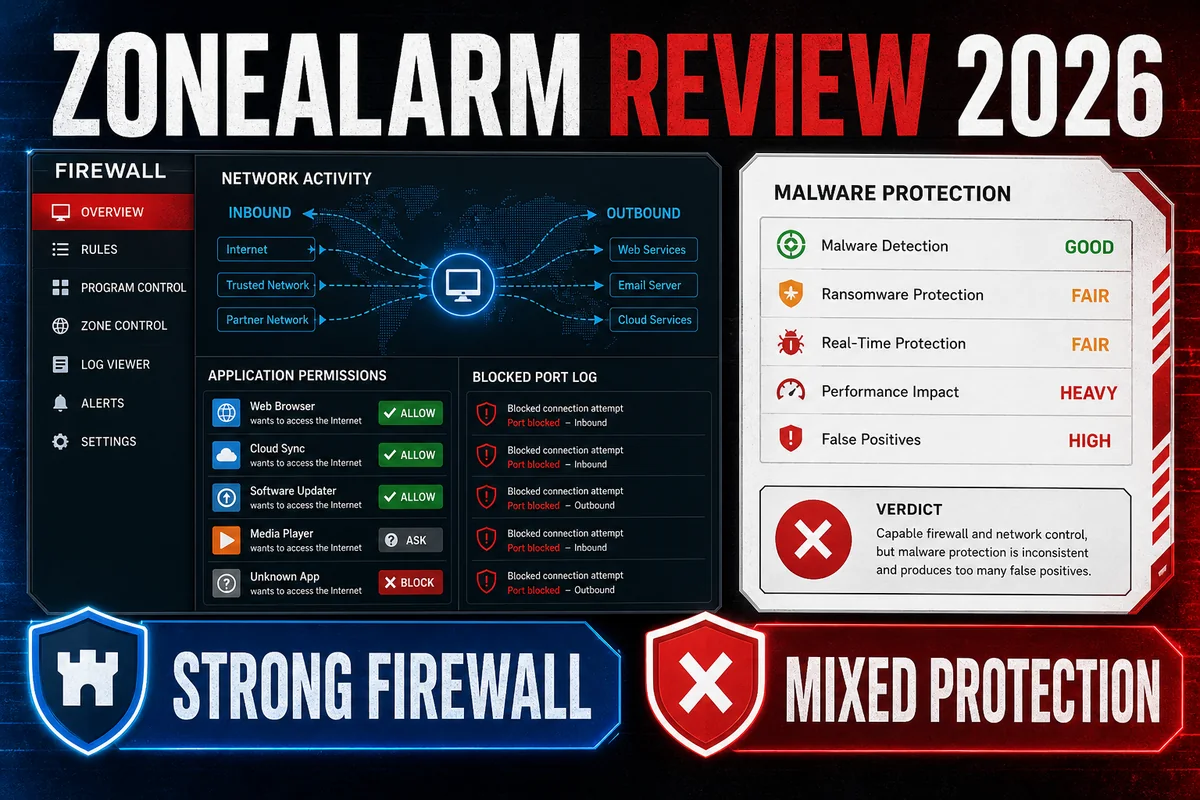
Our verdict: ZoneAlarm is no longer the neglected legacy suite described by many current-looking reviews. Check Point's release index lists NextGen 4.4.211 from January 19, 2026, and the same branch now powers Free Antivirus + Firewall, Pro and Extreme. Its firewall offers outbound application control, zones and Expert Rules that Windows' built-in interface doesn't make as approachable. Protection is credible, not flawless: AVLab measured 1,834 of 1,839 real threats neutralized in three 2025 rounds, or 99.72%, with five potential compromises. Slow third-party scan observations, weak fake-shop detection, polarized owner reports and no current direct AV-TEST result keep it below the leaders. Choose it when firewall control is the reason; don't install it merely to replace a well-running Defender setup. Score: 7.3/10.
- Current 2026 NextGen release
- Useful inbound and outbound application control
- Expert firewall rules added to the current build
- Strong 99.72% AVLab real-world result
- Free antivirus-plus-firewall edition
- Threat emulation, extraction and ransomware remediation in paid tiers
- 30-day return window
- Five AVLab compromises across 1,839 samples
- No direct current consumer AV-TEST result
- Poor 2024 fake-shop detection bands
- About 50 minutes per full scan in one published test
- No bundled VPN or password manager
- Must remove other anti-malware software
- Reports of false positives, blocked traffic and uninstall remnants
ZoneAlarm at a glance
ZoneAlarm began as a personal firewall, and that heritage still defines the decision. Windows Defender Firewall already blocks unsolicited inbound traffic well; ZoneAlarm earns its place by exposing outbound program permissions, network zones, logs and custom rules in one consumer product. The antivirus isn't a decorative add-on, but the firewall is still the clearest reason to install it.
| Question | Evidence checked | Our answer |
|---|---|---|
| Is it current? | Version 4.4.211, released January 19, 2026 | Yes. The consumer NextGen branch is actively maintained. |
| Does it stop malware? | 99.72% in three AVLab 2025 rounds | Strong overall, with five failures that matter. |
| Is the firewall useful? | Two-way control, application permissions, zones and Expert Rules | Yes, especially for users who need visible outbound control. |
| Is Free enough? | Real-time antivirus plus personal firewall for Windows | Enough to evaluate the model; paid tiers add the stronger web/cloud layers. |
| Is Extreme a full lifestyle suite? | No VPN or password manager in the listed feature set | No. It's a focused security suite, not a Norton-style extras bundle. |
| Can it run beside another antivirus? | Vendor permits Defender only | No. Remove other anti-malware software first. |
We score ZoneAlarm as an editorial review, not a crowd poll. The old page displayed two user votes and an expired price in structured data; both have been removed. A security recommendation should follow the current binary, current tests and current contract—not a historical reputation score.
NextGen 4.4.211 is a different product line from legacy ZoneAlarm
The most common factual error in ZoneAlarm reviews is treating every generation as the same application. The current Extreme Security NextGen changelog identifies build 4.4.211 and lists Expert Firewall Rules, upgraded security engines plus performance and stability improvements. Pro Antivirus + Firewall NextGen, Free Antivirus + Firewall, Free Firewall and Anti-Ransomware use the same public version number.
That matters because old screenshots, scan behavior and engine claims don't automatically describe NextGen. Our previous page said ZoneAlarm used licensed Kaspersky technology. The statement had historical support for older builds, including an AV-Comparatives report from 2017, but current official material doesn't identify Kaspersky as the NextGen engine. Check Point now describes behavioral blockers, heuristics, its real-time cloud database and Check Point ThreatCloud intelligence. We found community speculation about Sophos components too, but no current vendor document that justifies naming a third-party engine.
The careful answer is simple: ZoneAlarm is a Check Point consumer product using NextGen security engines and ThreatCloud services. Component licensing can change without changing the product name. Unless Check Point publishes the component map, a review should test and report the named product—not guess which logo sits under the hood.
One known security issue is already behind the current branch. NVD describes CVE-2023-28134, a local privilege-escalation flaw requiring an attacker to run low-privilege code first and rated 7.8 High. ZoneAlarm's release history says versions before 4.2.180 were affected and records the fix under 4.2.510. Build 4.4.211 is newer. That's evidence of patching, not proof that no undiscovered defects exist.
AVLab found 99.72% protection—and five compromised cases
The best current independent evidence isn't the AV-TEST badge on the product page. It's AVLab's long-running Advanced In-The-Wild Malware Test on Windows 11 Pro. ZoneAlarm Extreme Security participated in January, March and May 2025, facing 1,839 real malware samples delivered through browser and user-like execution paths.
| AVLab round | Malware samples | Blocked before launch | Stopped after launch | Compromised | Combined protection | Average remediation |
|---|---|---|---|---|---|---|
| January 2025 | 759 | 66.53% | 33.33% | 1 (0.13%) | 99.87% | 31 sec |
| March 2025 | 607 | 55.02% | 44.48% | 3 (0.49%) | 99.51% | 47 sec |
| May 2025 | 473 | 50.11% | 49.68% | 1 (0.21%) | 99.79% | 51 sec |
| Annual tested total | 1,839 | 57.22% | 42.50% | 5 | 99.72% | 43 sec |
The AVLab annual report says 1,834 threats were neutralized and five potentially exposed the operating system or disk data after malicious code ran. That's a strong result in a difficult test, but “99.72%” shouldn't be rounded into perfect protection. On one PC, a single successful credential stealer or ransomware payload is enough.
The layer split is also useful. About 57% were stopped in the browser or immediately after saving; nearly 43% had to execute before runtime defenses intervened. Post-launch remediation is a legitimate protection layer, and AVLab found it normally cleaned incidents without negative system or data impact. Earlier blocking is still preferable because it shortens the window for theft, persistence or lateral movement.
ZoneAlarm participated in only three of AVLab's six 2025 editions. The annual percentage describes those tested rounds, not an uninterrupted full-year sample. That limitation is why we call the result credible and strong rather than comprehensive.

The famous AV-TEST 6/6 score belongs to version 15.6 in 2019
ZoneAlarm's marketing still displays “100% protection — AV Test,” and many 2026 review pages repeat the badge as if it measured today's application. AV-TEST's own Check Point archive shows the exact boundary: the last consumer entry is ZoneAlarm Pro Antivirus + Firewall 15.6 from December 2019. It earned 6/6 Protection, 4.5/6 Performance and 6/6 Usability.
That historical result tells us the old product line could protect well and had measurable performance costs. It can't validate NextGen 4.4.211, whose architecture, engines and interface changed. Current AV-TEST results for Check Point's business endpoint products also can't be transferred to a differently packaged consumer application. Same parent company doesn't mean same configuration, policy or test target.
AV-Comparatives has a newer direct data point, but it answers a narrower question. In its November 2024 Fake-Shops Detection Test, Extreme Security NextGen detected only 11–20%, 11–20% and 21–30% of fraudulent shops across three runs. This was a fake-store test, not its malware or phishing certification, so it shouldn't be converted into an antivirus percentage. It does warn against trusting ZoneAlarm alone to recognize shopping scams.
The two-way firewall is the feature Windows power users will notice
Windows Defender Firewall is a capable stateful firewall and already blocks unsolicited inbound connections. Its standard interface, however, isn't designed around teaching ordinary users which applications are calling out. ZoneAlarm places program permissions, networks and traffic events in the security product itself.
Application Control can allow or block a process from reaching the internet. Public and Trusted Zones let a laptop treat hotel Wi-Fi differently from a known home LAN. Stealth behavior reduces exposed responses to unsolicited probes. Build 4.4.211 adds Expert Firewall Rules for users who need tighter address, port, protocol or direction criteria.
| Control | What it helps with | What can go wrong |
|---|---|---|
| Outbound app permissions | Stops an unknown or unwanted program from phoning home | Blocking a helper, updater or Windows service can break the parent app. |
| Public/Trusted zones | Separates hostile networks from local sharing | Putting an unknown network in Trusted exposes services unnecessarily. |
| Expert Rules | Creates precise traffic policy for advanced use | A broad deny can silently cut off VPN, DNS, streaming or business tools. |
| Early boot/self-protection | Loads defenses early and resists easy termination | Deep drivers complicate troubleshooting and removal after a conflict. |
| Logs and event timeline | Shows which layer blocked a connection | Logs need context; a blocked scan isn't proof that the PC was targeted. |
“Invisible to hackers” is marketing shorthand, not a security guarantee. A host firewall doesn't hide activity from an ISP, website or compromised router, and it can't compensate for a vulnerable browser or stolen password. Its job is narrower: enforce local traffic policy and reduce network exposure.
Most home users who accept Defender's defaults don't need a second firewall product. ZoneAlarm makes sense when you can name the missing control: visible outbound prompts, per-program blocking, separate network trust or custom rules. Installing a privileged network filter without using those controls adds complexity without much benefit.

Free, Pro and Extreme share the core but solve different jobs
ZoneAlarm's naming is messy because “Free Antivirus” also includes a firewall, while “Free Firewall” is a separate download. Pro focuses on Windows antivirus, firewall and browser/cloud defenses. Extreme adds the broader ransomware, content-filtering and multi-device package.
| Capability | Free Antivirus + Firewall | Pro Antivirus + Firewall | Extreme Security NextGen |
|---|---|---|---|
| Real-time Windows antivirus | Yes | Yes | Yes |
| Two-way personal firewall | Yes | Yes | Yes |
| Anti-phishing/Web Secure | Basic lineup doesn't list the paid layer | Yes | Yes |
| Threat emulation/extraction | No in the published free feature set | Yes | Yes |
| Ransomware remediation | General antivirus protection | Product copy mentions ransomware detection | Dedicated behavioral block and restoration layer |
| Content filtering | No | No | Yes |
| macOS/Android/iOS allocation | No; Windows 10/11 | No; Windows 10/11 | Yes; device-dependent apps/features |
| Best fit | Test the firewall model at no cost | Windows PCs needing paid web/cloud layers | Households wanting ransomware and multi-device coverage |
The separate Free Firewall is appropriate when you specifically want network control, but ZoneAlarm says even that product is compatible only with Microsoft Defender and not other anti-malware software. Don't assume “firewall-only” means it can be stacked safely with any third-party suite.
Extreme's platform list needs careful reading. Windows receives the full antivirus/firewall experience. macOS has its own current requirements and security feature set; Android and iOS use ZoneAlarm Mobile Security apps. iOS apps can't perform Windows-style file-system antivirus scanning. A five-device license is a pool of platform-specific products, not five identical copies.

Threat emulation and extraction add value, but no layer is absolute
Paid ZoneAlarm checks files against current cloud reputation and analyzes suspicious downloads. Threat Emulation opens supported documents and executables in a sandbox to look for unknown malicious behavior. Threat Extraction can strip active content, macros, scripts, embedded objects and dangerous links from documents, then deliver a reconstructed copy.
Those techniques reduce reliance on a known-malware signature. They also create tradeoffs: an emulation verdict can delay a download, and a sanitized PDF isn't an editable original Office file. Users should keep the original quarantined only when business policy permits and retrieve it after a trusted security review—not disable the layer for every file.
Extreme's anti-ransomware component uses behavioral detection and promises automated remediation of encrypted files. Behavior-based recovery is valuable, especially against an unknown family. The official claim that every encrypted file can be restored is too broad for an independent review. Ransomware can delete shadow copies, exfiltrate data, corrupt backups or encrypt network shares before a local rollback is complete. Maintain offline or versioned backups even when the security suite offers restoration.
Content Filtering and Safe Search are browser-dependent controls. They can reduce exposure to known categories and suspicious results, but they aren't parental supervision, payment protection or a guarantee that every new scam is categorized. The weak fake-shop result reinforces that boundary.
Web protection is useful against known threats, less convincing against scams
ZoneAlarm's current browser extension supports Chrome, Edge, Firefox and Brave on Windows; the product page also describes Safari for relevant Mac features. It checks URLs, blocks phishing attempts, filters content and applies emulation/extraction to supported downloads. This is broader than DNS blocking alone because the extension can inspect page and submission context.
Independent and hands-on evidence is mixed. The AVLab result shows more than half of its malware set stopped before execution, which supports a useful web/download layer. AV-Comparatives' fake-shop bands were poor. TechRadar's April 2025 test reported immediate handling of a standard malware test file but weak results against malware-hosting sites outside phishing. All About Cookies, updated April 2026, reported two of three EICAR exercises and a failed phishing exercise.
These exercises have different methods and shouldn't be averaged. The practical takeaway is consistent: keep browser and Windows reputation features enabled, use a password manager that refuses to autofill on the wrong domain, verify payment sites independently and don't rely on a single colored warning page to identify fraud.
Published hands-on tests point to slow full scans
We didn't run Windows malware or timed scans on this macOS restoration host, so we won't invent CPU, RAM or scan-time numbers. The best recent reproducible observations come from independent reviewers and owner reports.
TechRadar's 2025 hands-on review recorded about 50 minutes for an initial full scan and 52 minutes for the next one. The lack of a faster repeat suggested limited first-scan optimization in that setup. All About Cookies' 2026 update also characterized both scans as slow and clunky. Hardware, disk contents, archive depth, emulation and current engine versions can change those times, so they're comparison signals rather than promises for every PC.
AV-TEST's 4.5/6 Performance score is much older and belongs to version 15.6, not NextGen. AVLab's 43-second remediation metric isn't scan duration or UI responsiveness; it measures how long automated defenses took to repair live malware incidents.
For daily use, schedule full scans outside work hours and let the first update finish before judging idle load. If performance collapses, first confirm that no second antivirus is running, then identify whether antivirus scanning, Threat Emulation or the firewall driver is responsible. Permanently disabling the failing layer converts a performance problem into a protection gap.
ZoneAlarm supports current platforms but forbids another anti-malware engine
For Windows, Check Point lists Windows 10 and 11, a 2 GHz processor, 1.5 GB of free storage and .NET Framework 3.5 or later. The current Extreme page specifies 3 GB RAM for 32-bit and 4 GB for 64-bit Windows. Its Mac component requires macOS 11 or later, at least 8 GB RAM with 10 GB recommended and 1 GB free storage. Mobile apps require Android 8 or later and iOS 13 or later.
The decisive installation requirement is in plain text on the official Extreme Security page: ZoneAlarm is compatible only with Microsoft Windows Defender and not with any other anti-malware software. The vendor tells users to uninstall other anti-malware products first to avoid stability and performance problems.
Defender normally enters passive/secondary behavior when a registered third-party antivirus takes over; that's the supported coexistence model. Don't try to keep Bitdefender, Norton, Malwarebytes Premium real-time protection or another suite active beside ZoneAlarm. On-demand scanners can still conflict if their self-protection or drivers remain loaded, so check each vendor's compatibility guidance.
VPN clients deserve a test window. ZoneAlarm notes VPN compatibility improvements in earlier 4.2.510, but any local firewall can affect tunnel adapters, DNS, split tunneling and local LAN access. Install before a low-risk period, record working VPN settings and know how to disable the ZoneAlarm firewall temporarily for diagnosis.
Setup is easy only if you prepare for the network-filter change
Before installation, remove the prior antivirus with its normal uninstaller, reboot, run Windows Update and confirm you have local administrator access. Save VPN configuration and any custom Windows Firewall rules. A restore point is useful, but it isn't a backup of irreplaceable files.
- Download only from the official ZoneAlarm domain and verify that the installer is signed by Check Point/Zone Labs.
- Choose Free, Pro or Extreme deliberately; don't accept a paid trial without noting its end and renewal terms.
- Let initial definitions and components update before running a full scan.
- Mark only known private networks as Trusted. Keep airports, hotels and guest Wi-Fi Public.
- Use automatic program decisions initially unless you understand Windows services and helper processes.
- Test browser downloads, printing, file sharing, VPN, video calls and business applications before the rollback window closes.
- Export or document custom firewall rules after configuration; legacy backups can't simply be restored into NextGen.
Expert Rules are powerful precisely because they can break things. Add one rule at a time, name its purpose and test it. A rule that blocks a noisy application is better than a global policy that silently breaks every connection using the same service or port.
Owner feedback is polarized around control, false positives and connectivity
Community evidence is useful for discovering failure modes, not calculating protection. When checked, Trustpilot showed 126 total reviews, 32 in the previous 12 months and a heavily polarized distribution. Recent positive reviewers praised long-term reliability and helpful support. Recent negative reviewers described lost connectivity, repeated first-attempt blocks, difficult support and unwanted detections.
A detailed ZoneAlarm support-community thread on false malware reports includes NextGen users who said old installers and mail archives were newly flagged, some file types or folders couldn't be excluded, and restores sometimes stalled. Other users reported that exclusions helped and detections later quieted. The thread isn't a controlled false-positive test, but its repeated workflow complaints are relevant before entrusting rare software or large archives to automatic quarantine.
Migration is another theme. NextGen was built separately from the 15.x line, and an official support response says old settings backups can't be restored. Long-time users who expected the exact old prompts and controls sometimes experienced the new interface as a downgrade. Build 4.4.211's Expert Rules address part of that gap, but not every legacy workflow.
We don't quote anonymous praise as proof of malware efficacy or anonymous complaints as proof that every installation fails. Use owner reports to build a test checklist: restore a harmless test file, verify exclusions, test VPN/LAN access, confirm uninstall and contact support before a deadline matters.
ThreatCloud improves detection by sending security metadata off the device
Cloud reputation and threat emulation can't operate entirely offline. ZoneAlarm's data sheet says security analysis occurs on the device with anonymized metadata collected from the operating system, apps, web and networks, and that links are checked against Check Point ThreatCloud. Suspicious files or document characteristics may be evaluated by emulation services depending on the feature.
The broader ZoneAlarm privacy policy covers account and contact data, device/product activity, security reports, support history, cookies, analytics, marketing, vendors, Check Point affiliates and international transfers. It also says data can be used for threat analysis, product improvement, security monitoring and communications. That's more realistic than the product page's simple “100% privacy” phrase.
For an ordinary home PC, the trade can be reasonable: cloud intelligence sees new files and URLs faster than a local signature set. Sensitive organizations should confirm which file types are uploaded, whether extraction/emulation can send document content, retention, region and opt-out controls before deploying the consumer product. Don't feed confidential documents into a cloud sandbox solely to see whether it blocks them.
Safe Search can involve third parties receiving IP addresses and search terms for results, measurement or advertising, according to the privacy policy. Users who don't want that data path can use the security extension without adopting a replacement search provider where the controls allow it.
ZoneAlarm is inexpensive at checkout, but compare the renewal basis
Prices are dynamic by country, tax, device count, term and promotion. On July 14, 2026, the official site redirected our session to Germany and rendered the following VAT-localized one-year figures. These are a dated buying snapshot, not a universal price guarantee.
| Plan and devices | Displayed discounted payment | Displayed crossed/list price | What to verify |
|---|---|---|---|
| Pro · 1 PC · 1 year | €50.34 | €55.46 | Windows only; discount is first payment. |
| Pro · 3 PCs · 1 year | €63.15 | €68.27 | Check renewal for the exact device tier. |
| Pro · 5 PCs · 1 year | €67.42 | €72.54 | Compare with Extreme's extra platform/features. |
| Extreme · 1 device · 1 year | €72.54 | €84.49 | Platform-specific features; not all devices get a PC firewall. |
| Extreme · 3 devices · 1 year | €76.81 | €89.62 | Confirm which device allocations are needed. |
| Extreme · 5 devices · 1 year | €89.62 | €98.16 | Check renewal and tax on the final cart. |
ZoneAlarm explicitly says the discount applies to the first payment only. That phrase matters more than a large percentage badge: the next charge can be based on a different renewal price. Screenshot the final cart showing product, devices, term, tax and next billing terms.
Value depends on what you'd otherwise buy. Pro is attractive when advanced firewall and web/download controls are the target. Extreme is less compelling if you also need a VPN, password manager, identity monitoring, cloud backup or full parental controls, because those require separate products. Our internet security suite guide compares bundles where those extras are part of the subscription.

Web purchases auto-renew; uninstalling doesn't cancel billing
ZoneAlarm's subscription instructions say a website purchase is set to renew automatically. To change it, sign in to myAccount, open My Products and use the auto-renewal control under the subscription. Keep the confirmation email or screenshot.
Removing the application doesn't terminate the payment contract. Cancel renewal separately, preferably well before the billing date. If the license came through an app store or reseller, use that seller's subscription controls instead of assuming ZoneAlarm myAccount owns the charge.
The official return policy allows a return up to 30 days from purchase and directs customers to support chat/email or listed phone routes. It says the company processes the credit within seven days, after which a card issuer may need another two to ten business days. Submit the request with order number, product, date and reason, and keep the case ID. Local consumer law may provide additional rights.
Renewal prices aren't published as a stable universal table on the product page. Before buying, treat the first-year figure as an introductory payment and decide whether the full value still works without the discount.
How to handle a false positive or a firewall that blocks the internet
A security alert and a broken connection require diagnosis, not an immediate permanent shutdown. Save the alert name, file path, ZoneAlarm event, timestamp and recent change before clicking Delete.
If a legitimate file is quarantined
- Leave it quarantined while you verify the digital signature, source and expected hash.
- Submit the file or hash through official ZoneAlarm support as a suspected false positive.
- Wait for updated definitions or a vendor verdict; the official quarantine workflow supports rescan, restore and delete.
- Restore only when the provenance is strong. An old file isn't safe merely because it worked years ago.
- Add the narrowest possible exception. Don't exclude an entire downloads or backup drive to rescue one item.
If websites, VPN or LAN access stops
- Check the event timeline for the exact application, adapter, destination or rule blocked.
- Confirm the current network is in the correct Public or Trusted zone.
- Temporarily turn only the ZoneAlarm firewall off to test causation, then turn it back on.
- Disable the newest custom rule or reset the affected program permission instead of opening all traffic.
- For VPN trouble, update both products and recreate the tunnel adapter/rule after documenting settings.
- If connectivity returns only after uninstall, use the official removal path and contact support with logs.
Don't disable Windows security services, Memory Integrity or driver-signature enforcement to force a security suite to work. A product that requires weakening the platform has failed the compatibility test.
Uninstall NextGen normally and verify that networking recovers
Check Point's NextGen removal instructions use Windows Settings → Apps → Installed apps/Apps & features → ZoneAlarm → Uninstall. The vendor warns that removal can take many minutes and shouldn't be interrupted. Reboot when finished.
After restart, confirm Microsoft Defender Antivirus and Windows Defender Firewall are active, run Windows Update and test browsers, DNS, VPN and local sharing. Don't delete random Check Point services or network drivers by name while they're loaded.
A 2024 support-community report described ZoneAlarm updater services and hundreds of megabytes remaining after NextGen uninstall. An official representative acknowledged the concern and said a cleanup tool was in development, but no release date was given in that thread. A single report doesn't establish that current 4.4.211 always leaves remnants. It does justify checking Installed apps, services and network adapters when the original problem persists.
If the normal uninstaller fails, contact official support for a cleanup procedure that explicitly names NextGen and the current version. Create a backup first. Avoid old CLEAN.exe links from forums unless ZoneAlarm support confirms they apply to 4.4.211; legacy removal tools can target different drivers and registry layouts.
ZoneAlarm is best for a specific firewall-first user
Choose ZoneAlarm when: you use Windows 10 or 11, want visible outbound application control, will maintain network zones/rules, accept a focused suite without a VPN/password manager and can test compatibility during the refund window. Start with Free Antivirus + Firewall when you want to understand its decisions before paying.
Choose Pro when: you want the Windows firewall plus anti-phishing, cloud emulation/extraction and web monitoring, and the localized price is lower than a broader suite you wouldn't use.
Choose Extreme when: ransomware remediation, content filtering and a pool covering Windows, Mac, Android and iOS are useful, with the understanding that features differ by platform.
Skip it when: Defender already meets your needs, you require consistently quiet operation, another real-time anti-malware product must remain installed, you need broad current major-lab participation, or you want one subscription to include VPN, password management, backup and identity services.
Businesses shouldn't turn a consumer Extreme license into an endpoint-management strategy. Central policy, tamper reporting, incident telemetry, deployment, EDR and support SLAs belong to a business endpoint product tested in that configuration.
ZoneAlarm alternatives depend on whether you need firewall control or a suite
| Need | Alternative | Why choose it instead |
|---|---|---|
| Quiet built-in Windows protection | Microsoft Defender | No extra subscription or third-party network driver; strong current lab coverage. |
| Broad security suite and current labs | Bitdefender Total Security | Stronger current multi-lab record and a broader feature bundle; firewall control is less ZoneAlarm-like. |
| VPN, password manager and backup | Norton 360 | More complete lifestyle-security bundle, with a higher renewal price to manage. |
| Highly configurable Windows suite | Comodo Internet Security | Deep containment/firewall controls; requires more expertise and careful current-version review. |
| Simple free antivirus | Avast Free Antivirus | Broader user-facing extras and current test visibility; free edition advertising/upsell remains a tradeoff. |
| Second-opinion cleanup | Malwarebytes Free | Use on demand with Defender; it doesn't replace ZoneAlarm's two-way firewall. |
A standalone firewall such as TinyWall may suit users who want a lightweight interface over Windows Firewall rather than a full antivirus replacement. Verify current Windows-version support and maintenance before adding any privileged network filter. The name “firewall” doesn't make old driver software low risk.
Frequently asked questions
Is ZoneAlarm still good in 2026?
It's a credible firewall-first Windows product. Build 4.4.211 is current, and AVLab measured 99.72% protection in three 2025 rounds. Five samples still potentially compromised the test systems, scans were slow in published hands-on reviews and current major-lab coverage is limited. We rate it 7.3/10.
Does ZoneAlarm still use Kaspersky's antivirus engine?
Older ZoneAlarm versions used Kaspersky components, but current official NextGen material doesn't identify Kaspersky as the engine. Check Point describes upgraded NextGen security engines, behavioral and heuristic analysis, a real-time cloud database and ThreatCloud AI. We don't transfer the legacy engine claim to version 4.4.211.
Is ZoneAlarm Free better than Microsoft Defender?
Not automatically. Defender is built into Windows and has broad current lab coverage. ZoneAlarm Free adds a more visible two-way firewall and outbound application control, which can help users who need those controls. If Defender and Windows Firewall already run quietly, ZoneAlarm also adds compatibility and troubleshooting work.
Can ZoneAlarm run with another antivirus?
ZoneAlarm says its current products are compatible only with Microsoft Windows Defender and not with other anti-malware software. Uninstall other real-time antivirus products before installing it. Stacking security drivers can cause instability, slowdowns, quarantine conflicts and lost network access.
How much does ZoneAlarm cost?
Prices vary by country, tax, devices, term and promotion. In a German session on July 14, 2026, one-year Pro displayed €50.34 for one PC and €67.42 for five; Extreme displayed €72.54 for one device and €89.62 for five. The site says discounts apply only to the first payment, so verify the renewal in the final cart.
Does ZoneAlarm slow down a PC?
It can. TechRadar reported about 50 minutes for an initial full scan and 52 minutes for a repeat in its 2025 setup; All About Cookies also reported slow scans in 2026. Hardware and settings differ. Remove other antivirus engines, finish updates and identify the specific scan, emulation or firewall layer before disabling protection.
What should I do if ZoneAlarm blocks the internet?
Check the event timeline, network zone, application permissions and newest Expert Rule. Temporarily disable only the ZoneAlarm firewall to confirm the cause, then restore it and narrow the offending rule. If connectivity returns only after uninstall, use the official NextGen removal path and have support check logs or remnants.
How do I cancel ZoneAlarm auto-renewal or get a refund?
Sign in to ZoneAlarm myAccount, open My Products and turn off auto-renewal for the subscription; uninstalling the app isn't cancellation. The official return policy accepts requests up to 30 days from purchase through support. Keep the order number, cancellation confirmation and case ID.
Final verdict: buy it for firewall control, not for the badge wall
ZoneAlarm's 2026 story is better than its dated reputation suggests. Check Point has one current NextGen branch across the consumer Windows lineup, build 4.4.211 adds Expert Firewall Rules, and AVLab's 99.72% result shows that Extreme Security can stop a demanding real-world malware set.
The missing 0.28% matters. Five potential compromises, nearly 43% of threats requiring post-launch defense, weak fake-shop bands, slow published scans and recurring owner complaints prevent a top-tier recommendation. The product page's old AV-TEST badge can't fill a seven-year direct-test gap, and the absence of a VPN/password manager makes Extreme a narrower value proposition than its name implies.
ZoneAlarm scores 7.3/10. Free Antivirus + Firewall is the sensible trial for a Windows user who wants outbound application control. Pro is the focused paid choice. Extreme fits households that will use ransomware remediation and multiple platform apps. Everyone else should compare a clean Defender setup or a broader, more consistently tested suite before adding another privileged firewall driver.