
Sophos Home Review 2026: 97.8% Protection, Heavy Impact
Sophos Home has a genuinely useful ten-computer cloud console, but its current lab record is split: good real-world blocking, four successful targeted attacks at SE Labs and the heaviest performance impact in AV-Comparatives' field.
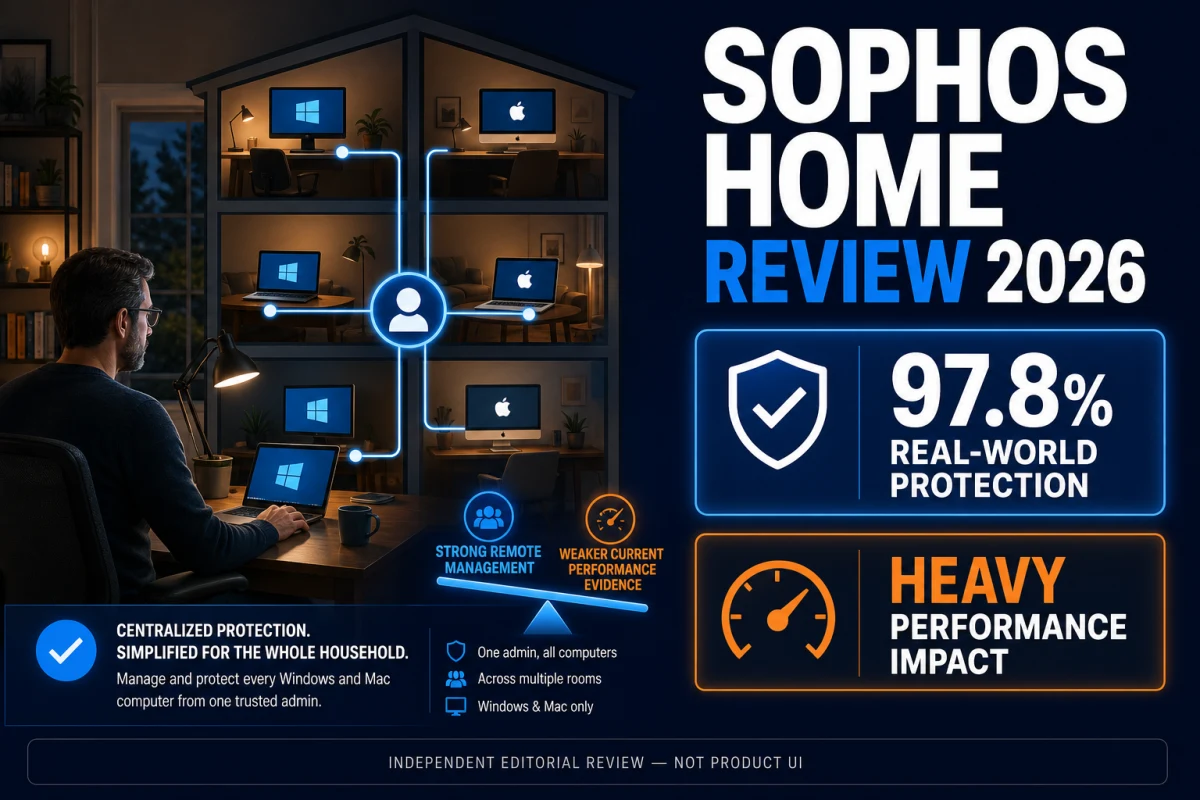
Our verdict: Sophos Home Premium is built for the person who acts as IT support for a large family. One web dashboard can manage up to ten Windows and Mac computers, and the license avoids the confusing feature ladder used by many rivals. Protection is credible rather than class-leading: AV-Comparatives measured 97.8% real-world protection with nine compromised cases; SE Labs recorded four successful targeted attacks in Q1; and the April performance test put Sophos 19th of 19. A perfect December SE Labs cycle shows the product can do much better, but also why one badge isn't enough. We rate it 6.8/10.
- One cloud dashboard for up to ten mixed Windows and Mac computers
- Strong December 2025 SE Labs result with 100/100 attacks protected
- Low four-false-alarm count in the current AV-C real-world test
- CryptoGuard ransomware blocking and conditional file rollback
- Useful remote scan, settings, history and category-filter controls
- Simple one-product license, 30-day trial and 30-day direct-purchase refund
- 97.8% current real-world protection, with nine of 400 cases compromised
- Four targeted attacks compromised the Q1 2026 SE Labs system
- Only 85.5% offline detection and 19 false alarms in the file test
- Highest performance impact score among 19 AV-C products
- Windows has important protection rows that the Mac matrix lacks
- No VPN, password manager, identity package or genuine parental-control suite
Sophos Home Premium at a glance
Sophos Home is a consumer antivirus for Windows and macOS, managed mainly through a browser dashboard. It brings a selection of Sophos endpoint technologies into a much simpler household product: real-time malware protection, exploit and script defenses, CryptoGuard ransomware monitoring, phishing and malicious-site blocking, category-based website filtering and remote administration. It isn't Sophos Central, Intercept X Endpoint, an MDR service or Sophos Firewall Home.
The distinction matters because search results routinely promise “enterprise security at home” and then quote a business Gartner award, an Endpoint test or an XDR capability. A shared vendor and some related technology don't make licensing, configuration, telemetry, response, performance or test results interchangeable. This review scores only the product named Sophos Home Premium.
| Buyer question | Current answer |
|---|---|
| Is Sophos Home good? | Credible but uneven. Current whole-product tests range from a perfect December SE Labs cycle to nine AV-C real-world compromises and four Q1 SE Labs compromises. |
| What does Premium cover? | Up to ten mixed Windows and Mac computers under one account. |
| Is Sophos Home still free? | Not for new users. They receive a 30-day Premium trial; only qualifying pre-November-2021 Free accounts remain grandfathered. |
| Does the license cover phones? | No desktop seat is consumed. Intercept X for Mobile is a separate free iOS/Android app. |
| Does it work on Windows ARM? | No. The current requirements explicitly exclude ARM architecture. |
| Does it include a VPN or password manager? | No. Home is a focused protection product, not a broad privacy/identity bundle. |
| Can a business use it? | No. Consumer terms restrict it to private, personal, non-commercial use. |
| Current US list price? | $59.99 per year for ten PCs/Macs, before regional promotions and tax. |
Our 6.8 is one editorial rating based on current independent evidence, product utility, platform parity, performance, billing and trust. It isn't a customer aggregate. The recovered page carried a one-reader score, an expired Offer and a copied review carousel; all three were removed because they answer neither protection nor value.
2026 lab scorecard: several current tests, no simple winner badge
Sophos Home isn't absent from current consumer testing. That claim appears in several recently updated reviews because AV-TEST's Home history is old, but both AV-Comparatives and SE Labs tested the consumer product in 2026. The fuller picture is more useful than either the stale “untested” label or an enterprise award.
| Independent test | Product/scope | Sophos result | What it means |
|---|---|---|---|
| AV-C Real-World Feb–May 2026 | Home Premium 2024.3–2025.2, Windows 11, 400 cases | 97.8%; 391 blocked, 9 compromised; 4 FP; Advanced | All protection layers could act, but the result trails the leaders. |
| AV-C Malware March 2026 | Home Premium 2024.3, roughly 10,000 files | 85.5% offline; 96.8% online detection; 99.59% final; 41 compromised; 19 FP; Tested | Large cloud benefit, but too many final misses and false alarms. |
| AV-C Performance April 2026 | Home Premium 2024.3 on a low-end Windows system | Impact 33.4; 19th of 19; Standard | The clearest current weakness; protection and speed are separate questions. |
| SE Labs Jan–Mar 2026 | Home Premium, 100 realistic general/targeted attacks | 96 protected; 4 compromised; 93% Protection Accuracy; 97% Total; AAA | Excellent legitimate handling, but four targeted attacks succeeded. |
| SE Labs December 2025 | Home Premium, 100 attacks and 680 legitimate objects | 100 protected; 100% protection, legitimate and total accuracy; AAA | Shows the product can lead, and that results can change by cycle. |
| AV-TEST Home history | Latest listed Home: macOS, December 2017 | 6/6/6 for Sophos Home 1.2 | Historical only. Current Endpoint/Central results don't transfer. |
Testing doesn't produce a permanent property called “detection rate.” Different labs use different threat sets, attack stages, default decisions, internet access, performance hardware and scoring. The defensible conclusion is that Sophos Home currently has real independent coverage, demonstrates good legitimate-file handling and can stop a broad attack set, but it's less consistent than the best-scoring rivals and unusually costly on performance in AV-Comparatives' current setup.

AV-Comparatives real-world result: 97.8%, nine compromises
The February–May 2026 Real-World Protection Test is the most direct current consumer result for malicious websites and downloads. AV-Comparatives used fully patched 64-bit Windows 11, allowed products to update and let every layer—URL filtering, cloud reputation, file scanning and behavior blocking—intervene. Out of 400 cases, Sophos blocked 391 and the test system was compromised nine times. That produces 97.8% protection.
Sophos landed in statistical cluster 2 with Fortect and G Data. It was below Kaspersky at 99.8%, Bitdefender at 99.5%, Avast/AVG/Norton at 99.3%, Microsoft/TotalAV at 99.0% and several products at 98.8–98.5%. It was above Panda, VIPRE and Quick Heal. The Advanced award is respectable. It isn't an Advanced+ result and shouldn't be marketed as equivalent to every higher raw percentage.
The false-alarm side was better. Sophos wrongly blocked four clean domains/files, below the field average of eight and well below Malwarebytes' 39 or Trend Micro's 83. That matters for household administrators: a remote console is useful only if alerts remain credible enough that family members don't learn to ignore them.
Nine compromises out of 400 is still too many to call protection excellent without qualification. The test is a time-bound comparison, not a promise that 2.2% of attacks reach every Sophos user. It shows where the submitted build sat against the same live conditions and competitors over four months. On that evidence, Sophos is usable but not our first protection pick.
File protection: strong final percentage, weak offline base
The March Malware Protection Test asks a different question. It exposes products to malicious files introduced through disk or network shares, measures offline and online detection, then executes samples that weren't initially detected. Sophos detected only 85.5% offline. With cloud access, detection rose to 96.8%; final online protection reached 99.59%.
That last percentage sounds close to perfect until the denominator is restored. AV-Comparatives reports 41 compromised cases from a set of 10,030. The same final rate group contained K7 and Malwarebytes, well behind products in the 99.9%+ clusters. Sophos also produced 19 false alarms, categorized in the “many” band. The award fell to Tested because of the false-alarm rule.
| Measurement | Result | Buyer interpretation |
|---|---|---|
| Offline file detection | 85.5% | Local signatures/static logic missed a meaningful portion without the cloud. |
| Online file detection | 96.8% | Connectivity added 11.3 percentage points; cloud services materially matter. |
| Final online protection | 99.59% | Execution/behavior layers recovered many misses, but 41 systems were still compromised. |
| File-test false alarms | 19 | More friction than the four false alarms in the separate real-world clean set. |
| Real-world protection | 97.8% | URL, download, cloud and behavior layers together blocked 391/400 live cases. |
The correct practical lesson isn't “Sophos fails offline.” Every modern product benefits from current reputation data, and the Home product is explicitly cloud-managed. The lesson is to treat a reliable internet connection and service availability as part of the protection model. A traveling laptop, isolated recovery system or machine behind a restrictive filter needs stronger local resilience than the online headline implies.
SE Labs: perfect in December, four compromises in Q1
SE Labs recreates attack chains rather than scanning a folder of samples. Threats can arrive through live-style websites and email, execute tools, escalate, persist and attempt later stages. The lab rewards an early block more than a delayed cleanup. That makes the change between two consecutive Sophos cycles especially useful.
In December 2025, Sophos Home Premium detected and blocked all 100 general and targeted attacks. It also correctly classified all 680 legitimate applications and websites. Protection Accuracy, Legitimate Accuracy and Total Accuracy were each 100%, earning AAA.
In the January–March 2026 report, Sophos detected all 100 attacks but blocked 96; four targeted attacks compromised the system. Its simple protected count was 96%, weighted Protection Accuracy was 93%, Legitimate Accuracy remained 100%, and Total Accuracy was 97%. It still received AAA because SE Labs' award threshold is broader than a perfect result.
This isn't evidence that Sophos “collapsed.” Attack sets and conditions change, and 96 stopped attacks with no legitimate-object errors remains strong. It does show why an AAA logo is insufficient. The raw table distinguishes a perfect protection cycle from a product that won the same award after four full compromises.
Performance: the heaviest current AV-Comparatives result
The recovered article called Sophos fast and published precise RAM, CPU, boot and scan numbers without surviving raw logs or a reproducible method. Those figures are gone. The current independent result is less flattering: in the April 2026 Performance Test, Sophos scored AVC 70, Procyon 86.6 and a combined impact score of 33.4. Lower is better; Sophos ranked last among 19 products and received Standard.
The task-level chart wasn't uniformly slow. Sophos was rated very fast for first-run app launching and browsing, and fast or very fast for several other operations. Its file-copy result was mediocre, and the combined benchmark/AVC penalty produced the worst overall number. “Heavy impact” in our title refers to this comparative lab result, not a claim that every modern PC will feel unusable.
The test used a low-end consumer system precisely because security overhead is easiest to see there. A recent desktop with a fast SSD may hide much of it; an older laptop, large photo/archive workflow or network-share user may not. Sophos's own requirements page recommends an SSD and warns of CPU/memory spikes during scans and updates.
- Record a clean baseline. Measure the file copy, app launch, browser, compile, backup and wake operations you actually repeat.
- Install and update. Let the initial update and first scan settle before judging steady state.
- Repeat the same workload. Use the same files, power mode and network, not a memory impression days later.
- Check low-resource devices first. The ten-device value disappears if an older family laptop becomes frustrating.
- Don't hide slowness with broad exclusions. Diagnose the exact process/path with support; excluding a whole user profile weakens protection.
APT research: good execution recovery, weaker modified-file resilience
AV-Comparatives also included Sophos in its 2026 APT Detection Coverage study. This was a research comparison using original and modified historical advanced-persistent-threat samples across offline scanning, online scanning, follow-up and execution. It isn't the normal consumer series and shouldn't be collapsed into a single Home rank.
On the initial original set, Sophos detected 35.7% offline and 91.6% online. After samples were modified to change static indicators, those figures were 35.3% and only 38.7%. At the later execution stage, behavior and other layers lifted detection to 100% for original samples but 91.95% for modified samples. The report identifies Sophos among products with larger drops on modified execution.
The useful interpretation is architectural: cloud reputation and known static indicators helped strongly on original samples, while execution behavior recovered many—but not all—altered files. This aligns with the file test's large online/offline difference. It doesn't mean an ordinary Home user faces an “8.05% APT infection rate”; the sample design and adversary context are entirely different.
What Sophos Home Premium includes—and leaves out
The current official feature matrix describes one Premium product rather than three marketing tiers. Both Windows and Mac receive real-time antivirus, category-based parental website filtering, malicious-site protection, remote management, ransomware security and advanced web/banking protection. Premium support is part of the active license.
Windows receives three additional named rows: predictive AI threat detection, advanced malware scan/clean and AMSI integration against obfuscated, encrypted or memory-resident scripts. Exploit mitigation, potentially unwanted application handling and behavior controls also appear in current Home documentation. The exact menu can change as components roll out, so the matrix and dashboard—not an old screenshot—control purchase expectations.
| Capability | Home Premium status | Important limit |
|---|---|---|
| Real-time antivirus and PUA protection | Windows and Mac | One primary real-time product; don't stack another suite. |
| Predictive AI / deep learning | Windows row only | Vendor feature claim, not a separate measured detection percentage. |
| AMSI script integration | Windows row only | Relevant to PowerShell/script content; not a universal exploit shield. |
| CryptoGuard ransomware protection | Windows and Mac | Requires 3GB free space; rollback is conditional. |
| Web and banking protection | Windows and Mac | No bundled VPN or hardened payment browser is documented. |
| Website category filtering | Windows and Mac | Per computer, not per user; no app limits, location or screen-time controls. |
| Remote web dashboard | Up to ten computers | Cloud account/connection is central to configuration and status. |
| Password manager / cloud backup / identity | Not included | Use separate services or compare a broader suite. |
| Replacement firewall / VPN | Not included | Keep the operating-system firewall active. |
The narrow bundle isn't automatically poor value. A family that already uses a reputable password manager, encrypted backup and VPN may prefer not to replace them with “free” suite modules. A single-computer buyer starting from zero will often get more useful tools—and better current protection/performance evidence—from another product at a similar first-year price.
Remote management is Sophos Home's best reason to buy
Sophos Home is cloud based, and its settings are configured mainly through the Sophos Home dashboard. From a browser, the account owner can see enrolled computers, review their protection state and recent activity, adjust protection and web-filtering settings, add devices, contact support and trigger a scan. The History tab retains 90 days of scans, detections, website filtering and related events.
That solves a real household problem. Parents and grandparents don't have to describe a tray icon over the phone; the trusted administrator can inspect status centrally. Each computer still needs a healthy agent, current operating system and internet access. A green portal can't patch a browser, secure a reused password or prove that a user didn't approve a malicious login.
Remote scans are queued when the target is offline and start when it returns. Scheduled scans require the computer to be online and awake; a laptop also needs to be connected to its charger. Those conditions should be visible in a family routine, otherwise a “weekly scan” can exist only as a setting that never runs.
Enable multifactor authentication on the Sophos account. The dashboard can change protections on every managed computer, create exclusions and expose event history; its credentials deserve the same treatment as a backup or router console. Don't enable password-free direct access on a shared Windows account unless every user should inherit administrator visibility.

CryptoGuard and parental filtering have narrower limits than the labels suggest
CryptoGuard watches for suspicious file-encryption behavior, blocks the process and can roll back encrypted files. Sophos's current ransomware guide is explicit about the boundary: recovery requires 3GB free disk, and rollback may no longer be available depending on when and how the encryption was stopped. It's a protective layer, not a substitute for versioned offline or immutable backups.
A credible ransomware plan keeps at least one backup inaccessible to the everyday desktop account, tests restoration and protects backup-console credentials with MFA. It also patches exposed software, limits admin use and blocks untrusted macros/scripts. An antivirus can stop an encryptor while still failing to reverse credential theft or data exfiltration that occurred earlier.
The “parental control” label also needs translation. Sophos provides website category filtering. Policies apply per computer, not per child or OS user. The dashboard offers category decisions rather than a direct “block this one URL” rule, and the feature isn't currently compatible with IPv6. Streaming CDNs and sites spanning several categories can make exceptions unreliable.
For a young child's dedicated laptop, category filtering is useful. It isn't a complete family-safety suite: no documented location, app-time, screen-time, social monitoring, per-user schedule or cross-device child profile is included. Use operating-system family controls or a specialist product when those are the actual requirements.
Windows versus Mac: same license, unequal feature and test evidence
Premium can mix up to ten Windows and Mac computers. That's licensing parity, not feature parity. The current official matrix lists predictive AI, advanced scan/clean and AMSI integration for Windows but not Mac. Windows also has the latest AV-Comparatives and SE Labs evidence discussed above. The latest AV-TEST result specifically labeled Sophos Home for macOS is from December 2017.
| Question | Windows | macOS |
|---|---|---|
| Current supported OS | Windows 11; Windows 10 64-bit in soft retirement | macOS 26 Tahoe, 15 Sequoia, 14 Sonoma, 13 Ventura |
| ARM support | Windows ARM explicitly unsupported | Current Mac requirements don't exclude Apple silicon |
| Minimum memory/disk | 4GB RAM; 4GB disk + 3GB CryptoGuard; two cores; SSD strongly recommended | 4GB RAM minimum/8GB recommended; 4GB disk + 3GB CryptoGuard |
| Predictive AI / advanced clean / AMSI | Listed | Not listed in current matrix |
| Current consumer lab evidence | AV-C and SE Labs 2026 cycles | No current Home result found; latest AV-TEST Home result is December 2017 |
| Current known issue emphasis | Network-share stalls, accessibility and several app/driver conflicts | Cloud-file delays/high CPU, Private Relay/filtering and captive portal/UI issues |
Windows 10's soft-retirement label should influence a multi-year purchase. Sophos hasn't yet ended support in the current requirements, but the operating system itself is outside normal consumer support unless a qualifying extended path applies. Antivirus can't compensate for an unpatched OS. Move eligible hardware to Windows 11 rather than treating the Home license as a reason to keep Windows 10 indefinitely.
On Mac, test Full Disk Access/system-extension permission, sleep/wake, browsing with and without Private Relay, OneDrive/SharePoint sync, CPU/battery, scan completion, quarantine/restore and supported removal. A current Mac install can be useful without having the same menus or independent evidence as Windows; the review should make that difference visible before checkout.
Sophos Home price in July 2026: excellent only when ten seats matter
Sophos's current US help documentation lists $59.99 MSRP per year for up to ten Windows and Mac computers. That's $6 per protected computer if all ten are genuinely used, but $59.99 for one if they aren't. Seat efficiency is a household fact, not a mathematical discount a single-device buyer receives.
The official purchase experience localizes. On July 14, our European view showed a 25% campaign and these totals: €37.46 for one year, €67.46 for two and €86.21 for three, against displayed list totals of €49.95, €89.95 and €114.95. Tax, currency and campaign can change. We record this dated snapshot to make the buying model concrete; the page intentionally carries no machine-readable Offer.
| Term | July 14 Europe campaign | Displayed list total | Approx. campaign cost/year | Buyer caution |
|---|---|---|---|---|
| 1 year | €37.46 | €49.95 | €37.46 | Best first purchase while testing renewal, performance and Mac behavior. |
| 2 years | €67.46 | €89.95 | €33.73 | Lower annualized cost, but product/lab/platform state can change. |
| 3 years | €86.21 | €114.95 | €28.74 | Largest lock-in; use after a successful full renewal cycle. |
| US annual MSRP | $59.99/year for ten PCs/Macs | $6/device only if all ten are used | Promotions may differ; verify the actual Cleverbridge checkout. | |
For six to ten household computers, Sophos is competitively shaped even without extras. For one to three devices, compare the total cost of Bitdefender, ESET, Norton and the built-in Microsoft Defender before buying “spare” seats. A three-year headline isn't automatically best value when the current performance result is this weak and Windows 10 support is already in retirement.

Sophos Home Free versus the current 30-day trial
New users don't receive a permanent Sophos Home Free license. The current licensing explanation says Sophos replaced the open Free option with a 30-day Premium trial. The trial includes all Premium features on up to three computers. It takes no payment information, so it can't silently become a paid renewal.
A narrow legacy exception remains. Accounts that switched to Free before November 11, 2021 can retain the existing Free license for up to three Windows and/or Mac computers. That doesn't make Free available to a new reader in 2026. Search results and old installation guides that say “protect three computers free forever” are describing grandfathered history.
When a trial or paid subscription expires, protected devices become disabled in the dashboard and the account can't manage settings or devices until it's active again. This isn't a free real-time fallback like Microsoft Defender. Before expiry, either purchase, uninstall Sophos so Windows Security can return to Defender cleanly, or install another primary product. Don't leave the agent in an expired state and assume the operating system resolved every layer automatically.
Auto renewal, cancellation, refund and support
Direct Sophos Home commerce is handled by Cleverbridge. According to the current renewal guide, a paid subscription normally auto-renews. The account dashboard says “Renews” when automatic renewal is active and “Expires” when it isn't. Use the secure order email or Cleverbridge Purchase Lookup to manage the subscription; never give a caller remote access because they claim a license failed.
Turning auto renewal off prevents the next charge but keeps protection until the paid expiry date. It doesn't create an immediate refund, and uninstalling Sophos doesn't cancel the subscription. The billing guide updated July 13 gives direct purchasers 30 days to request a refund. After that, unused time is normally not refunded.
Sophos also says a customer can't switch the current term in place. Disable renewal, let the old term expire, then buy the desired term; an account can be extended by at most three years. That workflow makes a screenshot claiming a fixed “renewal price” unreliable. The live account, merchant email, tax and next charge are the controlling facts.
Premium and trial users can reach support; the feature matrix lists live chat and email Monday through Friday, 9am–7pm US Eastern, with chatbot and knowledge-base access around the clock. A useful case includes Home version, OS build, exact event time, alert text, affected signed process/path, recent update and sanitized logs. Don't upload confidential files merely to prove a false positive.
Mobile, Linux, ChromeOS and other platform limits
The ten-device Premium entitlement covers Windows and Mac computers. Android and iOS use the separate free Sophos Intercept X for Mobile app. Premium customers can receive Home support for it, but mobile doesn't become a managed desktop seat and isn't the business-managed Intercept X mobile product.
On Android, a security app can inspect installed apps, links, network and device-security posture subject to Android permissions. On iOS, platform sandboxing means security apps focus on web, network, device and identity signals rather than scanning every app's files like a Windows antivirus. The correct description is “separate free mobile security app,” not “Sophos Home has no iOS product” and not “the ten-device license covers phones.”
The current requirements explicitly exclude ChromeOS and Linux. A Sophos business or server product appearing in search doesn't grant Home support for a Linux desktop. Windows Server, managed endpoints, virtual desktop fleets and nonprofit computers also belong to business licensing. Choose by the protected device, not the vendor logo.
Sophos Home isn't Intercept X Endpoint or Sophos Central
Sophos's consumer terms restrict Home to private, personal and non-commercial use. A freelance work laptop, small shop, charity office, government computer or managed customer endpoint needs an appropriately licensed business product even if the Home dashboard looks capable enough.
| Capability or claim | Sophos Home | Business Sophos context |
|---|---|---|
| Private family PCs/Macs | Yes, up to ten | Not the target use |
| Commercial/nonprofit/government use | No under consumer terms | Use Central/Endpoint or appropriate commercial SKU |
| Central family web dashboard | Yes | Central provides deeper organization policy/reporting |
| EDR/XDR/MDR and human response | Not included | Available in selected business services |
| Server/Linux/workload protection | Not supported | Separate business platform and licensing |
| USB/device control and enterprise policy | Don't assume | Product/tier-dependent business capabilities |
| Gartner/enterprise lab awards | Not evidence for Home | May describe a named business platform |
| Sophos Firewall Home | Separate network product | Not the Home antivirus client |
Some underlying research, detections or components can be related across the product family. What matters to a Home buyer is the submitted Home build, Home defaults, Home UI, Home license and Home support. This page therefore excludes current Sophos Endpoint and Central results from the score instead of using them to fill a favorable gap.
Thoma Bravo ownership and what the Home portal processes
Sophos began in the UK and remains headquartered around Oxford/Abingdon, but it isn't an independent public British company. Thoma Bravo completed a roughly $3.9 billion take-private acquisition in March 2020, and Sophos remains on the Thoma Bravo portfolio. Ownership is relevant disclosure; it neither proves nor disproves a malware result.
The current Home-specific privacy notice is more useful. It describes account details, IP and device identifiers, installed-product/update status, alerts, threats, blocked applications and websites, plus security lookups involving URLs, file names/paths, executable size, hashes and customer/machine IDs. Local logs aren't accessible to Sophos unless the user submits them for troubleshooting.
Portal data is hosted in the United States on AWS and Google Cloud infrastructure. Cleverbridge acts as an independent reseller/payment processor. Support can involve Zendesk and SendSafely in the US and BlueOcean in Canada. This is a normal but material cloud-management footprint; “Sophos does not collect data” would be false.
Minimize exposure by using a neutral device name, enabling MFA, reviewing optional diagnostics, limiting dashboard access and checking paths before submitting a sample. A hash or filename can disclose a project/customer even when the file body is absent. Families should also decide who is allowed to view the 90-day website and threat history for each computer.
Current known issues are part of the buying decision
Sophos maintains a specific known-issues page updated July 3, 2026. This is unusually helpful because it turns vague user complaints into scoped symptoms and workarounds. It also contradicts the recovered article's claim that Home can be recommended from generic CPU figures alone.
| Current issue | Affected area | Trial check / response |
|---|---|---|
| First save to a remote/network location can stall for minutes after boot | Windows file/network workflow | Test a real share after reboot; use only the exact documented exception if needed and remove it after a fix. |
| Windows UI isn't read correctly by screen readers | Accessibility | Dashboard can configure protection, but no current local-UI workaround exists; this can be a deal-breaker. |
| OneDrive/SharePoint apps can lag; TrustD/TCCD may exceed 60% CPU | macOS Sonoma/Tahoe | Test sync, Office and battery behavior early; Sophos says no fix timeline is available. |
| Safari filtering doesn't work with Private Relay enabled | macOS web protection | Choose between Private Relay and Sophos's Safari traffic processing, or use another browser. |
| HTTPS scanning can depress speed-test results | Windows web measurement | Judge real downloads/browsing; disable protection only briefly for diagnosis and restore it. |
| App conflicts include AutoIt, Enpass, Sage, Sonos, Visual Studio and others | Windows exploit/web controls | Confirm the signed process and add the narrowest exception; never exclude a whole downloads folder. |
| Mac shield can turn red when booted offline | Cloud status | Reconnect and confirm it self-corrects before changing protection. |
A listed conflict isn't evidence that every user suffers it. It's a reason to test the exact workload inside the trial and keep the support article with the incident record. Broad, permanent exceptions can create more risk than the original incompatibility.
How to install and evaluate Sophos Home safely
- Confirm support first. Check OS version, CPU architecture, RAM/disk and the current known-issues list. Don't install on Windows ARM, Linux or ChromeOS.
- Remove the old real-time suite. Save its license, use the vendor uninstaller and reboot. Sophos itself warns that two resident antivirus products can reduce security.
- Create the account securely. Use a unique password, enable MFA and avoid password-free direct dashboard access on shared user accounts.
- Enroll one representative computer. Start with the oldest or most complex device, not all ten at once.
- Update and verify status. Confirm current Home components, real-time layers, last update and Windows Security/macOS permissions.
- Run a full scan once. Inspect detections before deleting. Quarantine a questionable file and verify publisher, source, signature and hash.
- Exercise the real workload. Copy large folders, save to network shares, sync OneDrive/SharePoint, build code, play games, use banking and wake from sleep.
- Test protection harmlessly. Use EICAR and AMTSO feature checks, never live malware or a real phishing account.
- Test remote management. Queue a scan while offline, return online, review History, apply a safe setting change and confirm every family role is appropriate.
- Record billing before the deadline. Save merchant, currency, tax, term, renewal status and the 30-day refund date.
If Sophos fails the trial, uninstall through the current Windows Apps or Mac removal guide, reboot and confirm the operating system firewall and intended replacement antivirus are active. Canceling billing and uninstalling are separate actions. If a license remains, remove the old device from the dashboard only after the replacement is protected.
What current community discussions can—and can't—tell us
A small February 2026 r/antivirus question shows the current buyer vocabulary: protection quality, price and whether the product brings constant upsells. It has too little participation to support a consensus. A November 2025 r/sophos discussion asks whether Free still exists; the official licensing page, not replies, controls that answer.
Mac discussions notice that AI/ML controls shown on Windows are absent from the web console for Mac. That aligns with the current official feature matrix and is useful for planning a parity check. A 2025 amateur malicious-script test and university-provided-user threads provide anecdotal experience only; their sample selection, license type, version and setup aren't equivalent to a comparative lab.
We excluded firewall-home threads, MSP pricing, Sophos Central administration and XDR incident stories because they concern different products. We also excluded named testimonials from the recovered page and didn't invent quotes. The strongest community-derived recommendation is simply to trial remote administration and unusual software on the exact devices; protection and performance scores remain lab-led.
Who should choose Sophos Home—and who should skip it
| User profile | Decision | Why |
|---|---|---|
| Family IT administrator with 6–10 PCs/Macs | Strong shortlist | Remote status, scans, settings and ten-seat economics are genuinely distinctive. |
| Household with several remote relatives | Shortlist after one-device trial | Cloud management can replace phone-guided troubleshooting. |
| One modern Windows PC | Compare first | Spare seats add no value; leaders have stronger current protection/performance balance. |
| Older or performance-sensitive laptop | Trial cautiously or skip | Sophos ranked 19th/19 in the current AV-C impact test. |
| Mac evidence-first buyer | Compare alternatives | No current independent Home Mac result; several Windows-only feature rows. |
| Family needing screen time, app limits and child profiles | Use a specialist/OS tool | Sophos supplies a per-computer category web filter, not a full parental suite. |
| Buyer wanting VPN, passwords, backup and identity | Choose a broader suite | Those extras aren't included. |
| Small business, charity or freelance fleet | Don't use Home | Consumer terms prohibit commercial use; choose a business license. |

Best Sophos Home alternatives in 2026
Bitdefender is our stronger default when protection consistency and performance matter more than Sophos's family console. Its current AV-Comparatives real-world result was 99.5% with two compromises, and its impact score was far lower. Plans and renewal can be more complicated; compare exact seats and extras in our Bitdefender review.
Microsoft Defender is the rational no-extra-cost baseline for one patched Windows 11 PC. It reached 99.0% in the same real-world cycle and had a 12.9 impact score, although paid products can add support, phishing layers and cross-device management. Our Microsoft Defender review explains its current strengths and hardening limits.
ESET suits the buyer who values low false alarms, a lighter current impact result and granular controls. It's a better evidence-led fit for performance-sensitive Windows systems, while plan/device economics differ. See the current ESET review.
Norton 360 fits a family that wants VPN, password management, cloud backup and broader identity features rather than a focused antivirus. The tradeoff is more bundle, promotion and renewal complexity. Our Norton review separates current plan inclusions by platform.
Intego is the Mac-first alternative when platform-specific tools and current Mac test evidence matter more than one mixed Windows/Mac console. Read the Intego review before assuming a Windows-led product offers equal Mac depth.
Malwarebytes is another focused option, particularly for buyers who understand the difference between free cleanup and paid real-time protection. Its current real-world protection was higher but false alarms were much worse. Our Malwarebytes review maps the current tradeoff.
Sophos Home frequently asked questions
Is Sophos Home Premium good in 2026?
Sophos Home is credible but inconsistent. AV-Comparatives measured 97.8% real-world protection with nine compromises and four false alarms, while SE Labs recorded four targeted compromises in Q1 after a perfect December cycle. Its remote ten-computer dashboard is excellent; its current performance impact is poor. We rate it 6.8/10.
Is Sophos Home still free?
Not for new users. New accounts receive a 30-day trial of all Premium features for up to three computers, then need a paid subscription. Only accounts that switched to Sophos Home Free before November 11, 2021 can retain the grandfathered Free license for up to three Windows/Mac computers.
How many devices does Sophos Home Premium cover?
One Premium account covers up to ten mixed Windows and Mac computers. Phones and tablets use the separate free Sophos Intercept X for Mobile app and don't consume one of those desktop seats. The Home license is for private, personal, non-commercial use.
Does Sophos Home slow down a computer?
It can. In AV-Comparatives' April 2026 low-end-system test, Sophos had a 33.4 impact score and ranked 19th of 19, receiving Standard. Some individual operations were fast, so test your real file copies, apps, shares, battery and scans during the trial—especially on older hardware.
Does Sophos Home protect against ransomware?
Yes. CryptoGuard monitors suspicious encryption, blocks processes and may roll back encrypted files on Windows and Mac. Recovery needs 3GB free disk and isn't always available, depending on when and how the attack is stopped. Keep tested versioned offline or immutable backups.
Is Sophos Home the same as Intercept X Endpoint?
No. Sophos Home is a simplified consumer product for private Windows/Mac computers. Sophos Central, Intercept X Endpoint, XDR/MDR, server/Linux protection and enterprise device control are separately licensed business products. Their awards and lab results can't be assigned to Home.
Does Sophos Home work on Mac and Windows ARM?
Sophos Home supports current macOS 13–15 and macOS 26 plus Windows 11 and Windows 10 64-bit in soft retirement. Windows ARM is explicitly unsupported. The official matrix lists predictive AI, advanced scan/clean and AMSI only for Windows, and current independent Home Mac test evidence is absent.
How do I cancel Sophos Home or request a refund?
Use the Cleverbridge order email or Purchase Lookup to disable auto renewal; the dashboard should then say Expires rather than Renews. Service continues through the paid term. Direct purchases have a 30-day refund window; cancellation after it normally prevents the next charge without refunding unused time. Uninstalling doesn't cancel billing.
Final verdict: buy the console, not the enterprise story
Sophos Home's reason to exist is unusually concrete: one capable person can manage protection for ten family Windows and Mac computers from a browser. Remote status, settings, scan commands, event history and category filtering are more useful than another bundled tune-up tool. At six to ten real computers, the annual license can be good value.
The current protection case is adequate, not elite. A perfect December SE Labs result proves Sophos can stop a demanding attack set; four Q1 targeted compromises and nine AV-Comparatives real-world compromises prove the badge isn't permanent. The file test's 85.5% offline detection, 19 false alarms and Tested award reinforce the cloud dependence. The 33.4 impact score and last-place performance rank are the largest practical objection.
Choose Sophos Home when the remote console solves a real family-management problem, most devices are reasonably modern, and you'll use the trial to test shares, sync, apps and Mac parity. Skip it for one performance-sensitive PC, a Mac-first evidence requirement, a full privacy/identity bundle or any commercial use.
Our final score is 6.8/10. That's much higher than the recovered page's unsupported 2/10 dismissal and much lower than affiliate pages that borrow business awards for a 9/10. Sophos Home is a distinctive household administration product with mixed current protection and weak current performance—not an enterprise endpoint suite made cheap.