
Malwarebytes Review 2026: Great Cleanup, Mixed Primary Protection
Malwarebytes Free is still an excellent tool to keep for cleanup and a second opinion. Paid Malwarebytes is now a real primary antivirus, not merely the old scanner with a subscription attached. Its return to AV-TEST produced 17.5/18, but the completed AV-Comparatives cycle also exposed 39 false alarms and uneven performance. That makes Premium credible, not automatic.
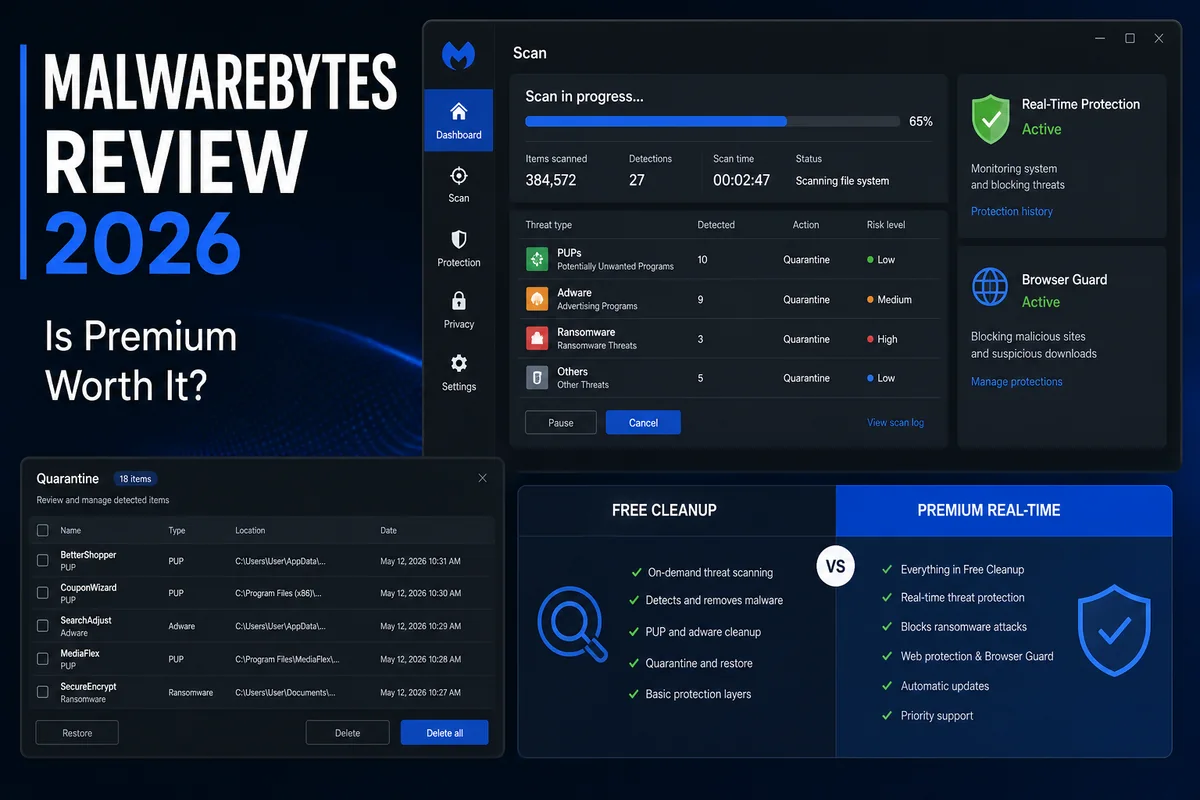
Our verdict: use Malwarebytes Free when you want a trusted on-demand cleanup tool, a second scan after suspicious behavior or a simple way to remove potentially unwanted programs. Buy Standard when you want Malwarebytes to become the always-on antivirus, not because the free edition quietly provides the same protection. The paid engine blocked 98.8% of 400 live web cases, yet its 39 false alarms forced an AV-Comparatives award downgrade to Standard. Plus is a VPN purchase; Total or Ultimate is an identity-service purchase. Those trade-offs make Standard a credible trial, not an automatic purchase.
- Excellent free on-demand cleanup and PUP-removal workflow
- Current paid product returned to AV-TEST with a 17.5/18 Top Product result
- Strong 98.8% completed real-world protection rate
- Clear, approachable Windows interface and useful Browser Guard
- Paid anti-exploit, web, malware and ransomware prevention on Windows
- 39 false alarms in the completed real-world cycle
- Only 99.59% final protection and 23 false alarms in the March malware-file test
- Combined performance score 17.6, with slow file/application tasks despite excellent Office score
- Running beside another real-time antivirus can cause conflicts
- Top-tier Total/Ultimate naming and identity value are harder to compare than core security
Malwarebytes in 2026 at a glance
The name covers two different consumer jobs. Malwarebytes Free is primarily a scanner and remediator: launch it when you want to inspect a device and remove an infection, adware or a potentially unwanted program. It doesn't give Windows or Mac the paid product's continuous malware, web and real-time protection. Malwarebytes Standard is the core paid security subscription. Plus adds a VPN. The identity bundle is shown as Total on the main US pricing page and as Ultimate in parts of the current help and promotional material.
That distinction matters because people still describe Malwarebytes as if the 2010s cleanup utility and the 2026 paid suite are interchangeable. They aren't. The free edition remains one of the easiest second-opinion tools to recommend. The paid edition is tested as a normal real-time antivirus and can be registered with Windows Security as the primary provider. A good reputation for removing an existing PUP doesn't prove that the paid product prevents every new attack; current lab results answer that separate question.
ThreatDown is a third, separate job: Malwarebytes' business endpoint-security family. It uses the Nebula management console and sells Core, Advanced, Elite and Ultimate bundles with business EPP, EDR and managed-response capabilities. Don't compare a ThreatDown quote with a consumer Standard subscription or assume the same device, service and lab claims apply to both.
Malwarebytes is legitimate software from a long-established security vendor. A detection after installing it isn't evidence that the app is malware, and a fake “Malwarebytes” download from a search ad or third-party bundle isn't evidence against the official product. Download from Malwarebytes, verify the publisher signature and decline grey-market “lifetime” keys. Malwarebytes stopped selling new lifetime consumer licenses in 2015; a cheap current marketplace key deserves skepticism.
Malwarebytes lab results in 2026
The strongest current review needs more than one percentage. AV-TEST measures protection, everyday performance and usability over two months. AV-Comparatives' real-world test starts with threats delivered from the web. Its malware protection test starts with malicious files already on disk or shared media and separates offline detection, online detection and final execution-time protection. Its performance test measures file/application tasks and a separate Office benchmark.
| Independent test | Product / period | Malwarebytes result | What it means |
|---|---|---|---|
| AV-TEST Windows 11 | Premium 5.5 March–April 2026 | 5.5/6 protection 6/6 performance 6/6 usability 17.5/18 | A strong Top Product return, with slightly imperfect zero-day protection. |
| AV-C Real-World Protection | Premium 5.4–5.5 February–May 2026 | 98.8% protected 395 blocked / 5 compromised 39 false alarms Standard award | Strong web-threat blocking, but too many clean sites/files were blocked. |
| AV-C Malware Protection | Premium 5.4 March 2026 / 10,000 cases | 92.4% offline detection 98.3% online detection 99.59% online protection 23 false alarms | Connectivity and execution layers helped, but the final result and false alarms trailed leaders. |
| AV-C Performance | Premium 5.5 April 2026 | Impact: 17.6 AV-C 75 / Procyon 97.4 | Best Office score in the field, but slower file and application tasks raised total impact. |
| MRG Effitas Consumer Assessment | Premium Security 5.5.1.240 March 2026 | Level 1 certified 300/300 ITW cases blocked 0/100 clean apps blocked | A strong result in a smaller, differently designed in-the-wild and false-positive assessment. |
17.5/18 at AV-TEST is a real improvement, not a perfect score
Malwarebytes returned to AV-TEST's public Home Windows results after a long gap. Premium 5.5 earned the Top Product label in the March–April 2026 cycle: performance and usability were 6/6, protection was 5.5/6. Against zero-day web and email threats, it protected 98.9% in March and 97.7% in April. Against widespread malware it reached 99.9% in both months.
That's strong evidence that the paid suite belongs in the primary-antivirus conversation. It isn't 18/18, and “99.9%” can't be pasted onto every threat category. The lower April zero-day result explains why a careful verdict remains conditional. It also makes the recovered claim that Malwarebytes was absent from AV-TEST obsolete.
98.8% protection came with the cycle's second-highest false-alarm count
In the completed 400-case AV-Comparatives real-world cycle, Malwarebytes blocked 395 threats and five systems were compromised. The 98.8% protection rate put it in the leading statistical cluster with F-Secure and close to Microsoft/TotalAV at 99.0%. But Malwarebytes also blocked 39 clean sites or files, compared with the eight-product average of eight. Only Trend Micro produced more.
AV-Comparatives doesn't award protection rate in isolation. Its rule downgrades a cluster-one product with 26–50 false alarms to Standard, which is the award Malwarebytes received. This is the practical reason we don't promote it solely from the 98.8% number. A false positive can stop a legitimate installer, business utility or less-popular site; repeated warnings also train users to click through real alerts.
The 99.59% malware-file result isn't the same as 98.8% web protection
AV-Comparatives' March malware test began with 10,000 malicious files. Malwarebytes recognized 92.4% without cloud access and 98.3% when connected. After all execution-time layers were allowed to act, online protection reached 99.59%, meaning 41 test systems were still compromised. Twenty-three clean files generated false alarms.
The result is useful because it exposes both cloud dependence and execution behavior. Calling 92.4% the final protection rate would understate the product. Calling 99.59% “near perfect” without mentioning 41 compromises and 23 false alarms would oversell it. Keep connectivity and updates available, and retain tested backups even when a paid suite is installed.
MRG Effitas adds a strong result with a narrower test design
Malwarebytes Premium Security 5.5.1.240 earned Level 1 in MRG Effitas' March 2026 Consumer Assessment. It automatically blocked all 300 in-the-wild samples on first exposure, produced no false block across 100 clean applications and met the phishing threshold required by the certification. Bitdefender was the only other Level 1 product in that eight-product assessment.
This doesn't cancel the larger AV-Comparatives false-positive result. MRG Effitas used a different sample set, 100 clean applications and its own certification rules; AV-Comparatives tested clean domains and files throughout a four-month web-threat cycle. The honest conclusion is that Malwarebytes can be accurate in one controlled workload while still requiring careful alert review in another.

Malwarebytes Free vs Premium, Standard and paid protection
The vendor's July 2026 free-versus-paid matrix is unusually important because the same app can look similar before and after activation. On Windows and Mac, Free includes Quick Scan and Custom Scan. Continuous real-time, web and malware protection require a paid subscription. On Windows, ransomware and exploit protection are also paid. That's the difference between checking after suspicion and trying to stop execution before damage.
| Job | Free | Standard / paid security | Practical consequence |
|---|---|---|---|
| Quick and custom scan | Yes | Yes | Free is useful for a second opinion and targeted cleanup. |
| Real-time malware protection | No | Yes | Free isn't the only always-on layer a Windows/Mac device should have. |
| Web protection | No in desktop app | Yes | Browser Guard can add separate browser filtering, but it isn't the whole paid engine. |
| Ransomware and exploit protection | No | Paid on Windows | Platform-specific prevention isn't a free cleanup promise. |
| Scheduled Threat Scan | Limited/plan-dependent matrix | Yes | Verify the current app because the help table contains an unusual free monthly entry. |
| VPN | No full desktop VPN | Plus / identity tier | Don't buy Plus if another VPN already covers the needed devices. |
Free should be kept updated and run deliberately. A Quick Scan is useful after a suspicious download, browser redirect or PUP installation. A Custom Scan is useful for a known folder or removable drive. If you suspect a deeply compromised PC, scan from a clean state and review persistence, accounts and backups rather than treating one “0 threats found” screen as proof that credentials and firmware are safe.
Paid doesn't mean “Free plus automatic scheduling.” It adds file-system, behavior, exploit, ransomware and web layers that participate before and during execution. Conversely, paying doesn't guarantee every free tool is suddenly identical across platforms. Windows receives ransomware/exploit modules that macOS doesn't list; iPhone has no conventional file scanner at all.

Malwarebytes plans, prices, renewal and refund terms
The official US pricing page currently organizes consumer subscriptions as Standard, Plus and Total. The current help matrix and some offer pages instead call the identity tier Ultimate. That naming drift isn't a reason to guess: the cart must identify device count, covered adult, VPN, personal-data removal, monitoring and identity coverage before you compare it with another review.
| Tier | Core scope | Dated US price snapshot | Buy it for |
|---|---|---|---|
| Free | On-demand cleanup plus free account/browser tools | $0 | Second-opinion scans and remediation, not sole real-time desktop protection. |
| Standard | Device security and Browser Guard | About $44.99/year for 1 device or $59.99 for 3 | Primary real-time antivirus without paying for a VPN. |
| Plus | Device security + Privacy VPN | About $79.99/year for 3 devices or $99.99 for 5 | A buyer who has tested and needs the bundled VPN. |
| Total / Ultimate | Security + VPN + identity/data services | Check current cart | An eligible adult who values the named monitoring, removal and coverage benefits. |
| Family | Multi-person/device bundle, offer-dependent | Check current cart | A household that has verified people, devices and identity entitlements. |
The numeric Standard and Plus figures are March–May 2026 independent US snapshots because the official page client-renders the live offer. They aren't an Offer in our schema and not a guarantee of today's checkout. Taxes, promotions, device count and account history can change the charge. We omit a fixed identity-tier number because current sources disagree on both name and price. That's more useful than publishing a precise but unreproducible coupon.
Subscriptions bought from the Malwarebytes Online Store have auto-renewal enabled by default. The current cancellation instructions say annual subscribers receive an email 30 days before renewal with the amount. Turning auto-renewal off in the account cancels a Windows/Mac subscription at the end of its term; it remains active until expiry. Apple and Google purchases must be managed in their stores.
Retail licenses can begin on manual renewal, but the April renewal guide says completing a manual online renewal enables automatic renewal by default. The official pricing page advertises a 60-day money-back guarantee, while the refund help page refers eligibility to the license agreement/support and warns that app-store rules differ. Treat the 60 days as a policy to verify for the exact seller, not unconditional cash-back language.
Protection, Browser Guard and cleanup features
Malware, PUP and remediation scanning
Malwarebytes built its reputation on removing malware and potentially unwanted programs that a traditional suite missed or tolerated. The current scanner still makes quarantine decisions understandable and gives a user a fast route from suspicious behavior to a concrete file, registry item or browser modification. That's valuable after adware, bundled installers and unwanted browser changes.
A potentially unwanted program isn't automatically a Trojan. It may be software with aggressive ads, bundling, remote access, dubious optimization or a behavior the user didn't meaningfully consent to. Review the detection name, path, digital signature and installation context before restoring or deleting. If the file is a legitimate niche utility, submit the false positive and use the narrowest temporary allow-list entry instead of excluding the whole downloads folder.
Real-time, web and exploit protection
Paid Malwarebytes uses multiple layers: file/signature and heuristic recognition, behavior monitoring, malicious-site filtering and Windows exploit protection. Web protection can block a known malicious domain before a payload arrives. Exploit protection focuses on attack techniques against browsers and applications. These layers explain why final connected protection can exceed the initial on-demand detection percentage.
Browser Guard is a separate free extension for major browsers that blocks ads, trackers, scams and malicious pages. It can be useful even when Defender or another suite remains primary, but every content-blocking extension can break a site or checkout. Disable it for one site only after checking the domain and understanding which rule caused the problem. Don't treat a browser extension as a replacement for OS updates, MFA or endpoint protection.
Ransomware prevention isn't consumer file rollback
Paid Windows protection includes a ransomware module. Malwarebytes' current consumer ransomware guidance emphasizes stopping the malware before encryption and keeping backups. We found no current official evidence that Standard or Plus gives a consumer a seven-day file rollback. Malwarebytes describes rollback in its business endpoint detection and response products, where controlled backup/snapshot behavior and license terms differ.
That correction matters. Prevention can block known and behavioral encryption activity; remediation can remove a payload; neither recreates encrypted files after the only copy is destroyed. Keep versioned backups with at least one copy isolated from normal write access, test a restore and protect cloud-backup accounts with strong MFA. No antivirus score substitutes for a recovery plan.
Scam Guard, privacy tools, VPN and identity services
Scam Guard and the Digital Footprint Scan are available as free account tools in the current matrix. They can help assess a suspicious message or reveal exposed personal data. Their output is advice and monitoring, not proof that every message is safe or that every broker record has been erased. Never upload passwords, recovery codes or private keys to a “scam checker.”
Plus bundles Malwarebytes Privacy VPN. A VPN encrypts traffic between the device and VPN server and can reduce exposure on untrusted Wi-Fi. It doesn't make a phishing site safe, prevent account tracking or turn a compromised endpoint into a clean one. Test the required platform, country, speed, kill switch and streaming/business service before valuing it above Standard.
Total/Ultimate adds identity and personal-data features whose details can vary. Monitoring can alert after data appears; removal can submit broker requests; insurance-like coverage is governed by eligibility and a policy. Read the covered adult, limits, exclusions, enrollment requirements and country before comparing the top tier with a standalone identity service. Paying for monitoring without completing enrollment creates no practical protection.

Can Malwarebytes run with Windows Defender or another antivirus?
Sometimes, but “Malwarebytes never conflicts with antivirus” is no longer a responsible answer. The vendor's June 2026 compatibility article warns that another antivirus may block Malwarebytes, stop working, break internet access or even contribute to a Windows blue screen. Malwarebytes recommends uninstalling the other suite when incompatibility occurs or installing in a specific order and adding mutual allow-list entries when both must run.
The safest common setups are simple:
- Defender primary + Malwarebytes Free: Defender supplies continuous protection; Malwarebytes runs only when you request a second scan.
- Malwarebytes Standard primary: Malwarebytes registers as the real-time provider and Defender's role changes according to Windows Security settings.
- Two paid real-time suites: only after both vendors support the combination and you have tested updates, browsing, sleep/wake, VPN and full scans. This is rarely the best default.
Mutual exclusions aren't free. Allow-listing another security product can reduce duplicate scanning and prevent deadlocks, but a broad folder/process exception can also create a blind spot if that trusted process is abused. Use the vendors' documented executable paths, keep both updated and remove the second real-time engine if errors persist.
After changing providers, open Windows Security and confirm which antivirus is active. Check that real-time protection, firewall and updates are on. Reboot and test DNS, browser downloads, a large file copy and sleep/wake. Don't assume the green Malwarebytes dashboard proves Defender is still operating in the same mode.

Performance: fast Office benchmark, slower file tasks
Malwarebytes' performance evidence looks contradictory until the workloads are separated. AV-TEST awarded 6/6 for performance. In AV-Comparatives' April report, Malwarebytes posted the best Procyon Office score at 97.4, so common Word, Excel, PowerPoint and Outlook-style activity remained responsive on the lab PC. Its AV-C task score was only 75 because file copying, archiving, installing, launching and browsing tasks were slower. The combined impact score was 17.6.
That isn't evidence that Malwarebytes is universally heavy or universally light. It suggests an office-document user may barely notice it while a developer, installer-heavy workflow or someone unpacking large archives may. The same product can feel excellent after startup and intrusive during a large code dependency install. Measure the tasks you actually repeat.
- Record a clean baseline. Time browser/Office launch, a large file copy, archive extraction, application install, game/build startup and idle CPU before installation.
- Choose one primary real-time provider. A conflict with another suite invalidates performance conclusions.
- Update, then run one complete scan. First-run classification isn't the same as steady-state behavior.
- Repeat each task at least three times. Compare medians and separate active scan time from normal work.
- Record false positives. A fast system that blocks a legitimate installer isn't a successful result.
- Test Browser Guard and VPN separately. Web slowdown can come from extension rules, VPN routing, DNS or endpoint scanning.
- Inspect before excluding. Never exclude an entire downloads, user-profile or source-code tree simply to improve a benchmark.
- Decide inside the verified refund window. Keep the receipt, current policy and seller route.
If file work remains slow, reproduce one path and operation, capture the responsible process and ask support for a narrow fix. If clean tools are repeatedly quarantined, submit them rather than building a long permanent allow list. Defender, McAfee and ESET all produced substantially lower combined impact scores in the same April cycle and are sensible A/B comparisons.
Malwarebytes on Windows, macOS, Android and iOS
The current desktop requirements support Windows 10 and 11, including documented ARM scenarios, with at least 4 GB RAM (8 GB preferred) and 1 GB free storage. macOS support runs from Big Sur 11 through Tahoe 26. The same help page explicitly says Malwarebytes isn't supported on ChromeOS, correcting the recovered page's Chrome OS claim.
| Platform | Current useful scope | Important limit |
|---|---|---|
| Windows 10/11 | Full paid real-time, web, malware, ransomware and exploit protection; free scans and utilities. | The newest OS and ARM support details matter; Windows 10's general support status is a separate risk. |
| macOS 11–26 | Scanning, paid real-time/web/malware protection and App Block; Mac firewall tools. | Windows ransomware/exploit modules and Windows lab scores don't transfer automatically. |
| Android 9–17 | Free scanner/SMS/Scam Guard; paid real-time, ransomware and safe-browsing protection. | Features and permissions vary by OS version and device vendor. |
| iOS/iPadOS 17, 18, 26 | Web, call/SMS, ad blocking and Scam Guard features where supported. | No conventional malware scanner or real-time file antivirus. |
| ChromeOS | Not supported by Malwarebytes v5. | An Android app listing doesn't make a Chromebook equivalent to a protected Windows PC. |
The mobile requirements page lists Android 9 through 17 and iOS/iPadOS 17, 18 and 26. On Android, the app can scan installed content and provide paid real-time/ransomware protections. Apple restricts security apps to a different model, so useful iPhone features filter web, calls, messages, ads and scams rather than scanning the whole file system.
One subscription label therefore doesn't produce one identical product on four devices. Before buying a five-device plan, map each device to the actual feature. A family with two Windows PCs and three iPhones may value web/scam protection, but it shouldn't count five conventional antivirus engines.
What current users say about Malwarebytes
Current community discussions repeat the product's split identity. In a May 2026 “is Malwarebytes good?” thread, some users praised the free scanner and remediation workflow, while others preferred Defender plus occasional Malwarebytes scans over a paid subscription. That's directional evidence of the buying question, not a controlled protection comparison.
A second group argues that Malwarebytes has become bloated as it added VPN, privacy, identity and account tools. A June 2026 “what happened to Malwarebytes?” discussion and a separate request for a scanner-focused edition use that exact failure language. Others like having those functions in one place. Both can be true for different buyers. A cleanup-only user sees every dashboard module as expansion; a household replacing a separate VPN or data-removal service sees consolidation. These threads don't measure how common either view is, so value each tier feature at the amount you'd otherwise pay, not at the crossed-out list price.
Billing complaints deserve a practical response. In a May auto-renewal discussion, official support directed the customer to MyAccount and a ticket. One thread can't prove a systemic failure, but it supports saving the cancellation email and checking the 30-day renewal reminder rather than trusting memory.
Cleanup praise is similarly anecdotal but useful: users still report that Malwarebytes removes adware/PUPs another tool missed. That's exactly where Free offers durable value. It doesn't overturn the independent false-alarm data or prove paid real-time protection is better than Bitdefender, Defender or ESET. Community reports help locate workflow strengths and recurring friction; labs answer comparative protection questions.
Who should use Malwarebytes—and who should choose another option
- You want a straightforward free scanner for cleanup and a second opinion
- You prefer Malwarebytes' interface and remediation workflow
- You can test paid real-time protection without another conflicting suite
- You understand the current false-positive caveat and can submit/allow-list a rare clean file narrowly
- You need the bundled VPN or verified identity services enough to pay for the relevant tier
- You want the lowest current false-alarm count
- Your work involves frequent installs, archives, builds or less-common signed utilities
- Microsoft Defender already meets your needs at no subscription cost
- You expect two full real-time antivirus engines to run together with zero configuration
- You're buying Plus/Total only because the product page makes the upper tier look “more secure”
For most existing Malwarebytes users, the clean decision tree is: keep Free for manual scans; try Standard when you specifically want its real-time engine; upgrade to Plus only if Privacy VPN replaces another expense; consider Total/Ultimate only after confirming the identity benefits and enrollment. Don't use a top tier to solve a protection problem that Standard already addresses with the same core engine.
For a new Windows 11 PC, start by reading our Microsoft Defender review. If built-in protection and safe-computing controls are sufficient, add Malwarebytes Free as a manual tool. If you want a paid suite, compare current lab trade-offs rather than brand memory: Bitdefender for higher completed real-world protection, ESET for low false alarms and controls, McAfee for the best current task-impact score, Norton for a family bundle.
Malwarebytes vs Defender, Bitdefender, ESET, McAfee and Norton
| Option | Choose it for | Trade-off against Malwarebytes | Read next |
|---|---|---|---|
| Malwarebytes Free | Excellent on-demand cleanup and second-opinion scans. | No paid desktop real-time/web/malware protection. | Best malware removal tools |
| Microsoft Defender | Built-in, no-renewal Windows protection with zero false alarms in the current real-world cycle. | Less specialized cleanup workflow; April impact 12.9 versus Malwarebytes 17.6. | Defender review |
| Bitdefender | 99.5% completed real-world protection and more consistently strong current lab record. | More suite complexity; common Total Security plan has a capped VPN. | Bitdefender review |
| ESET | Granular controls, two real-world false alarms and 4.2 combined task impact. | Less famous remediation-first workflow and potentially higher per-device cost. | ESET review |
| McAfee | Five-device/household bundles and leading 3.3 April task-impact score. | More complex sales ladder and a lower 98.5% current web result. | McAfee review |
| Norton 360 | Coherent family bundle with parental tools and Windows cloud backup. | Renewal pricing and promotion complaints; larger bundle than a cleanup-first buyer needs. | Norton review |
No alternative makes Malwarebytes Free obsolete. An on-demand scanner can coexist as a troubleshooting tool without duplicating the continuous provider. The paid decision is different: current Malwarebytes protection is good, but Defender, ESET, Bitdefender, McAfee and Norton each present a measurable reason to choose them. Use the same device and workload during the refund/trial window rather than comparing marketing feature counts.
Frequently asked questions about Malwarebytes
Is Malwarebytes good and safe in 2026?
Yes. Malwarebytes is legitimate security software, and paid Premium 5.5 earned 17.5/18 and Top Product at AV-TEST. It also protected against 98.8% of 400 live web cases at AV-Comparatives. The caveat is 39 false alarms, which caused its award to be downgraded to Standard, plus mixed file/application performance.
Is Malwarebytes Free enough as an antivirus?
Not by itself on Windows or Mac. Free provides useful Quick and Custom scans for cleanup and a second opinion, but Malwarebytes' current matrix reserves desktop real-time, web and malware protection for paid subscriptions. Keep Microsoft Defender or another supported real-time provider active if you use Malwarebytes Free.
Can Malwarebytes run with Microsoft Defender?
Malwarebytes Free works well as an on-demand scanner while Defender remains primary. Paid Malwarebytes can become the registered primary provider. Running two real-time engines may work with mutual allow-listing, but Malwarebytes warns that conflicts can block either app, break internet access or cause a blue screen, so it isn't the safest default.
Does Malwarebytes remove ransomware and restore encrypted files?
Paid Windows protection includes ransomware prevention and Malwarebytes can remove malicious code, but we found no current official consumer promise of seven-day file rollback. Rollback belongs to business EDR material. Prevention or removal can't recreate encrypted files, so keep versioned, isolated and restore-tested backups.
Does Malwarebytes slow down a PC?
It depends on the workload. AV-TEST awarded performance 6/6, and Malwarebytes led AV-Comparatives' Office benchmark at 97.4. But slower file, archive, install and launch tasks produced a combined impact score of 17.6. Test the exact workload after the first scan without another real-time suite conflicting.
Which Malwarebytes plan is worth it?
Standard is the sensible paid choice when you want Malwarebytes as the real-time antivirus. Plus is worth more only if its VPN replaces a service you need. Total or Ultimate is an identity-service purchase; verify the tier name, covered adult, monitoring, data removal, insurance terms, devices and renewal amount in the current cart.
How do I cancel Malwarebytes auto-renewal?
For an online-store Windows or Mac subscription, turn auto-renewal off in the Malwarebytes account; service continues until expiry and the vendor sends a confirmation email. Annual renewals should receive a reminder 30 days before charging. Apple and Google subscriptions must be canceled through their stores. Save the confirmation.
Does Malwarebytes work on Mac, Android, iPhone and Chromebook?
It supports current Windows, macOS, Android and iOS/iPadOS versions, but features differ. Android can scan apps and adds paid real-time/ransomware protection. iPhone uses web, call, SMS, ad and scam tools rather than a conventional system-wide malware scanner. Malwarebytes v5 isn't supported on ChromeOS.
Final verdict: keep Free, trial Standard, scrutinize the bundles
Malwarebytes has two strong reasons to remain relevant. Free is a focused, approachable cleanup and second-opinion scanner. Paid Premium returned to AV-TEST with 17.5/18 and blocked 98.8% of current web threats in AV-Comparatives. Those are credible primary-antivirus results and a meaningful improvement over the old assumption that Malwarebytes belongs only after infection.
The weaknesses are equally current. Thirty-nine real-world false alarms triggered a Standard award despite the leading protection cluster. The malware-file test ended at 99.59% with 23 false alarms. April performance was excellent for Office but weak enough on file and application tasks to produce a 17.6 combined impact. Compatibility beside another real-time suite is conditional, not effortless.
Bottom line: download Free from the official site and keep it available for deliberate scans. Trial Standard if you prefer Malwarebytes as the primary real-time product and can evaluate its alerts and workload on your PC. Pay for Plus only when its VPN is useful. Treat Total/Ultimate as a separate identity-services decision, and never buy it for an unsupported promise of consumer ransomware rollback.
Continue your antivirus comparison
Compare the current shortlist in our best antivirus software guide, browse every restored antivirus review, read Malwarebytes versus Bitdefender or Malwarebytes versus Avast, and see how we separate lab evidence, hands-on observations and community signals.