
Kaspersky vs Malwarebytes in 2026: The Banned Champion vs the Cleanup King
One posted the year's best protection line and lost its US buy button. The other is nobody's lab champion but everybody's cleanup tool. The useful comparison is about jurisdiction and jobs, not just scores.
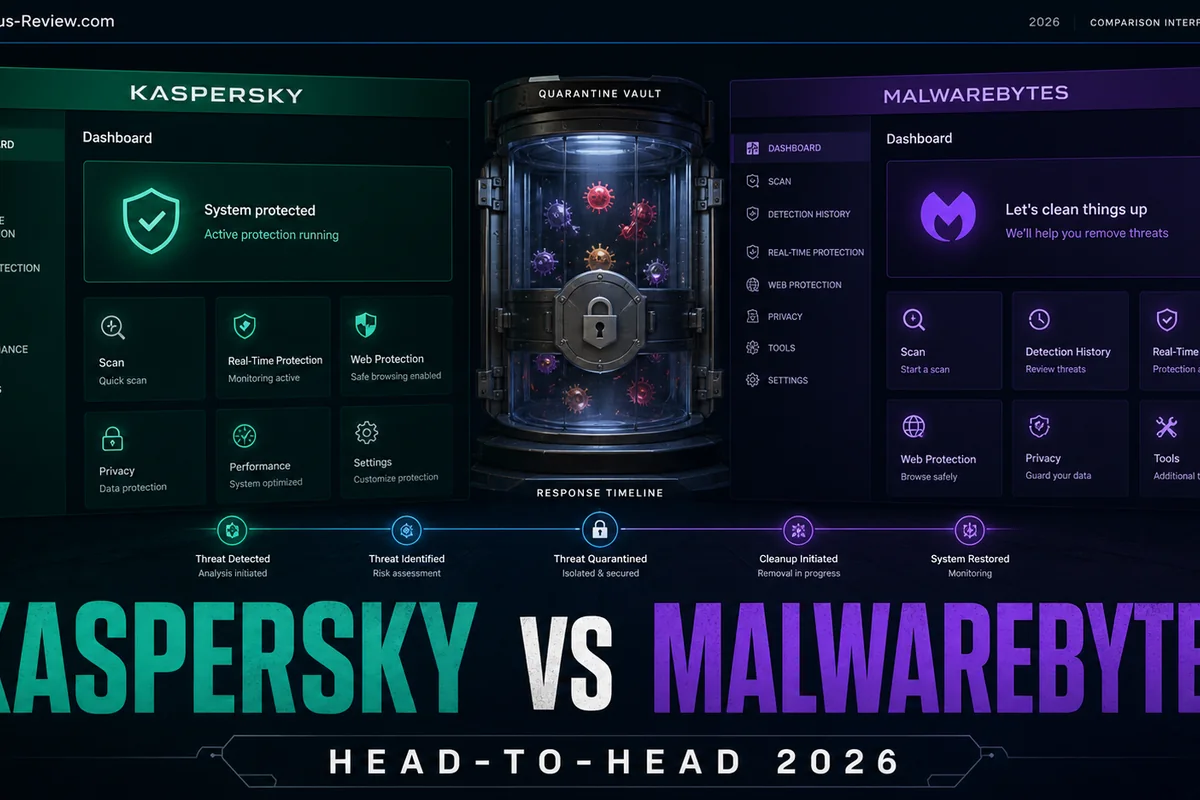
Quick answer: In the US: Kaspersky is off the table — no lawful sales or updates — so Malwarebytes wins by default in its niches, with Defender or Bitdefender as the primary engine. In supported markets: Kaspersky Premium's 99.8% protection, 3 false alarms and 3.5 impact beat Malwarebytes' rows decisively; keep Malwarebytes Free as the cleanup layer either way.
Kaspersky vs Malwarebytes at a glance
On lab paper this is the widest gap on our compare shelf. Kaspersky Premium led the 2026 cycles outright: 399 of 400 real-world attacks blocked, three false alarms, 18/18 at AV-TEST, the second-lightest impact of the April report, a perfect SE Labs run. Malwarebytes Premium: 98.8% with thirty-nine false alarms, 17.5/18, and the second-heaviest impact score.
Off paper, geography rewrites everything: Kaspersky can't lawfully sell to or update US machines. And product roles differ — people rarely buy Malwarebytes as a lab champion; they buy the remediation workflow its free tier made famous.
| Kaspersky | Malwarebytes | |
|---|---|---|
| Editorial rating | 8.4 (conditional) | 8.2 |
| AV-TEST (Mar–Apr 2026) | 18/18 Top Product (Premium 21.24, March–April 2026) | 17.5/18 Top Product (Premium 5.5, March–April 2026; 5.5/6 protection) |
| Price path | No legitimate current US price. UK snapshot: Standard £17.99 → £45.99, Plus £22.99 → £55.99, Premium £23.99 → £59.99 (3 devices/year) | Standard ~$44.99/year (1 device) or $59.99 (3); Plus adds VPN at $79.99 (3) / $99.99 (5) |
| Best fit | Supported-market households only — US sale and updates are prohibited | Cleanup, second opinions and a simple paid engine — with a false-positive caveat |
Lab showdown: what the current cycles actually say
| Current test | Kaspersky | Malwarebytes |
|---|---|---|
| AV-TEST Windows 11, current cycles | 18/18 Top Product (Premium 21.24, March–April 2026) | 17.5/18 Top Product (Premium 5.5, March–April 2026; 5.5/6 protection) |
| AV-Comparatives Real-World, Feb–May 2026 (400 cases) | 99.8% protected (399/400) · 1 compromised · 3 false alarms — best raw result of the cycle | 98.8% protected · 5 compromised · 39 false alarms · Standard award |
| AV-Comparatives Malware Protection, Mar 2026 | 92.1% offline detection · 99.97% online protection · 2 false alarms | 92.4% offline detection · 99.59% online protection · 23 false alarms |
| AV-Comparatives Performance, Apr 2026 (impact, lower is better) | 3.5 — second-lightest combined impact of the report | 17.6 — best Office score of the report (97.4) but slow file/app tasks |
Every protection row belongs to Kaspersky. Real-world: 99.8% vs 98.8%, one compromise against five. Accuracy: 3 false alarms against 39 — a thirteenfold difference that AV-Comparatives punished by award tier. The malware test: 99.97% vs 99.59% final protection, 2 vs 23 false alarms. Performance: 3.5 vs 17.6 total impact.
The only asterisk favoring Malwarebytes is jurisdictional, not technical: its results are available to everyone. Kaspersky's excellence is unavailable precisely where this comparison gets searched most.
Pricing and renewal reality
| Kaspersky | Malwarebytes | |
|---|---|---|
| Checked July 14, 2026 | No legitimate current US price. UK snapshot: Standard £17.99 → £45.99, Plus £22.99 → £55.99, Premium £23.99 → £59.99 (3 devices/year) | Standard ~$44.99/year (1 device) or $59.99 (3); Plus adds VPN at $79.99 (3) / $99.99 (5) |
| Refund window | 30-day money-back in supported markets; the seller controls the route | 60-day guarantee on eligible direct purchases; app-store and reseller terms can differ |
| Free tier | Not the buying question in the US — the ban is | Free tier is on-demand cleanup only, not real-time protection |
Kaspersky has no legitimate US price. Supported-market snapshot (UK store, July 14): Standard £17.99, Plus £22.99, Premium £23.99 for three devices, renewing at £45.99–£59.99 — consistently cheaper than Western rivals for what's included. Malwarebytes prices globally: Standard ~$44.99 (1 device) or $59.99 (3), Plus with VPN at $79.99–$99.99, with naming drift (Total vs Ultimate) on upper tiers.
Refund routes differ in kind: Kaspersky's 30-day guarantee runs through whichever seller processed payment — identify them first — while Malwarebytes' terms follow the store. Neither punishes the careful buyer.
Feature comparison
| Feature | Kaspersky | Malwarebytes |
|---|---|---|
| Platforms and devices | Windows, macOS, Android, iOS — supported markets only | Windows, macOS, Android, iOS, ChromeOS |
| VPN | Unlimited VPN from Plus | Privacy VPN in Plus and above |
| Password manager | Password manager from Plus | None |
| Firewall / hardening | Yes, with payment protection | No firewall — relies on Windows Firewall |
| Cloud backup | None current | None |
| Parental controls | Safe Kids sold separately | None |
Kaspersky Plus is a full suite: firewall, payment-protected browsing, unlimited VPN, password manager, leak monitoring. Malwarebytes is deliberately not: engine, Browser Guard, VPN at the Plus tier, and the remediation toolkit — no firewall, no password manager, no family features.
The jobs barely overlap. Kaspersky replaces a security suite; Malwarebytes supplements one. Which is why our recommendation in every market includes Malwarebytes Free — it complements whatever primary engine geography and preference hand you.
What changes on Windows, Mac and mobile
A feature-table check mark doesn't mean equal coverage everywhere. Kaspersky currently supports Windows, macOS, Android, iOS — supported markets only. Its firewall/hardening position is: Yes, with payment protection. VPN: Unlimited VPN from Plus. Backup: None current.
Malwarebytes currently supports Windows, macOS, Android, iOS, ChromeOS. Its firewall/hardening position is: No firewall — relies on Windows Firewall. VPN: Privacy VPN in Plus and above. Backup: None. Before paying, list the devices you actually own and mark the one feature you need on each. A Windows-only backup or separately configured family tool shouldn't be counted as a full cross-platform benefit.
The practical test is one Windows machine plus the least-supported device in your household—usually a Mac, iPhone or Chromebook. Check that web protection, account login, notifications and removal all behave sensibly there during the refund window. That exposes platform gaps faster than comparing another row of marketing icons.
Setup, alerts, support and the exit route
Kaspersky: a polished supported-market app, but availability and update continuity override interface preference in the United States. The current refund position is 30-day money-back in supported markets; the seller controls the route. Its official support page linked below is the right place to verify removal, renewal and platform-specific steps before the refund clock expires.
Malwarebytes: the cleanest scanner-first interface in this set; Free and paid modes must not be confused. The current refund position is 60-day guarantee on eligible direct purchases; app-store and reseller terms can differ. Save the order email and identify who charged the card: a vendor, an app store and a reseller can have different cancellation paths even when the product name is identical.
For a fair trial, install only one contender at a time, update it, run the same normal workload for several days, then check browser launches, file copies, notifications, quarantine restoration and account cancellation. Protection scores come from controlled laboratories; ease of ownership is the part you can verify on your own hardware.
Performance on a real PC
Kaspersky's 3.5 impact score was second only to McAfee in April — near-invisible even on the low-end test hardware. Malwarebytes' 17.6 carries its usual split: excellent in Office tasks (best-in-field 97.4), heavy in file and application work. On struggling hardware in a supported market, Kaspersky is the kinder full-time resident by a wide margin.
Used as we suggest — Malwarebytes Free, on-demand only — its performance cost rounds to zero, which is the fairest way to run the heaviest real-time engine in our set.
Can you run Kaspersky and Malwarebytes together?
Don't leave both paid real-time engines active by default. Malwarebytes Free is different: it's an on-demand cleanup scanner and can be kept for a manual second opinion beside Kaspersky. Malwarebytes Premium enables real-time layers, so running it beside another registered antivirus can duplicate web filtering, quarantine the same file twice or make a slowdown impossible to diagnose.
Choose one primary engine, uninstall the other real-time suite, reboot, and confirm Windows Security names the product you intended. Then run an EICAR-safe test or the vendor's status screen—not live malware—to confirm protection. If you keep Malwarebytes Free, disable any trial that silently turns real-time protection back on and update it before each manual scan.
How we compared Kaspersky and Malwarebytes
Our editorial testing and fact-check method separates four questions that are often blended into one score: protection and false alarms from the latest comparable independent Windows cycles; system impact from AV-Comparatives' April 2026 protocol; ownership cost from dated first-term, renewal and refund terms; and fit from platform limits, included tools and the setup a reader actually needs.
The lab rows aren't our home-made malware test and the community links aren't votes. Each result keeps its test name, date and denominator so a small one-cycle margin isn't presented as permanent truth. Prices are snapshots, not promises: checkout region, campaign and seller remain the contract. We revise the verdict when a new comparable cycle or material product term changes it.
Primary sources and real-world checks behind this comparison
For Kaspersky, we checked the current product or pricing page and the official support documentation. For Malwarebytes, we checked its current product or pricing page and official support documentation. Those pages establish plan names, supported systems and bundle limits; the independent lab links in the table establish protection, false alarms and performance. Regional availability is checked against the relevant government restriction page.
Community reports are used only to identify what a buyer should test. A current Kaspersky discussion focuses on strong supported-market experiences weighed against availability, jurisdiction and update continuity. A current Malwarebytes discussion focuses on its role as a second-opinion scanner, false positives and the practical difference between Free and paid real-time tiers. These threads are directional and can be biased; they don't override controlled malware tests. They do justify checking notifications, renewal controls, exclusions and uninstall behavior during the refund period.
Who should pick Kaspersky
- You're in a supported market and want the best protection-and-accuracy line of 2026
- Low system impact on modest hardware — 3.5 vs 17.6 is decisive
- Plus-tier bundle (unlimited VPN, password manager) at below-rival pricing
- Your employer and sector have no vendor-origin restrictions
US readers: don't buy gray-market keys to route around the ban — updates and cloud protection are exactly what the prohibition breaks, and antivirus without updates is theater. Transition guidance is in our Kaspersky review.
Who should pick Malwarebytes
- You're in the US, where this comparison has one lawful contestant
- You want the best free cleanup scanner regardless of your primary engine
- Simple paid protection with no bundle appeals more than suite depth
- Your tools are mainstream enough that the false-positive tax stays theoretical
If Malwarebytes Premium is becoming your primary US engine, benchmark it against Bitdefender and Defender first — both out-test it. Buy Premium for the workflow you prefer, not as the default Kaspersky replacement; better defaults exist.
Frequently asked questions
Can Americans still use Kaspersky in 2026?
Lawfully buying it, no — and existing installs can't receive updates or cloud protection, which makes them decorative. US machines running Kaspersky remnants should transition to Defender, Bitdefender or another supported engine.
Is Kaspersky technically better than Malwarebytes?
By every current lab row: 99.8% vs 98.8% real-world protection, 3 vs 39 false alarms, 3.5 vs 17.6 system impact, 18/18 vs 17.5/18 at AV-TEST. The comparison only tightens where Kaspersky can't legally operate.
What should US Kaspersky users replace it with?
For the engine: Bitdefender (closest protection evidence) or Defender (free, already present). Malwarebytes Free earns a place as the cleanup layer in that transition — its remediation shines while switching engines — but it isn't the primary-engine answer.
Why does Malwarebytes flag so many clean files?
Aggressive detection tuning: 39 clean sites/files in the real-world cycle and 23 in the malware test. Kaspersky's counts — 3 and 2 — are the accuracy benchmark of the year. Niche and unsigned software feels the difference most.
Can I run Malwarebytes Free alongside Kaspersky?
Yes — in supported markets that's a sensible stack: Kaspersky as the real-time engine, Malwarebytes Free for on-demand second opinions. On-demand scanning doesn't conflict with a real-time engine.
Final verdict
Two verdicts, one border apart. In supported markets, Kaspersky doesn't just win — it posts the most lopsided lab victory on our compare shelf, at lower prices, with the year's cleanest accuracy record. A household there choosing between these two products for real-time protection has an easy evening.
In the United States, the champion forfeits. Malwarebytes wins the matchup by being present — but presence isn't a mandate, and the honest US recommendation reads: Defender or Bitdefender as the primary engine, Malwarebytes Free as the cleanup layer, Premium only for those who prefer its workflow enough to pay the false-positive tax.
In every jurisdiction, one line survives: Malwarebytes Free belongs in the toolkit. Champions come, champions get banned; the ambulance stays useful.
Full write-ups: Kaspersky Premium review · Malwarebytes Premium review · all head-to-head comparisons.