
Adaware Antivirus Review 2026: Discontinued—Remove It
Adaware Antivirus is no longer a product to compare or download. The vendor ended every version, purchases, license transfers and virus-definition updates.
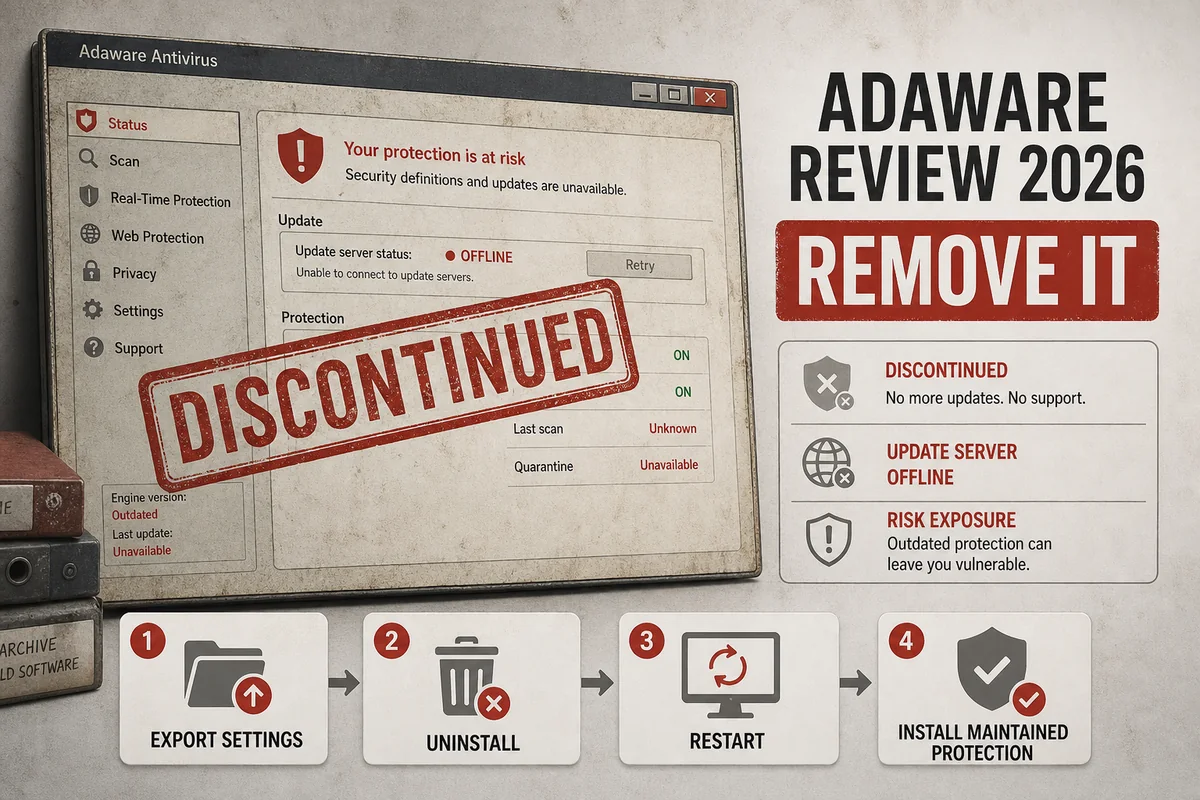
Our verdict: Don't download, buy or keep Adaware Antivirus as protection in 2026. Adaware's current support FAQ says the antivirus and all previous versions are officially discontinued; downloads, license transfers, purchases and definition updates are no longer supported. That makes even a working installation unsafe as primary antivirus because it can't learn current malware signatures or receive normal product maintenance. Version 12 had credible historical VB100 results in 2020, but those results can't rescue an end-of-life build six years later. Existing users should export any needed quarantine record, uninstall Adaware, restart, confirm Microsoft Defender or another supported antivirus is active, update/scan, cancel any recurring subscription separately and request a refund within 30 days of an eligible charge. Adaware Privacy is a different browser/privacy utility, not a documented replacement antivirus. Our editorial score is 1.0/10: historical relevance only.
- Legitimate anti-spyware/antivirus history dating to Ad-Aware
- Free version 12 once included real-time file protection
- Historical VB100 certification-quality results in 2020
- Official account portal still supports subscription cancellation
- Official support still states a 30-day refund route for eligible charges
- Vendor provides a removal-tool route if Windows uninstall fails
- Every Antivirus version is officially discontinued
- No supported download, reinstall, activation or license transfer
- Virus-definition updates have ended
- No current lab result for a supported product can be cited
- Stale official pages and third-party portals still create download confusion
- Adaware Privacy doesn't document a malware file-scanning engine
Adaware Antivirus is officially discontinued
The product-status question now has a direct first-party answer. Adaware's current Antivirus FAQ states that Adaware Antivirus and all previous software versions have been discontinued. It also says downloads, reinstall/activation, license transfers and definition updates are no longer supported, new purchases are unavailable, and customer care is limited.
This isn't a rumor inferred from an old installer or missing store button. The FAQ was updated December 12, 2025 and is the clearest current statement by the company responsible for the product. It overrides stale marketing pages that still describe version 12, daily definitions or Buy/Download buttons as though the old lifecycle continues.
| Question | Current answer | What to do |
|---|---|---|
| Can I buy Adaware Antivirus? | No; official purchase ended. | Don't use an old store or reseller listing. |
| Can I download or reinstall it? | No supported download/reinstall. | Avoid third-party installer archives. |
| Can I transfer my license? | No; license transfers ended. | Cancel renewal and migrate. |
| Do definitions still update? | No. | Remove it as primary protection immediately. |
| Is customer support available? | Limited for the discontinued product. | Use current billing/support forms for account issues. |
| Is Adaware Privacy the same product? | No; it's a different privacy/browser tool. | Keep a supported antivirus active. |
| Our current rating? | 1.0/10, one editor. | Historical record, not a buying recommendation. |
The recovered article still compared free and paid plans, installation and a $/year Offer as if readers could buy them. Those elements have been removed. A discontinued antivirus can't responsibly retain purchase schema or a “best plan” box.

Is an old Adaware Antivirus installation still safe?
No—not as an active protection layer. The executable doesn't become malware merely because support ended, and a clean legacy installation may still launch and scan against its last local database. The danger is false confidence: modern malware, phishing loaders, packers, certificates and legitimate-software baselines change after the final engine/signature update.
An antivirus needs more than a running Windows service. Signature feeds identify known families and variants; reputation/cloud systems change their decisions; engines receive parser and privilege fixes; URL lists expire; root certificates and operating-system integrations evolve. Ending both product and definition updates removes the normal response loop.
Don't treat a green tray icon, completed scan or “no threats found” message as evidence of current protection. It only proves the old app executed its old checks. The correct action is to migrate to a supported security provider, then scan from the supported product after Adaware has been removed and Windows restarted.
If the PC is offline and preserved solely for historical software, isolate it from networks and removable media rather than relying on the old antivirus. The moment it handles current files or connects to the internet, its threat model is current even if the operating environment isn't.
Don't download Adaware Antivirus from a third-party portal
Search results still show download pages whose visible “updated” date changes every week or year. That doesn't mean the antivirus binary, engine or definitions changed. A portal can refresh metadata around the same unsupported installer. Some official-domain pages also remain stale, including old version-12 support, standalone installer and suite copy.
The current explicit EOL FAQ says downloads are no longer supported. That settles the safety decision. Don't use an old mirror, torrent, software archive, search ad or direct link copied from a forum. With no supported hash/signature/version channel and no definition service, even an authentic legacy installer can't become a viable 2026 antivirus.
If your goal is adware/PUP removal, don't search “Adaware download” and assume the brand name describes the task. Use a current antivirus plus a maintained on-demand tool such as Malwarebytes/AdwCleaner from its publisher. If your goal is Adaware Privacy or AdBlock, download that specifically from Adaware and keep the product distinction visible during installation.
Never run an installer merely to obtain its uninstaller. Try Windows removal first, then the vendor's current official removal-tool route. Installing a second copy can replace files, restore services or change the very state you're trying to clean.
Ended virus-definition updates are the decisive failure
Adaware's support FAQ explicitly says definition updates are no longer supported. That's stronger than “no recent major lab result.” A product missing one lab cycle might still receive active protection updates; Adaware has declared that the data feed itself has ended.
Definitions aren't the only layer in modern detection, but they remain a core input. Behavior rules, machine learning and cloud reputation also require maintenance because attackers deliberately change file structure, loaders, command-and-control domains and living-off-the-land chains. An engine frozen around old assumptions can miss new threats or flag new legitimate software.
Historical use of another vendor's engine doesn't solve the issue. A licensed engine inside an end-of-life product depends on the integrator's update contract, cloud connection, configuration, exclusions and response logic. Bitdefender's current results don't transfer to discontinued Adaware, just as they didn't automatically transfer between old Adaware editions.
There's no safe grace period to calculate from the FAQ date. The vendor doesn't provide a last-definition timestamp or promise residual cloud coverage. Because this is security software and supported alternatives already exist, migrate now rather than waiting for a visible failure.
The last meaningful lab results were good—and are now historical
Version 12 wasn't always ineffective. In the October 2020 VB100 report, Adaware Antivirus Free and Pro 12.8.1241.0 recorded 99.9% WildList detection, a 0.000% false-positive rate and 99.90% in the Diversity Test on Windows 7 and 10. The report used 1,666 certification malware samples, 99,999 clean files and 999 diversity samples; only a different product appears in the not-certified appendix.
The February 2020 test was also strong: Free and Pro 12.7.1055.0 achieved 100.0% WildList detection, 0.000% false positives and 99.29% Diversity. Those are useful facts about named builds under a named 2020 method.
| Test | Product/build | WildList | False positives | Diversity | 2026 meaning |
|---|---|---|---|---|---|
| VB100 February 2020 | Free/Pro 12.7.1055.0 | 100.0% | 0.000% | 99.29% | Historical result only. |
| VB100 October 2020 | Free/Pro 12.8.1241.0 | 99.9% | 0.000% | 99.90% | Historical result only. |
| Current AV-TEST/AV-C/SE Labs | No supported product | — | — | — | Nothing current to test or recommend. |
The results don't answer current ransomware, infostealer, phishing or Windows 11 performance questions. Six years, multiple Windows generations and an ended definition service separate the test from today's user. We preserve the record to avoid the opposite error—claiming Adaware was always fake or useless—while giving it zero current protective credit.

What Free, Personal, Pro and Total used to include
Legacy version-12 documentation described four tiers. Free supplied scanning, real-time anti-malware/rootkit protection and gaming-mode notifications. Personal added Active Virus Control behavior monitoring and web protection. Pro added network/two-way firewall and email protection. Total added parental controls and, on other stale pages, a broader bundle of privacy/performance utilities.
| Legacy feature | Free | Personal | Pro | Total | Current status |
|---|---|---|---|---|---|
| Computer scan / real-time protection | Yes | Yes | Yes | Yes | Discontinued; no definitions. |
| Behavior / web protection | No/limited | Yes | Yes | Yes | Unsupported legacy feature. |
| Network firewall / email protection | No | No | Yes | Yes | Unsupported legacy feature. |
| Parental controls | No | No | No | Yes | Unsupported legacy feature. |
| New purchase or renewal value | Not applicable | Don't buy | Product unavailable. | ||
This table is an archive, not a recommendation. It exists because searchers with an installed copy may need to identify why a firewall, web filter or parental-control component is present. No legacy tier is “best” in 2026; all share the decisive EOL/definition problem.
The recovered page also presented prices and a plan recommendation. We removed them because the vendor says purchase is unavailable. A reseller offering an activation key can't restore the ended definition infrastructure, license transfer or support lifecycle.
Adaware Privacy is a different product, not replacement antivirus
Adaware calls Privacy a different solution designed to protect users while browsing. The current Free/Plus feature matrix lists web protection, microphone/webcam usage monitoring, email-breach scanning and an ad blocker; Plus adds unlimited breach scans/alerts and VPN.
The matrix doesn't list computer malware scanning, on-access file scanning, quarantine, ransomware behavior detection or a Windows Security antivirus provider. Its web protection may block a known malicious site, but that's one layer, not an endpoint antivirus engine. Keep Microsoft Defender or another supported antivirus active if you install Privacy.
Privacy's product page itself still lists Windows XP/Vista/7/8/10-era requirements and doesn't clearly name Windows 11 in the visible system list we checked. That's another reason not to treat “the successor” as automatic migration. Verify current Windows compatibility and decide whether you need its VPN/breach/webcam tools separately.
Don't install Privacy only to preserve an Adaware subscription. Evaluate it as a new product: price, renewal, VPN jurisdiction/logging, web-filter behavior, microphone/webcam alert quality, data collection and uninstall. A company keeping the brand doesn't preserve the old product's function.
Adaware, adware, Web Companion, AdBlock and AdwCleaner aren't the same
Adaware Antivirus (formerly Ad-Aware) is the discontinued Windows anti-spyware/antivirus reviewed here. Adware is the generic category of advertising-supported or unwanted software; the lowercase security term isn't a brand recommendation.
Adaware Privacy is the current web/privacy/VPN utility described above. Adaware Web Companion and Adaware AdBlock are separate browser-facing products/extensions. Removing Antivirus doesn't automatically prove that those separate components are removed, and finding Web Companion doesn't prove the old antivirus is installed.
Malwarebytes AdwCleaner is an unrelated on-demand PUP/adware cleaner made by Malwarebytes. The similar “Adw” name causes persistent search confusion. If you choose it as a cleanup tool, download it from Malwarebytes and remember that an on-demand cleaner doesn't replace Defender's real-time role.
When auditing the PC, record exact publisher, product name, installation path and browser extension ID. “I found Adaware” isn't precise enough to decide whether to cancel a subscription, remove a Windows service or delete a browser extension.
Cancel auto-renewal separately and request eligible refunds
Uninstalling software doesn't cancel billing. Adaware's current account instructions say to sign in to the Account Portal, open Subscriptions, choose Manage Subscription and Cancel subscription. The company sends a confirmation email. Preserve that email and a screenshot of the inactive renewal state.
Cancellation stops future renewals but doesn't automatically refund the current product. Adaware says official-site software can be returned for a refund within 30 days of the charge through its authenticated support-request flow. Submit the billing email, order/invoice, amount, charge date and the fact that Antivirus is discontinued/no longer updates.
- Find the receipt, card descriptor and Adaware account email.
- Cancel auto-renewal in the portal and save the confirmation.
- If charged within 30 days, open the refund request immediately.
- If the portal shows no subscription but charges continue, contact support with transaction details; don't post full card/license data publicly.
- Ask the bank about dispute options only after documenting the merchant contact and applicable deadlines.
The current auto-renewal article covers Adaware subscriptions generally, not a promise that an old Antivirus license continues receiving security. Billing access isn't product support.
Before uninstalling: preserve what you may need
Most users can remove Adaware immediately. Pause for a few minutes if its quarantine contains a legitimate file, if a business record requires evidence of the old alert, or if the PC has no working alternative network access.
- Write down the installed Adaware version, last definition date, protection state and any recent detections.
- Export or photograph quarantine entries. Restore a file only after independently verifying its publisher/hash; don't empty quarantine blindly.
- Create a Windows restore point or full backup. A restore point isn't a backup for personal documents.
- Download updates for Microsoft Defender/your replacement from the official publisher before removal if internet access is unreliable.
- Close browsers and save work. Security-provider changes require a restart.
- Cancel renewal separately; don't assume the uninstaller contacts billing.
If you suspect an active infection, disconnect the PC from sensitive accounts/network shares first. Don't sign into banking or a password manager just to download a replacement.
How to uninstall Adaware Antivirus completely
- Open Windows Settings → Apps → Installed apps (or Control Panel → Programs and Features on an older system).
- Find the exact Adaware Antivirus entry, choose Uninstall and follow the built-in removal flow.
- Remove product-specific optional components only when their names/publishers match; don't delete unrelated browser or system software by guesswork.
- Restart Windows even if the uninstaller doesn't insist.
- Open Windows Security → Virus & threat protection and confirm a supported provider is active.
If standard removal fails or remnants remain, the vendor's official Fix my PC page still exposes a Removal Tool route. That page also contains stale installer/rescue claims contradicted by the EOL FAQ. Use only the removal function, download only from the official Adaware domain, verify the publisher signature, create rollback first and restart afterward.
Don't start by deleting the Program Files folder, WSC service or registry keys. Antivirus components include protected services, filters and Windows Security registration. Manual partial deletion can leave Defender believing another provider owns protection or make the vendor tool unable to identify the installation.
Check residual WSC services, startup items and browser components
After restart, inspect Windows Security first. If it still names Adaware or says settings are managed by another provider, return to Installed apps, run the official removal tool and restart again. Community reports mention a residual `Adaware Antivirus WSC service`; its presence after uninstall is a troubleshooting signal, not permission to delete arbitrary services.
| Check | Expected state | If not |
|---|---|---|
| Windows Security provider | Defender or chosen supported antivirus active | Restart; rerun official removal; update Windows. |
| Installed apps | No Adaware Antivirus entry | Use the vendor removal tool, not an installer mirror. |
| Services/startup | No active Antivirus/WSC component | Document service name/path/signature; contact support. |
| Browser extensions | Only extensions intentionally retained | Remove Web Companion/AdBlock separately if unwanted. |
| Scheduled tasks | No Adaware Antivirus updater/task | Use Autoruns/support with a restore point; don't bulk-delete. |
| Network filters | Normal browsing/DNS after restart | Reset only the affected layer after documenting it. |
Advanced manual cleanup should be evidence-driven. Capture the executable path and digital signature, check whether it belongs to Antivirus, Privacy or another Adaware product, and back up configuration before using Microsoft Autoruns or service tools. A generic filename search can remove a current product the user intended to keep.
Verify Microsoft Defender returns after removal
Windows normally disables Defender's active antivirus role when a recognized third-party provider registers. After the third-party product is removed and the PC restarts, Defender should return automatically—but verification matters, especially after a failed or partial uninstall.
- Open Windows Security → Virus & threat protection.
- Confirm Microsoft Defender Antivirus is on and no Adaware provider is listed.
- Run Windows Update, then Security intelligence updates.
- Enable real-time, cloud-delivered protection and automatic sample submission according to your policy.
- Run a Quick scan, followed by Microsoft Defender Offline scan if infection is suspected.
- Review Protection history; distinguish old Adaware quarantine paths from new detections.
Don't install two active replacements “for extra safety.” One real-time provider should own the endpoint. An on-demand second-opinion scanner can be closed when not in use.

If you suspect infection, use a supported cleanup path
An expired Adaware scan can't certify the PC. Disconnect from sensitive network shares, stop using the machine for credentials, update Microsoft Defender and run its scans. For a second opinion, use a current on-demand scanner from its publisher. Don't download multiple cleaners from search ads or software portals.
If an infostealer is plausible, scan/remediate first, then change passwords from a separate clean device, revoke sessions/tokens, rotate recovery codes and watch financial accounts. Merely deleting the detected file doesn't invalidate stolen browser cookies or credentials.
For ransomware, preserve encrypted files/notes, disconnect affected storage and avoid random decryptors. Check No More Ransom/vendor guidance for the exact family. Restore only from known-clean offline/versioned backups after the system is rebuilt or confidently remediated.
For a business PC or persistent root/service problem, reimage from trusted media and restore verified data rather than stacking removal tools on an unknown base. Document the old Adaware version/definitions as part of incident scope.
Legacy privacy promises and current support limits
Old Antivirus documentation and EULAs describe accounts, activation, scans, telemetry and a Canadian Adaware Software entity; current support pages identify the brand as part of the Avanquest group. Those documents are useful for account ownership and billing context, but an EOL review shouldn't reconstruct current telemetry from an app whose supported data flows have ended.
Assume any old cloud, URL or sample-upload feature may be unavailable or behave differently from its original policy. Don't submit sensitive files to a legacy client to test whether the cloud still answers. During removal, preserve only records you need and delete the account or marketing subscriptions separately if desired.
Limited customer care means security troubleshooting may not receive product-engineering support. Billing and privacy rights still exist through current account/support channels, but the company doesn't promise a new engine update or license transfer. The remedy is migration, not a support ticket asking to re-enable definitions.
Community reports explain the removal checklist, not the product score
Support forums and Reddit contain reports of old WSC services after removal, difficulty uninstalling, unexpected/bundled Web Companion components and people installing Adaware Privacy while expecting a virus scanner. These are credible prompts to verify services, extensions and Defender activation.
They can't establish how often a failure occurs. Posts span different years, products, installer sources and Windows versions. We don't import a community rating, name individual users or claim every Adaware install was bundled.
The decisive rating evidence is simpler and primary: the vendor ended the product and its definitions. Community sentiment can refine the migration steps, but it can't make an unsupported antivirus safe or unsafe by itself.
Who should act now?
| User state | Action | Priority |
|---|---|---|
| Adaware Antivirus is active primary protection | Uninstall, restart, activate/update Defender and scan. | Now |
| Old copy is installed but real-time protection is off | Export needed quarantine records and remove it. | Today |
| Considering a third-party download | Don't download; choose a supported alternative. | Stop |
| Recently charged subscriber | Cancel renewal; request refund within 30 days if eligible. | Before deadline |
| Adaware Privacy user | Keep a separate supported antivirus; evaluate Privacy independently. | Verify now |
| Web Companion/AdBlock only | Audit/remove the exact browser product if unwanted. | As needed |
| Offline museum/legacy PC | Keep network/removable-media isolated; don't treat old AV as protection. | Before use |
Supported Adaware alternatives
Microsoft Defender is the immediate no-cost replacement on a supported Windows 11 PC. It integrates with Windows, receives current security intelligence and participates in independent testing. Verify it reactivates after Adaware removal.
Bitdefender is the strongest paid migration when current multi-lab malware/web/ransomware evidence matters. Buying Bitdefender's own product isn't the same as relying on an old licensed engine inside discontinued Adaware.
ESET suits a technical user who wants detailed policy, firewall and low-friction controls with current product-specific testing.
Avast Free, AVG Free and Avira Free are current free third-party choices. Each has upsells/data/feature trade-offs, but all are fundamentally different from a definition-frozen EOL product.
Malwarebytes can serve as an on-demand second opinion or paid real-time product. Malwarebytes AdwCleaner is useful for PUP/adware cleanup but is separate from the Adaware brand and shouldn't replace Defender in scan-only mode.
Choose one active provider, confirm the exact current product/build in independent results and test uninstall/refund before moving important systems. “It used to score well” isn't a lifecycle plan.
A 30-minute Adaware migration checklist
- Record state: installed version, last definition date, detections/quarantine and subscription email.
- Preserve evidence: export only quarantine/billing records you may need; never restore an unknown malicious file.
- Create rollback: back up personal data and create a restore point.
- Cancel billing: turn off auto-renewal in the Adaware portal; save confirmation; submit a refund request if the charge is within 30 days.
- Uninstall: Windows Settings/Programs and Features → Adaware Antivirus → Uninstall.
- Restart: required to release security services/filters and update Windows Security registration.
- Verify provider: Defender or your one supported replacement must show active.
- Update and scan: Windows/security intelligence updates, Quick scan, and Offline scan if compromise is suspected.
- Audit residuals: installed apps, WSC provider, services/startup, scheduled tasks and browser extensions.
- Escalate carefully: if removal fails, use the official vendor removal route, preserve signature/path evidence and avoid random registry cleaners.
- Credential response: if malware was plausible, rotate credentials/revoke sessions from a separate clean device.
Completion means more than “Adaware disappeared from the Start menu.” A supported provider is active and updated, the system has restarted/scanned, no stale security registration or unwanted browser component remains, and recurring billing is resolved.

Frequently asked questions
Is Adaware Antivirus discontinued?
Yes. Adaware's current support FAQ says Adaware Antivirus and all previous versions are officially discontinued. Downloads, reinstall/activation, license transfers, purchases and definition updates are no longer supported, and customer care is limited. Don't use an old installation as primary protection.
Can I still download Adaware Antivirus Free?
Not through a supported vendor channel. Some stale official pages and third-party portals still show version-12 download language, but the current EOL FAQ says downloads are no longer supported. Don't install an archived binary whose definitions and lifecycle have ended.
Does Adaware Antivirus still update virus definitions?
No. The vendor explicitly says definition updates are no longer supported. A green icon or completed scan only shows the old app ran its old checks; it doesn't make the database current. Remove it and activate/update Microsoft Defender or another supported antivirus.
Was Adaware Antivirus ever good?
Named version-12 builds had good historical results. In October 2020, Free/Pro 12.8.1241.0 recorded 99.9% VB100 WildList detection, 0.000% false positives and 99.90% Diversity. Those results describe that 2020 build/test and can't support a discontinued, non-updating product in 2026.
Is Adaware Privacy a replacement antivirus?
No based on its current documented matrix. Adaware Privacy provides web protection, microphone/webcam monitoring, breach scanning and ad blocking; Plus adds VPN and monitoring. It doesn't list malware file scanning, quarantine or a real-time Windows antivirus provider. Keep Defender or another supported antivirus active.
How do I uninstall Adaware Antivirus?
Use Windows Settings → Apps → Installed apps, select Adaware Antivirus, uninstall and restart. Then verify Defender/your supported provider is active and updated. If standard removal fails or a WSC component remains, use the removal route on Adaware's official Fix my PC page—never a third-party mirror—and create rollback first.
How do I stop Adaware auto-renewal and get a refund?
Sign in to the Adaware Account Portal, open Subscriptions, manage the subscription and cancel; save the confirmation email. Cancellation stops future charges but isn't an automatic refund. The vendor says official-site purchases can be refunded within 30 days of the charge through an authenticated support request.
Are Adaware, Web Companion and AdwCleaner the same?
No. Adaware Antivirus is the discontinued product here; Adaware Privacy, Web Companion and AdBlock are separate Adaware products. “Adware” is a generic unwanted-software category. Malwarebytes AdwCleaner is an unrelated on-demand PUP/adware cleaner made by Malwarebytes.
Final verdict: preserve the history, remove the software
Adaware deserves an accurate obituary, not a recycled buying guide. Ad-Aware helped define consumer anti-spyware, version 12 offered real-time protection, and its 2020 VB100 numbers were respectable. That historical legitimacy is why calling the old product “a virus” is as unhelpful as pretending it remains current.
The present decision is unambiguous. The vendor ended every Antivirus version, supported downloads, transfers, purchases and definition updates. An antivirus that no longer receives definitions isn't an acceptable layer for current files, browsing or credentials. Stale official pages, portal timestamps and old lab badges can't override the EOL notice.
Our editorial score is 1.0/10. Existing users should cancel billing separately, uninstall, restart, restore/update Defender or one supported alternative, scan and verify no WSC/browser remnants remain. Adaware Privacy may be evaluated as a separate privacy utility, never as the missing antivirus engine.