
Comodo Antivirus Review 2026: Strong Tests, Unpatched Flaw
Comodo's default-deny protection still works, but the current consumer build has a high-severity remote-crash vulnerability with no released fix.
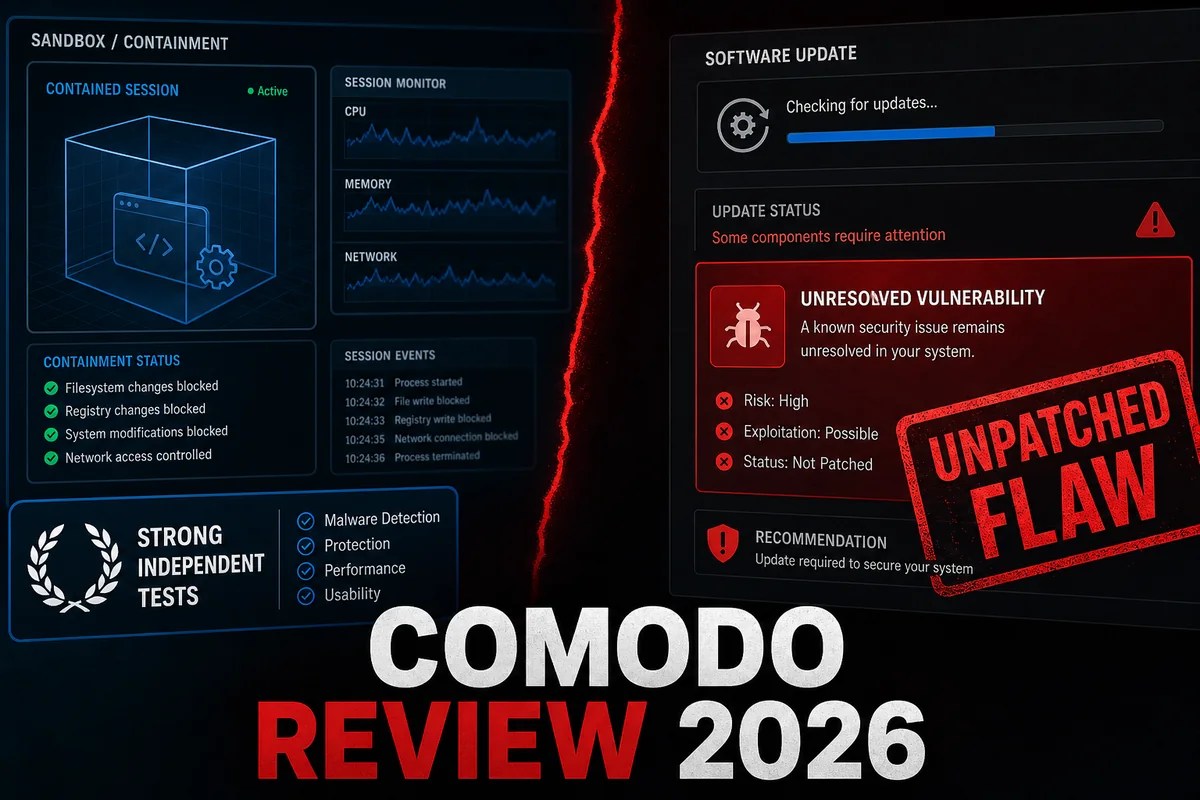
Our verdict: Don't install or continue relying on Comodo Internet Security 12.3.4.8162 while CVE-2026-49494 remains unfixed. The current consumer build produced an excellent 2,522/2,523 (99.92%) result across five AVLab 2025 editions, and its Auto-Containment, HIPS and firewall provide unusually deep control. But NVD identifies every Comodo Internet Security version through 12.3.4.8162 as affected by a high-severity flaw in the firewall driver: a remote, unauthenticated attacker can send one crafted IPv6 packet and crash Windows even when all ports are blocked. The record says a consumer fix is expected in Q3 2026; we found no patched CIS build by July 14. Existing users should move to supported protection now, then reconsider only after Comodo ships a fixed consumer build and the CVE record confirms it. Editorial score: 4.0/10.
- 99.92% across AVLab's 2025 series
- Powerful default-deny Auto-Containment
- Granular two-way firewall and HIPS
- VirusScope behavior monitoring
- Secure Shopping earned a 2026 AVLab certificate in Pro
- Core Premium protection remains available free
- Current 12.3.4.8162 build is affected by CVE-2026-49494
- Remote unauthenticated IPv6 packet can cause a Windows BSOD
- Consumer fix was only expected for Q3 2026 at review time
- Application release hasn't moved since December 2024
- Public website and installer paths are confusing and stale
- SE Labs measured only 76% Protection Accuracy in 2024
Comodo is active, but its consumer application release is stalled
The current consumer product is Comodo Internet Security 2025, version 12.3.4.8162. Comodo announced that build on December 12, 2024. The release notes were short: upgrades from existing versions and a fix for a potential containment issue. A March 22, 2026 support answer still directed users to the same build, and the current forum category continued to center on it in June 2026.
That means Comodo hasn't abandoned signature delivery or its community, but its Windows application hasn't received a public consumer build in more than eighteen months. The founder said the company was working on “CIS 2026” in September 2025; we found no released CIS 2026 consumer build by July 14, 2026. A promised name or roadmap isn't a patch.
| Question | Verified answer | Decision impact |
|---|---|---|
| Latest consumer build found | 12.3.4.8162 | Released Dec. 12, 2024; still linked as latest in Mar. 2026. |
| Malware definitions | Still delivered, with intermittent outage reports | Database activity doesn't patch the firewall driver. |
| Current serious vulnerability | CVE-2026-49494 | All CIS versions through 12.3.4.8162 are affected. |
| Fixed consumer build | None found July 14, 2026 | NVD says a CIS fix is expected Q3 2026. |
| Current recommendation | Don't install / replace now | Recheck after a confirmed consumer patch. |
| Our score | 4.0/10, one editor | Strong protection design outweighed by current patch risk. |
Calling the product “discontinued” would be inaccurate. Calling it comfortably current would also be inaccurate. The precise status is: active definitions and support conversations, a consumer application build frozen since December 2024, and an important driver fix not yet available on the review date.
CVE-2026-49494 makes the current firewall a remote crash surface
NVD's CVE-2026-49494 record says Xcitium Client Security before 13.8.2.10019 and Comodo Internet Security through 12.3.4.8162 contain an integer-underflow flaw in the `Inspect.sys` firewall driver. The consumer CIS fix is expected in Q3 2026. Xcitium's enterprise version number must not be treated as a patch for the separate consumer application.
The bug is in Comodo's IPv6 packet parser. It subtracts extension-header lengths from an untrusted payload-length field without validating that the result can remain positive. A crafted packet can make the unsigned value wrap to an enormous number. Subsequent kernel memory access triggers a blue screen. The CNA score is 8.7 High under CVSS 4.0 and 7.5 High under CVSS 3.1.
Security researcher Marcus Hutchins published the technical analysis and public proof of concept on June 3, 2026. The important consumer detail isn't theoretical jargon: parsing happens before firewall rules are enforced, so the packet can crash an affected Windows PC even if the target port is closed and the firewall is configured to block inbound connections.
The demonstrated impact is denial of service, not proven remote code execution or data theft. That distinction matters, but it doesn't make the flaw acceptable in software installed specifically to reduce attack surface. A remote crash can interrupt work, corrupt unsaved data, destabilize a service and create repeated availability attacks on a reachable IPv6 host.

Existing Comodo users should replace it until a fixed CIS build ships
Our prudent response is migration, not an improvised firewall rule. If you run 12.3.4.8162 or any older CIS build, assume it's affected. Export your configuration only for reference, install another supported protection path, remove Comodo, restart and verify that Windows Security reports one active antivirus and firewall.
- Open Comodo → About and record the full application version. Don't equate the virus-database timestamp with the program build.
- Save screenshots or export rules you may need to recreate, but don't import an old policy blindly into a future patched build.
- Download your replacement from its official vendor, or plan to use the Microsoft Defender and Windows Firewall already included with supported Windows 11.
- Disconnect from untrusted/public networks if the machine has a publicly reachable IPv6 address while you migrate.
- Uninstall Comodo normally, restart, and confirm the Comodo firewall driver and services are no longer active.
- Update the replacement, run a scan, confirm Windows Firewall profiles and review any application rules that were unique to Comodo.
Temporarily disabling IPv6 may reduce the specific network path, but it isn't a substitute for a vendor patch. IPv6 can be used by Windows components, VPNs, local networks and applications; partial adapter/router changes are easy to miss. Disabling Comodo's firewall component may also alter the security stack unpredictably. For a home PC, removing the affected product and activating a maintained alternative is simpler to verify.
If Comodo publishes a fix after this review, check three things before reinstalling: the release notes explicitly cite CVE-2026-49494 or the `Inspect.sys` fix; NVD's affected-version range excludes the new CIS build; and the installer/About screen shows that newer version. A generic “latest” button is insufficient.
Comodo Antivirus, Premium, Pro and Firewall are easy to confuse
Search results use “Comodo Antivirus” as the broad consumer name, but the Windows package is commonly presented as Comodo Internet Security (CIS). Its installer can include antivirus and firewall components, while Comodo Firewall is also sought as a standalone configuration. CIS Premium is the free consumer edition; CIS Pro layers commercial support/service benefits around the same core protection according to current forum guidance.
| Name | What it means here | Don't assume |
|---|---|---|
| Comodo Antivirus | Search/marketing name for the consumer malware component | That every old antivirus landing page serves the current package. |
| CIS Premium 2025 | Free Internet Security package, build 12.3.4.8162 | “Premium” means paid; in Comodo naming it's the free edition. |
| CIS Pro | Paid consumer edition with support/service extras | That stale public price or old cloud/VPN bundle remains current. |
| Comodo Firewall | Firewall-focused installation/component choice | That it avoids CVE-2026-49494; the affected component is the firewall driver. |
| Xcitium Client Security | Related enterprise endpoint product | Its 13.8.2.10019 fix installs into consumer CIS. |
| Comodo Mobile/Mac/Linux pages | Separate products or legacy pages | Windows CIS evidence applies to another platform. |
This naming problem is more than branding. It affects downloads, vulnerability triage and test interpretation. We restrict every protection result on this page to the named Windows consumer product/version used by the laboratory, and we don't transfer Xcitium enterprise fixes or certifications to CIS.
The official website is too stale to be a reliable version guide
Comodo's public antivirus pages still surface old Windows 7 end-of-life copy, 2018/2019 lab references, historical plan bundles and prices that conflict across pages. Forum moderators and experienced users have repeatedly pointed out that the website is outdated and that some prominent download routes lead to an old build or a Pro trial instead of the current free Premium installer.
The December 2024 official release announcement links the 12.3.4.8162 Premium and Pro installers on Comodo's download infrastructure, and a March 2026 support reply still pointed users there. There were also March 2026 forum reports of temporary CDN failures affecting the installer and definition downloads. Those reports don't establish a permanent outage, but they show why an evergreen “Download” button needs version verification.
While the CVE remains unfixed, we don't recommend downloading CIS at all. After a patch, start from a release announcement in the official CIS forum category, confirm the destination is a Comodo-controlled download host, verify the digital signature and compare the installed About version with the fixed-build notice. Avoid third-party software portals and search ads.
We deliberately removed purchase buttons and Offer schema. A page that mixes old CIS Complete, Pro, cloud storage, VPN, support and warranty copy can't support a precise July 2026 checkout claim. If you later consider Pro, read the live cart terms, renewal amount, device count, refund policy and included services immediately before paying.
Independent results are strong in AVLab, mixed elsewhere
Comodo has useful current evidence—but not the broad, repeated coverage available for Bitdefender, ESET or Norton. The strongest data is AVLab's 2025 Advanced In-The-Wild series. Comodo participated in five of six editions and stopped 2,522 of 2,523 live malware samples, or 99.92%. More than 26% were stopped before launch and more than 73% during/post launch; average remediation time was 37.1 seconds.
The one miss occurred in July. AVLab later explained that the sample had been mistakenly manually marked by a Comodo operator. That context matters, but the test result remains 239/240 for that edition. We don't rewrite a laboratory failure as a pass.
| Lab / period | Product/result | What it tells us |
|---|---|---|
| AVLab full 2025 series | 2,522/2,523 · 99.92% · five editions | Excellent live-malware prevention/remediation evidence. |
| AVLab Jan. 2025 | 759/759 · 100% · 165.0s avg. | Perfect block count; unusually long average remediation. |
| AVLab Mar. 2025 | 607/607 · 100% · 5.1s | Perfect count and fast response in that edition. |
| AVLab May 2025 | 473/473 · 100% · 5.4s | Perfect count in that edition. |
| AVLab Jul. 2025 | 239/240 · 99.58% · 5.4s | One recorded fail; don't round to 100%. |
| AVLab Sep. 2025 | 443/443 · 100% · 4.8s | Perfect count in final Comodo appearance that year. |
| SE Labs Apr-Jun 2024 | AA; 90% total; 76% protection; 2 false positives | Respectable overall award, substantially weaker protection score. |
| AV-TEST Aug. 2019 | 6/6 protection; 5.5/6 performance/usability | Historical only; too old for a 2026 recommendation. |
SE Labs' April–June 2024 factsheet is an important counterweight: Comodo earned an AA rating and 90% Total Accuracy, with 98% Legitimate Accuracy, but Protection Accuracy was only 76% and there were two false positives. Different methods can produce different outcomes; that's why we show both rather than choosing the prettier number.
AV-TEST's consumer archive last lists Comodo in August 2019. AV-Comparatives' current consumer set doesn't include it. Absence isn't proof that Comodo fails, but it limits triangulation and leaves no current standardized performance/false-positive series from those two major labs.

AVLab rewards Comodo's pre-launch and post-launch layers
Traditional “scanner percentage” summaries understate how CIS is designed. Known malicious files can be blocked by signatures or cloud reputation before launch. Unknown executables can be placed in Auto-Containment, where filesystem and registry writes are virtualized. VirusScope then observes behavior, and the product can classify or remediate after launch.
AVLab's result splits prevention into pre-launch and post-launch phases. Across 2025, Comodo stopped more than a quarter of samples at web/download/pre-launch stages and most of the rest during/post launch. That distribution is consistent with a default-deny product: allowing an unknown file to start in a restricted container isn't the same as letting it modify the real system.
Remediation time needs context. January's 165-second average pulled the annual average to 37.1 seconds; the March, May, July and September editions were around 4.8–5.4 seconds. A longer time can reflect observation/classification inside containment, but users still need clear status and no leakage. The July miss proves the architecture isn't infallible.
The results also don't neutralize CVE-2026-49494. Malware tests evaluate hostile files/URLs and endpoint response; the current vulnerability is in the firewall's kernel packet parser. A product can score 99.92% against one threat set while introducing a separate remote availability risk.
Auto-Containment is Comodo's most distinctive strength
Comodo's containment documentation says contained applications can read local files and registry data but can't modify the real versions; writes are redirected to a virtual filesystem and registry. This lets an unknown program run with sharply reduced ability to persist or alter Windows.
That's “default deny” in practical form. Instead of requiring every new malicious hash to be known, CIS asks whether the file is trusted. Known-good software runs normally, known malware is blocked, and unknown software is restricted while file rating/cloud analysis and behavior monitoring produce a verdict.
The trade-off is operational complexity. A legitimate unsigned utility, freshly compiled in-house app, niche driver or installer can be contained. It may appear to save settings or install successfully inside the virtualized environment, then seem to “lose” changes outside it. An impatient user may mark the program trusted and undo the safety layer.
Virtualization also isn't permission to execute arbitrary ransomware, credential stealers or exploit samples on a daily-use computer. Containers reduce access; they aren't a guarantee against kernel exploits, browser vulnerabilities, data read/exfiltration or social engineering. Malware research belongs in a disposable, isolated lab with snapshots and no personal secrets.

The firewall and HIPS offer expert control—and expert failure modes
CIS exposes inbound/outbound network rules, application policies, network zones and connection logs. HIPS monitors sensitive actions such as process execution, inter-process access, protected files/registry areas and device changes. VirusScope adds behavior analysis and possible action reversal. In Advanced View, this is one of the most configurable free consumer security stacks.
Configuration depth can prevent threats that a simple antivirus misses, but it also transfers decisions to the user. Repeated prompts create habituation; a novice may click Allow because a program name looks familiar. Over-tight policies can break Windows updates, VPN adapters, development tools, games and signed-but-unrecognized utilities. Over-broad “trusted application” rules remove the control.
The default configuration should be the starting point after any future fixed release. Change one protection area at a time, keep an export and record why a rule exists. Don't copy old “maximum security” templates from a forum post without understanding their effect on file rating, installers and Windows services.
CVE-2026-49494 is especially damaging to Comodo's value proposition because it sits in `Inspect.sys`, the firewall driver that sees packets before rules can decide whether to allow them. The component meant to enforce network policy currently processes a crafted packet unsafely. Until that driver is patched, granular rules can't solve the underlying parser flaw.
Secure Shopping has current banking-test evidence—but only in the tested Pro setup
Secure Shopping opens websites in an isolated environment intended to protect transactions from keyloggers, screenshot capture, remote connections and fake SSL/browser interference. It's more than a colored browser border: the design separates the shopping session from ordinary desktop processes and can use a virtual keyboard.
AVLab's 2026 online banking and payments test ran from November 3 to December 23, 2025. Comodo Internet Security Pro with Secure Shopping was one of six products to receive the certificate, and AVLab described its dedicated mode as among the more advanced default configurations.
We scope that result exactly: Internet Security Pro + Secure Shopping. It doesn't prove every free installation includes/configures the same module, doesn't cover the mobile products and doesn't patch the firewall CVE. A protected banking window also can't rescue credentials already stolen from email, a password manager or another device.
For current users who migrate, don't perform sensitive payments in the affected CIS environment merely because Secure Shopping passed its module test. Use an updated supported endpoint, a clean browser profile, multifactor authentication that resists phishing where available, and transaction alerts.
CIS Premium is free; Pro's value depends on live checkout terms
Comodo's current community guidance describes CIS Premium as the free edition and CIS Pro as paid. The core antivirus/firewall/containment protection is substantially the same; Pro's differentiation is support, warranty or related services. That means a malware percentage shouldn't automatically be higher merely because a user paid.
| Area | Premium (free) | Pro / paid caveat |
|---|---|---|
| Antivirus/firewall core | Included | Same underlying protection family. |
| Auto-Containment/HIPS/VirusScope | Core CIS capabilities | Verify live edition/component matrix. |
| Support/removal service | Community/self-service emphasis | Paid support/service is the main proposition. |
| Secure Shopping | Don't infer tested scope | AVLab certificate names Pro + Secure Shopping. |
| Current program vulnerability | Affected through 12.3.4.8162 | Paying doesn't remove the affected driver. |
| Price/refund | Free | Check the live cart; public pages are inconsistent. |
Old reviews cite $29.99, $39.99, cloud backup, VPN, a virus-removal guarantee or several device bundles. We don't repeat them as current facts. If Comodo returns with a fixed build, compare the actual cart against a full suite from Norton or Bitdefender, including first term, renewal, devices, cancellation and the support service you'd genuinely use.
Current standardized performance evidence is too thin
We didn't fabricate CPU, RAM or scan-time numbers on an arbitrary local PC. Comodo's current AVLab data provides remediation timing, not a full office-work/application-install benchmark. The last AV-TEST consumer performance score is 5.5/6 from August 2019—too old to predict behavior on Windows 11 24H2/25H2 hardware.
In daily use, the larger burden can be cognitive rather than raw CPU. File rating, containment events, HIPS prompts and firewall notices require interpretation. Basic View hides much of the detail; Advanced View exposes it. Developers and power users may value the logs, while a family member can become frustrated and approve the wrong prompt.
Containment and first-run analysis may slow or alter new installers. Full scans compete for storage I/O, and optional utilities add processes. If a fixed version arrives, evaluate it on a noncritical Windows installation first: measure boot/login, browser launch, archive extraction, application installs, a trusted software build, large file copy and sleep/resume. Record the default configuration before tuning.
Don't judge performance while the current driver is unfixed by intentionally sending the public proof of concept to a daily machine. A crash test is destructive and unnecessary; version/CVE data is sufficient.
Unknown-file handling can look like a false positive
Comodo distinguishes known malicious, known trusted and unknown files. An unknown file may be contained without being labelled malware. That's an important advantage of default deny, but users often interpret any restriction as “Comodo detected a virus.” Check the event type and verdict before deleting a file.
SE Labs recorded two false positives in its April–June 2024 test and 98% Legitimate Accuracy. That isn't catastrophic, but it confirms that legitimate-software handling is part of the decision. Newly signed software, uncommon tools and internal builds deserve special care.
When a trusted program is contained, verify its publisher/signature and download source, calculate a hash, check the Comodo file-rating details and submit a false-positive report if appropriate. For confidential proprietary software, don't upload the binary to a public multi-scanner. Use vendor support or an approved private analysis workflow.
Never solve a prompt by disabling antivirus, HIPS, containment and firewall globally. Add the narrowest justified rule, retest, and remove it if the publisher/hash changes. If you can't confidently evaluate these events, Comodo is the wrong product even after a patch.
Cloud file submission deserves an explicit privacy decision
Comodo can submit unknown files for analysis through its file-lookup/cloud workflow, including automated and manual analysis associated with File Lookup Service/Valkyrie. This supports faster trusted/malicious classification and reduces the time an unknown item remains contained.
The current help explains the workflow and submission controls, but Comodo's broad group privacy policy isn't a granular inventory of every CIS telemetry field, retention period and recipient. It covers websites, products, accounts, logs and Comodo entities in general. We therefore don't promise that endpoint processing is purely local.
Review the submission setting before installing a future fixed build. Automatic sample submission may be reasonable for a home PC with ordinary downloads. It may be unacceptable for source code, client documents, medical/legal files, unreleased binaries or malware-research samples. In those environments, use organizational policy, exclusions narrowly limited to controlled paths and a private analysis channel.
Turning off cloud submissions can reduce classification speed and protection. That's a trade-off, not a free privacy upgrade. If policy prevents the product from using the services its design expects, choose an endpoint product with documented enterprise data-residency/submission controls instead of weakening CIS ad hoc.
Windows 11 reports are mixed, and a clean install matters
Users have reported 12.3.4.8162 running on Windows 11 25H2, while others reported definition-update trouble, missing GUI/tray behavior or Windows Update conflicts on 24H2. Forum reports aren't prevalence data: machines differ in previous security drivers, VPN adapters, policies, architecture and upgrade history. They're useful as troubleshooting signals, not proof that every Windows 11 PC works or fails.
If Comodo ships a fixed build and you decide to test it, create a restore point/system image, fully update Windows, remove the previous third-party antivirus using its documented procedure, restart, and install only the CIS components you intend to use. Read every installer screen; don't accept a browser, DNS, search or telemetry change without understanding it.
Running two permanent real-time antivirus engines isn't a sound safety strategy. Windows Defender normally steps back when a recognized third-party provider registers. Installing only a Comodo firewall alongside Defender is an expert configuration and doesn't avoid this CVE because the affected code is the Comodo firewall driver.
After installation, verify Windows Security provider status, update both program and signatures, run a trusted application set, inspect containment and firewall logs, and test Windows Update, VPN, sleep/resume and networking. Keep a rollback path until the machine has completed several normal work cycles.
Current community signals show loyal experts and operational friction
Comodo's forum remains active. Experienced users value default deny, granular rules and a free firewall/containment stack; moderators still answer current-version questions. That activity is the main reason we can identify 12.3.4.8162 accurately when the marketing site can't.
The same forum documents persistent friction: users struggle to locate the current free installer, complain that public pages are out of date, report temporary definition/CDN failures, and troubleshoot Windows 11 updates, UI state, file rating and trust rules. One report doesn't establish a universal bug, but the pattern supports our “expert-heavy” characterization.
Recent Reddit and forum discussions also split sharply: enthusiasts defend containment because unknown malware can run only virtually, while other users recommend Defender or a suite with quieter defaults. We use that sentiment to understand workflows, not to manufacture a protection score. No named quotation or crowd rating appears in our schema.
The vendor response around the June CVE is the more objective concern. Hutchins said he sent a report, root-cause analysis, patch suggestions and proof of concept but initially received no response. The CVE later gained an expected Q3 consumer fix, yet the current consumer build remained affected at our cutoff. Patch delivery—not forum loyalty—determines the recommendation.
Uninstall Comodo normally; use the cleanup tool only if needed
Comodo's own uninstaller-tool guide says the normal Windows uninstall is strongly preferred. The cleanup utility is a fallback for broken installations. It creates a restore point and requires two restarts to finalize removal.
- Export rules/logs only if you need them for analysis; don't restore quarantined unknown files.
- Open Windows Settings → Apps → Installed apps and uninstall Comodo Internet Security and unwanted associated Comodo components.
- Restart Windows. Open Windows Security and confirm Microsoft Defender Antivirus and Windows Firewall are active and updated, or install one supported replacement.
- Check network connectivity, VPN, Windows Update and Security providers. Run a current scan.
- If services/drivers or the product entry remain, use the official Comodo cleanup tool—not a registry-cleaner download—and follow its restore-point/two-restart process.
- After the final restart, verify that no Comodo firewall adapter/filter/service remains active and that the replacement firewall is enabled for Domain/Private/Public profiles as applicable.
Uninstalling software doesn't cancel a paid subscription. If you bought Pro, separately sign in to the account/payment channel, stop renewal and retain confirmation. Because storefront terms are inconsistent, contact the seller named on the receipt rather than assuming an old review's refund window.
Who should use Comodo after a confirmed patch?
| User/scenario | Recommendation now | After a confirmed fix |
|---|---|---|
| Everyday home/family PC | Replace / don't install | Still choose a quieter supported suite or Defender. |
| Power user who understands HIPS/rules | Wait or migrate | Potentially useful after independent version verification. |
| Malware researcher | Don't use on a personal host | Only in a disposable isolated lab; containment isn't a research VM. |
| Business/managed fleet | Don't deploy consumer CIS | Use a supported managed endpoint with SLAs and data controls. |
| Banking-only motivation | Don't rely on affected CIS | Pro + Secure Shopping has good module evidence, but compare full-stack risk. |
| Free firewall seeker | Use Windows Firewall now | Comodo may suit experts after patch; CVE affects the firewall component. |
Even patched, CIS wouldn't be our default for a nontechnical relative. Its strength is control. A user who can't distinguish “unknown and contained” from “malicious,” or who habitually allows prompts, won't receive the architecture's full benefit.

Safer Comodo alternatives are already available
Microsoft Defender plus Windows Firewall is the fastest no-cost migration on a supported, fully updated Windows 11 PC. It avoids adding a third-party kernel firewall driver and provides real-time, cloud, behavior and offline scanning. Confirm it reactivates after Comodo removal.
Bitdefender is the stronger “install and manage less” paid alternative, with broader current lab participation and fewer expert rule decisions. ESET is a good fit for users who still want detailed configuration but prefer a product with current independent coverage and a more disciplined interface.
Norton combines malware protection with VPN/identity-oriented extras, though renewal terms and bundle scope need careful reading. Malwarebytes can provide a maintained second-opinion/remediation workflow; decide separately whether to use its paid real-time protection.
No alternative guarantees safety. Keep Windows, browsers, firmware and applications updated; use phishing-resistant MFA/passkeys where available; back up important data with one offline/versioned copy; and don't give admin approval to an unknown executable merely because antivirus is installed.
Frequently asked questions
Is Comodo Antivirus safe to use in 2026?
Not the current consumer build. NVD says Comodo Internet Security through 12.3.4.8162 is affected by CVE-2026-49494, a high-severity remote denial-of-service flaw in the firewall driver. One crafted IPv6 packet can crash Windows even with blocked ports. No fixed CIS build was found by July 14, 2026, so replace it until a confirmed patch ships.
What is the latest Comodo Internet Security version?
The latest consumer build we found is 12.3.4.8162, announced December 12, 2024 and still linked as latest in a March 2026 support answer. A CIS 2026 version was discussed, but no released newer consumer build was found at our July 14, 2026 cutoff.
Has Comodo fixed CVE-2026-49494?
Not in the consumer release available at our cutoff. NVD lists Comodo Internet Security through 12.3.4.8162 as affected and says a consumer fix is expected in Q3 2026. Xcitium Client Security 13.8.2.10019 is a separate enterprise product and must not be treated as a patch for CIS.
How well does Comodo detect malware?
AVLab measured 2,522 blocks from 2,523 live samples across five 2025 editions, or 99.92%, which is excellent. SE Labs' April–June 2024 result was more mixed: AA and 90% total accuracy, but 76% Protection Accuracy and two false positives. AV-TEST's last consumer Comodo result is historical, from August 2019.
Is Comodo Internet Security really free?
CIS Premium is the free consumer edition; “Premium” doesn't mean paid in this product naming. CIS Pro adds paid support/service benefits around the same core security family. We don't recommend either current 12.3.4.8162 edition until the firewall CVE is fixed and verified.
What is Comodo Auto-Containment?
Auto-Containment runs unknown applications with restricted access. Comodo's documentation says they can read local data but their file and registry writes are redirected to virtual locations instead of changing the real system. It's powerful default-deny protection, but legitimate unknown apps can be restricted and a container isn't a guaranteed malware-analysis sandbox.
Can I run Comodo Firewall with Microsoft Defender?
An expert can install a firewall-focused Comodo configuration while Defender handles antivirus, but it requires careful component/provider setup. It doesn't avoid the current risk: CVE-2026-49494 is in Comodo's firewall driver. Use Windows Firewall or another supported path until a fixed consumer build is confirmed.
How do I completely uninstall Comodo?
Use Windows Installed apps first, remove Comodo Internet Security and unwanted associated components, then restart and verify Defender/Windows Firewall or one replacement is active. If services or drivers remain, use Comodo's official cleanup tool; its guide creates a restore point and calls for two restarts. Cancellation of a paid plan is separate.
Final verdict: strong default deny can't excuse an unfixed firewall driver
Comodo isn't a hollow product. Auto-Containment, HIPS, VirusScope and its granular firewall form a distinctive prevention stack. AVLab's 2,522/2,523 result across 2025 is excellent, and the Pro Secure Shopping setup earned meaningful current banking-test evidence. Expert users have good reasons to admire the architecture.
The current decision turns on maintenance. The latest consumer application build is from December 2024. In June 2026, a public proof of concept demonstrated that its firewall driver can be remotely crashed by one crafted IPv6 packet. NVD lists every CIS version through 12.3.4.8162 as affected and only expects a consumer fix in Q3. We found no fixed build by July 14.
Our editorial score is 4.0/10. That preserves credit for real protection quality while reflecting a present, product-specific reason not to run it. Migrate to Defender or a supported alternative now. If Comodo ships a verified patch, we'll reassess the new build, release cadence, Windows 11 behavior and independent test coverage rather than carrying this score forward automatically.