
Privacy notice · reviewed July 14, 2026
Privacy Policy
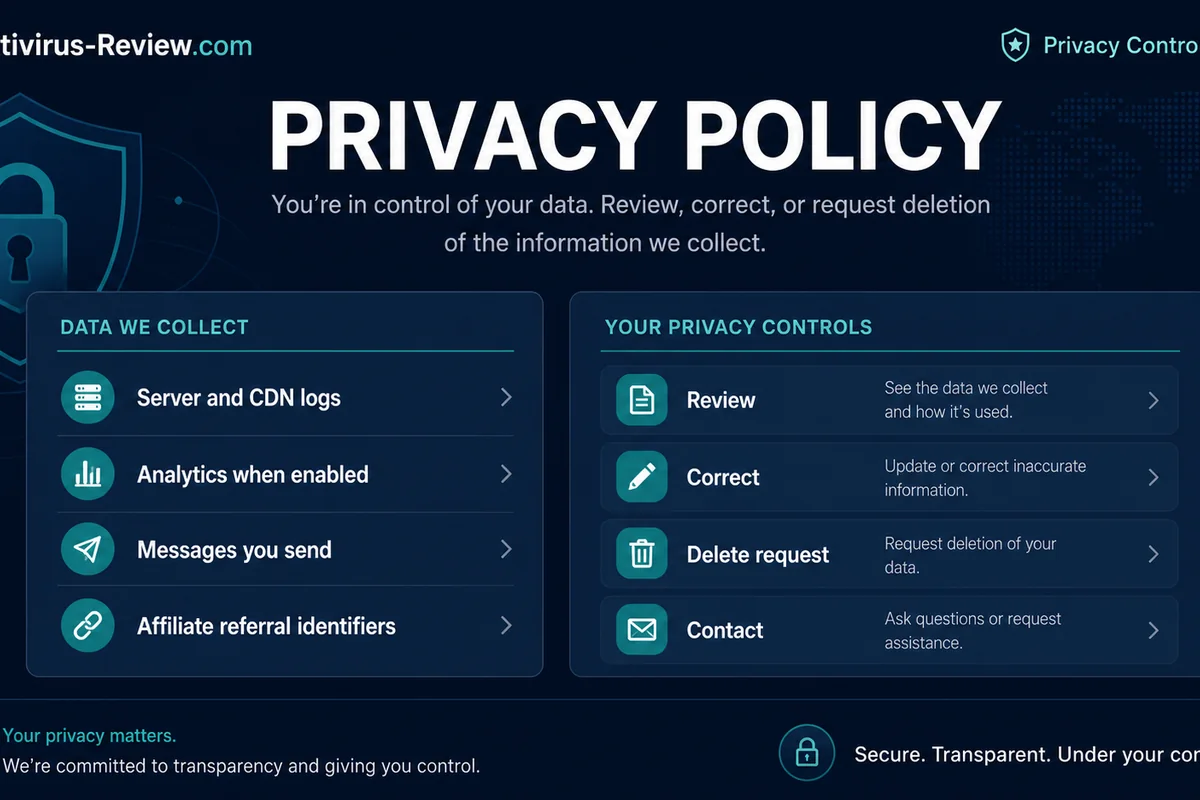
This notice explains the information Antivirus-Review.com can receive when you read the site, follow an affiliate link or email the editorial team. It also separates our data from information handled by hosting, analytics, security and destination-vendor services.
Plain-language summary: you can read the rebuilt site without creating an account or giving us payment details. Servers and enabled service providers can still receive technical request data. If you email us, we receive what you choose to send. If you leave for a vendor or partner site, that destination applies its own privacy and cookie rules.
Scope and privacy contact
This Privacy Policy applies to pages served on antivirus-review.com and to privacy-related editorial email sent to the site. It does not govern an antivirus vendor, affiliate network, social platform, laboratory, embedded service or any other external website. Those organizations decide their own purposes, retention and legal bases.
For a privacy request or question, email [email protected] with the subject “Privacy request.” The site's verified public materials do not establish a physical office, telephone privacy line or separate registered privacy entity, so this policy does not invent one. The email route is the current contact point for the publisher of Antivirus-Review.com.
What the current site actually does
This notice is based on a July 14, 2026 review of the restored static site, not on a generic ecommerce template. The core rebuilt pages do not provide reader accounts, comments, an on-site shopping cart, payment processing, order fulfilment, a live newsletter signup or a dependable web contact form. Editorial contact is by email, and product purchases occur on the destination seller's site.
Some legacy/static templates can contain a Google Tag Manager container identifier, analytics-related markup, Cloudflare beacon/security markup and old campaign-script references. Availability and behavior can differ by page, deployment, region, browser settings and service configuration. The site must not treat the absence of a cookie during one test as proof that no service can process request data.
| Site interaction | What is present | What is not handled by us |
|---|---|---|
| Read a page | Normal web request, server/CDN logs and any enabled measurement/security signals | No reader account is required |
| Email the editorial team | Sender address, message, headers and attachments you choose to include | No site login or password is needed |
| Use navigation/search/compare controls | Page navigation and query parameters may be processed by the browser/server | No verified personal profile is created merely by using a control |
| Click a product or affiliate link | Destination URL can contain referral/campaign parameters; referrer and request data may reach the destination | Checkout, payment, license, refund and vendor account stay with that seller |
| Follow social/source links | The external site receives a request when you choose to visit it | Its cookies, account and privacy settings are not controlled here |
Information we can receive
Technical and log data. A website host, CDN or security service ordinarily receives the IP address needed to return a page, request date/time, requested URL, response status, referrer when supplied, browser/user-agent, device or operating-system information, language, approximate network/geographic information and security/error signals. IP addresses and persistent identifiers can be personal information under some laws even when they do not reveal a name.
Analytics data when measurement is enabled. Google states that a default Google Analytics implementation can collect user/session counts, approximate geolocation, browser and device information, and can store a client ID in the first-party `_ga` cookie when analytics storage is enabled. A tag manager is a delivery tool: what it processes depends on the tags configured inside the container. This policy therefore does not claim that a container name alone proves every Google Analytics feature is active.
Information you send. An email can include your address, display name, message, email headers, page/product references and attachments. If you request a correction or privacy action, the correspondence can also contain evidence needed to investigate the request. We do not need your banking data, antivirus account password or full identity documents for ordinary editorial contact.
Affiliate-link information. A referral URL can include a publisher, campaign, product or sub-ID. The destination seller or affiliate network may combine that identifier with request, cookie, device, order or account information under its own policy to attribute a qualifying purchase. Antivirus-Review.com does not receive your full card number through the static content pages.
Why information is used
| Purpose | Typical information | Why it is reasonably necessary |
|---|---|---|
| Deliver and secure the site | IP, URL, time, user-agent, status, error and security events | Return pages, prevent abuse, diagnose outages and preserve integrity |
| Measure and improve content | Page/session, device/browser, approximate location and referral data when analytics is enabled | Understand whether pages work and which subjects need maintenance |
| Reply and correct | Email address, message, cited URL and evidence | Answer a request, investigate a factual issue and document a correction |
| Attribute referrals | Campaign/link identifiers and qualifying transaction status supplied by a partner | Measure affiliate referrals and support publisher revenue |
| Meet legal obligations | Request and correspondence records where applicable | Exercise rights, handle disputes, comply with lawful process and protect users/site |
Depending on the visitor's location and the specific processing, an applicable legal basis may be necessary—such as providing the requested site/response, legitimate interests in security and publishing, consent for non-essential storage or access, or compliance with law. This paragraph does not claim that one legal basis fits every jurisdiction or service configuration.
Affiliate links and external destinations
Some product links can generate commission when a purchase is attributed to the referral. The Affiliate Disclosure explains the commercial boundary. From a privacy perspective, clicking the link starts a separate request to the vendor or network. That destination may receive the referral URL, referrer, IP, device/browser data and any information you later submit there.
Antivirus-Review.com is not the merchant of record. We do not control a vendor's checkout cookies, account profile, identity monitoring, payment processor, licensing system, support transcript, cancellation or refund records. Read the destination privacy notice and cookie choices before entering information. Opening a source, Reddit, social or laboratory link creates the same basic third-party boundary even when no commission is involved.
How long information is kept
There is no honest single retention period for every category. Technical logs can be retained for operations, security and troubleshooting; email can be retained while a request, correction or dispute is active; accounting/affiliate records can be retained as needed for reporting and legal obligations. Providers apply their own documented retention and deletion settings.
Our rule is to keep identifiable information only as long as reasonably needed for the stated purpose, security, recordkeeping or law, then delete, anonymize or isolate it when practical. A request can be denied or limited when deletion would conflict with a legal obligation, security need, freedom-of-expression interest or another applicable exception. The response should explain the reason when the law requires it.
Security and what not to send
The production domain should use HTTPS in transit and infrastructure controls appropriate to a public static publication. Service access, software updates, backups and incident response are operational safeguards, but no website, email route or third-party service can promise absolute security.
Antivirus-Review.com is not an antivirus vendor, payment processor, incident-response firm or secure malware-submission portal. Do not email live malware, ransomware samples, account credentials, payment-card details, Social Security/national ID numbers, private encryption keys or medical records. If a message contains unnecessary sensitive data, it can increase risk and may be deleted without being opened or processed further.
Your privacy choices and legal rights
Depending on where you live and whether a law applies to the publisher/service, you may have rights to know or access personal information, correct it, request deletion, object to or restrict certain processing, withdraw consent, obtain a portable copy, opt out of certain sale/sharing or targeted advertising, and complain to a regulator. The European Commission, the UK Information Commissioner's Office and the California Attorney General describe location-specific rights and limitations.
We do not promise that every listed right applies to every visitor. To make a request, use the six-step process below. There is no need to create an account.
- Email the privacy contact. Send the request to [email protected] with “Privacy request” in the subject.
- Name the right or outcome. Say whether you seek access, correction, deletion, objection, withdrawal or another applicable action.
- Identify the interaction. Include the email address used, approximate date and relevant page or correspondence; do not send unrelated sensitive documents.
- Complete proportionate verification if necessary. We may need enough information to avoid disclosing or deleting another person's data, but will not request more than reasonably needed.
- Receive the decision. The response will follow the deadline and exceptions of applicable law and will explain a refusal or limitation when required.
- Appeal or contact a regulator where available. If local law provides an appeal or complaint route, you can use it without retaliation for exercising a valid right.
Children's privacy
The site is a general-audience cybersecurity publication and is not directed to children under 13. It does not knowingly ask a child to create an account or make an on-site purchase. The US Federal Trade Commission explains that COPPA applies to child-directed services collecting personal information and to general-audience operators with actual knowledge that they collect it from a child under 13.
If a parent or guardian believes a child sent personal information to the editorial email, contact us with the address/date needed to locate it and request deletion. Do not include additional information about the child beyond what is needed for that request. Other regions may use a higher age threshold for particular consent rules.
International processing
A public website and email route can use providers and infrastructure located in more than one country. As a result, request, security, analytics, affiliate or correspondence data may be processed outside your country and under different laws. Where transfer safeguards are legally required, responsibility depends on the operator/provider relationship and the services actually enabled.
This policy does not claim that every provider stores data in one named country. Check a relevant provider's current privacy and data-location documentation for its role. Cloudflare's privacy policy and Google's Analytics privacy materials are linked so readers can inspect those separate practices.
Policy changes and contact
The “reviewed” date changes only when this notice or the underlying data inventory is checked. Material changes—such as a new form, account system, advertising service, analytics configuration or payment flow—require this page to be reassessed before the new processing is described as current.
For questions, requests or a tracker/cookie that appears inconsistent with this notice, email [email protected] and include the page URL, approximate date/time, browser/region if relevant, and what you observed. For editorial questions that do not concern personal data, use the broader contact guide.
Privacy Policy FAQ
Do I need an account to read Antivirus-Review.com?
No. The rebuilt core site is a static publication and does not require a reader account, login or subscription to read its editorial pages.
Does Antivirus-Review.com collect my payment-card details?
The static editorial pages do not run checkout or receive full card details. Product purchases occur on an external seller's site under that seller's privacy, payment and account terms.
What data can be recorded when I read a page?
Hosting, CDN or enabled measurement/security services can receive technical request data such as IP address, time, URL, status, referrer, user-agent, device/browser information and security or error signals.
Does the site use Google Analytics or cookies?
Some legacy templates can contain a Google Tag Manager identifier and analytics-related markup. What runs depends on the deployed page, configuration, region and consent state; Google says Analytics may use the _ga cookie when analytics storage is enabled.
What happens when I click an affiliate link?
Your browser sends a separate request to the seller or affiliate destination. The URL may contain referral parameters, and the destination can process request, cookie, account and purchase data under its own privacy policy.
How can I request access, correction or deletion?
Email [email protected] with “Privacy request” in the subject, the right or outcome requested, the email/date/page needed to identify the interaction, and no unnecessary sensitive documents.
Does every privacy right listed here apply to me?
Not necessarily. Rights and exceptions depend on your location, the type of processing and whether the relevant law applies to the publisher or provider. The site will assess a request under applicable law rather than promise universal coverage.
Is Antivirus-Review.com intended for children?
It is a general-audience cybersecurity publication and is not directed to children under 13. A parent or guardian can email the privacy contact if they believe a child sent personal information.