
Best Antivirus With Deepfake Protection in 2026
Norton has the broadest consumer deepfake layer we can verify, but “deepfake protection” still describes three different products: automatic media analysis, an on-demand scam checker, or ordinary anti-phishing around the lure. This guide separates them before ranking them.
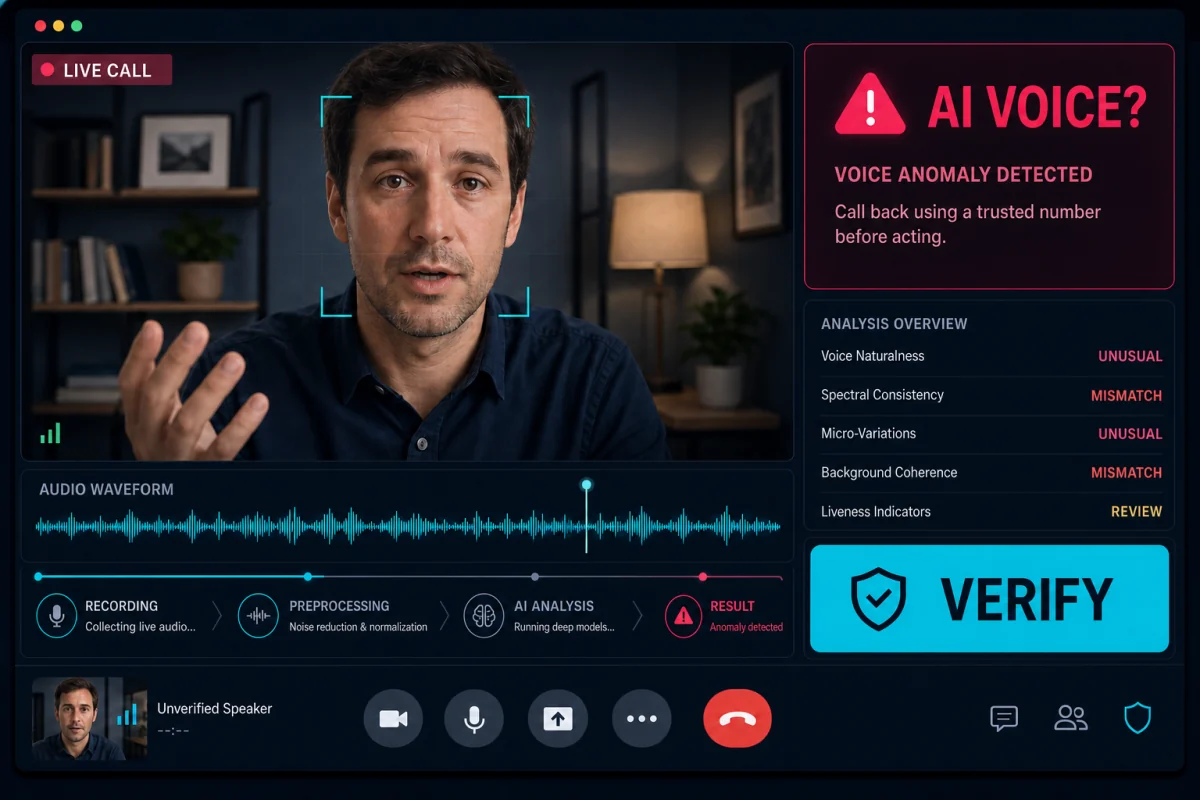
Quick answer: Norton 360 is the strongest general recommendation because its current Scam Protection combines automatic deepfake analysis on compatible PCs with Safe Web, Safe SMS and the Genie assistant. McAfee Deepfake Detector is a narrower on-device choice for selected AI PCs. Bitdefender Scamio is the useful no-cost fallback when you can submit a suspicious link, message, image or QR code yourself. None of these tools can prove that every video or caller is genuine.
“Deepfake protection” isn't one product category
A ranking becomes misleading when it puts unlike tools in one column. Current consumer products fall into three groups. Automatic detectors analyse supported video or audio as it plays. On-demand scam checkers inspect material you deliberately share with them. Protective layers block the phishing page, malicious download or payment redirect around a synthetic-media lure without deciding whether the voice itself was cloned.
Automatic analysis
Norton and selected McAfee installations can analyse supported media on compatible Windows hardware. Coverage depends on device, language, browser, site and plan.
On-demand checking
Bitdefender Scamio and Norton Genie let you submit suspicious content. They're useful for triage, but they don't watch every call or app.
Surrounding protection
SmartScreen, Safe Web and other anti-phishing layers may stop the malicious destination. That's valuable, but it isn't deepfake detection.
There's still no public independent consumer lab that publishes a cross-vendor deepfake-detection leaderboard. We use current AV-TEST and AV-Comparatives results only to judge the underlying malware and web-protection engine—not to award a fictional deepfake accuracy score.
Best deepfake protection tools in 2026
Norton 360 — best overall consumer option
Norton's current AI-powered Scam Protection documentation confirms deepfake analysis alongside Safe Web, Safe SMS and Genie. The automatic feature looks for manipulated audio and video on supported streaming sites and sends an alert when it sees suspicious signals. Genie handles content you submit manually, which gives phone users a second route when automatic desktop coverage is unavailable.
The catches matter. Norton's feature comparison says automatic detection is currently aimed at English-language video on named services and requires a compatible PC. Safe Call and Safe Email aren't included in every Norton plan. Treat the plan table and support page as part of the purchase decision; a Norton logo alone doesn't guarantee that every device receives every scam feature.
Choose it if: you want one paid suite spanning malware, phishing, texts and supported streaming video. Read our Norton review.
McAfee Deepfake Detector — best for a supported AI PC
McAfee's dedicated detector analyses media on the neural processor in selected AI PCs. On-device processing is attractive because the media doesn't need to be uploaded for the first pass, but availability is tied to supported hardware and OEM bundles. Check the exact device and the installed McAfee account—not merely the CPU family—before counting it as a feature.
McAfee also markets broader Scam Detector capabilities for text, email, video and QR-based lures. Vendor accuracy claims aren't substitutes for an independent cross-product test. We therefore rank McAfee on verified capability and fit, not on a percentage we can't reproduce.
Choose it if: your new Windows AI PC already includes the detector and you want local analysis.
Bitdefender Scamio — best free manual checker
Scamio accepts a suspicious message, link, screenshot or QR code and explains the warning signs. It works without a neural processor and is useful on a Mac, Chromebook or phone where automatic desktop detectors don't run. This is an assistant, not an always-on deepfake scanner: you have to stop, submit the material and still verify the response through an independent channel.
Choose it if: you want a no-cost second opinion and understand the manual workflow. Pair it with Bitdefender's endpoint protection or another reputable antivirus rather than treating a chatbot as malware protection.
Kaspersky Premium — strong anti-phishing outside the US
Kaspersky doesn't offer a consumer deepfake detector we can verify. It belongs here only as a surrounding layer: anti-phishing and Safe Money can block a fake bank page or malicious download that a synthetic celebrity, executive or family video tries to push. US buyers shouldn't choose it because US Commerce restrictions stopped Kaspersky sales and updates to US persons; availability elsewhere doesn't erase that regional limit.
Choose it if: you're outside the United States and want strong conventional protection around scam lures, not media authentication.
Microsoft Defender + Scamio — best free baseline
Microsoft Defender and SmartScreen provide a credible Windows malware and reputation layer; Scamio supplies the manual content check. The combination costs nothing and is more honest than calling Defender a deepfake detector. It has no continuous synthetic-media analysis, identity restoration or guarantee against a convincing live caller.
Choose it if: you use a supported, updated Windows 11 PC and want to spend first on backups, a password manager or a hardware security key. See when Defender is good enough.
Deepfake protection compared
| Option | What it really does | Main requirement | Mobile route | Critical limit |
|---|---|---|---|---|
| Norton 360 | Automatic supported-media analysis plus Genie | Compatible Windows PC for automatic checks | Manual checks through Genie where available | Language, site, device and plan coverage varies |
| McAfee | On-device deepfake detection on selected AI PCs | Supported NPU and eligible OEM installation | Broader scam tools vary by plan | Not a universal McAfee download |
| Bitdefender Scamio | Manual scam analysis | You submit the content | Web and supported messenger access | No automatic live-media monitoring |
| Kaspersky | Anti-phishing and payment protection | Supported non-US market | General mobile security | Not a deepfake detector |
| Defender + Scamio | Windows reputation/malware layer plus manual check | Updated Windows and a deliberate check | Scamio only | No dedicated automatic detector |
Don't buy from a table that labels every green tick “AI protection.” Ask four specific questions: Does it analyse media automatically? On which operating system? Which sites and languages? Does the analysis stay on the device? If the vendor can't answer, the checkbox has little decision value.
What no antivirus can prove
- A clean result doesn't authenticate a person. A detector can miss a new generation method or a low-quality call.
- Ordinary carrier calls remain a gap. A desktop video feature isn't sitting inside every phone call.
- Real footage can carry a false story. A scammer may reuse genuine video with fraudulent captions, timing or payment instructions.
- Compromised real accounts still look real. A message from a hijacked family or executive account may contain no synthetic media at all.
- Regional terms change. Platform support, reimbursement and identity benefits vary by country and plan.
The FBI's current AI threat guidance lists visual inconsistencies as possible clues, but modern scams aren't reliably defeated by counting blinks. Verification beats visual guesswork.
The family verification protocol works even when detection misses
- Agree on a private phrase in person. Don't put it in a public post or a cloud note shared with everyone.
- End the incoming call. Urgency and secrecy are control tactics; hanging up removes the attacker's stage.
- Call back on a number you already know. Don't use a number supplied in the message.
- Verify through a second person or channel. A family member, colleague or official switchboard can confirm the story.
- Never send irreversible payment under pressure. Gift cards, crypto, cash couriers and wire transfers deserve an automatic pause.
The FTC's family-emergency scam advice explicitly warns that a cloned voice can sound like someone you love and recommends independent contact. Software can add friction; this protocol makes the decision safer.
How we evaluated these products
We separated media detection from scam checking and ordinary anti-phishing. Vendor documentation had to identify the feature, platform or workflow. We used independent antivirus labs only for the underlying endpoint engine. We didn't turn vendor accuracy claims into editorial test results, and we didn't invent a live-call benchmark.
Our recommendation also accounts for hardware dependence, privacy, plan and regional limits, recovery support, and what happens when the detector is wrong. For wider scam coverage across text, email, QR codes and calls, compare the best antivirus for scam protection. For the mechanics and response checklist, read what a deepfake scam is.
Frequently asked questions
Can antivirus detect every deepfake?
No. Detection depends on the media, model, language, platform and device, and a new or degraded sample can evade analysis. Treat an alert as useful evidence and a clean result as inconclusive.
Which antivirus has real deepfake protection?
Norton documents automatic deepfake analysis on compatible PCs, while McAfee offers a dedicated detector on selected AI PCs. Bitdefender Scamio is an on-demand scam checker, not continuous deepfake monitoring.
Does Microsoft Defender detect deepfakes?
Microsoft Defender provides malware protection and SmartScreen reputation checks, but we can't verify a consumer Defender feature that authenticates deepfake audio or video. Pair it with manual verification or a dedicated tool.
Can deepfake protection hear a scam phone call?
Don't assume it can. Desktop streaming-video analysis and a mobile scam-call label are different capabilities. End an unexpected money call and verify through a known number.
Is a family safe word still useful?
Yes. A private phrase combined with a callback on a known number can defeat an impersonation attempt even when the voice sounds convincing and no detector is available.
Is Bitdefender Scamio the same as deepfake detection?
No. Scamio checks content you submit and gives a risk assessment. That's useful triage, but it doesn't automatically monitor every video, app or live call.
Should I buy a new AI PC just for a detector?
Usually not. First use account security, a verification protocol, supported antivirus and payment safeguards. Hardware-assisted analysis is a bonus when you already need a new computer, not a substitute for those controls.
Verdict
Norton 360 is our best overall pick because it joins a verified deepfake feature to a broader consumer scam stack. McAfee is compelling when the detector is already supported on your AI PC, and Scamio is the easiest free second opinion. The deciding control is still independent verification: no badge can tell you with certainty that the person on a screen or call is who they claim to be.