We review products independently, but we may earn commissions if you make a purchase using affiliate links on our website. Also note that we are not antivirus software; we only provide information about some products.

Independent Zemana help hub · evidence rechecked August 10, 2026

Zemana guides: choose the page that matches your state

This is no longer a normal product-help directory. Four focused pages answer the questions that remain around the 2021 build: use it, migrate, interpret a driver alert or remove it safely.

Four verified routesBuild 3.2.28No new installEvidence first

Quick route: don't start with a download

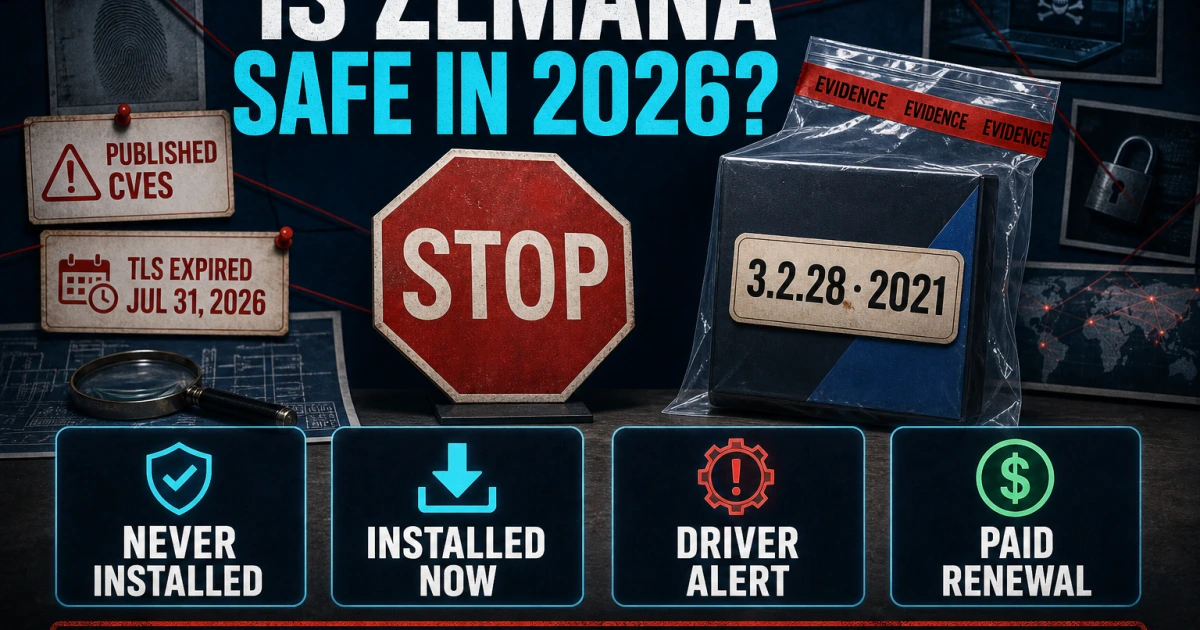
If Zemana was never installed, read the status advisory and choose a maintained product. If 3.2.28 is installed without an alert, preserve the license and billing context, then plan a normal migration. If Windows or another antivirus flags a Zemana-related driver, preserve the path, hash, signer and event before changing it. If removal is the task, use the dedicated uninstall guide and finish with one active protector. The vendor domain's certificate expired July 31, 2026, so none of these routes requires bypassing a browser warning or fetching the old installer.

Four pages, four jobs

Search results mix decade-old reviews, current driver errors, vague “is it malware?” threads and removal commands. A single mega-page would force incompatible intents together. This hub routes each question to the page that owns it while keeping the shared facts consistent.

GuideWhat it ownsAction
Zemana AntiMalware Review 2026Broad verdict on build 3.2.28, lifecycle evidence, safety, compatibility, billing and replacement fit.Open this page
Is Zemana Safe? Status and AlternativesCurrent release trail, expired distribution certificate, careful EOL wording, migration routes and maintained replacements.Open this page
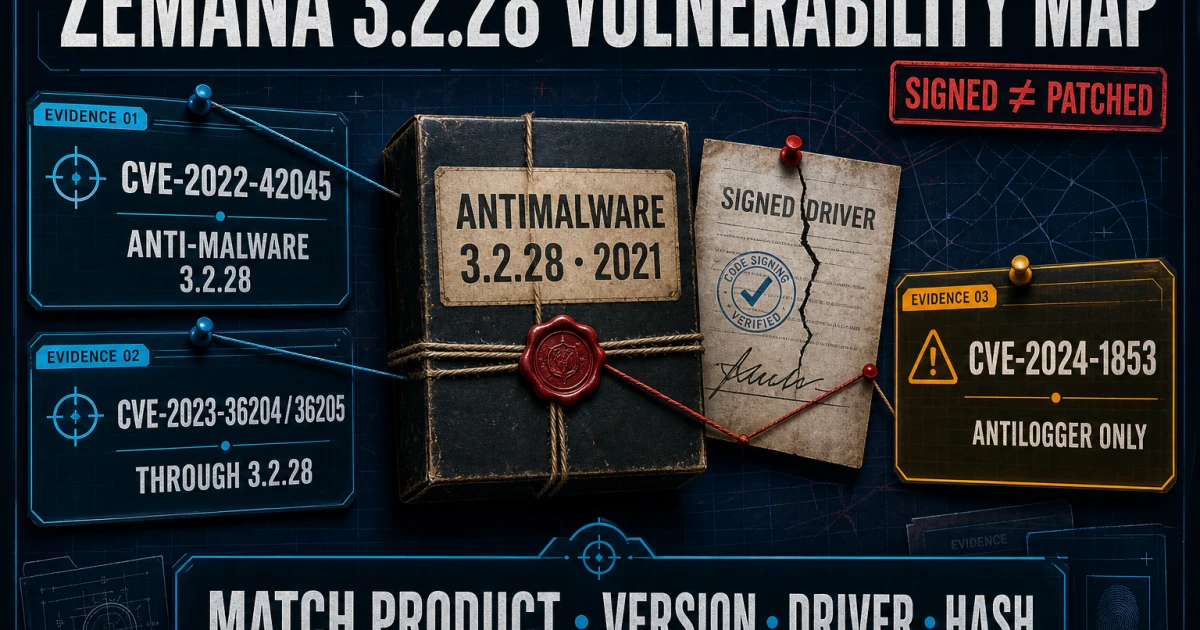
Zemana Vulnerabilities and Driver AbuseExact CVE product/version scope, signed-driver boundary, BYOVD sequence and evidence-first driver triage.Open this page
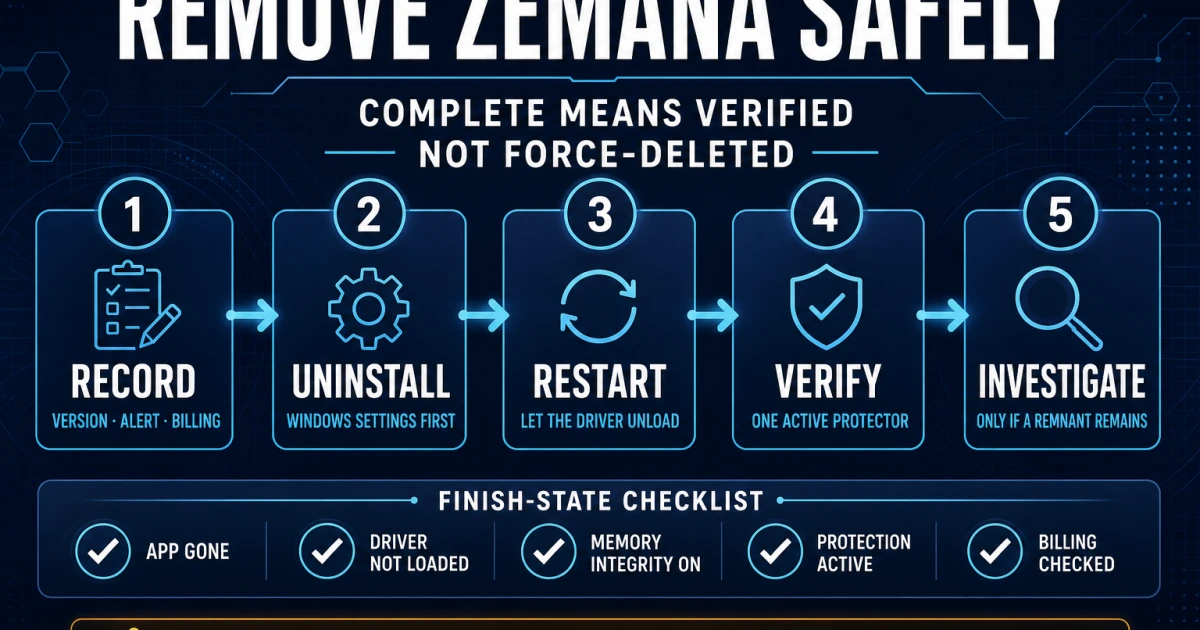
Uninstall Zemana Completely and SafelyNormal uninstall, restart, active-protection handoff and separate file, service, driver and billing verification.Open this page

The shared safety verdict is stable: we don't recommend installing build 3.2.28. The route changes what evidence and next action you need, not that baseline.

Your state decides the next page

Zemana routes for never-installed installed driver-alert and renewal states with evidence requirements
GPT Image 2 independent state router. A familiar driver name is an investigation clue, not proof of a complete attack chain.

The fastest mistake is answering a different question. A person who never installed Zemana needs a current safety decision. A known user with no alert needs a migration and protection handoff. A driver alert needs provenance. A renewal needs the payment processor. Mixing those states creates panic, weakens Windows or leaves billing active.

Current stateFirst evidenceCorrect route
Never installedCurrent release and distribution statusStatus and alternatives
Installed, no alertBuild, license, renewal and active providerStatus, then safe removal
Driver alertFull path, hash, signer, version and load/block eventVulnerability and driver evidence
Renewal or chargeSeller, order reference, charge date and confirmationStatus advisory billing route; cancellation remains separate

Use the review when the question is “what was this product?”

The Zemana AntiMalware review is the broadest page. It reconciles the historical second-opinion scanner with the current maintenance gap, old pricing and renewal model, Windows compatibility, published vulnerability history and replacement options. It's useful for a reader inheriting an unfamiliar PC or license.

The review doesn't pretend we ran a fresh 2026 lab test of an unsupported 2021 build. Its verdict rests on the public release trail, current TLS state, exact vulnerability records, Windows enforcement and current maintained alternatives. That's a stronger answer than republishing old detection marketing.

Use the status advisory when the decision is stay or migrate

The status, security and alternatives advisory owns the current operational verdict. Zemana's public release notes end at 3.2.28 on March 31, 2021. We found no formal consumer AntiMalware discontinuation announcement, so “apparently unmaintained” is the precise wording. The Endpoint Security discontinuation notice covers a different product line.

On August 10, normal TLS verification for zemana.com failed because the certificate had expired. A legacy page returning content only after trust checks are bypassed isn't a safe distribution channel for security software. We didn't download the installer. Certificate renewal alone wouldn't repair the missing patched-build and lifecycle evidence.

The evidence timeline explains why old praise and current warnings coexist

Zemana earned a real reputation as a lightweight second-opinion scanner years before the current safety problem. That historical usefulness explains the surviving reviews, recommendations and installed copies. It doesn't establish that the same privileged Windows components remain suitable after five years without a public AntiMalware successor. A review written around a contemporary cloud scanner and a 2026 decision about an old kernel driver are answering different questions.

March 31, 2021 is the last public AntiMalware release date we found. CVE-2022-42045 later named version 3.2.28 directly. VoidSec's subsequent analysis assigned CVE-2023-36204 and CVE-2023-36205 across relevant AntiMalware and related AntiLogger scope. Sophos then documented continued attacker use of Zemana-related signed drivers in Terminator variants. Check Point's 2025 research added a distinct WatchDog SDK-derived driver case and carefully separated it from the consumer installer.

By February 2026, a public support case showed Windows Code Integrity blocking an amsdk.sys component because of certificate and hypervisor enforcement. One case isn't a prevalence estimate, and the WatchDog SDK binary isn't automatically Zemana AntiMalware 3.2.28. It does show why “the old interface opens” can't substitute for current driver acceptance, support and patch evidence.

On August 10, 2026, the distribution site's expired certificate added a separate trust failure. None of these facts alone proves every installation is compromised. Together they remove the basis for a new installation and justify a controlled migration for known users. The hub preserves that measured conclusion across every route: historical legitimacy, current maintenance failure and attacker abuse are related facts, not synonyms.

Use the vulnerability guide when Windows names a driver

The technical vulnerability guide separates records competitors often collapse. CVE-2022-42045 explicitly names AntiMalware 3.2.28. VoidSec's independent analysis covers AntiMalware through 3.2.28 in CVE-2023-36204 and CVE-2023-36205. CVE-2024-1853 names AntiLogger 2.74.204.664 and must not be silently transferred to every AntiMalware file.

Sophos' Terminator research explains attacker abuse of legitimately signed Zemana-related drivers. That doesn't make every historical install an attacker tool. BYOVD is post-compromise: the loader and follow-on actions are separate evidence. Match product, version, binary and hash before naming the incident.

Use the removal guide when a known installation needs to leave

The complete removal guide starts with Windows' registered uninstall route, not file deletion. Record useful context, uninstall through Settings or Programs and Features, restart, verify one maintained antivirus and keep Memory Integrity enabled.

Complete removal is a verified state across the application, file, service, driver, protection provider and billing. Presence isn't registration; registration isn't execution. An old file on a secondary disk doesn't carry the same immediate meaning as a renamed copy restored after quarantine.

Build one compact evidence packet before asking for help

A good support packet prevents strangers from guessing. Record the Windows version, whether Zemana was knowingly installed, the exact 3.2.28 or other build, current antivirus provider and the full text of the problem. For a file, add path, SHA-256, size, signer status and version. For billing, add the seller and redacted order reference.

QuestionMinimum evidenceNever publish
Should I keep it?Build, Windows version, role and current providerLicense key
Why is a driver flagged?Full path, hash, signer, version, event and timestampSensitive corporate binary or private log
Why did removal fail?Uninstall route, exact error and restart stateUnreviewed registry export
Why was I charged?Seller, date, product, order reference and renewal termsFull card details or password-reset link

A filename-only forum post is rarely enough. The long-running Microsoft Q&A case shows how quickly a Memory Integrity question becomes confused when product origin, current file state and registered service aren't separated.

Use an evidence hierarchy, not the loudest search result

For exact vulnerability scope, start with NVD and the named research. For Windows behavior, use Microsoft documentation. For current product status, use the vendor's release trail while recording the certificate failure and missing fixed-build statement. For attack-chain evidence, use researchers such as Check Point Research and Sophos.

Community threads are directional. A real r/antivirus quarantine discussion exposes the difference between a detection record and a current file. Another old-disk case shows that presence doesn't mean load. Neither supplies a prevalence rate or proves every machine is compromised.

Every route ends with a different proof

RouteFinish proof
ReviewYou can explain why 3.2.28 isn't a responsible new installation
Status/migrationOne maintained real-time provider is active and the old role is replaced
Driver alertThe exact binary, provenance, load/block state and incident boundary are known
RemovalApp gone, driver not loaded, protection healthy and billing checked separately

Stop changing the PC when the original state is resolved and the security posture is healthy. A vanished warning isn't success if protection was disabled. An empty search isn't success if a service still loads a renamed file. A clean uninstall isn't success if renewal continues.

This definition prevents the endless-cleanup trap. Security software legitimately touches services, quarantine, logs and provider registration, so finding a leftover label doesn't automatically justify another cleaner. Ask whether the component is active, risky or blocking the desired Windows state. Preserve useful records, remove identified active remnants through a bounded route and leave harmless historical evidence alone when it has no execution path.

It also tells you when to escalate. A known old install that uninstalls normally is a migration. An unexpected driver in a temporary path, a renamed binary, a fresh load event, repeatedly restored files or disabled security processes is an incident. The same word “Zemana” can appear in both cases; provenance and behavior make the difference.

Zemana help FAQ

Where should I start in the Zemana guides?

Start with your current state. If you never installed Zemana or are deciding whether to keep it, read the status advisory or full review. If Windows flags a Zemana-related driver, use the vulnerability guide before changing the file. If a known installation needs to leave, use the complete removal guide.

Is this the official Zemana support website?

No. Antivirus-Review.com is an independent editorial publication. We don't operate Zemana, issue licenses, process renewals or provide an official installer. The vendor domain currently fails normal certificate verification, so we don't direct readers to bypass warnings or download build 3.2.28.

Is Zemana AntiMalware discontinued?

We found no formal notice naming consumer AntiMalware as discontinued. The public AntiMalware release trail stops at version 3.2.28 on March 31, 2021, and no patched successor was found. We therefore describe it as apparently unmaintained, not formally discontinued.

Is Zemana AntiMalware safe to install in 2026?

No. The last public build is from 2021, public vulnerability records name that build or related drivers, no current fixed AntiMalware release was found and the vendor site currently has an expired TLS certificate. Use maintained protection instead.

Does zamguard64.sys mean the PC was attacked?

Not by itself. The file can be an expected component, an inactive remnant, a copy on an old disk or an attacker-staged driver. Record the full path, hash, signer, version, service and load or block event before deciding which state applies.

Should I disable Memory Integrity for Zemana?

No. Don't weaken Memory Integrity or vulnerable-driver enforcement to accommodate a 2021 security component. Remove the identified legacy application or remnant and keep a maintained protection provider active.

How do I remove Zemana completely?

Use Windows Settings or Programs and Features, complete the expected uninstaller and restart. Then verify the app is gone, the driver isn't loaded, one maintained antivirus is active, Memory Integrity remains enabled where supported and billing was cancelled separately.

What should replace Zemana?

Replace the role, not the brand. Microsoft Defender can be the everyday Windows real-time owner; Malwarebytes Free or Microsoft Safety Scanner can serve deliberate on-demand jobs; Defender Offline fits higher suspicion; maintained paid products such as Emsisoft cover another real-time option. Keep one real-time owner.

One current state, one owned page, one verifiable finish

Zemana's small modern query space is unusually safety-heavy. That makes four deep, non-overlapping pages more useful than dozens of thin setup posts for an obsolete build. Start with your actual state and let the owning page carry the technical depth.

The final recommendation is consistent across the cluster: don't install 3.2.28, don't bypass the expired certificate, don't disable Windows protections and don't treat a driver name as a complete incident. Preserve evidence, migrate to maintained protection and verify the finish state.