
Best Antivirus for Scam Protection in 2026
Scams, not viruses, are how most people lose money online in 2026. We compared the scam-detection layers of the major suites: which channels each covers, how the AI detectors work and where your judgement still has to fill the gap.
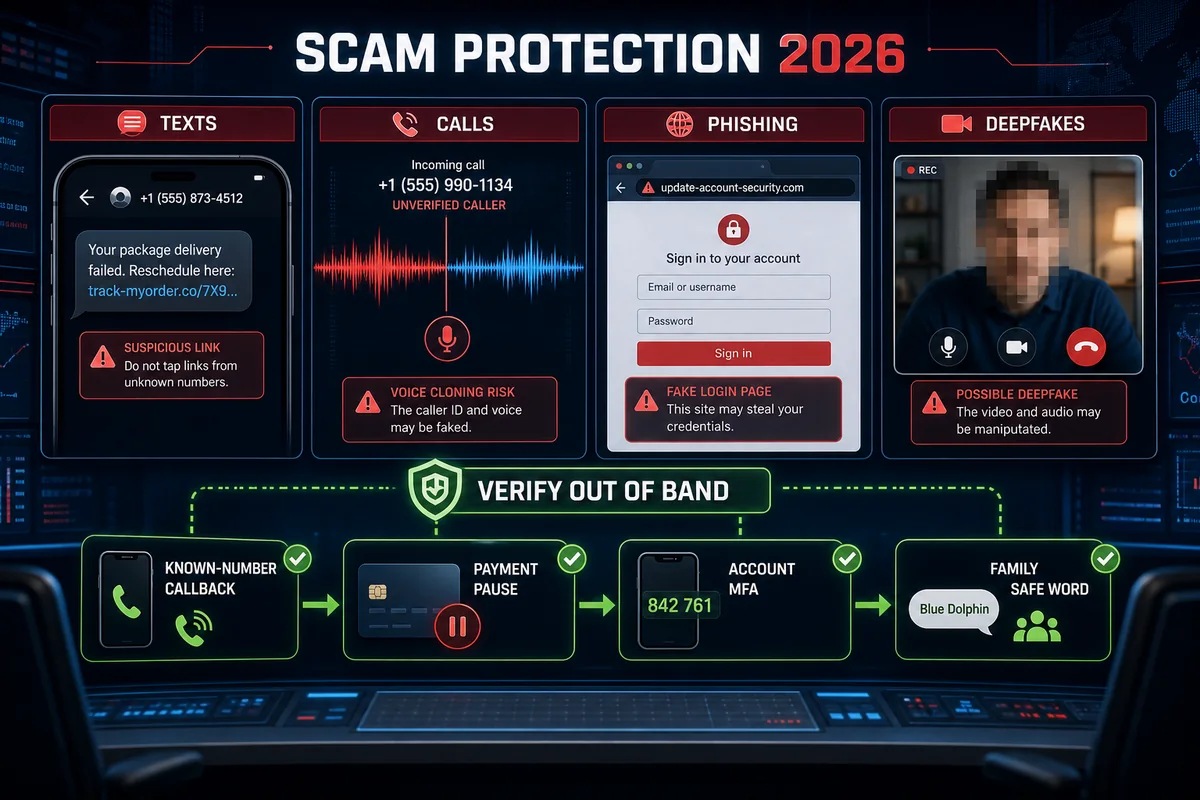
Quick answer: the best antivirus for scam protection in 2026 is Norton 360, which bundles the widest net of AI scam tools — deepfake-video detection, scam-text, scam-email, scam-call and scam-site filters, plus its Genie assistant — into one subscription. McAfee+ runs the most polished dedicated Scam Detector (McAfee claims 99% accuracy on text and 96% on deepfakes, processed on your device). Bitdefender pairs the strongest core engine with its free Scamio scam-checker. Microsoft Defender blocks known phishing and malicious sites through SmartScreen, but it has no scam-text, scam-call, QR or deepfake tools — the gap most people overlook.
Software can block malicious destinations, but it can't authenticate every caller or undo an authorized payment. Use the FTC's current scam guidance for verification and recovery steps; US victims can report internet-enabled crime through the FBI's Internet Crime Complaint Center.
Scams, not viruses, are what empty bank accounts in 2026. Phishing is still the most common reported attack type by far in recent government breach surveys, and CrowdStrike reported that 82% of the detections in its latest threat report were malware-free — links, lookalike sites, fake calls and AI-generated voices. Traditional signature scanning does nothing against those. So the antivirus that matters now is the one with a real scam layer on top of the malware engine. We compared what each major suite's scam tools actually do, where the marketing outruns reality, and which one fits your risk.
Best Antivirus for Scam Protection in 2026: Top Picks
1. Norton 360 Deluxe — best overall scam protection. Norton has gone the widest. Its AI Scam Protection spans five channels: Deepfake Protection scans the audio inside videos to flag AI-generated voices in financial scams; Safe Email flags phishing before you open it; Safe SMS catches scam texts and fake delivery notices; Safe Web blocks fraudulent sites and fake stores; and Safe Call screens scam calls. There's also Norton Genie, a free AI assistant you can paste a suspicious message into for a verdict. Norton is expanding the languages and platforms its deepfake detection covers, but availability varies by device, region and plan — check the current Norton feature page before relying on a specific language. The core malware engine is excellent too (18/18 at AV-TEST February 2026 — that's a malware-suite score, not a scam-detection one). The paid suite also throws in a VPN, password manager and dark-web monitoring. If you want one subscription that covers the most attack surfaces, this is it.
2. McAfee+ — best dedicated scam detector. McAfee's Scam Detector is the most polished single tool here, and it's now included in every core plan rather than locked behind the top tier. McAfee claims over 99% accuracy on scam texts and 96% on deepfake videos — vendor figures, since there's no independent scam-detection lab to confirm them. The part we like most: it does the analysis on-device, so your messages aren't shipped to the cloud. It covers text, email and video, and in early 2026 McAfee added instant QR-code scam checks (quishing) and smarter social-messaging protection. If your threat model is mostly texts, DMs and QR codes, McAfee's detector is the sharpest.
3. Bitdefender — best core protection with a scam checker. Bitdefender's core web and phishing protection handles malicious sites in real time, while Scamio is its on-demand AI scam checker — you forward a suspicious message, link, QR code or screenshot and ask "is this a scam?" (Scamio doesn't silently read every message; you bring it the ones you doubt.) Scamio is free to use, and Bitdefender's protection scores are top-tier, so if you trust the engine first and treat scam-checking as an on-demand second opinion, this is the pick.
4. Avast (and AVG) — best free scam layer, plus Deepfake Guard. Avast is the only major name here with a genuinely useful free tier for scams: its web shield blocks phishing and fraudulent sites at no cost on one device. That's the free part. Paid Avast Premium Security adds Deepfake Guard, which analyses audio and video in real time for synthetic voices — Avast confirms support for Czech, English, French, German, Japanese and Spanish, scanning video on YouTube, Facebook, X, TikTok, Vimeo, Instagram, Dailymotion and Twitch. AVG runs the same engine. Want scam basics for free? Start here. Want deepfake detection? That's the paid tier.
5. Trend Micro — best for less technical users and seniors. Trend Micro pairs Pay Guard — a hardened browser that opens banking and shopping sites with keyloggers blocked — with ScamCheck, its AI scam-defence tool: a call blocker, SMS filtering, fake-video-call detection and a malicious-site blocker. That's genuine multi-channel scam coverage wrapped in the simplest interface of the group: big buttons, clear status. For an older relative you're setting up from a distance, that combination matters more than feature counts.
Worth knowing: Malwarebytes ScamGuard lets you share a suspicious text, email, URL or image and get AI advice — a companion, not a full antivirus. Guardio and Aura are scam- and identity-focused tools that aren't traditional antivirus but show up in the same searches. And Microsoft Defender's SmartScreen blocks known phishing and malicious sites well, but Defender has no scam-text, scam-call, QR-code or deepfake tools the way Norton, McAfee or Trend Micro do. Solid for malware; not a scam suite.
Antivirus Scam Protection Features Compared
This is the table the big "best antivirus" lists never build. Features as of 2026; "—" means no dedicated feature (a general web filter may still catch known-bad sites). Accuracy figures are vendor claims — there's no independent scam-detection lab yet.
| Feature | Norton 360 | McAfee+ | Bitdefender | Avast | Trend Micro |
|---|---|---|---|---|---|
| Deepfake video/voice | ✅ Deepfake Protection | ✅ McAfee-claimed 96% | via Scamio (on-demand) | ✅ Deepfake Guard (Premium) | ✅ ScamCheck fake-video-call |
| Scam text / SMS | ✅ Safe SMS | ✅ McAfee-claimed >99% | ✅ via Scamio (on-demand) | — | ✅ ScamCheck SMS filter |
| Scam email | ✅ Safe Email | ✅ | ✅ real-time | ✅ web/email shield | ✅ |
| Scam calls | ✅ Safe Call | — | — | — | ✅ ScamCheck call blocker |
| Scam sites / phishing | ✅ Safe Web | ✅ | ✅ real-time | ✅ free web shield | ✅ Pay Guard + site blocker |
| QR-code (quishing) | — | ✅ (added 2026) | ✅ via Scamio | — | — |
| AI scam assistant | ✅ Norton Genie | — | ✅ Scamio (free) | — | — |
| On-device analysis | partial | ✅ on-device | partial | ✅ Deepfake Guard on-device | partial |
| Free scam option | — | — | ✅ Scamio (free) | ✅ web shield | — |
| Pricing | paid suite, first-year promo | paid suite, all plans | paid suite + free Scamio | free + paid Premium | paid + ScamCheck app |
Read it this way: Norton owns the most boxes (Genie is unique; it shares scam-call coverage with Trend Micro). McAfee leads on claimed accuracy, on-device privacy and QR. Bitdefender and Avast give you a free way in (Scamio; the free web shield). Trend Micro's ScamCheck quietly covers calls, texts and sites in one simple app. Nobody does everything — "best" depends on the scam types you actually face. Prices shift constantly with first-year promos and higher renewals, so check the current vendor page before you buy.
Best antivirus by scam type
- Worst hit by scam texts and fake-delivery SMS? McAfee Scam Detector (on-device, McAfee-claimed >99%), Norton Safe SMS, or Trend Micro ScamCheck.
- Worried about deepfake videos and AI voice clones? Norton Deepfake Protection or Avast Deepfake Guard are built for it; Trend Micro flags fake video calls.
- Getting scam phone calls? Norton's Safe Call and Trend Micro's ScamCheck call blocker are the two with dedicated call screening.
- Seeing sketchy QR codes (parking meters, fake invoices)? McAfee added quishing checks in 2026; Bitdefender Scamio reads a QR image on demand.
- Mostly phishing emails and fake stores? Any of the five blocks these; Norton Safe Email and Bitdefender's real-time filter are the strongest, and even Defender's SmartScreen catches known-bad sites.
- Setting up a less technical parent? Trend Micro's ScamCheck plus Pay Guard and a simple UI.
How AI scam detection actually works
Old phishing protection compared the site you visited against a blocklist of known-bad URLs. The problem: scammers spin up fresh domains hourly, so anything new sails through. The 2026 approach is different. These tools read the content and behaviour — the wording of a text, the intent behind an email, the audio waveform of a video — using natural-language and behavioural models rather than a list. That's why AI scam detection can flag a scam the first time it appears, before any blocklist has heard of it. The trade-off is between on-device analysis (McAfee, Avast Deepfake Guard — private, nothing leaves your phone) and cloud analysis (faster to update, but your message is processed remotely). For sensitive messages, on-device is the safer design.
The scams antivirus stops in 2026
The threat mix has shifted hard toward social engineering. The categories these tools target: phishing emails (impersonating banks, couriers, Microsoft/Apple); smishing (scam texts and fake "package held" notices); deepfake video and voice (fake CEO calls, celebrity investment clips, "grandkid in trouble" voice clones); quishing (malicious QR codes); fake account-suspension and copyright notices aimed at US consumers; and romance and investment fraud. With CrowdStrike reporting 82% of its detections were malware-free, a scanner that only looks for virus files is fighting last decade's war.
What scam protection can't do (the honest part)
None of this is a force field, and the marketing won't tell you the limits — so we will. Deepfake detection is language- and platform-bound: Avast confirms six languages, Norton's coverage varies by region and plan, so a scam outside that envelope slips past. These tools alert you; they don't decide for you — a notification you ignore protects nobody. On-device models are private but can lag the very newest scam patterns until they update. And no tool reliably catches a scammer you call back on a "real" number you found yourself, or a romance scam that plays out over weeks with no single flaggable message. Scam protection lowers your odds; it doesn't replace the habit of slowing down before you click, pay or share.
Antivirus scam protection vs standalone scam apps
You'll see Guardio, Aura and Malwarebytes ScamGuard in the same searches. They're scam/identity specialists rather than full antivirus — ScamGuard, for instance, is an advice companion you bring a message to, not a replacement for a malware engine. The honest split: if you already pay for a security suite, its built-in scam layer (Norton's, McAfee's) is usually enough and saves a second subscription. A standalone like Guardio or Aura makes sense if you specifically want identity-theft restoration and monitoring as the headline, with scam-checking attached — but you still want a real antivirus engine underneath for malware. Don't pay twice for the same scam-text filter.
Is free antivirus enough for scam protection?
Partly. Avast's free web shield blocks phishing sites and Bitdefender's Scamio checks a message for free, so a careful, budget-conscious user can cover the basics at zero cost. But the deeper layers — deepfake detection, scam-call screening, on-device text analysis — are paid features. And the most-used free option, Microsoft Defender, has no dedicated scam tooling beyond SmartScreen's known-site blocking. Free is a real floor in 2026; it just isn't the ceiling.
How we evaluated these
There's no independent scam-detection benchmark yet: AV-TEST and AV-Comparatives measure core malware protection, not scam-layer accuracy, so every accuracy figure here (like McAfee's 99%/96%) is a vendor claim, and we label it as one. We compared each suite's documented scam features against the vendors' current product pages and 2026 announcements, and weighed core protection using AV-TEST February 2026 and AV-Comparatives April 2026 results. Where we say who a product suits, that's editorial judgement from the feature set and how these tools behave in normal use — not a certification of scam-blocking, which nobody publishes yet.
Verdict
If you want the broadest scam coverage in one subscription, Norton 360 is the pick — it screens texts, email, web, calls and deepfakes together, and Genie is a genuinely handy "is this a scam?" check. If you mainly worry about texts, DMs and QR codes and care about privacy, McAfee+'s on-device Scam Detector is the sharpest single tool. Trend Micro's ScamCheck is the easiest to hand to a less technical relative, Bitdefender and Avast both give you a free way to start, and Microsoft Defender covers known-bad sites but leaves texts, calls and deepfakes uncovered. The one thing to remember: the antivirus that protects you in 2026 is the one with a scam layer — not the one with the best virus scanner alone.
Frequently asked questions
Can antivirus actually stop scams?
The scam layer in modern suites can flag and block many phishing sites, scam texts, scam calls and deepfake videos before you engage — but it's an alert system, not a guarantee. It lowers risk; your judgement still matters.
What is the best antivirus for scam protection in 2026?
Norton 360 overall, for covering the most channels (text, email, web, calls, deepfakes). McAfee+ if you want the most polished, most private dedicated detector.
Does Norton detect deepfakes?
Yes — Norton Deepfake Protection scans the audio in videos for AI-generated voices, and Norton Genie lets you check suspicious messages manually. Language and platform coverage is expanding but varies by plan and region, so check Norton's current feature page.
Is McAfee's Scam Detector any good?
It's the strongest dedicated scam tool here: McAfee claims 99%+ on scam text and 96% on deepfakes (vendor figures), it runs on-device, and it now checks QR codes and social messages. It's included in all core plans.
Which antivirus protects against scam calls?
Norton (Safe Call) and Trend Micro (ScamCheck call blocker) are the two here with dedicated scam-call screening. Most other suites don't include call protection.
Which antivirus protects against QR-code scams?
McAfee added QR-code (quishing) checks in 2026, and Bitdefender's free Scamio can scan a QR image on demand. The others don't have a dedicated QR feature yet.
Can antivirus catch AI voice-clone scams?
The deepfake features in Norton and Avast analyse video/audio for synthetic voices, but only in supported languages and mainly within video content — a live cold call in your language can still get through. Treat them as backup, not a guarantee.
Do I need a separate scam app if I already have antivirus?
Usually no. If your suite includes a scam layer (Norton, McAfee, Trend Micro), adding Guardio or Aura mostly duplicates it. A standalone is worth it only if you specifically want identity-theft monitoring and restoration as the main product.
Is free antivirus enough for scam protection?
For basics, yes — Avast's free web shield and Bitdefender's free Scamio cover phishing sites and message-checking. Deepfake, scam-call and on-device text detection are paid. Microsoft Defender has no dedicated scam layer beyond SmartScreen.
Does Windows Defender have scam protection?
Only partly. SmartScreen blocks known phishing and malicious sites, but Defender has no scam-text, scam-call, QR-code or deepfake tools like Norton, McAfee or Trend Micro. Solid for malware, not a scam suite.