
360 Total Security Review 2026: Free, but Can You Trust It?
360 Total Security 11 is active, free and feature-rich. The harder question is whether you should trust it as primary protection without a current major-lab result.
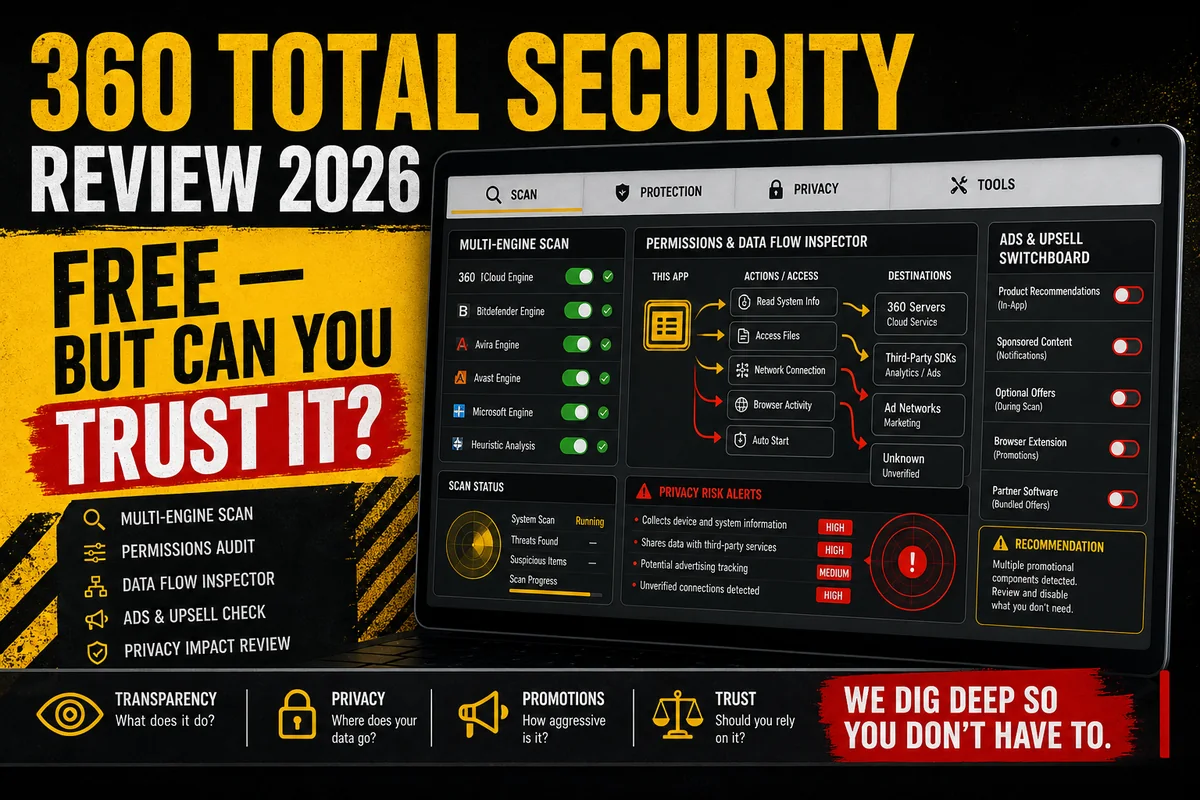
Our verdict: 360 Total Security is legitimate Windows security software, not a fake antivirus. Its free edition combines real-time malware protection, web defenses, cleanup and optimization tools, while Premium removes in-app ads and adds utilities. Version 11.0.0.1314 was released in April 2026, so the product isn't abandoned. We still do not recommend it as primary protection. We found no current product-specific consumer result in the major independent lab sets checked; the current product page and newer vendor blog posts disagree about the engine lineup; three labs revoked Qihoo awards in 2015 over a materially different test configuration; and Qihoo entities carry current U.S. BIS and Section 1260H designations. Those designations aren't a blanket consumer-use ban, but they matter on any PC containing sensitive, government, defense or regulated data. Our editorial score is 4.4/10. For a supported Windows 11 PC, Microsoft Defender or a currently tested paid suite is the lower-uncertainty choice.
- Active 2026 Windows releases and online/offline installers
- Free real-time antivirus rather than an on-demand-only scanner
- Selectable protection modes and multiple first-party engines
- Cleanup, startup management and vulnerability utilities in one interface
- Low Premium headline price with 1-, 3- and 5-PC choices
- Current privacy policy exposes Cloud Analysis and Internet Protection controls
- No current consumer result found in the major independent lab sets checked
- 2015 awards revoked over submitted-versus-public configuration differences
- Current engine and Mac documentation is contradictory
- Free edition contains ads and value-added-service promotions
- Broad file/device/URL telemetry depending on enabled features
- Current U.S. government designations create material trust risk
360 Total Security at a glance
360 Total Security is a Windows antivirus and system-utility suite published by Beijing Qihu Keji Co. Ltd., part of the Qihoo 360 group. The international product combines real-time malware scanning, cloud analysis, phishing and download protection with one-click system checks, junk cleanup, startup management and optional Premium utilities. The free model is funded by advertising and paid services; it isn't a time-limited trial.
The official version history identifies 11.0.0.1314 as the current release, dated April 8, 2026. That matters because many ranking reviews still describe old version 10 interfaces, old third-party-engine defaults or detection tests run years ago. We grade the named current product, not nostalgia, copied benchmarks or the year in a competitor headline.
| Buyer question | Evidence-checked answer |
|---|---|
| Is it a real antivirus? | Yes. The Windows app provides free real-time protection, scanning and cloud-assisted detection. |
| Current version? | 11.0.0.1314, released April 8, 2026. |
| Current independent consumer result? | None found in the current major-lab sets checked. |
| Free limitations? | In-app ads/promotions and fewer privacy, driver, firewall, shredder and desktop utilities. |
| Premium price? | From $26.98/year for one PC in the U.S.-dollar store snapshot; localized pricing and campaigns vary. |
| Refund? | Official store/support pages state 30 days from purchase. |
| Platforms? | Current evidence supports the Windows product. Mac documentation is stale/contradictory; mobile is separate. |
| Our rating? | 4.4/10 from one editor, not a customer-review aggregate. |
The recovered page mixed a $26.98 card with a 4.5 score, a fourteen-person crowd count and copied-looking testimonials. We removed the crowd count and all testimonial claims. A self-selected store review can't prove malware protection, and a changing subscription price shouldn't be frozen into Offer schema.
Is 360 Total Security safe—or is it malware?
Calling 360 Total Security “malware” isn't supported by the evidence we found. It has an identifiable publisher, signed installers, an active release history, product support, a privacy policy and a conventional uninstall route. The app performs the security and utility functions it advertises. Downloading it from the vendor is categorically different from downloading a repackaged installer from an unrelated portal.
“Legitimate” doesn't answer the trust question. Antivirus receives unusually deep access: it inspects file metadata, can upload suspicious executables for cloud analysis, sees requested URLs when web protection is enabled, changes system configuration, starts with Windows and can quarantine or remove files. A buyer therefore needs stronger evidence than “the installer works.” Independent protection tests, transparent data controls, stable documentation and ownership risk all matter.
Our answer is deliberately two-part. The app is a legitimate product, and a low-risk user can evaluate it in an isolated test environment. We wouldn't place it on a work PC, government or defense device, regulated endpoint, administrator workstation, password/crypto machine or computer containing sensitive client data. On an ordinary home PC, the lack of current product-specific lab proof still leaves no compelling reason to replace the already integrated Microsoft Defender.
Version 11.0 is active, with six releases in early 2026
The current release trail is one of 360's strongest facts. Version 11.0.0.1314 updated the antivirus engine on April 8. The vendor lists builds 1313 on March 25, 1308 on March 4, 1306 on February 24, 1302 on February 3 and 1298 on January 22. Those entries include bug fixes, virus-database updates and a “Win10 Shield” addition. Several late-2025 builds also mention engine, database, browser-protection and decompression changes.
That cadence disproves “abandoned antivirus” claims. It doesn't demonstrate how effectively those builds stop current malware or how often they misclassify legitimate files. Release notes are maintenance evidence; an independent test is comparative effectiveness evidence. A rigorous review credits one without silently converting it into the other.
The current product page offers online and offline installers. Use the offline package when you need to preserve a known installer for an isolated test, but verify the digital signature and obtain it directly. Don't reuse an old download just because its filename still says version 11; the build and signatures matter.
No current major-lab result for the consumer product
We checked current consumer product sets and reports from AV-TEST, AV-Comparatives, SE Labs, MRG Effitas and AVLab. We found no current product-specific 360 Total Security consumer result in the sets reviewed. That absence doesn't prove the product misses a particular percentage of threats—labs select participants, regions and test scopes—but it removes the best public way to compare protection, false alarms and performance under controlled conditions.
This evidence gap is more important than any one feature. A security suite can show four engine names and a long feature list while still making poor decisions at the endpoint. It can also perform well despite not entering a test. The honest outcome is uncertainty, not a made-up score. We therefore don't publish a current detection percentage for 360.
| Evidence source | Current consumer 360 result? | What we can conclude |
|---|---|---|
| AV-TEST home Windows, 2026 sets checked | No result found | No current product-specific Protection, Performance or Usability score to cite. |
| AV-Comparatives consumer series | No result found | No current real-world, malware, false-positive or performance comparison. |
| SE Labs home reports | No result found | No current total-accuracy result for the product. |
| MRG Effitas / AVLab current consumer reports checked | No result found | No current product-specific certification found in the reviewed sets. |
| Vendor feature/version pages | Yes, current commercial documentation | Supports build/features, not comparative detection percentages. |
| Vendor blog benchmarks | Not independent unless report-linked | Unlinked claims were excluded from our score. |
| Community reports | Self-selected anecdotes | Useful for troubleshooting patterns, not effectiveness rates. |
Current participation is a clear advantage for products such as Bitdefender, ESET, Norton, Avast and Defender. A historical result or an engine supplier's score can't be transferred to a different product, configuration or cloud stack.

The 2015 test-configuration controversy still matters—but needs context
In 2015, AV-Comparatives, AV-TEST and Virus Bulletin revoked Qihoo certifications/awards after finding that the product submitted for testing behaved materially differently from the version generally available to consumers. The reported difference involved default engine/configuration choices: the submitted build relied on the Bitdefender engine in a way the public build didn't by default, while Qihoo's own QVM configuration also differed.
Qihoo publicly disputed the “cheating” characterization. Its contemporaneous response said the configuration had been declared and argued that the public default was chosen for users on lower-powered systems, who could enable the third-party engine themselves. The labs' action and Qihoo's response can both be true descriptions of their positions; a review shouldn't erase either.
We don't score version 11 as though it repeated that conduct today. The event is more than a decade old. It remains relevant because independent tests depend on the tested configuration matching the user's product, and because the current documentation again makes engine verification harder than it should be. A current, public, product-specific lab result would be the cleanest way to close that trust gap. We didn't find one.
Which antivirus engines does 360 Total Security use now?
The current version-11 core feature page names four engines: 360 Cloud Scan, 360 QVMII AI, QEX and KunPeng. That's the lineup we can support directly. It describes a combination of cloud reputation, machine-learning/heuristic analysis and local scanning, but the page doesn't publish enough method detail to turn those names into a reproducible protection result.
Some newer 360-controlled blog posts and older documentation still describe optional Avira and Bitdefender engines. The live core page doesn't name them. A user may see additional engine switches in a particular region/build, but we won't promise that from contradictory marketing copy. Open the installed app's Virus Scan or Settings panel, record the exact build, and confirm which engines are actually present and enabled.
More engines don't automatically mean more protection. Detections can overlap; cloud queries and exclusions can differ; and extra engines can increase memory, scan time or false positives. Most importantly, Bitdefender's or Avira's own lab performance isn't 360's score. Integration, defaults, update timing, web filtering, behavioral rules and remediation remain product-specific.

What the current U.S. government designations mean
Qihoo 360 entities remain on the U.S. Commerce Department Bureau of Industry and Security Entity List. The current BIS data retains Qihoo entries added in June 2020 with a licensing requirement for items subject to the Export Administration Regulations and a presumption of denial. The original notice cited risk involving procurement for military end use in China.
A separate June 2026 Section 1260H Federal Register notice names “360 Security Technology, Inc. (Qihoo 360)” as a Chinese military company and states the U.S. government's affiliation/military-civil-fusion rationale. That's a serious official trust signal, not a social-media rumor.
The legal scope must be stated accurately. An Entity List entry controls exports, reexports and transfers of covered U.S.-origin items to listed entities; Section 1260H is a statutory designation with government/procurement/investment consequences. Neither cited document declares that every ordinary U.S. consumer commits an offense by downloading the app. “Banned in the United States” is therefore too broad.
| Use case | Our risk judgment | Why |
|---|---|---|
| Government, defense or contractor endpoint | Don't deploy | Current U.S. designations and supply-chain policy are directly material. |
| Regulated business, admin workstation or client-data PC | Avoid | Deep endpoint access plus ownership/designation and evidence uncertainty are hard to justify. |
| Personal banking, password manager or crypto device | Avoid | The consequence of a trust error is high and better-evidenced alternatives exist. |
| Ordinary home Windows 11 PC | Not recommended | No blanket legal prohibition, but no compelling benefit over currently tested integrated protection. |
| Isolated disposable test VM | Reasonable for evaluation | Useful for feature inspection if no personal credentials/data enter the environment. |
Premium pricing, auto-renewal and 30-day refund
In the U.S.-dollar store snapshot checked during this audit, 360 Premium displayed $26.98 for one PC/year, $35.98 for three PCs/year and $47.98 for five PCs/year. Two- and three-year baskets lowered the annualized price. The same store localized another crawl to Polish złoty, which is why a precise review must date and label its checkout rather than present one number as universal.
The current store promises a 30-day money-back guarantee, and the Premium support flow also says refunds are available within 30 days of purchase. Save the order number, license key, paid amount and timestamp. “Money-back guarantee” is only useful if you can identify the transaction and contact support within the window.
Auto-renewal isn't invisible in the documentation. The official cancellation page says it can be disabled at any time, promises an email before renewal and asks users to submit order/license and purchase email no later than ten days before the next renewal takes effect. That ten-day request is the practical deadline we would use, even if local consumer law gives additional rights.
- Capture the final basket, currency, device count, term, tax and renewal wording—not only the landing-page headline.
- Use an email account you can retain; Premium activation and recovery depend on the account/license record.
- Test every paid feature during the first week, not on day 29.
- If the app is unsuitable, request the refund in writing and preserve the case/timestamp.
- If keeping it, disable auto-renewal early if you prefer a manual renewal decision.

Protection features worth understanding
Full Check combines security, performance and cleanup findings into one dashboard. It's convenient, but a red/yellow “health” score mixes different risk classes. A malware detection, disabled browser protection, startup delay and reclaimable cache aren't equivalent. Open each category before clicking Repair.
Virus Scan is the core antivirus workflow. Current documentation names local and cloud engines, while Protection offers Performance, Balanced, Security and Custom modes. Higher protection can increase scanning and alerts; Performance can reduce scrutiny. Record the selected mode when comparing results because “360 detected it” without the configuration is incomplete.
Internet/download protection checks URLs and files against cloud reputation. That can stop phishing and malicious downloads earlier than a file scan, but it also means URL information is processed when Internet Protection is active. The privacy policy documents a Custom-mode switch, so users who keep the app should make that choice consciously.
Ransomware/data tools can add protected-folder or behavior monitoring, but the current store doesn't publish a reproducible anti-ransomware test. Keep versioned offline or immutable backups. No endpoint toggle can recover files if the same account and connected backup are encrypted or deleted.
Firewall is a Premium item on the current store. Verify whether it's an independent filtering layer or an interface around Windows controls in the exact build. Running overlapping network/security filters can complicate debugging; more toggles aren't automatically more secure.
Cleanup, Speedup and Driver Updater need a rollback plan
Cleanup can remove temporary files, browser residue and obsolete caches. That's useful when disk space is genuinely constrained, but “junk” can include sign-in state, crash diagnostics, installer caches or application data a user expected to retain. Review categories and start with temporary data that Windows itself can recreate.
Speedup manages services, startup entries and plugins. Disabling an obvious updater may reduce boot noise; disabling synchronization, accessibility, security, audio or OEM services can create delayed failures that are harder to connect to the optimization click. Measure boot/login time before and after, and change a small set at once.
Driver Updater is the highest-risk convenience feature. Prefer Windows Update and the PC/component manufacturer's signed package. Create a restore point, export the current driver version and confirm Device Manager rollback before accepting a batch. 360's own Premium FAQ includes recovery advice for sound or other problems after a driver update, which is a useful reminder that failure is an expected support case, not a theoretical edge.
Data Shredder and Duplicate Cleaner are irreversible by design when used carelessly. A shredder should never target a file that exists only on one disk; a duplicate finder needs path/context review because equal-looking names aren't proof that two copies are redundant.
Free includes ads and value-added-service promotions
The vendor's support documentation says the free product is possible because of advertising and value-added services. Premium explicitly lists “No in-app ads” as a benefit. Treat promotions, recommended utilities and shopping/news modules as commercial content, not security findings.
During installation and updates, read every screen for optional browsers, office tools, extensions or changed defaults. We didn't find enough reproducible evidence to claim every current official installer silently bundles a particular third-party program, and isolated forum reports can't establish prevalence. The safe rule is still to use Custom/Advanced installation when offered and decline anything unrelated to antivirus.
After installation, check Windows Installed apps, browser extensions, default browser/search, scheduled tasks and startup entries. If an item appears that you didn't approve, document the installer source/build and report it. Premium removes in-app ads, but it doesn't retroactively prove what a previous free installer did.
Performance claims lack a current independent baseline
We found no current independent consumer-lab performance score for version 11 in the major sets checked. We therefore removed specific CPU, RAM, boot-time and scan-time claims that couldn't be tied to a reproducible current configuration. Vendor blog benchmarks aren't a substitute when the method, comparison machines and raw report are unavailable.
The product's selectable modes and optional engines mean local impact can vary substantially. A clean Windows 11 laptop in Performance mode isn't comparable with Security/Custom mode plus every engine, extension, cleanup monitor and Premium utility. Measure the configuration you intend to keep.
| Check | How to measure | Stop condition |
|---|---|---|
| Idle impact | Record CPU, memory, disk and network after ten quiet minutes before/after install. | Persistent activity with no scan/update and no clear explanation. |
| Restart/login | Time three cold starts to usable desktop; compare median, not one run. | Material regression or new startup errors. |
| Quick/full scan | Record mode, engines, dataset size, duration and peak resource use. | Thermal throttling, unresponsive work or repeatable crashes. |
| File operations | Copy/extract a known large developer/photo archive before and after. | Large repeatable slowdown or unexplained quarantine. |
| False-positive handling | Scan known signed tools; verify publisher/hash before trusting or submitting. | Legitimate workflow repeatedly blocked with poor explanation. |
| Network/privacy | Observe idle connections and toggle Cloud/Internet Protection intentionally. | Required data flow conflicts with your threat model or policy. |
Privacy: the current policy is detailed, but collection is broad
The privacy policy was changed May 19, 2026 and identifies Beijing Qihu Keji Co. Ltd. as controller. Essential/standard can be used without an account; Premium requires one. Account data can include username, password, phone, email, settings and preferences.
For product operation, the policy lists IP address, a unique 360 serial number, operating-system/language/CPU/memory/disk information and basic file data such as name, format, path, characteristics and MD5 hashes. When Cloud Analysis is active, suspicious executable files can be uploaded; the policy provides a Settings → General → Cloud Analysis switch. Internet Protection can collect browser type/language, IP and requested URL, with a Protection → Configure → Custom control.
AppHub can process installed-software information such as registry installation records, main program and version. Payment-card/bank details are handled by the payment processor, while 360 receives account/payment-result data. The policy says it doesn't collect the content of non-executable files such as documents, PDFs or images, nor data generated/transmitted through the product. That statement narrows collection; it doesn't make filenames, paths, hashes, suspicious executables or URLs non-sensitive.
The policy also discloses advertising partners using cookies/SDKs and sharing with group companies and service providers. Its claim that ads aren't based on interests or browsing/operation activity is useful, but a privacy-sensitive user should still minimize optional modules, avoid account creation on Free, turn off unneeded cloud/web inventory features and choose a product whose controller/jurisdiction fits their threat model.
Windows is current; Mac and mobile claims need separation
The current version page advertises Windows 11/10/8.1/8/7/Vista/XP and Server 2008 or later. Version compatibility isn't lifecycle support. Windows XP, Vista, 7 and 8/8.1 are end-of-life for ordinary Microsoft support; an antivirus can't patch the operating system, browser, drivers and applications back into a supported security posture. Use Windows 11 on compatible hardware.
The Mac story isn't reliable enough for a recommendation. A localized official Mac page still identifies version 1.2.6 from September 2018 and old macOS compatibility, while the current English URL labelled for Mac serves PC plan content. Recent vendor blog posts don't replace a current signed build, release history and product-specific lab result. Treat the Mac product as unverified/legacy until the vendor publishes coherent current documentation.
The download page lists “360 Security” mobile apps and browser extensions separately. A mobile store app isn't the Windows 360 Total Security build, and a Windows Premium key isn't automatically a mobile license—the official Premium help says the Android product is purchased separately. Don't transfer this review's feature, privacy or verdict claims across products.
Support, false positives and complete uninstall
The official help center covers Premium activation, device binding, daily definition updates, Trust List handling, false-positive submission and Windows uninstall. The direct support address is `[email protected]`. Premium promises priority support, but the public documentation doesn't state a guaranteed response time; preserve ticket IDs and avoid relying on chat availability for a time-sensitive refund.
For a suspicious detection, don't immediately whitelist or delete. Check the full path, digital signature and hash; compare the file with the publisher's official download; quarantine it; and submit a false-positive sample when appropriate. A clean VirusTotal majority isn't proof of safety, and one 360 heuristic hit isn't proof of malware. Context and provenance decide the next action.
To uninstall, first turn off auto-renewal if relevant and export any quarantine record you may need. Use Windows Settings → Apps (or Programs and Features on older systems), select 360 Total Security, choose Uninstall and restart. Then confirm Windows Security has re-enabled Microsoft Defender, update it and run a scan. Check browser extensions, startup entries and scheduled tasks; don't use random “removal tools” from download portals.
Recent community posts describe difficult removals, input/recovery problems and Desktop Organizer behavior. They justify a restore point and post-uninstall verification, not a claim that every uninstall breaks Windows. If the machine fails to boot after removal, use Windows Recovery/Startup Repair or System Restore before deleting drivers/services manually.
Community sentiment is a warning signal, not a detection benchmark
Current Reddit and support discussions cluster around false positives, unexpected installation questions, removal trouble, sponsored software and Desktop Organizer settings. Older forums also contain users who like the free feature set and light everyday feel. The posts are self-selected, rarely identify the exact build/mode and often begin after something has gone wrong.
We use those reports to improve the evaluation checklist: record the installer source, create rollback, inspect optional offers, quarantine before delete, test uninstall and verify Defender returns. We don't turn them into a percentage, claim prevalence or quote a named user as representative.
Trustpilot, G2 and Capterra similarly describe support/usability experiences, not controlled malware resistance. The recovered 4.5/14-review widget has therefore been removed rather than refreshed with a different platform's crowd number.
Who should consider 360—and who should skip it
| User | Recommendation | Reason |
|---|---|---|
| Government, defense, contractor or regulated organization | Don't deploy | Current U.S. government designations and supply-chain risk are disqualifying. |
| Business/admin PC or sensitive personal workstation | Skip | No current major-lab result and high consequence of a trust error. |
| Normal Windows 11 home user wanting free protection | Prefer Defender | Integrated, currently tested and avoids another ad/telemetry/utility layer. |
| User wanting cleanup and startup tools | Use Windows/OEM tools first | Utilities don't justify switching the primary security provider. |
| Researcher evaluating consumer security products | Use an isolated VM | Reasonable for observing build/features without exposing real data or credentials. |
| User already satisfied with 360 | Reassess deliberately | Verify build/mode, minimize data features, retain backups and compare a current tested alternative. |
| Mac or mixed-device household | Skip | Current Mac documentation is contradictory; mobile is a separate product/license. |

Better-evidenced alternatives
Microsoft Defender is the default answer for a supported Windows 11 home PC. It's integrated with Windows, receives current platform updates and appears in current independent testing. It has settings and false-positive trade-offs, but it avoids installing another deep-access vendor without a clear protection advantage.
Bitdefender is the strongest direct paid alternative when current multi-lab protection and web defense matter. Don't confuse the historical presence of a Bitdefender engine inside 360 with using Bitdefender's own complete product.
ESET fits a technical buyer who wants granular policy, controlled utilities and current product-specific evidence without an oversized identity bundle. Its first-year/renewal value still needs comparison.
Avast Free and AVG Free provide free third-party protection with current lab participation, but both have promotions, data-history and upsell considerations. They're evidence-superior, not friction-free.
Malwarebytes is useful as an on-demand second opinion for PUP/adware cleanup; its Free tier isn't a replacement for real-time Defender. This is a cleaner role separation than installing a full utility suite mainly for cleanup.
A safe 45-minute evaluation plan
- Use isolation: evaluate in a disposable Windows 11 VM or non-sensitive spare PC. Don't sign into email, banking, password-manager, work or crypto accounts.
- Get the current official installer: use the vendor's online/offline link, verify its digital signature and record version/hash.
- Take rollback: create a VM snapshot or full system restore point before installation; back up irreplaceable data separately.
- Read installation choices: decline unrelated apps, extensions, default-browser/search changes or promotional features.
- Record configuration: note protection mode, engine switches, Cloud Analysis, Internet Protection, AppHub and startup settings.
- Verify harmless detection: use the standard EICAR test file to confirm the alert/quarantine path. Never use live malware and never call EICAR a detection-rate test.
- Measure impact: compare idle resources, restart, browser, archive copy/extract and full-scan behavior using the same dataset.
- Inspect traffic and changes: check browser extensions, startup, scheduled tasks, installed apps and idle network connections.
- Test recovery: restore one harmless quarantined file and verify a false-positive submission/Trust List path.
- Test uninstall: remove the app, restart, confirm Defender reactivates, update/scan and check that extensions/startup entries are gone.
- Only then consider Premium: capture the localized basket, 30-day refund terms and auto-renewal state; set a reminder more than ten days before renewal.
If the product can't pass installation, transparency, false-positive, performance and uninstall checks on a disposable environment, don't place it on the real PC. Even if it passes, the independent-evidence and ownership risks remain; a successful local trial doesn't answer detection efficacy against current threat campaigns.
Frequently asked questions
Is 360 Total Security safe to use in 2026?
It's legitimate, actively updated Windows antivirus software, not a fake antivirus. We still don't recommend it as primary protection because no current product-specific consumer result was found in the major lab sets checked, its documentation is inconsistent and current U.S. government designations create material trust risk. Avoid it on sensitive, government, defense, regulated, banking/admin or crypto systems.
Is 360 Total Security banned in the United States?
Not as a blanket consumer-use ban in the sources reviewed. Qihoo entities are on the U.S. BIS Entity List, which controls covered exports/reexports/transfers, and 360 Security Technology is named under Section 1260H. Those designations have serious government, procurement, investment and supply-chain implications, but the cited notices don't say every ordinary U.S. consumer is prohibited from downloading the app.
Is 360 Total Security Free a real antivirus?
Yes. Free includes Windows real-time antivirus, Virus Scan, cloud-assisted analysis, web/download protection, Full Check, Cleanup and Speedup. It's supported by in-app advertising and value-added-service promotions. Premium mainly removes ads and adds privacy, driver, firewall, shredder, data and desktop utilities.
Does 360 Total Security use Bitdefender and Avira engines?
The current version-11 core feature page names 360 Cloud Scan, QVMII AI, QEX and KunPeng, not Bitdefender or Avira. Other vendor-controlled pages mention optional third-party engines, creating a documentation conflict. Check the exact installed build and enabled engine panel; don't transfer Bitdefender or Avira lab scores to 360.
How much is 360 Total Security Premium?
In the U.S.-dollar store snapshot checked July 14, 2026, one year cost $26.98 for one PC, $35.98 for three PCs or $47.98 for five PCs, with lower annualized multi-year baskets. Locale, tax and campaigns change the displayed currency and price, so save the final checkout. The official store/support promise a 30-day refund period.
Does 360 Total Security auto-renew?
Auto-renewal is offered and can be disabled through the vendor's cancellation page. The page promises an email before renewal and asks users to submit the order/license and purchase email no later than ten days before the next renewal. Capture the subscription state after purchase and cancel early if you want manual renewal.
Does 360 Total Security work on Mac, Android and iPhone?
The current evidence supports the Windows product. An official Mac page still shows a 2018 build while the current English Mac URL serves PC content, so we treat Mac as unverified/legacy. The mobile “360 Security” apps are separate products, and the official Premium help says the Windows license isn't the Android license.
How do I completely remove 360 Total Security?
Use Windows Settings → Apps or Programs and Features, choose 360 Total Security, uninstall and restart. Then confirm Microsoft Defender is active, update it and scan. Check browser extensions, startup entries and scheduled tasks. Disable Premium auto-renewal separately, preserve quarantine/refund records and use Windows Recovery/System Restore rather than random removal tools if boot problems occur.
Final verdict: active and generous, but not trustworthy enough for primary protection
360 Total Security is better than its simplest critics claim. It's a real, actively maintained Windows product; Free includes real-time protection rather than a scan-only teaser; the interface combines useful security and maintenance controls; and Premium is inexpensive. Calling it abandoned or automatically illegal for every U.S. home user would be inaccurate.
The recommendation still fails on evidence and trust. We found no current consumer result in the major independent sets checked. The current core engine list conflicts with other vendor content. The 2015 revoked-award episode is historical, but directly relevant to configuration transparency. Privacy controls exist, yet enabled features can process file metadata/hashes, suspicious executables, device data, software inventory and URLs. Current BIS and Section 1260H designations materially raise the cost of a wrong trust decision.
Our editorial score is 4.4/10. Don't deploy 360 on government, defense, regulated, work, administrator, banking/password or crypto endpoints. A researcher can inspect it in an isolated VM; a normal Windows 11 user should keep Defender or choose Bitdefender, ESET, Norton, Avast/AVG or another product with current product-specific independent evidence.