
Best Antivirus for Windows 10 in 2026: 5 ESU-Aware Picks
ESET is our best paid choice for a 64-bit Windows 10 holdout, Avast One Free has the clearest dated third-party support promise, and Microsoft Defender remains a credible built-in baseline. But antivirus is only half the decision: Windows 10 left normal support in 2025, and the newly extended consumer ESU program now supplies critical and important patches through October 12, 2027.
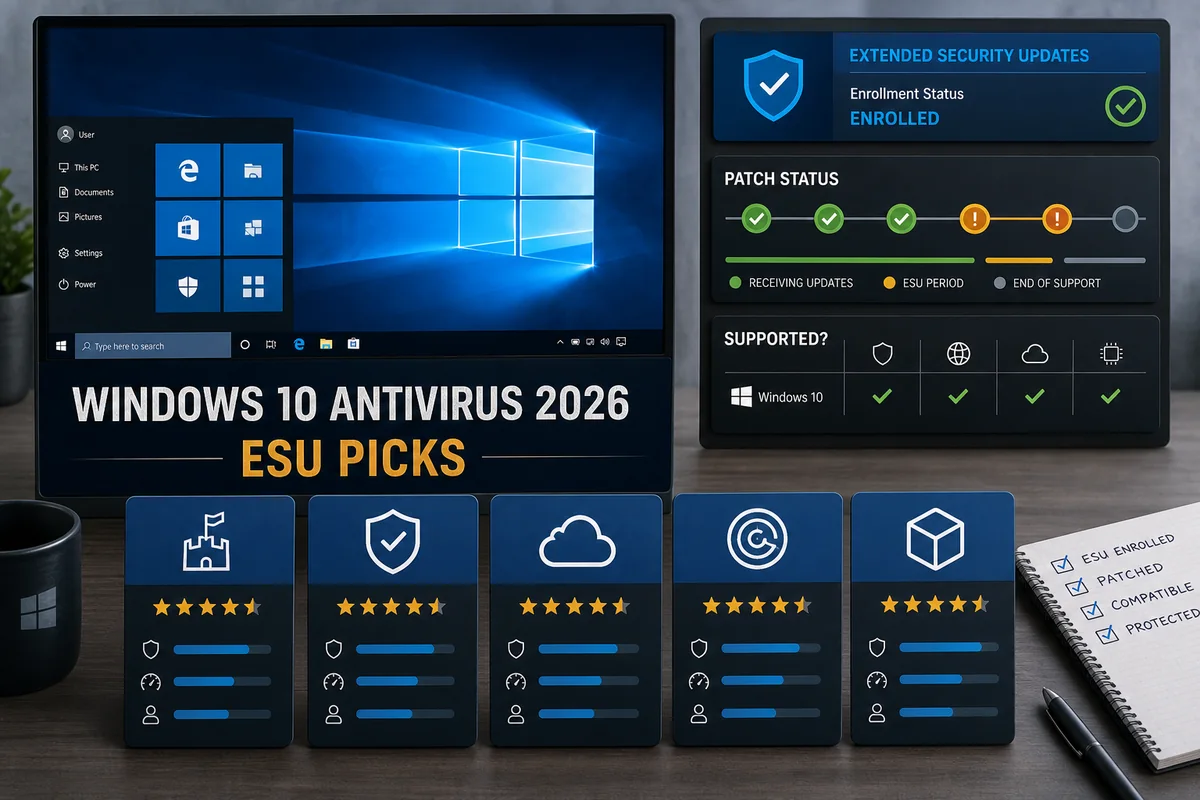
Quick answer: first enroll an eligible Windows 10 22H2 PC in Microsoft's Extended Security Updates. Then choose ESET HOME Security Essential if you want a light, configurable paid product with an explicit ongoing 64-bit/ARM support commitment; choose Avast One Free if you want free third-party protection promised through October 2028; or keep Microsoft Defender if the built-in layer and its security-intelligence updates meet your needs. No antivirus can patch an unpatched operating-system flaw.
For enrollment, pricing and the migration decision after Windows 10 support ended, use the current Windows 10 ESU guide.
The five Windows 10 antivirus picks that still make sense
This ranking is different from a generic Windows 11 list. Current malware results still matter, but so does the date on which the vendor stops shipping compatible engines and product updates. A product can lead one 400-case test and still be the wrong long-term purchase for a Windows 10 machine.

ESET HOME Security Essential
ESET explicitly says future consumer versions will continue supporting 64-bit and ARM Windows 10 until further notice. Its current lab profile favors low impact and few nuisance blocks.

Avast One Free
The strongest dated support promise in this shortlist: Avast says its Free, Premium and One products will remain fully supported on Windows 10 through October 2028.
Microsoft Defender Antivirus
Direct current tests are strong, and Microsoft says security-intelligence updates will continue through October 2028. Pair it with ESU; definitions don't replace OS patches.

Norton 360 Deluxe
Current Norton support lists Windows 10 compatibility, while Deluxe adds five-device coverage, VPN, parental controls and 50 GB PC cloud backup. No public Windows 10 end date is stated.

Bitdefender Total Security
It led this shortlist's current protection numbers, but Bitdefender's consumer notice promises Windows 10 antimalware support only through October 14, 2026. Buy it for this PC only if migration is imminent.
*AV-TEST evaluated ESET Security Ultimate 19.0/19.1, while AV-Comparatives directly tested HOME Security Essential 19.x. We don't copy Ultimate-only recovery features onto Essential. Prices are US snapshots and can change.
Windows 10 ESU now runs through October 12, 2027
Windows 10 Home and Pro reached normal end of support on October 14, 2025. The important July 2026 update is that Microsoft's current consumer ESU page now ends the program on October 12, 2027, one year later than the original October 2026 deadline. PCs already enrolled continue automatically; Microsoft says no additional action is needed for the extension.
Consumer ESU covers eligible Windows 10 version 22H2 Home, Pro, Pro Education and Pro for Workstations PCs used personally. The machine needs current Windows updates, and the Microsoft account used for enrollment must be an administrator and not a child account. Domain-joined, MDM-managed and most commercial-use devices follow different licensing. The consumer license can cover up to ten eligible PCs.
How much does consumer ESU cost?
Microsoft currently lists three enrollment routes: no additional cost when PC settings are synced, redemption of 1,000 Microsoft Rewards points, or a one-time $30 purchase plus applicable tax. Regional details vary. All three routes now provide coverage through October 12, 2027. Microsoft requires a Microsoft account even when Windows is normally used with a local account.
How to check and enroll
- Open Settings → Update & Security → Windows Update.
- Install the latest Windows 10 22H2 updates and restart if requested.
- Select Enroll now when the ESU link appears.
- Sign in with the administrator Microsoft account and choose settings sync, Rewards or purchase.
- Return to Windows Update and confirm the device says it's enrolled.
Don't use registry hacks or third-party activation scripts to imitate enrollment. They don't create a legitimate update entitlement and add a new supply-chain risk to the machine you're trying to secure.

Windows 10 antivirus comparison: lab results and support horizon
| Product | AV-C protection | False alarms | Impact | Published Windows 10 position |
|---|---|---|---|---|
| ESET HOME Security Essential | 98.5% | 2 | 4.2 | Future consumer versions: 64-bit/ARM until further notice; 32-bit frozen at 18.2 |
| Avast One Free | 99.3% | 5 | 5.5 | Free/Premium/One fully supported through October 2028 |
| Microsoft Defender | 99.0% | 0 | 12.9 | Security-intelligence updates through October 2028; OS ESU separately through October 2027 |
| Norton 360 | 99.3% | 5 | 5.3 | Current compatibility page says yes; no public end date on that page |
| Bitdefender Total Security | 99.5% | 5 | 9.6 | Consumer antimalware support through October 14, 2026 |
A dated support promise isn't an operating-system patch. Avast and Defender may update malware intelligence through 2028, but they can't repair every Windows component after ESU ends. Likewise, ESET's ongoing app compatibility means the ESET agent can still run and update; it doesn't mean Microsoft has restored the OS to normal support.

What the current Windows antivirus labs show
AV-Comparatives tested 400 live web cases from February through May 2026. Bitdefender Total Security blocked 398 and allowed two compromises: 99.5% with five false alarms. Avast One Free and Norton Antivirus Plus blocked 397: 99.3% with five false alarms each. Microsoft Defender blocked 396: 99.0% with zero false alarms. ESET HOME Security Essential blocked 394: 98.5% with two false alarms.
Those one- to four-case differences need context. AV-Comparatives places statistically similar results into clusters. Bitdefender, Avast, Norton and Microsoft occupied the first cluster; ESET sat in the second. ESET nevertheless produced fewer nuisance blocks and the lowest performance impact among these five. A Windows 10 PC that runs specialist or old software may value that restraint.
The separate April 2026 Performance Test used a low-end Core i3 machine with 8 GB of RAM and SSD storage. ESET scored 4.2, Norton 5.3, Avast 5.5, Bitdefender 9.6 and Microsoft 12.9; lower is better. Performance results measure common tasks and an office benchmark, not malware protection.
AV-TEST's March–April 2026 Windows 11 cycle gave Bitdefender Total Security, Norton, Avast Free and Microsoft Defender 6 points each for Protection, Performance and Usability. ESET Security Ultimate received 6/5.5/6. These tests ran on Windows 11; they're current engine evidence, not proof that an old Windows 10 kernel has the same security posture.
How we rank antivirus for an operating system after end of support
30% current protection and accuracy
Named-product lab results, false alarms and repeatability across current public cycles.
25% Windows 10 support horizon
An explicit vendor statement outranks a bare compatibility checkbox. Dates, architecture and product family must match.
15% system impact
Old Windows 10 PCs often have weak CPUs or hard drives; measured friction can decide whether protection stays enabled.
10% OS-patch honesty
Products lose credit when marketing implies antivirus makes an unpatched operating system safe.
10% price and renewal
First-term and renewal figures are separated, and free products aren't confused with trials.
10% useful Windows features
Firewall, exploit/ransomware controls, recovery and backup matter more than generic cleanup utilities.
That weighting is why ESET ranks ahead of Bitdefender here even though Bitdefender led the current protection table. On a supported Windows 11 PC, the order can be different. On a Windows 10 PC that will remain in service into 2027, published compatibility is part of the product—not a footnote.
Detailed Windows 10 antivirus verdicts
1. ESET HOME Security Essential — best paid holdout option
ESET published the clearest architecture-aware consumer policy. Future home applications will continue supporting 64-bit and ARM Windows 10 until further notice. The 32-bit line is different: consumer version 18.2 is the last compatible release and reaches its own end of life on October 31, 2026. Check Settings → System → About → System type before buying.
Essential supplies real-time antivirus, anti-phishing, firewall, secured banking/browsing, Network Inspector, webcam/microphone controls and anti-theft where supported. It doesn't include Ultimate's automatic ransomware remediation. Current AV-Comparatives evidence directly names Essential 19.x, which is valuable for this recommendation: 98.5% real-world protection, two false alarms and a 4.2 impact score.
Choose ESET if: the PC is 64-bit/ARM, runs older specialist software and needs a light, configurable paid product. Skip it if: you want the highest single-cycle raw protection rate or a simple bundle with backup, parental controls and identity services.
2. Avast One Free — best free third-party support runway
Avast says Avast Free Antivirus, Premium Security and Avast One will remain fully supported on Windows 10 through October 2028. That's longer than the current consumer ESU date and much more useful than a product page that merely lists “Windows 10.” The vendor also acknowledges that its agent can't replace Microsoft's OS fixes and recommends Windows 11.
Avast One Free earns its product position with direct evidence: 6/6/6 at AV-TEST, 99.3% with five false alarms at AV-Comparatives, and a 5.5 impact score. The free tier includes core scans, file/web shields, ransomware protection and quarantine. Trade-offs are upgrade prompts and Avast's material privacy history, detailed in our full review.
3. Microsoft Defender — still enough for many ESU PCs
Defender remains built into Windows 10, and Microsoft states that built-in Defender Antivirus will continue receiving security-intelligence updates through October 2028. That directly contradicts vendor marketing that says Defender stops updating when normal Windows 10 support ends. Intelligence updates can recognize new malware, but they don't supply every OS quality/security patch.
Its direct lab results are credible: 6/6/6 at AV-TEST, 99.0% at AV-Comparatives with the only zero-false-alarm result in the 20-product field, and a current SE Labs AAA award. The AV-Comparatives impact score of 12.9 was heavier than the four paid/free alternatives above on the same low-end PC.
Keep Defender if: the machine is enrolled in ESU, fully updated, used conservatively and already has independent backups. Choose another product if: you need a longer explicit application support promise, different cross-browser web filtering, family management or better performance on your hardware.
4. Norton 360 Deluxe — best family and backup bundle
Norton's compatibility document, modified March 24, 2026, lists the current Norton 360, AntiVirus Plus, VPN, Password Manager, Family, Utilities and AntiTrack lines as Windows 10 compatible. It doesn't publish a Windows 10 end date there, so we won't invent one.
Deluxe makes sense when its five-device plan replaces separate subscriptions: malware protection, VPN, parental controls, dark-web monitoring and 50 GB of cloud backup for PCs. The backup is relevant to ransomware recovery, although a cloud-synced folder shouldn't be your only recovery copy. Current protection was 99.3%, with five false alarms and a low 5.3 impact score.
The billing drawback is substantial: the official US page showed $49.99 for the first year and $124.99 renewal on July 25. Save the checkout terms and set a reminder before auto-renewal.
5. Bitdefender Total Security — excellent engine, October 2026 deadline
Bitdefender delivered the strongest current lab combination in this five-product set: 6/6/6 at AV-TEST and 99.5% AV-Comparatives protection with five false alarms. The product page still lists Windows 10, and the suite covers five devices across major platforms.
The deciding limitation is the vendor's Windows 10 consumer support notice: antimalware support continues until October 14, 2026. That deadline is only three months from this audit and now ends a year before consumer ESU. Unless Bitdefender publishes an extension, don't buy a long Windows 10 subscription on the assumption that compatibility lasts through ESU 2027.
Choose it if: the license will also protect newer devices and this Windows 10 PC will migrate by October. Skip it for a long-term holdout: ESET, Avast or Defender publishes a clearer post-October path.
Is Microsoft Defender enough for Windows 10 in 2026?
Yes, but only with the right operating-system layer. Defender plus consumer ESU is a defensible no-cost baseline for a careful home user. Defender without ESU leaves an avoidable gap because definitions can't repair Windows kernel, networking, font-parser, spooler or browser-integration vulnerabilities.
- The PC runs Windows 10 22H2 and shows enrolled.
- Windows Update and Defender intelligence update normally.
- You use a supported browser and supported applications.
- Versioned/offline backups exist and are tested.
- You avoid cracks, unknown installers and risky extensions.
- The PC can't enroll in ESU or has broken Windows Update.
- Business, medical, financial or client data is involved.
- Critical hardware/software is already losing vendor support.
- Less technical users need stronger web/scam guidance.
- You need the machine beyond October 2027.
Don't run Defender real-time protection beside another registered full antivirus. Windows normally places Defender into passive/off mode when a third-party product registers correctly. Limited periodic scanning isn't a second independent security stack and shouldn't be used to justify conflicts.
Free vs paid antivirus for Windows 10
Paying doesn't buy Windows patches. Defender and Avast Free both posted strong direct current lab results, and both publish protection-update horizons through October 2028. A paid product earns its price when it provides a lighter agent, better web/scam filtering, backup, family controls, support or configuration that solves a real task.
Best free paths
- Defender + ESU for the quiet built-in baseline.
- Avast One Free + ESU for a separately maintained third-party agent.
- Malwarebytes Free only as an on-demand second opinion, not primary real-time protection.
Paid paths worth considering
- ESET Essential for light impact, low false alarms and explicit 64-bit/ARM continuity.
- Norton 360 Deluxe when backup and family tools replace other bills.
- Bitdefender only with a migration plan before its published October 2026 support date.
Compare the second-year charge, not only the green first-year discount. Also confirm the exact plan and device count: a multi-platform subscription may remain useful after the old PC is replaced, while a one-device Windows license may not.
How to secure an old Windows 10 PC without pretending it's new
- Confirm version 22H2 and ESU enrollment. Windows Update should show the device is enrolled; don't assume successful monthly updates prove ESU status.
- Check 32-bit versus 64-bit. Vendor commitments differ sharply. A 32-bit PC is approaching more product end dates and is a poor candidate for long-term internet exposure.
- Remove unsupported software. Old Office, Java runtimes, browser extensions, remote-access tools and drivers create routes antivirus may not close.
- Use a supported browser. Keep it updated, remove unused extensions and enable phishing/safe-browsing protection.
- Use a standard account for daily work. Keep a separate administrator account and approve elevation only for a known task.
- Turn on firewall and tamper protection. Don't install two antivirus or firewall suites merely because the OS is old.
- Back up outside the PC. Use versioned cloud backup plus an offline or otherwise write-protected copy for irreplaceable files.
- Reduce its job. An old PC can become an offline scanner, media workstation or single-purpose controller instead of a banking and email device.
When Windows 10 should be taken offline now
Don't wait for the ESU end date when the machine can't install updates, Secure Boot/firmware is broken, the browser or critical application is unsupported, or infection has damaged Windows Update and security tools. A clean reinstall may restore integrity, but it doesn't extend hardware or application support. For regulated or high-value work, migrate sooner.

Plan the move from Windows 10 before October 2027
ESU is a bridge. Start by checking Windows 11 eligibility in Windows Update or Microsoft's PC Health Check. An eligible Windows 10 Home/Pro PC can upgrade to the equivalent Windows 11 edition without a separate Windows license charge. Back up first, update firmware and drivers, confirm application compatibility and save encryption recovery keys.
If the PC fails Windows 11 hardware requirements, three safer paths exist: replace it with a supported device, install a supported Linux distribution when the workload permits, or reduce the old machine to offline/single-purpose use. Bypassing TPM or CPU requirements may install Windows 11, but Microsoft doesn't promise normal support for unsupported hardware; that isn't the clean security solution this page recommends.
Before disposing of a PC, verify backups on the new device, sign out of accounts, remove the device from vendor dashboards, erase storage appropriately and recycle through a responsible program. Full-disk encryption helps, but a verified wipe remains prudent.

What Windows 10 users are debating in July 2026
Current Windows 10 and r/antivirus discussions shifted after Microsoft's quiet ESU extension. Users are correcting older advice that support ends in October 2026, comparing whether Defender intelligence updates are enough, and asking which vendors will keep their agents compatible. ESET, Avast/AVG and Defender recur because their support statements are easier to verify.
The most useful community signal isn't a winner—it's the question “start by checking OS support.” A July 12 thread about disabling Windows Update illustrates the danger of focusing only on antivirus: a separately updating malware engine doesn't make deliberate patch blocking safe. Community experience helps identify friction; Microsoft, vendor support pages and independent labs establish the factual boundary.
Frequently asked questions about Windows 10 antivirus
What is the best antivirus for Windows 10 in 2026?
ESET HOME Security Essential is our best paid choice for a 64-bit or ARM Windows 10 holdout because it combines low measured impact and few false alarms with an explicit ongoing consumer-support commitment. Avast One Free is the best third-party free choice and is promised through October 2028. Microsoft Defender remains a credible built-in baseline when the PC is enrolled in ESU.
Is Windows 10 still safe to use in 2026?
It can be used more defensibly when an eligible 22H2 PC is enrolled in consumer Extended Security Updates, which now run through October 12, 2027. ESU supplies critical and important security patches but no new features, general fixes or normal support. A supported Windows 11 device remains the safer long-term path.
Did Microsoft extend Windows 10 ESU to 2027?
Yes. Microsoft's current consumer ESU page says enrollment and coverage continue through October 12, 2027. PCs already enrolled are extended automatically with no action needed. This changed in late June 2026 and many older comparison pages still show the original October 2026 date.
Can antivirus replace Windows 10 Extended Security Updates?
No. Antivirus can detect malicious files, behavior and web threats, but it can't reliably patch vulnerable Windows components. Microsoft explicitly says antivirus alone isn't enough without regular operating-system security updates. Use ESU while planning a supported migration.
Will Microsoft Defender update on Windows 10 after end of support?
Microsoft says it will continue security-intelligence updates for built-in Microsoft Defender Antivirus on Windows 10 through October 2028. Those updates improve malware detection but are separate from OS security patches, which require ESU after normal support ended.
Which antivirus will support Windows 10 the longest?
Among our picks, Avast publishes a specific October 2028 support date. ESET says future consumer versions will continue supporting 64-bit and ARM Windows 10 until further notice. Microsoft promises Defender security intelligence through October 2028. Norton currently lists compatibility without an end date. Bitdefender's consumer notice ends support October 14, 2026.
Can I run two antivirus programs on Windows 10?
Don't run two full real-time antivirus suites together. They can conflict over file, network and quarantine hooks and make an old PC slower. Windows normally reduces Defender activity when a third-party provider registers. An on-demand second-opinion scanner is different if its real-time trial is disabled.
What should I do when Windows 10 ESU ends?
Move to a supported Windows 11 PC, switch to a supported operating system that fits the workload, or take the Windows 10 machine offline and reduce it to a narrow task. Don't plan to keep banking, email and sensitive work on an internet-connected consumer Windows 10 PC after the final patch program.
Continue with the guide that matches your next step
Compare our best free antivirus picks, read the full Microsoft Defender review, choose low-impact gaming protection, or browse all antivirus reviews. If malware may already be present, use the malware-removal guide rather than changing products on an infected system.
Editorial note: Microsoft's consumer ESU end date, eligibility and enrollment terms were checked July 25, 2026 after the late-June extension. Lab figures, vendor support statements and US prices were rechecked the same day. Support policies and offers can change; follow the linked primary page before committing a Windows 10 PC to another year of service.