
TotalAV Review 2026: Strong Protection, Costly Renewal
TotalAV is legitimate antivirus software, not fake protection. The latest paid Windows build earned 17.5/18 at AV-TEST, with full protection and usability scores, and blocked 99.0% of live web threats at AV-Comparatives. The harder question is value: a $19–$49 first term can renew at $99–$149, current campaigns disagree on some device counts, and two current performance tests leave room for faster alternatives.
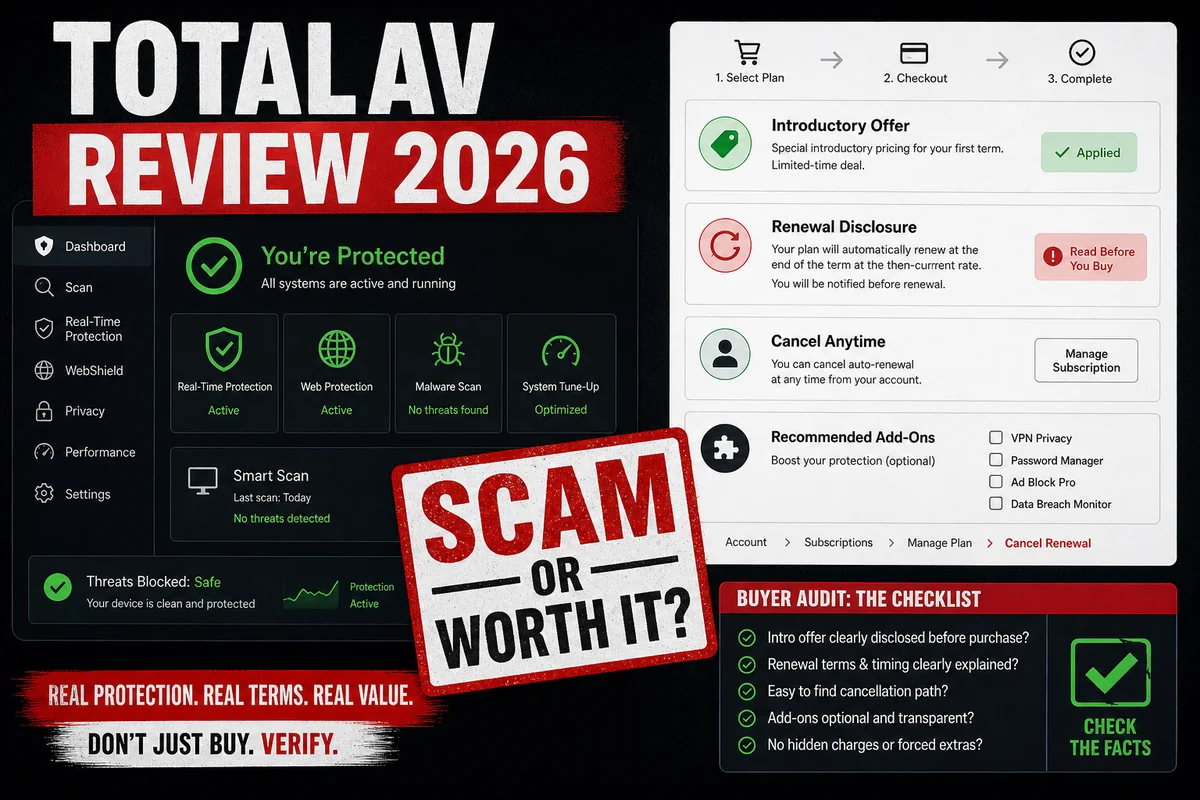
Our verdict: TotalAV is safe to buy from the official site and its core paid antivirus now has excellent independent protection evidence. Total AV Plus is attractive for the first term if the cart covers every device you need. It's much less compelling at a $99 regular renewal when Microsoft Defender costs nothing and ESET, Bitdefender and Norton offer different strengths. Internet Security makes sense only if you'll use its VPN; Total Security only if the password manager and upper-tier extras replace services you'd otherwise buy. Billing clarity, average current performance and campaign-dependent packaging hold the product to 8.1/10.
- 17.5/18 in the latest AV-TEST cycle, with 6/6 protection and usability
- 99.0% live web protection with only five false positives
- 99.98% final online protection in the 10,000-file malware test
- Simple interface and useful web-protection layer
- Low first-term price when the exact cart matches the buyer
- $19–$49 promotions can renew at $99–$149
- Entry-tier name and three/four-device scope vary by campaign
- 18.2 combined performance impact trailed several alternatives
- Free scan language can be mistaken for continuous protection
- Add-on subscriptions may require separate cancellation
Is TotalAV a scam or legitimate antivirus?
TotalAV is legitimate commercial security software. Its Windows antivirus is submitted under the Protected.net/TotalAV name to AV-TEST and AV-Comparatives, where the current product achieved high controlled-test results. The legal seller is identified, the subscription terms are published and the product has documented support, cancellation and refund processes. Those facts don't make every promotion good value, but they rule out the idea that the official application is fake antivirus.
The “scam” question persists because three different experiences get collapsed into one word. First, TotalAV uses deep first-term discounts followed by a substantially higher regular rate. Second, free scan and cleanup flows can lead to paid-protection prompts. Third, malicious ads, browser notifications and lookalike pages sometimes use antivirus branding on devices that don't have the real product installed. A reader can reasonably dislike the commercial experience without claiming that the independent protection results are invented.
Before installing, type `totalav.com` yourself or verify the domain, download signature and publisher. A warning that appears inside a random web page can't scan the whole computer and shouldn't be trusted merely because it displays a TotalAV logo. If a browser alert says “TotalAV found viruses” but TotalAV isn't installed, close the tab, revoke the site's notification permission and scan with the antivirus already registered in Windows Security. Don't call the phone number or install a remote-support tool from that alert.
TotalAV lab results in 2026
A reliable TotalAV verdict needs four current tests. AV-TEST measures protection, usability and everyday slowdown over two months. AV-Comparatives' real-world test starts from malicious web destinations; its malware protection test begins with files already on disk or removable media; its performance report compares common file, application and Office tasks. One percentage can't describe all four.
| Independent test | Product / period | TotalAV result | What it means |
|---|---|---|---|
| AV-TEST Windows 11 | TotalAV 6.6 May–June 2026 | 6/6 protection 5.5/6 performance 6/6 usability 17.5/18 | Protection and usability stayed perfect; the latest performance category slipped half a point after April's perfect cycle. |
| AV-C Real-World Protection | Premium 6.5–6.6 February–May 2026 | 99.0% protected 396 blocked / 4 compromised 5 false positives Advanced+ | Excellent protection against live web-delivered attacks with manageable alert noise. |
| AV-C Malware Protection | Premium 6.5 March 2026 / 10,000 cases | 98.6% offline detection 99.1% online detection 99.98% online protection 19 false alarms / Advanced | Only two systems were ultimately compromised, but 19 clean-file alerts lowered the award. |
| AV-C Performance | Premium 6.6 April 2026 | AV-C tasks: 85 Office: 86.8 Impact: 18.2 | Acceptable, not class-leading: several rivals had much lower combined impact. |
17.5/18 in June keeps the protection result strong, with a performance caveat
Protected.net TotalAV 6.6 earned 6/6 for protection, 5.5/6 for performance and 6/6 for usability in AV-TEST's May–June Windows 11 cycle. The preceding March–April cycle was a perfect 18/18, so both results are real, but 17.5/18 is the current headline. Protection stayed at 100% in every measured threat set, while the half-point change came from everyday workload impact rather than missed malware or false alarms.
The result isn't permission to copy “100% protection” onto every scenario. AV-TEST defines its sample sets, default configuration and Windows 11 workload, and no consumer antivirus makes an unsupported device immune. It does show that TotalAV belongs in the primary-antivirus conversation; the June performance score simply makes system fit a live buying question instead of a footnote.
99.0% live protection came with four compromises and five false positives
In AV-Comparatives' completed 400-case February–May cycle, TotalAV blocked 396 attacks and four test systems were compromised. The 99.0% rate, five false positives and Advanced+ award make it one of the better-balanced results in that field. Bitdefender protected against 99.5%; Norton 99.3%; Microsoft Defender also 99.0%. Statistical ranges overlap, so a tenth of a percentage point isn't a reason to ignore price, workload and feature fit.
The five false positives matter because the same test produced 39 for Malwarebytes and 41 for Trend Micro. TotalAV showed much less clean-site/file friction there. In the separate malware-file test it generated 19 false alarms, enough for a downgrade from the leading protection cluster to Advanced. This is why the page reports both tests rather than advertising only the most favorable number.
The Avira engine is verified, but TotalAV isn't simply Avira
AV-Comparatives' March report explicitly identifies TotalAV among products using the Avira engine. That's an unusually useful disclosure because it explains part of the strong signature/cloud foundation. It doesn't mean the products have identical behavior: TotalAV controls its own interface, configuration, web layers, update integration, plan packaging, support and subscription relationship. Test results apply to the submitted TotalAV build, not to a generic engine in isolation.

TotalAV Free vs paid real-time protection
TotalAV's no-cost path is useful for scanning, identifying and in some flows removing detected items. It shouldn't be described as equivalent to a paid always-on antivirus. The current product material reserves continuous real-time malware protection and the full web/security stack for a premium/trial entitlement. On Windows, Microsoft Defender may remain the registered real-time provider while a free scanner checks the device; verify that status in Windows Security rather than assuming the dashboard's green color answers it.
| Job | Free scan path | Paid plan | What to verify |
|---|---|---|---|
| Manual malware scan | Available | Available | Whether removal or repeated scans require a trial/activation in the current flow. |
| Continuous real-time protection | Don't assume it | Included in antivirus plans | Windows Security should show one active registered provider. |
| WebShield/phishing defense | Offer/extension-dependent | Included in current paid security stack | Browser support, extension permission and whether filtering is enabled. |
| VPN | No full paid entitlement | Internet Security and Total Security in current ladder | Server/usage policy, platforms and whether it replaces an existing VPN. |
| Password manager | No | Current Total Security upper tier | Import/export, supported browsers and recovery model before migrating. |
| Ad blocker | May be a separate extension/subscription | Campaign/plan-dependent | Whether Total Adblock is included or billed separately. |
A free scan that finds hundreds of “issues” may combine malware, cookies, junk files, privacy settings and optimization suggestions. Read the category before treating every count as an infection. Tracking cookies and temporary files aren't active trojans. A paid decision should be driven by continuous malware/web protection and needed bundle services, not the largest dashboard number.
Don't run paid TotalAV real-time protection beside another paid real-time suite by default. TotalAV's own support warns that two antivirus programs can conflict. Defender normally enters passive behavior when a compatible third-party provider registers correctly, but verify the provider status after installation and after major updates. Two scanners on demand are different from two drivers intercepting the same file activity.

TotalAV plans, introductory prices and regular renewals
TotalAV is easiest to judge when the first and next charge appear together. On July 31, 2026, the main US product ladder showed Total AV Plus at a $99 regular annual price for four devices, Internet Security at $129 for six and Total Security at $149 for eight. Current deal paths commonly show $19, $39 and $49 first-term offers. Another active entry route says “Antivirus Plus” and three devices. That campaign drift makes the final checkout—not a review table—the contract.
| Current tier | Typical current scope | Observed first term | Published regular price | Best reason to choose it |
|---|---|---|---|---|
| Total AV Plus / Antivirus Plus | Core antivirus; current pages show 3 or 4 devices by campaign | About $19 | $99/year | Low-cost first term when the exact device count is enough. |
| Internet Security | Core security + Safe Browsing VPN; commonly 6 devices | About $39 | $129/year | You need the bundled VPN and have tested its locations/speed. |
| Total Security | Upper bundle with password manager and campaign-specific extras; commonly 8 devices | About $49 | $149/year | Named extras replace separate services you already value. |
| Separate add-ons | Total Adblock, Total VPN or other account services may be separate | Varies | Varies | Only after the portal confirms whether the feature is bundled or separately billed. |
This dated snapshot is deliberately not encoded as an Offer in the page schema. Promotions, account history, geography, taxes and campaign URLs can change both the first charge and entitlements. A “$19 TotalAV” search ad may open a legitimate campaign with a different device limit from the main product page. Capture the cart and receipt before installation, including the renewal amount or the page where it can be viewed.
The entry tier is the strongest value when judged only on year one: the same tested core protection costs less than many rivals. Its long-term value is less obvious. At $99, compare built-in Defender, ESET's low current impact, Bitdefender's stronger current web result and the bundle value of Norton. The upper tiers shouldn't be read as stronger malware engines; they primarily add privacy and convenience services.

TotalAV features: useful core, plan-dependent extras
Real-time antivirus, cloud scanning and WebShield
The core paid stack monitors files and execution, uses cloud classification and adds web filtering against malicious or phishing destinations. The current lab results show that these layers work well together. The 98.6% offline versus 99.1% online detection rates in the malware-file test also show why internet connectivity and current definitions matter. Final execution-time online protection reached 99.98% after all layers acted.
WebShield is valuable because many infections begin before a traditional file scan: a fake login, drive-by download, malicious redirect or browser-based social engineering path. It doesn't replace judgment. A legitimate bank domain reached through a password-manager bookmark is safer than an urgent link in a message, and multifactor authentication limits damage when a phish gets through.
Smart Scan and system tune-up
Smart Scan combines security and maintenance checks. That's convenient, but its categories should stay separate in the reader's mind. Malware, potentially unwanted programs, privacy cookies, startup entries and duplicate/junk files have different urgency. Deleting caches may reclaim storage yet slow the next application launch; modifying startup entries can remove a needed sync or backup agent. Review each proposed change and preserve a restore path.
We removed the recovered page's precise scan-time, CPU and RAM figures because they weren't tied to a reproducible machine, version and screenshot set. A credible local result names the CPU, storage, file count, product build, first/second scan and competing background tasks. The current independent reports provide comparable evidence; readers should test their own workload inside the refund window.
Safe Browsing VPN, Total Adblock and password vault
The current product ladder places Safe Browsing VPN in Internet Security and Total Security. That makes the middle tier worthwhile only if the VPN's locations, speed, streaming behavior and privacy terms suit the buyer. Antivirus test scores don't validate a VPN's logging architecture. Run a DNS/IP leak test, try the exact remote-work and streaming routes, and confirm whether every intended platform is included.
Total Adblock can appear as an included feature, a browser extension or a separately billed account service depending on the path. The same applies to Total VPN and other add-ons visible in the portal. “Available in my account” doesn't always mean “included in this antivirus renewal.” The password manager in the upper tier should be evaluated for browser support, mobile autofill, import/export and account recovery before moving credentials.
No bundle eliminates the need for versioned backups, unique passwords, MFA and updates. Ransomware protection can block behavior; it can't guarantee recovery of encrypted local and cloud-synced files. Keep at least one backup version isolated from the logged-in endpoint and perform a restore test.
Does TotalAV slow down a PC?
TotalAV isn't universally heavy, but the current comparative performance result is a weakness. In April, its AV-Comparatives task score was 85 and Procyon Office score 86.8, producing a combined impact of 18.2. That placed it around the lower-middle of the 20-product field. McAfee scored 3.3, ESET 4.2, Norton 5.3, Bitdefender 9.6 and Microsoft Defender 12.9 in the same report. Lower is better.
AV-TEST awarded 5.5/6 performance in its latest May–June Windows 11 workload after a perfect 6/6 in March–April. That direction now agrees with AV-Comparatives that performance deserves testing, though the labs use different mixes, baselines and scoring. TotalAV may feel responsive during common browsing and office work yet add more delay to particular file copies, archiving, installation or application-launch patterns. A single “my PC feels fast” paragraph can't settle that for a developer, gamer or archive-heavy user.
- Measure before installation. Record cold and warm app launches, a large copy, archive extraction, browser startup, game/build launch and idle resource use.
- Install from the official source. Decline or document every optional add-on so the test measures the intended plan.
- Verify one real-time provider. A conflict with another suite makes speed and stability results meaningless.
- Update and finish the first scan. Initial indexing/classification isn't steady-state behavior.
- Repeat each task three times. Compare medians and separate active-scan impact from normal work.
- Test VPN and browser extensions separately. Routing, DNS and blocking rules can cause web delay independently of the antivirus engine.
- Review false positives. Don't exclude whole user, downloads or source-code folders merely to make a benchmark pass.
- Decide before the verified refund deadline. Save the receipt, terms, cancellation and refund route.
If the product remains slow after its first complete scan, reproduce one operation and identify the responsible component before adding a narrow exclusion. If everyday work includes frequent installs, large archives or builds, test ESET, Norton or McAfee on the same machine rather than relying on their lower lab impact alone.
TotalAV on Windows, macOS, Android and iOS
The current system-requirement page lists Windows 10 and 11 for TotalAV v6, a dual-core processor, 2 GB RAM and 2 GB storage. Windows on ARM isn't supported. Legacy v5 can run on older Windows versions, but an operating system Microsoft no longer secures isn't made safe by installing an antivirus; upgrade the OS or isolate/replace the device.
| Platform | Current support | Important limitation |
|---|---|---|
| Windows | v6 on Windows 10/11; full desktop scanning and real-time security | No Windows on ARM; Windows 10 lifecycle risk remains separate. |
| macOS | Catalina 10.15 through Tahoe 26; Intel and Apple Silicon | May require Rosetta 2; Windows lab results don't prove identical Mac protection. |
| Android | Android 5–16; scanning and real-time/mobile security features | Permissions and features vary by Android/vendor version. |
| iPhone/iPad | iOS/iPadOS 9–26; web/privacy/security tools | No conventional system-wide antivirus scan under Apple's platform model. |
| Windows ARM / Linux / Chromebook | Not documented as supported desktop antivirus targets | Don't count them merely because a browser extension or Android app can install. |
macOS support spans Catalina through Tahoe 26 on Intel and Apple Silicon. Android supports a conventional mobile malware model with suitable permissions. On iPhone and iPad, TotalAV itself says the app doesn't run antivirus scans; it offers tools compatible with Apple's sandboxed platform. A six-device plan covering three iPhones therefore doesn't equal six Windows-style antivirus engines.
Map each device before checkout. Write down OS/version, processor architecture and the exact feature needed—real-time file protection, phishing defense, VPN, password autofill or breach alert. Then confirm that the active cart covers the device count and feature on that platform. This avoids paying for an eight-device label that doesn't solve the household's actual needs.
How to cancel TotalAV and request a refund
TotalAV's current billing documentation distinguishes four actions that reviews often mix up. Turning off auto-renewal prevents the next eligible charge but normally leaves service active through the term. Letting the term expire ends that subscription. Requesting a refund requires full termination and ends access. Separately billed Total Adblock, Total VPN or other add-ons may need their own cancellation.
- Open the account portal yourself. Use the official TotalAV site, not a phone number or link from an alarming pop-up.
- Open My Subscriptions. Inventory every listed antivirus, VPN, ad-blocking and other subscription, including seller and renewal date.
- Select Cancel Subscription. Complete the identity-verification flow and read whether it disables renewal or fully terminates access.
- Save proof. Keep the final screen, confirmation email, plan name, subscription ID and stated end date.
- Handle stores separately. Apple App Store and Google Play subscriptions/refunds are managed through those stores.
- Request a refund explicitly when eligible. Turning off renewal alone doesn't ask for money back.
- Check every add-on. Cancel each separately billed service rather than assuming the antivirus action covers the whole portal.
- Confirm the payment method. Approved refunds may be initiated in 24–48 hours but can take up to ten working days to appear.
The current refund guide generally provides a 30-day window for annual or biannual initial purchases and renewals, and 14 days for monthly, quarterly and many add-on subscriptions. Jurisdiction and seller can change the rule; app stores apply their own process. Read the terms attached to the specific transaction rather than assuming the longest window applies.
The promotion and renewal guide says the discount applies to the first period and the regular rate follows. The portal/receipt should expose the next charge, and annual users receive a renewal reminder under the current flow. Treat that email as a checkpoint, not the only control: use a calendar date and inspect the portal well before renewal.
Don't automatically disable renewal on installation if the checkout grants a value-added “Continuous Protection” service only while renewal remains active. First identify every entitlement and its condition. If no dependent benefit matters, turn renewal off and retain proof; if it does matter, schedule a deliberate decision before the billing date.
What current users report—and what fake TotalAV pop-ups mean
Current antivirus-community discussions are mixed in a predictable way. Some users are satisfied with protection and the simple interface; others complain about free-app prompts, subscription renewal or support friction. A March 2026 billing/support complaint and a May free-antivirus discussion are useful signals to inspect checkout, prompts and cancellation. They're individual accounts, not a measured complaint rate.
Protection anecdotes can't override the controlled results in either direction. One person who “never got a virus” may simply have avoided attacks; one infection may involve an unpatched browser, stolen credentials or a disabled module. Labs provide the comparative protection evidence. Community reports identify the parts of the workflow a prospective buyer should test: upsells, renewal display, add-on inventory, support and alert clarity.
An unsolicited browser notification deserves separate treatment. If the official app isn't installed, a site that says “TotalAV found five viruses” is likely an ad, malicious notification or impersonation. Check the address bar, browser notification permissions, installed applications and Windows Security provider. Remove the notification permission, clear the site's data, run a trusted scan and never enter payment details into the warning.

Who owns TotalAV, PC Protect and Scanguard?
TotalAV's current legal terms identify Total Security Limited, UK company 10161957, and Total Security US LLC. The current PC Protect terms say Total Security Limited trades as PC Protect; Scanguard's terms also name Total Security Limited/Total AV. That verifies a common corporate family.
It doesn't prove that every product shares an identical implementation, version, interface or entitlement. We therefore removed the recovered page's stronger implementation claim. A common owner is still commercially useful: don't buy two sibling subscriptions assuming they provide independently tested engines or independent support relationships. Compare the exact current plans and cancel each account separately if you don't need it.
The engine disclosure comes from a different source: AV-Comparatives identifies TotalAV's submitted product as using Avira technology. Engine licensing is common in antivirus, and it neither makes TotalAV fraudulent nor turns its pricing/support into Avira's. The tested outcome belongs to the full submitted configuration.
Who should choose TotalAV—and who shouldn't
- You want strong current paid protection at a very low first-term price
- The active Plus cart clearly covers all required devices
- You prefer a simple interface and web-protection workflow
- You'll use the VPN enough to justify Internet Security
- You're comfortable managing renewal and separate add-ons in the portal
- You want a stable long-term price with less promotional drift
- Microsoft Defender already meets your needs without a subscription
- Your workload needs the lowest current file/application impact
- You assume Free provides the same real-time protection as paid
- You'd buy Total Security only because “top tier” sounds more protective
The cleanest TotalAV purchase is a small household buying the entry tier from a cart that clearly shows its three- or four-device limit, first charge and $99 regular rate. The buyer tests alerts and workload immediately, inventories subscriptions in the portal and decides well before the renewal date.
Internet Security is a VPN decision. Total Security is a password-manager/extras decision. Neither should be purchased merely to improve the core lab-tested engine. If the bundle duplicates an existing VPN, password manager or blocker, compare the core Plus renewal with alternatives instead of treating crossed-out bundle prices as savings.
TotalAV vs Defender, Bitdefender, ESET, Norton and McAfee
| Option | Choose it for | Trade-off against TotalAV | Read next |
|---|---|---|---|
| TotalAV Plus | Excellent current protection and a very cheap first term. | $99 regular renewal; campaign/device-count drift; 18.2 performance impact. | Best antivirus guide |
| Microsoft Defender | Built-in Windows protection with no antivirus renewal. | Fewer bundle/support extras; relies on Windows account/security configuration. | Defender review |
| Bitdefender | 99.5% completed real-world protection and mature layered controls. | Total Security's standard VPN is capped; plan ladder is also complex. | Bitdefender review |
| ESET | Low 4.2 current impact, two real-world false positives and granular control. | Can cost more initially and asks more of a hands-on user. | ESET review |
| Norton 360 | Family bundle, VPN, parental controls and Windows cloud backup. | Higher renewal and more promotions/modules than a core-antivirus buyer needs. | Norton review |
| McAfee | Leading 3.3 current task impact and household device bundles. | 98.5% current real-world result and a complicated sales ladder. | McAfee review |
TotalAV's lab evidence is stronger than its old reputation, so the alternative decision is no longer “real antivirus versus a weak scanner.” It's price stability, workload, interface and bundle fit. Compare all candidates on the same PC after first-run scans and with only one real-time provider active.
Frequently asked questions about TotalAV
Is TotalAV a scam or legitimate antivirus?
TotalAV is legitimate paid security software. TotalAV 6.6 earned 17.5/18 in AV-TEST's May–June 2026 cycle, including 6/6 protection and usability, and TotalAV Premium blocked 99.0% of 400 live web threats at AV-Comparatives. The commercial caveat is a heavily discounted first term followed by a higher regular renewal, plus campaign-dependent device limits and possible separate add-ons.
Is TotalAV safe to install?
Yes, when downloaded from the official TotalAV domain and verified as the signed vendor application. A random browser page or notification claiming “TotalAV found viruses” isn't the installed scanner and may be an ad or impersonation. Close it, revoke suspicious notification permission and scan with the provider registered in Windows Security.
Is TotalAV Free enough for real-time protection?
Don't rely on the free scan path as equivalent to the paid always-on antivirus. It can scan and identify threats, but current real-time malware and full web protection require a paid or active trial entitlement. On Windows, verify that Microsoft Defender or another supported provider remains active if you use TotalAV only for a free manual scan.
How much does TotalAV cost and renew for?
On July 31, 2026, current US paths commonly showed first-term offers around $19 for Total AV Plus, $39 for Internet Security and $49 for Total Security, with published regular annual prices of $99, $129 and $149. The entry tier appeared with three or four devices in different campaigns, so the current checkout controls the actual price and entitlement.
Does TotalAV slow down a computer?
It can be acceptable in everyday use, but AV-TEST's latest June 2026 result was 5.5/6 for performance after 6/6 in April. In AV-Comparatives' April mixed workload, TotalAV's combined impact was 18.2, behind McAfee, ESET, Norton, Bitdefender and Defender. Test file copies, installs, launches and your own workload after the first scan with no competing real-time suite.
How do I stop TotalAV auto-renewal?
Open the official account portal, go to My Subscriptions, choose the subscription and complete Cancel Subscription/identity verification. Save the confirmation and stated end date. Turning off renewal normally preserves access through the paid term and isn't a refund. Check Total Adblock, Total VPN and other add-ons separately; Apple/Google purchases are managed in their stores.
Can I get a refund from TotalAV?
The current policy generally allows 30 days for annual/biannual initial purchases and renewals, and 14 days for monthly, quarterly and many add-ons, subject to seller, jurisdiction and transaction terms. A refund requires explicit full termination and ends access. Approved refunds may be initiated in 24–48 hours but can take up to ten working days to appear.
Who owns TotalAV, PC Protect and Scanguard?
TotalAV's legal terms name Total Security Limited and Total Security US LLC; PC Protect and Scanguard terms identify the same corporate family. That proves common ownership, not that every application build or entitlement is identical. AV-Comparatives separately confirms that the submitted TotalAV product uses the Avira engine.
Final verdict: real protection, conditional value
TotalAV has earned a better technical verdict than its older reputation suggests. The latest paid Windows build scored 17.5/18 at AV-TEST with 6/6 protection and usability, delivered 99.0% live protection with five false positives, and reached 99.98% final online protection in the 10,000-file test. These aren't the results of fake antivirus.
The purchase remains conditional. Current first-term offers are dramatically lower than $99–$149 regular renewals. The entry tier can mean three or four devices depending on campaign. The April 18.2 performance impact was materially worse than several strong alternatives. Free scanning, continuous paid protection and bundle add-ons aren't interchangeable.
Bottom line: Total AV Plus is a good first-term buy when the official cart covers every device and you're prepared to manage renewal deliberately. Choose Internet Security only for the VPN and Total Security only for verified upper-tier services. Save the cart, receipt and cancellation proof; inspect each add-on separately; compare long-term cost before treating a low introductory price as lasting value.
Continue your antivirus comparison
Compare the full shortlist in our best antivirus software guide, browse every restored antivirus review, compare TotalAV versus Norton, and see how we separate lab evidence, hands-on observations and community signals.