
AVG TuneUp Review 2026: Worth the $79.99 Renewal?
AVG TuneUp puts disk cleanup, browser cleanup, app updates, startup/background control, uninstallation and an Undo Center into one polished dashboard. That convenience is real. So is the overlap: Windows already provides Storage Sense, Cleanup Recommendations, Startup Apps, Installed Apps and scheduled drive optimization for free. TuneUp is most defensible for a nontechnical 10-device household—not as a magic speed booster.
Quick verdict: AVG TuneUp earns 6.3/10. The current US store offered a 10-device plan for $34.68 in the first year, renewing at $79.99/year, when checked July 14, 2026. The first-year household price can be reasonable if you want one guided interface across devices. Most Windows 11 users should keep the money: built-in tools cover the core jobs. Never run Full cleanup blindly—it can delete Downloads, backups, Recycle Bin contents and browser autofill—and leave registry cleaning disabled.
Need a different AVG task? The complete AVG guide hub routes review, plans, setup, troubleshooting, Web Shield, privacy, browser, VPN, Android, utilities, billing and removal without mixing their steps.
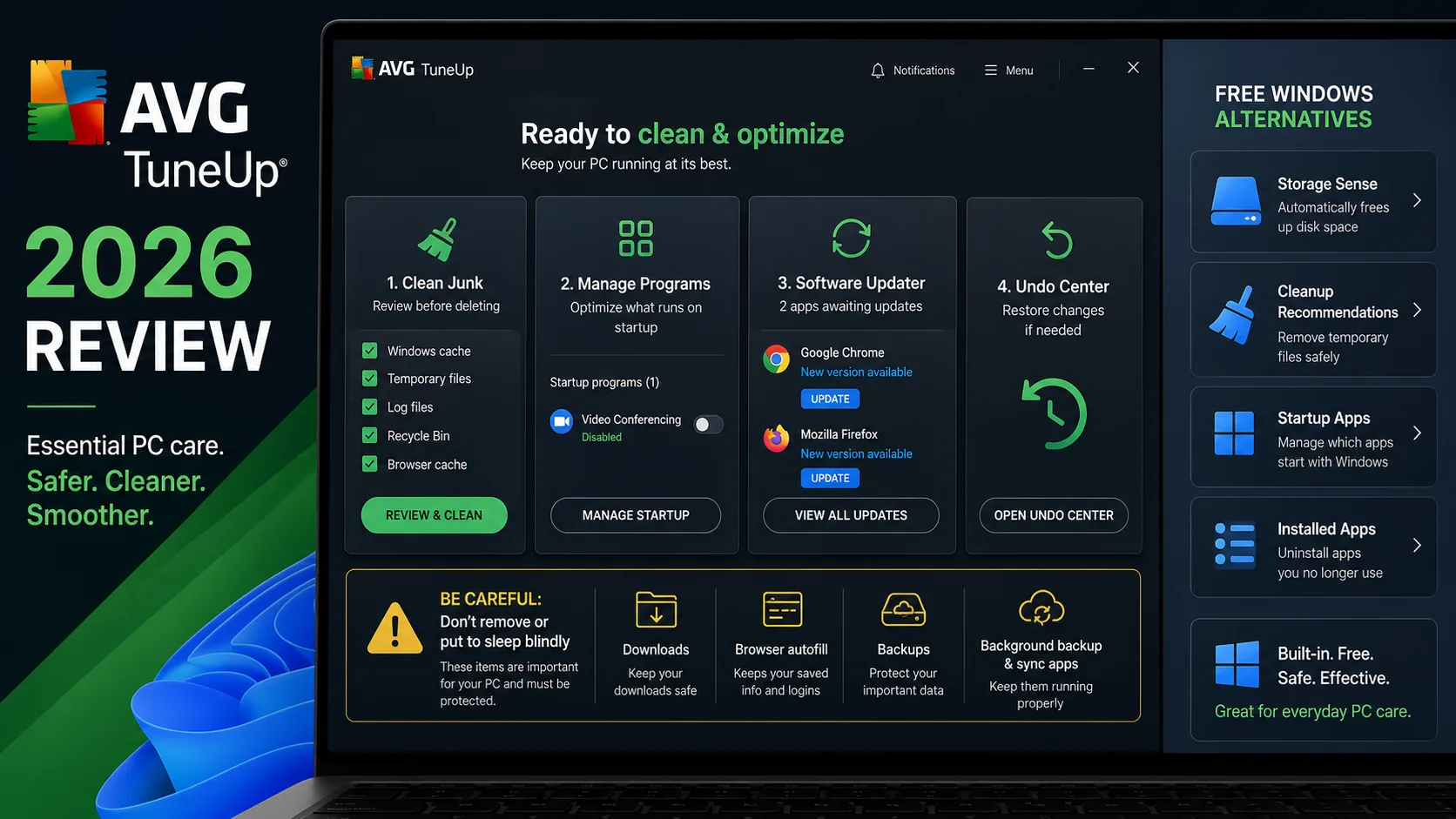
- Consolidates cleanup and program management in a clear interface
- Software Updater covers some third-party desktop applications
- Sleep Mode can stop a genuinely unnecessary background app
- Undo Center can reverse supported changes when backups exist
- Ten-device introductory plan can suit mixed-device households
- Windows already supplies the everyday maintenance basics
- Full cleanup can erase Downloads, backups and browser autofill
- Sleeping the wrong app can stop backup, sync, messages or updates
- Microsoft doesn't support routine registry cleaners
- The renewal price more than doubles the checked intro price
Is AVG TuneUp worth it in 2026?
For most people, no at the $79.99 renewal. TuneUp is legitimate utility software, not malware, and it can make recurring maintenance easier to understand. Its useful outcomes—recovering disk space, stopping an unwanted startup process, removing an unused application and patching supported third-party software—are concrete. None transforms a healthy modern PC into new hardware.
The best buyer is a household managing several devices whose owner wants prompts, a consistent dashboard and an Undo Center rather than separate operating-system menus. The worst buyer is someone responding to a red “performance issue” counter without a measurable problem. A large count of caches, broken shortcuts or registry entries isn't a benchmark.
Windows 11 already includes Storage Sense and Cleanup Recommendations, a startup-impact view in Task Manager, Installed Apps, browser cookie/cache controls and automatic drive optimization. These free tools are more conservative and integrated, though less unified.
Our 6.3/10 score credits the interface, app updater, selective Sleep Mode and recoverable actions, then subtracts for duplication, an aggressive Full cleanup option, registry-cleaner conflict with Microsoft guidance and steep renewal. We don't use AVG antivirus lab results to score TuneUp; malware protection tests don't measure cleanup accuracy or performance gains.
What AVG TuneUp actually does
The Windows app begins with a general scan, then offers Quick Clean and individual tools. Current AVG documentation groups them into cleaning, program management, drive/data utilities and recovery. The Mac product has a smaller, different set; mobile maintenance is delivered through platform-specific AVG apps. Don't assume a feature shown on Windows exists everywhere.
Disk Cleaner identifies temporary system/application/installer files, logs, caches, backups and other candidates. Browser Cleaner handles cache, cookies, history and—only in its broadest mode—autofill. Cloud Cleaner looks for duplicate, old or large files in connected storage. Quick Clean combines system junk, browser data, broken shortcuts and registry entries, which is convenient but also makes category review essential.
Manage Programs includes Software Updater, Processes/Sleep Mode and App Uninstaller. AVG's current TuneUp usage guide says the Processes view identifies apps running in the background and returns a slept app to sleep after use. It specifically warns that daily-use apps shouldn't be slept and that sleeping WhatsApp can make calls or messages disappear.
Data Recovery attempts to restore deleted/damaged files; Data Shredder deliberately makes selected files unrecoverable. Disk tools cover hard-drive defragmentation/optimization. Undo Center stores backups for supported TuneUp actions, but AVG says not every action is reversible. That last limit matters more than the reassuring “Undo” label.
| Feature | Useful when | Risk / limitation | Our default |
|---|---|---|---|
| Disk Cleaner | Storage is genuinely low and categories are reviewed | Full mode includes Downloads, backups and Recycle Bin | Custom or Basic only |
| Browser Cleaner | You deliberately want cache/cookie cleanup | Cookies sign you out; Full mode removes autofill | Select one browser/category |
| Software Updater | A supported app lacks reliable automatic updates | Coverage isn't universal; updates can change behavior | Preview, then update individually |
| Sleep Mode | A nonessential app wastes resources in background | Can stop backups, sync, notifications and helper services | Exclude essential background apps |
| App Uninstaller | You recognize and no longer need a program | “Unused” doesn't mean unnecessary; local data may be removed | Back up data and use vendor uninstall |
| Broken registry keys | Almost never as routine maintenance | Microsoft doesn't support registry cleaners | Disable |
| Undo Center | A supported TuneUp change causes trouble | Not all actions can be reversed; retention is configurable | Enable backups before changes |
AVG TuneUp price, renewal and device count
The AVG US store listed its standalone multi-device TuneUp plan at $34.68 for the first year, a 57% introductory discount from a $79.99/year renewal, when we checked July 14, 2026. It displayed ten devices and Windows, Apple, Android and iOS icons. Local currency, tax, promotion and included app names can differ; the checkout and order email control.
That price is materially different from the old page's $49.99/$99.99/$149.99 table and from the stale $59.88 figure appearing in indexed copies. We date the live-store snapshot and don't freeze it into Offer schema. A search snippet or affiliate page isn't a renewal promise.
AVG also sells single-platform/single-device variants and bundles. Its current transfer guide distinguishes TuneUp Multi-Device (up to ten simultaneous devices) from TuneUp for PC or Mac (one device). AVG Ultimate Multi-Device includes TuneUp alongside Internet Security, VPN and AntiTrack for up to ten devices, so an existing Ultimate customer shouldn't buy TuneUp twice.
Online AVG orders normally renew automatically unless canceled before the account's next billing date. For annual and multi-year subscriptions, AVG says that date can be up to 35 days before the next term. The renewal—not the discounted first year—is the honest long-term value test.
Does AVG TuneUp really make a PC faster?
It can improve a specific bottleneck; it can't create CPU, memory, storage bandwidth or battery health. If a startup app consumes a second of CPU and several megabytes of disk I/O at sign-in, disabling it can reduce startup work. If the system drive is critically full, removing safe temporary files can make room for Windows Update and normal operation. If neither condition exists, a cleanup counter may produce no noticeable speed change.
Microsoft's Startup Apps guidance shows actual impact levels in Task Manager. That's a better baseline than “program installed = PC slow.” Measure Task Manager CPU/memory/disk, free space and startup impact before changing anything, then repeat the same measurement after.
Sleep Mode can reduce active background work, but only by stopping functionality. A backup client, cloud-sync engine, messaging app, VPN, password-manager helper, printer monitor, accessibility tool or security component runs in the background because that's its job. AVG's own troubleshooting page says an app may become unresponsive if it was accidentally slept.
Disk cleanup primarily creates capacity. Deleting a browser cache may make the next page load slower until assets are downloaded again. Removing cookies signs users out. Registry cleaning has no reliable speed case: Microsoft's support policy doesn't support registry cleaners and warns that incorrect modification can cause instability or require reinstalling Windows.
| Claim / task | When it can help | Free evidence or route | What it can't prove |
|---|---|---|---|
| Free disk space | System drive is low and safe junk occupies material space | Windows Storage and Cleanup Recommendations | More free space doesn't automatically increase CPU speed |
| Faster startup | A high-impact unneeded app starts at sign-in | Task Manager shows startup impact | Disabling an essential helper isn't optimization |
| Lower background use | A nonessential process is measurably active | Task Manager and app settings | Sleeping a process may remove required behavior |
| Safer current software | A supported third-party app is genuinely outdated | Vendor updater, Microsoft Store or WinGet | TuneUp doesn't cover every app/version source |
| Drive optimization | Windows reports an HDD needs optimization | Windows schedules Optimize Drives weekly by default | Manual SSD defragmentation isn't a speed upgrade |
| Registry cleanup | No routine performance case established | Leave registry maintenance to supported installers/Windows | A count of “broken keys” isn't a benchmark |
Risky TuneUp settings and recovery limits
Full cleaning can remove personal or authentication data
AVG's guide is unusually clear: Full Disk Cleaner removes the contents of Downloads plus logs, caches, backups and Recycle Bin contents; Full Browser Cleaner removes autofill from selected browsers. A 2023 AVG Community support case describes lost Downloads that support said couldn't be restored. That's one report, not a prevalence estimate, but it illustrates the documented design.
Use Custom or Basic. Open every category, deselect Downloads, backups, password/autofill data and anything you can't recreate. Browser cache is disposable; a tax PDF, installer license, recovery code or local backup isn't “junk” because it sits in a broad folder.
Sleep Mode can silently disable the feature you paid for
Don't sleep backup, cloud sync, messaging, VPN, password-manager, security, remote-access, accessibility, printer/scanner, GPU, audio or hardware-control software. A directional Backblaze community discussion shows the category error: a continuous backup client appears as background activity precisely because it must remain active.
If an app stops opening or background behavior disappears, open Manage Programs → Processes/Sleep Mode and turn it back on. AVG's current support article confirms accidental sleeping as a cause of an unresponsive program. Restore first; don't reinstall Windows or delete random registry keys.
Undo Center isn't a backup of your personal files
Undo Center uses TuneUp's stored backups to reverse supported configuration actions. AVG says not all actions can be reversed. It isn't versioned backup for documents, and a securely shredded file is intentionally unrecoverable. Before cleanup, make a separate tested backup of personal data and confirm retention settings inside Undo Center.
Drive optimization must match the storage type
Windows already optimizes drives automatically. Its official drive guidance distinguishes HDD defragmentation from SSD TRIM and says scheduled optimization is automatic. Don't repeatedly force legacy defragmentation on an SSD.
Windows, Mac and mobile TuneUp aren't the same product
On Windows, TuneUp has the broadest feature set: junk/browser/cloud cleaning, Quick Clean, Software Updater, Sleep Mode, uninstaller, registry/shortcut cleaning, drive tools, data recovery/shredding and Undo Center. Exact features can change between releases; the current app and support page win over an old screenshot.
On Mac, AVG TuneUp Premium focuses on clutter, duplicate/similar/poor photos, app uninstall and startup items. macOS requires authorization for destructive cleaning. Windows-only claims about registry keys, Sleep Mode or drive tools must not be transferred to Mac.
The US storefront represents the multi-device subscription across Windows, Apple and mobile platforms, but Android/iOS use platform-specific AVG Cleaner/Mobile tools and operating-system permission limits. Confirm the named app and entitlement in the order email before treating “10 devices” as ten identical desktop installations.
AVG's current TuneUp FAQ says the paid app can run in scan-only mode without activation and the allowed device count is the number purchased. It also confirms that TuneUp is separate from AVG Internet Security; only a named bundle such as AVG Ultimate includes both.
How to configure AVG TuneUp safely
- Measure the actual problem. Record free disk space, Task Manager startup impact and the CPU/memory/disk use of suspected processes. Don't optimize a color or issue count.
- Run Windows tools first. Review Storage → Cleanup Recommendations, Storage Sense, Task Manager → Startup Apps, Installed Apps and Optimize Drives. Stop if the built-ins solve the problem.
- Protect personal data. Make and test an independent backup. Move irreplaceable files out of Downloads, empty Recycle Bin deliberately and export browser/password data only through its own supported process.
- Configure Undo Center. Enable backups for every supported TuneUp action and choose adequate retention before applying changes. Remember that deletion/shredding and some cleanup actions can't be undone.
- Disable broad automatic categories. Leave registry cleaning off. Don't allow Auto-Clean or Full mode to remove Downloads, backups, autofill, cookies, cloud files or Recycle Bin contents without review.
- Protect essential background apps. Exclude backup, sync, messaging, security, VPN, password-manager, remote-access, accessibility and hardware utilities from Sleep Mode.
- Change one category at a time. Clean a reviewed file category, update one app or disable one startup item, then reboot/test sign-in, browsers, messages, sync, backup and work apps.
- Verify value before renewal. Compare measured before/after behavior, review the next payment date and cancel renewal if consolidation didn't save enough time to justify $79.99/year.
Privacy, auto-renewal, cancellation and uninstall
Browser cleaning isn't the same as online anonymity. Removing local cookies/history may reduce stored traces but can sign users out, erase preferences and remove autofill. Websites, accounts, networks and services can retain their own records. Use each browser's site-data controls when you need a precise result.
Cloud Cleaner must inspect connected storage metadata/content categories to find large, old or duplicate files. Review permissions, select the correct account and never authorize deletion before confirming the original and duplicate. Data Shredder is intentionally destructive; don't use it on a sync folder until every linked device and backup path is understood.
AVG applications expose usage, analytics and offer controls under privacy settings. Disable optional sharing you don't want and leave only data needed for the service/support you use. Cleanup findings shouldn't be treated as a security breach; TuneUp isn't antivirus and doesn't replace AVG AntiVirus or Microsoft Defender.
Uninstalling TuneUp doesn't cancel billing. AVG's uninstall guide says this explicitly and offers a choice to delete backups/logs. First wake slept apps and undo unwanted changes; then cancel renewal in the AVG Account, keep confirmation, uninstall and retain backups until normal behavior is verified.
Free alternatives to AVG TuneUp
| TuneUp job | Free first choice | Why it's enough for most users | Safety note |
|---|---|---|---|
| Temporary/system cleanup | Storage Sense + Cleanup Recommendations | Built into Windows with storage categories and scheduled cleanup | Review Downloads, cloud placeholders and previous installations |
| Startup control | Task Manager / Settings → Startup Apps | Shows measured startup impact and simple enable/disable | Don't disable security, sync or hardware helpers blindly |
| App removal | Settings → Apps → Installed apps | Uses the app's supported uninstaller | Export data and cancel the subscription separately |
| Software updates | App/vendor updater, Store, or WinGet | First-party channels; WinGet can preview available upgrades | Preview before `winget upgrade --all`; coverage isn't universal |
| Drive optimization | Optimize Drives | Windows schedules HDD defrag/SSD TRIM appropriately | Don't apply HDD advice to an SSD |
| Browser data | Browser privacy/site-data settings | Precise control by site and data category | Cookies/autofill deletion changes sign-in behavior |
| Registry cleanup | None for routine maintenance | Microsoft doesn't support registry cleaners | Use specific trusted repair instructions and backups only |
These tools are less dramatic because they don't manufacture a single “health score.” That's a strength. You can tie each action to a measurable problem, see which category changes and avoid granting one utility broad deletion/process-control authority.
AVG TuneUp FAQ
Is AVG TuneUp legitimate and safe?
The official AVG TuneUp is legitimate software from AVG/Gen Digital. Its default usefulness doesn't make every action safe: Full cleanup can remove Downloads, backups, Recycle Bin contents and browser autofill, while Sleep Mode can stop essential background apps. Download from AVG, review every category and keep independent backups.
Does AVG TuneUp really speed up a PC?
It can improve a specific bottleneck by disabling an unnecessary startup/background app or freeing critically low storage. It can't increase hardware performance, and cleanup may show no noticeable gain on a healthy PC. Measure startup impact, resource use and free space before and after instead of trusting an issue count.
How much does AVG TuneUp cost?
AVG's US store showed $34.68 for the first year of a ten-device plan, renewing at $79.99/year, when checked July 14, 2026. Price, tax, promotion and plan type can change. Confirm the live checkout, order email, device entitlement and next payment date.
Is AVG TuneUp included with AVG Internet Security?
No. AVG's FAQ says TuneUp requires a separate paid subscription from AVG Internet Security. AVG Ultimate bundles can include TuneUp, Internet Security, VPN and AntiTrack, so check the exact product names in your account before buying a duplicate subscription.
Should I use AVG TuneUp's registry cleaner?
No for routine maintenance. Microsoft doesn't support registry cleaners and warns that incorrect modifications can cause instability or require an operating-system reinstall. Disable broken-registry-key cleaning in Quick Clean/Auto-Clean and use only specific trusted repair instructions with a backup.
What should never be put to sleep?
Exclude backup, cloud-sync, messaging, security, VPN, password-manager, remote-access, accessibility, printer/scanner and hardware-control apps. Their background work is the feature. If an app becomes unresponsive or stops syncing, wake it in TuneUp before reinstalling or changing system files.
Can AVG TuneUp recover everything it deletes or changes?
No. Undo Center reverses only supported actions while its backups are retained. AVG says not every action can be reversed; Data Shredder is intentionally irreversible, and deleted personal files may not be recoverable. Maintain a separate tested backup before cleanup.
Does uninstalling AVG TuneUp cancel the subscription?
No. Uninstalling doesn't cancel renewal. Wake slept programs and undo unwanted changes, cancel renewal in the AVG Account before the displayed billing date, save the confirmation, then uninstall. Keep TuneUp backups/logs until the system and apps are working normally.
Final verdict: useful dashboard, optional subscription
AVG TuneUp isn't a scam and not a miracle. It packages real maintenance controls into a friendlier interface and adds useful consolidation, especially Software Updater, selective Sleep Mode and an Undo Center. A cautious ten-device household may reasonably value that convenience at the introductory price.
The product becomes hard to recommend when “cleanup” is treated as an automatic performance cure. Windows covers the everyday work for free, Microsoft rejects routine registry cleaning, and AVG's broadest modes can delete important files/data or suppress background functionality. The $79.99 renewal should fund measurable saved time, not anxiety created by a health counter.
Our score is 6.3/10. If you buy it, choose Custom/Basic cleanup, disable registry cleaning, protect essential background apps, enable Undo backups and compare before/after measurements. If that sounds like more supervision than the dashboard saves, use the Windows tools instead.