
Comodo Hijack Cleaner Review 2026: Still Downloadable, No Longer Trustworthy
Comodo's product page and download button are still online, and the help index now calls the program Xcitium Hijack Cleaner. That surface freshness is misleading. The official ZIP is a 2018 artifact, the only guide is version 1.0 from 2018, Internet Explorer is supported while Edge is absent, and users have reported an expired-certificate launch failure since 2023. I wouldn't run this utility on a current Windows PC.
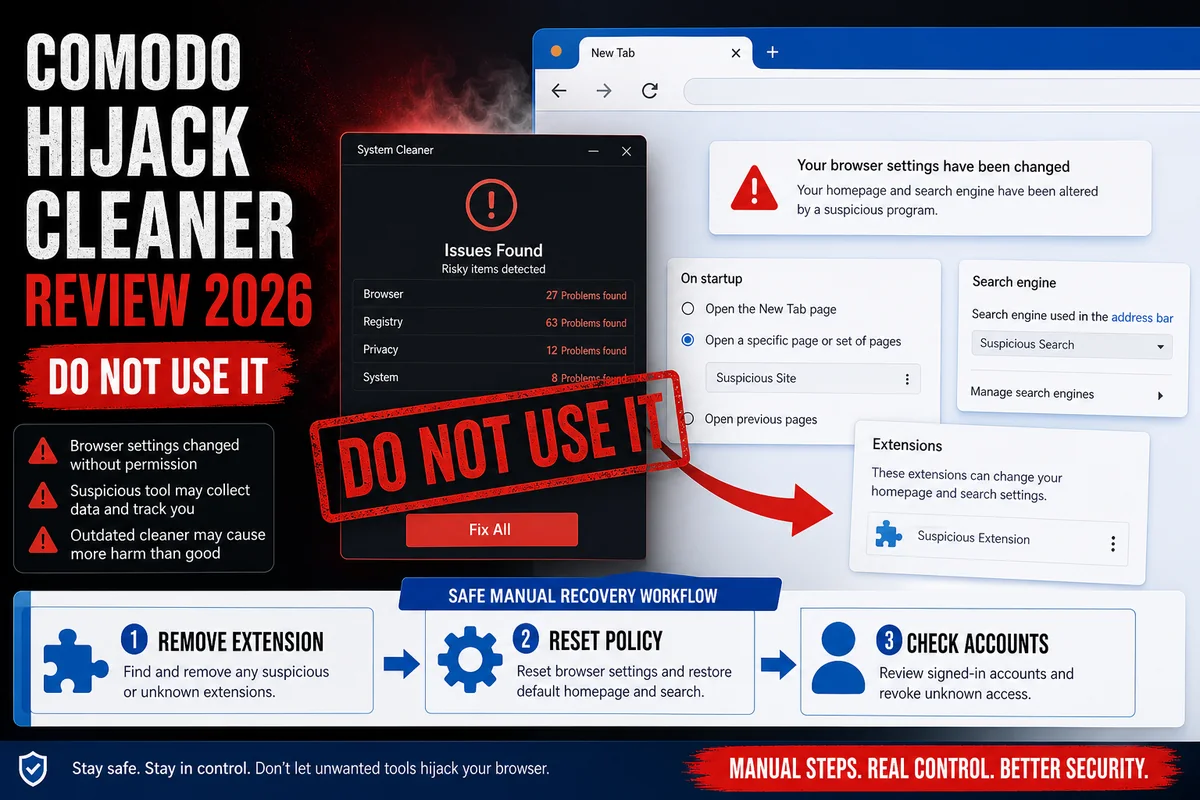
Our verdict: Don't use Comodo/Xcitium Hijack Cleaner in 2026. Its original idea—inspect browser extensions, homepage, search, DNS, hosts file and shortcuts—was sensible in 2018. The current official download is still that old generation, and the documented cleanup can replace homepage/search with Google and DNS with Google Public DNS rather than restore the user's known-good configuration. Our 2.0/10 score measures current suitability, not the historical concept. Use supported browser recovery tools, Malwarebytes AdwCleaner and a current antivirus scan instead.
- Portable 32-bit and 64-bit executables
- Checked extensions, search, homepage, new tab and shortcuts
- Included DNS and hosts-file inspection
- Offered exclusions and false-positive reporting
- Required approval before changing DNS
- Official package and executable timestamps are from 2018
- No current release notes or supported-OS statement
- Internet Explorer in scope; Microsoft Edge missing
- Community reports of expired-certificate launch failure
- Cleanup substitutes Google settings instead of restoring your baseline
Current status: online doesn't mean maintained
The Comodo Hijack Cleaner product page returned HTTP 200 on July 14, 2026 and still described a free portable scanner. Comodo's help selector also lists “Xcitium Hijack Cleaner,” while the selected guide continues to call the application Comodo Hijack Cleaner. There's no current release number, release date, lifecycle notice or supported-operating-system statement on either surface.
The download is the decisive evidence. Comodo redirects the product button to its CDN, which serves `chc.zip` with `Last-Modified: Tue, 12 Jun 2018 16:57:57 GMT`. The archive contains 2018 32-bit/64-bit executables and matching `sciter.dll` files. The official PDF guide identifies “Software Version 1.0,” guide version `1.0.120318`, and © 2018.
That combination is best described as orphaned or effectively discontinued, not formally discontinued: Comodo has left the page, binary and guide online but provides no evidence of product maintenance. A 2026 copyright footer and an Xcitium label in the product picker don't refresh the underlying code.
What we verified inside the official download
| Official route | `download.comodo.com/chc/download/setups/chc.zip` → Comodo CDN |
|---|---|
| Archive response | HTTP 200, `application/zip`, 9,047,080 bytes |
| Last modified | June 12, 2018 |
| Archive SHA-256 | 1b3f67e95304ae292884bda58a02640d173c4f6ceb80ee66e8d8fdceee1adfb4 |
| 32-bit executable | `chc32.exe`, PE timestamp June 5, 2018, SHA-256 `b6b0569c…9d7` |
| 64-bit executable | `chc64.exe`, PE timestamp June 5, 2018, SHA-256 `7ab28fb5…db4` |
| Embedded code certificate | Comodo Security Solutions certificate valid Jan 4, 2018–Jan 4, 2019; old timestamp material is also present |
| Current release notes | None found for Hijack Cleaner in current Comodo/Xcitium product updates |
An expired signing certificate doesn't automatically invalidate a correctly timestamped old signature, so the certificate dates alone aren't proof of tampering. The real problem is maintenance and compatibility: an eight-year-old security utility makes privileged changes to browsers and network settings without a current release trail. A 2023 Comodo forum report showed the tool failing with “certificate has expired”; another user reproduced it in 2024, and no published fix appears in that thread.
For reproducibility, the full hashes and archive listing are preserved in this page's audit ledger. We do not link the download as a call to action, because the safest conclusion from the evidence isn't to execute it.
What Comodo Hijack Cleaner was designed to do
The 2018 online user guide describes a portable scanner for six browser-control surfaces:
- homepage and new-tab URLs;
- enabled and disabled browser extensions;
- default search engine;
- DNS provider and the Windows hosts file;
- desktop, Start menu and quick-launch browser shortcuts;
- remote whitelist/blacklist decisions downloaded before scanning.
The approach was broader than “remove a toolbar.” Hijackers often persist through a shortcut argument, policy, proxy, hosts entry or unwanted program that recreates a browser setting. CHC also offered exclusions and an upload-to-Comodo false-positive report. Those were good ideas for a reversible diagnostic workflow.
The cleanup action was less careful. According to Comodo's guide, cleaning could set the homepage and search engine to Google, change an unrecognized DNS provider to Google Public DNS after approval, uninstall extensions, remove hosts entries and rewrite shortcuts. That's a vendor-selected default, not restoration of the user's previous state. A legitimate company DNS server or internal hosts mapping could look “unrecognized” to a consumer whitelist.
Why the 2018 browser model is stale in 2026
CHC documents Chrome, Firefox, Internet Explorer, Comodo Dragon and IceDragon. It doesn't document Microsoft Edge, Chromium extension policy, browser account sync, progressive web apps or the modern managed-browser signals users actually encounter. Microsoft states that Internet Explorer 11 desktop support ended on affected Windows 10 versions on June 15, 2022; the retired desktop app was later permanently disabled on those systems.
| Area | CHC 1.0 model | 2026 problem |
|---|---|---|
| Browsers | Chrome, Firefox, IE, Dragon/IceDragon | Edge absent; IE retired; current profile/policy models changed |
| Known-good state | Google homepage/search and optional Google DNS | User/company baseline may be different and intentional |
| Updates | Program and remote list update at launch | No current package/release evidence that those paths still deliver maintained logic |
| Persistence | Extension, shortcut, hosts, DNS | Also account sync, enforced policy, installed PUP, task/service and router configuration |
| Response | Scan and clean selected browser/network items | Credential/session theft and broad malware require containment beyond settings repair |
A current hijack cleaner must understand current browser storage, policy and extension manifests. Without a maintained release trail, we can't assume CHC's remote classifications or cleanup code safely handle them. The absence of Edge alone is enough to disqualify the guide as a current Windows recovery plan.
Risks of running the old utility now
Running any old security utility as administrator increases the blast radius of a bug. CHC can change DNS, hosts entries, shortcuts, homepage, search and extensions—the exact settings that determine where traffic goes. Even an authentic old binary can make a harmful or simply wrong change on a system it was never tested against.
- Compatibility risk: it predates current Windows 11 and current Chromium/Firefox releases.
- Classification risk: the guide relies on remote trusted-domain/DNS lists whose present maintenance is undocumented.
- Configuration loss: a managed DNS, proxy, hosts entry or extension can be legitimate.
- Recovery risk: the guide documents exclusions and reporting, but not a modern quarantine/rollback history for every setting change.
- False reassurance: a clean browser-settings scan says nothing about an infostealer, malicious process or stolen web session.
A safer browser-hijack recovery workflow
This process uses supported browser controls and current scanners. It preserves evidence and avoids changing DNS, proxy, hosts and policy all at once.
- Record the symptom and affected scope. Capture the unwanted URL, extension name/ID, startup behavior, notifications and whether the change affects one browser profile, every browser or every device on the network.
- Protect accounts from a clean device. If you entered passwords after the hijack began, revoke sessions and change high-value credentials from a known-clean device. Browser repair can't undo token or password theft.
- Remove the parent unwanted program. Check recently installed Windows apps and uninstall the bundle that created the change. Don't remove employer/school management software from a managed PC.
- Disable and remove suspicious extensions. Use the browser's own extension manager. Record extension IDs and note “managed by your organization” before changing anything.
- Reset or refresh the affected browser. Use Chrome Reset Settings, Firefox Refresh or Edge's supported settings/profile recovery. Sync can restore a bad extension, so review synced extensions on the account too.
- Inspect shortcuts, proxy, DNS and hosts only when symptoms persist. Compare each value with the known-good router/company configuration. Don't replace an unfamiliar DNS server or wipe policy automatically.
- Run current security scans. Use Malwarebytes AdwCleaner for PUP/browser-junk traces, then Microsoft Defender or another full current antivirus for broader malware. Use Defender Offline if normal Windows may be subverted.
- Verify after reboot. Confirm the search/homepage/redirect stays fixed, extensions don't return and account logs show no unauthorized activity. Recurrence means persistence remains; stop repeating resets and escalate.
Use the browser vendor's current recovery controls
Google Chrome
Google's extension manager guide explains removal and warns that a suspicious program can keep changing extension files. Then use Reset settings to default. Google says this resets search, homepage/startup, new tab, content settings, cookies/site data, extensions and themes without deleting saved bookmarks or passwords. It isn't a full profile wipe.
Microsoft Edge
Use Microsoft's current Edge extension controls. If an extension shows a briefcase/managed label on a personal PC, check `edge://policy` and run a full malware scan; on a work or school device, ask IT before deleting policy. Old CHC doesn't document Edge at all.
Mozilla Firefox
Refresh Firefox creates a new profile, preserves essentials such as bookmarks/passwords/history and removes extensions, themes and modified preferences. Mozilla notes that the old profile is placed on the desktop and can contain sensitive data; keep it only as long as recovery requires.
DNS, proxy, hosts and router checks need a baseline
A browser redirect on every device can point to router DNS or a compromised account rather than a Windows browser. A redirect in one profile more often points to an extension, sync or profile setting. Test another browser/profile and another device before rewriting network configuration.
On a personal Windows PC, compare the configured proxy and DNS with your router/ISP or chosen encrypted-DNS provider. Inspect the hosts file for unexpected entries, but preserve comments and intentional local development mappings. On a managed PC, VPN, proxy, DNS and hosts entries may be policy. Escalate to IT instead of “cleaning” them to Google defaults.
If every device on the home network redirects, change the router administrator password from a clean device, update router firmware, review DNS and remote-management settings, and reset the router only with ISP/configuration details available. A Windows utility can't remediate a compromised router or revoke a stolen Google/Microsoft/Mozilla session.
Supported alternatives to Comodo Hijack Cleaner
| Tool or route | Best job | Why it's safer now | Limit |
|---|---|---|---|
| Browser reset/refresh | One affected browser/profile | Maintained by Chrome, Edge or Firefox vendor | Doesn't remove the parent Windows program or stolen sessions |
| Malwarebytes AdwCleaner 8.8.1 | PUP, adware, hijacker and toolbar traces | Current 2026 release, quarantine, restore, logs and false-positive workflow | No real-time or broad incident protection |
| Microsoft Defender | Current Windows malware scan and prevention | Built in, updated and can run an Offline scan | A clean scan doesn't revoke compromised accounts |
| Emsisoft Emergency Kit | Portable broader second opinion | Current official package and documented scan/quarantine flow | Runs inside Windows; no real-time protection |
| Clean profile/reinstall | Settings keep returning or integrity is uncertain | Rebuilds from a known-good baseline | Requires backup, account and policy planning |
Our current AdwCleaner review covers the narrow PUP/hijacker job; the Emsisoft Emergency Kit guide covers a broader portable scan. Use the malware-removal decision guide when symptoms extend beyond one browser.
Evidence boundary: no 2026 lab result can rescue an abandoned build
We found no current AV-TEST, AV-Comparatives, SE Labs or other controlled result for Comodo Hijack Cleaner/Xcitium Hijack Cleaner. Comodo Internet Security, Xcitium endpoint or Verdict Cloud evidence can't be transferred to CHC 1.0. They're different products, versions and protection models.
The 2.0 rating reflects verifiable current suitability: official package age, missing Edge support, lack of release notes, destructive-default design and unresolved launch reports. It isn't a detection percentage. Historical screenshots and marketing claims can't demonstrate that the scanner's domain lists, update channel and cleanup actions are correct for July 2026.
We also avoid calling the product formally discontinued because Comodo still hosts it and rebrands the help entry. The more exact conclusion is stronger for users: maintenance is unproven, the binary is frozen in 2018, and there are supported alternatives. Don't run it.
Comodo Hijack Cleaner FAQ
Is Comodo Hijack Cleaner discontinued?
Comodo hasn't posted a clear discontinuation notice we could verify. However, the official ZIP and executables are from 2018, the only guide is version 1.0 from 2018, no current release notes exist, and users reported an expired-certificate launch failure. Treat it as orphaned/effectively discontinued.
Is Xcitium Hijack Cleaner a newer version?
The Comodo help selector now labels the product Xcitium Hijack Cleaner, but its selected guide still describes Comodo Hijack Cleaner 1.0 and links the same 2018 ZIP. A new label isn't evidence of a new maintained binary.
Is the official Comodo Hijack Cleaner download malware?
We found no evidence that the official CDN archive was malicious, and it contains signed Comodo-era executables. That doesn't make an eight-year-old privileged security tool suitable for current Windows. Authentic but unmaintained software can still be unsafe or incompatible.
Does Comodo Hijack Cleaner support Microsoft Edge?
Edge isn't listed in the official guide. It documents Chrome, Firefox, Internet Explorer and Comodo Dragon/IceDragon. Because Edge and current Chromium policy/profile behavior are missing, don't use CHC as a current Edge recovery tool.
What should I use instead of Comodo Hijack Cleaner?
Use the affected browser's supported reset/refresh and extension controls, Malwarebytes AdwCleaner for PUP/adware/hijacker traces, and Microsoft Defender or another current full scanner. Use an offline scan or professional response if malware or account theft is suspected.
Should I change DNS to Google DNS to fix a hijack?
Only after proving the configured DNS is unauthorized. CHC's old guide offered Google DNS when it didn't recognize a provider, but company, VPN, ISP and privacy DNS services can be legitimate. Compare with your known-good router or IT configuration first.
Why does the tool say its certificate expired?
Users reported this launch error in the Comodo forum in 2023 and 2024. The official executable is from 2018 and includes an old Comodo signing certificate. We found no published current build or fix, so don't bypass the warning or change the system clock to force execution.
Does a browser reset remove a stolen password or session?
No. If you entered credentials while the browser was redirected or an infostealer is possible, revoke sessions and change important passwords from a clean device. Repairing homepage, DNS or extensions doesn't invalidate stolen tokens.
Verdict: preserve the history, retire the recommendation
Comodo Hijack Cleaner had a coherent 2018 idea: inspect the browser and network settings that ordinary antivirus often ignored. The surviving guide is detailed enough to show why people liked it. But the same evidence shows why the recommendation must end: the binary, browser list, certificate chain and recovery assumptions belong to another Windows era.
The correct 2026 action isn't to hunt for a mirror or override the certificate error. Use the browser vendor's maintained controls, run a current PUP cleaner and full antivirus, and restore DNS/proxy/hosts from a known baseline. Comodo/Xcitium can publish a current signed build, supported-browser list and release notes if the product returns. Until then, 2.0/10 and don't run.