
AVG Driver Updater Review 2026: Is $43.99 Worth It?
AVG Driver Updater is a legitimate Windows utility with better safety controls than many one-click driver tools: it downloads manufacturer installers, backs up the current driver and creates a restore point. It's still unnecessary for most home PCs. Windows Update and the PC maker already cover the safer default route for free, while a wrong third-party match can break Wi-Fi, audio, touchpad, sleep or graphics.
Quick verdict: AVG Driver Updater earns 6.1/10. It's real software, not malware, and its backup, restore-point, per-driver selection and rollback features are meaningful. The value case is weak: AVG's US store listed it at $43.99 per year for one Windows PC when checked on July 14, 2026, while Microsoft says Windows Update is the best way to receive drivers. We would consider it only for a difficult older or multi-vendor PC after the free routes fail—and would never press “Update all.”
Need a different AVG task? The complete AVG guide hub routes review, plans, setup, troubleshooting, Web Shield, privacy, browser, VPN, Android, utilities, billing and removal without mixing their steps.
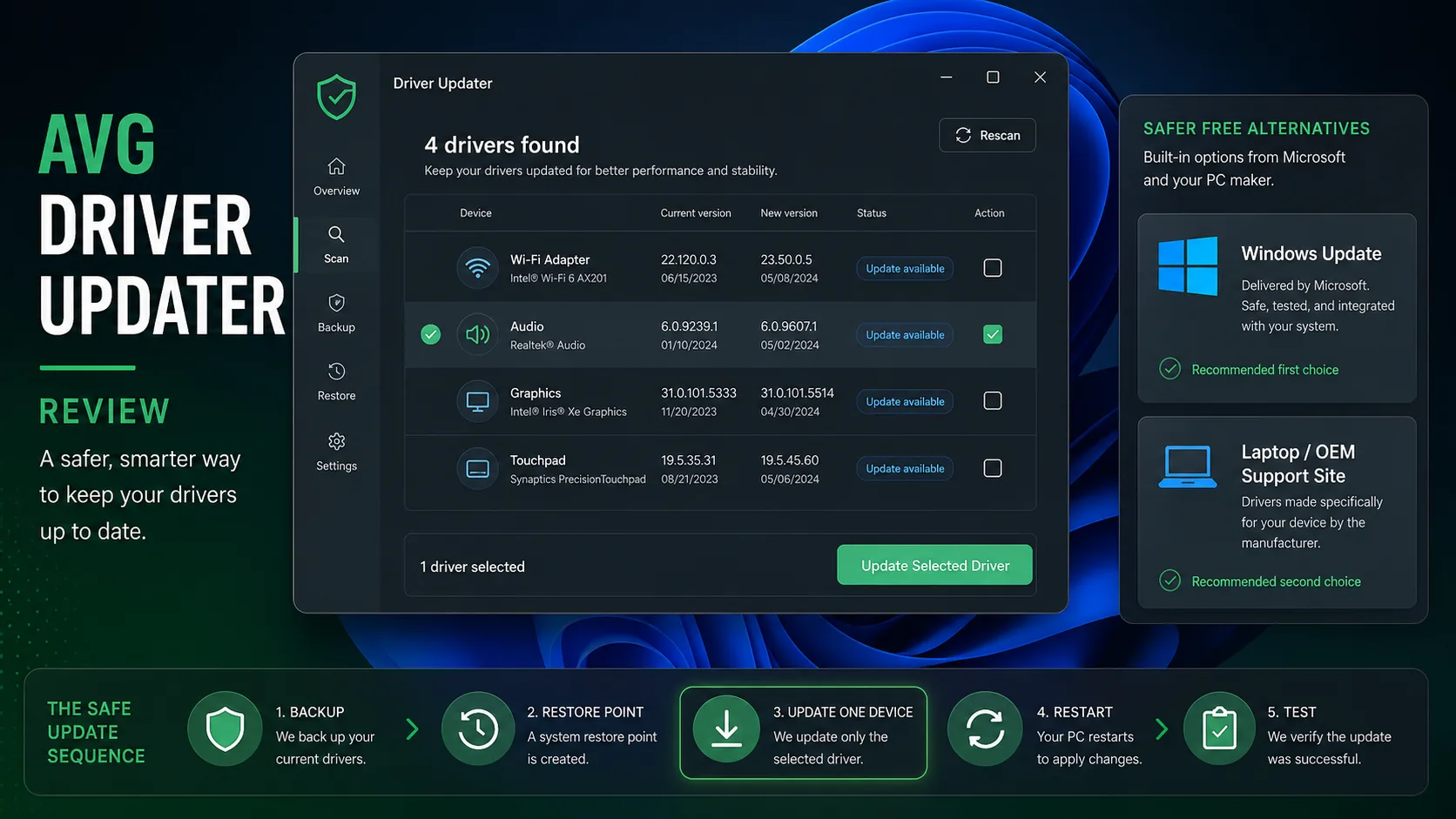
- Backs up the existing driver before its own update
- Creates a Windows system restore point before updates
- Lets you update, skip or ignore individual drivers
- Can detect an issue after an update and offer a revert
- Uses verified manufacturer driver installers, according to AVG
- Windows Update and manufacturer tools are free
- A generic “newer” driver can be worse for an OEM laptop
- The tempting Update all workflow multiplies troubleshooting risk
- Alternative-driver matching adds avoidable uncertainty
- Uninstalling the app doesn't cancel its subscription
Is AVG Driver Updater worth it in 2026?
Usually no. It solves a real but narrower problem than its marketing suggests: identifying device drivers and finding replacement packages without visiting several support sites. That can save time on an older desktop assembled from many vendors, a rebuilt PC with missing devices, or a machine whose manufacturer no longer provides a useful update tool. It isn't routine maintenance that every healthy Windows 11 PC needs.
Microsoft's current Device Manager guidance calls Windows Update the best way to get driver updates. Recommended drivers arrive automatically; optional driver packages are available under Windows Update when a user deliberately opens that section. If a device works and Windows reports no problem, a different date or higher version number isn't by itself a reason to replace the driver.
AVG is more defensible than an unknown free updater because the company documents its driver sources, backups, restore points and recovery procedure. Those controls reduce the cost of a bad match; they don't prove every offered package is the best one for the exact PC. AVG's own instructions warn that an incorrect update can affect compatibility, cause system errors or produce hardware malfunction.
Our 6.1/10 score reflects that split. The utility is functional and has a responsible rollback design, but the recommended outcome for most readers isn't to buy it. A product can be legitimate without being necessary or good value.
What AVG Driver Updater actually does
AVG describes Driver Updater as a Windows performance tool. It inventories devices and installed drivers, looks for broken or outdated entries, and offers replacement packages for printers, scanners, cameras, network adapters, sound devices, graphics hardware and other components. The company says it downloads verified installers from the hardware manufacturer rather than inventing or modifying drivers.
After a scan, users can filter the list, open a driver's details, update one item, select several items, skip a specific version or ignore a device. “Skip” hides the offered version but checks again when a different update appears. “Ignore” stops checking that device until the user reverses the choice. This distinction is useful for a touchpad or audio driver that must stay on an OEM-tuned release.
The app also tests components during scanning and after its updates. If it associates a problem with a changed driver, it may add an “Issue detected” tag and offer to revert. Its official Driver Updater FAQ says the program saves the previous driver and creates a Windows restore point before updating.
AVG Driver Updater is separate from AVG AntiVirus and AVG Internet Security. Buying the antivirus doesn't automatically activate the standalone updater, and the updater doesn't scan for malware. Antivirus test results from AV-TEST or AV-Comparatives tell us nothing about driver matching, rollback reliability or device stability, so we don't use them to score this product.
| Feature | What it provides | Editorial assessment |
|---|---|---|
| Device scan | Inventories drivers and flags broken or “outdated” entries | Convenient, but a flag is a prompt to investigate—not proof that an update is needed |
| Manufacturer installers | AVG says it downloads verified official driver installers | Better than opaque driver archives; exact OEM suitability still matters |
| Update selected / Update all | Installs one or multiple proposed replacements | Use selected only; bulk changes make failures harder to isolate |
| Backup and revert | Saves drivers updated through AVG and can restore them | Strong safeguard, but it can't revert drivers changed elsewhere |
| System restore point | Creates an OS rollback checkpoint before changes | Important second recovery path; verify the setting is enabled |
| Alternative drivers | May look beyond the original developer after a chosen wait period | Disable on laptops and other tightly integrated OEM systems |
AVG Driver Updater price, devices and renewal
AVG's US store displayed $43.99 per year when checked on July 14, 2026. The license covers one PC at a time; AVG's FAQ says it can be moved to a new PC after it's no longer used on the old one. Price, taxes and promotions can vary by country and checkout date, so confirm the final total rather than relying on an old review or a search-result snippet.
The store price is hard to justify against free first-party channels. Windows Update, Device Manager, the support page or update app supplied by Dell/HP/Lenovo/another PC maker, and the official NVIDIA/AMD/Intel tools don't charge an annual driver-maintenance fee. AVG's value is the consolidated inventory and rollback workflow, not exclusive access to better drivers.
Online AVG purchases normally use a continuous subscription. AVG says they renew automatically unless canceled before the next billing date. For annual and multi-year subscriptions, the charge date can be up to 35 days before the next term begins; the account shows the exact date. Deleting the application doesn't cancel future billing.
| Route | Cost | Best use | Main limitation |
|---|---|---|---|
| AVG Driver Updater | $43.99/year on the US store at our check | Central scan and rollback on one complex Windows PC | Annual cost and third-party matching risk |
| Windows Update | Included with supported Windows | Recommended and optional system-compatible drivers | May not carry the newest vendor feature release |
| PC maker support | Free | Laptop chipset, power, audio, touchpad, camera and firmware | Older models may receive fewer updates |
| Component vendor | Free | GPU releases and specific Intel/AMD/NVIDIA components | User must identify the exact hardware and OS |
| Device Manager rollback | Included with Windows | Reverting a recently changed device driver | Rollback can be unavailable after cleanup or replacement |
Is AVG Driver Updater safe?
The official AVG Driver Updater application is legitimate software from AVG/Gen Digital. Download it only from AVG, verify the installer publisher and reject “cracked,” bundled or look-alike downloads. Calling the official product a virus would be inaccurate.
The real safety question is whether the proposed driver is right for the exact hardware and system design. A signed, authentic Realtek or Intel package can still be a poor choice for a laptop whose maker customized audio routing, sleep states, hotkeys, camera privacy controls or Wi-Fi power behavior. Authentic doesn't automatically mean optimal for every device ID and OEM configuration.
AVG's recovery design is its strongest feature. The app's current usage guide documents a backup before updates, system restore-point creation, per-driver revert and post-update issue detection. We would confirm those settings before trusting the tool and keep a copy of the laptop maker's network driver offline in case Wi-Fi disappears.
Don't use any general driver updater for BIOS/UEFI or firmware. Those updates have device-specific power and recovery requirements and should come from the PC or motherboard manufacturer through its documented process. A failed application driver is usually recoverable; a failed firmware flash can leave hardware unable to boot.
Do you need to keep every driver constantly updated?
No. Security-sensitive kernel drivers, a driver tied to an active Windows vulnerability, broken hardware, compatibility fixes and graphics releases for a new game can justify an update. A stable mouse, printer, storage controller, touchpad or audio device doesn't become unsafe merely because a database knows about a newer version.
Windows ranks driver packages by hardware identifiers, targeting rules and other compatibility signals. Recommended packages normally arrive through Windows Update; optional packages require a user decision. This is intentionally different from treating the largest version number as universally best. Microsoft's current driver policy explanation also describes code-integrity and signature enforcement for kernel drivers.
Laptops deserve extra caution. Start with the laptop manufacturer's model-specific support page for chipset, storage, power management, audio, touchpad, camera, Bluetooth and firmware. For a discrete gaming GPU, a current NVIDIA driver or equivalent AMD package can be appropriate when you need a game profile, bug fix or security update—but read the release notes and preserve rollback.
Updating everything “for performance” isn't an evidence-based maintenance plan. Driver changes can improve one workload, do nothing measurable, or trade an old bug for a new one. The useful question is: what problem, security issue or required application does this specific update solve?
What can go wrong after a driver update?
The common failure is a device-specific regression rather than a total Windows crash: Wi-Fi disappears, Bluetooth stops pairing, speakers vanish, the touchpad loses gestures, external monitors flicker, sleep drains the battery or a game becomes unstable. AVG lists audio, touchpad, mouse, keyboard, optical drive, resolution and graphics problems in its own support material.
Community reports show why one-at-a-time testing matters. A March 2026 r/antivirus support thread described Wi-Fi disappearing after a Driver Updater change; an earlier AVG Community case reported both Wi-Fi and Bluetooth loss. These are individual reports, not a failure-rate study, but they mirror the failure modes AVG itself documents.
Bulk updating makes diagnosis worse. If audio, network, chipset and graphics change in the same session, a symptom after reboot no longer points to one package. The recovery backup may exist, but the user has to know which driver to revert. That's why the big “Update all” button is the wrong default even though it's convenient.
If Wi-Fi or Bluetooth disappears
Don't delete every network device or run another updater. Open AVG's overview, find the changed network/Bluetooth driver and use Revert. If the culprit is unclear, use the restore point created before the session. If Windows can't connect, install the exact network package previously downloaded from the PC maker using a USB drive, then ignore the bad proposal.
If sound, touchpad or display breaks
Revert the most recent matching device first, reboot and test. Device Manager's Driver tab may also offer Roll Back Driver. For an OEM laptop, reinstall the model-specific package from its manufacturer. Don't disable signature enforcement or install an unrelated “universal” package to force a match.
How to use AVG Driver Updater with less risk
- Finish Windows Update first. Install normal Windows updates, reboot, then check Settings → Windows Update → Advanced options → Optional updates → Driver updates. Stop if the problem is already resolved.
- Record the current state. Note the PC model, device name, driver provider/date/version and the actual symptom. Download the PC maker's network driver before changing Wi-Fi or Bluetooth.
- Verify AVG's safeguards. In Settings, confirm driver backup and system restore-point creation are enabled. Check backup retention and space; AVG lists 2048 MB as the default maximum folder size.
- Disable alternative drivers. Turn off AVG's alternative-driver option, especially on laptops, mini PCs and branded desktops. Prefer the original PC or component maker's package.
- Review every proposed match. Don't infer need from “outdated.” Compare hardware ID, provider, version, release notes and the problem it claims to solve. Ignore critical OEM components that are already stable.
- Update one noncritical device. Choose Update selected, never Update all. Avoid storage, chipset, network and input drivers first; don't use the app for BIOS or firmware. Keep the PC powered and don't interrupt installation.
- Restart and test deliberately. Test Wi-Fi, Bluetooth, sound, microphone, camera, touchpad, sleep/wake, battery, graphics and external displays. Use the PC normally before changing another component.
- Revert at the first regression. Restore the changed driver in AVG, or use its pre-update Windows restore point if the cause is unclear. Mark the version skipped/ignored and keep recovery files until stability is proven.
This process is slower than one click, but it preserves cause and effect. A driver tool should make identification easier; it shouldn't turn every available package into a required update.
Privacy, telemetry, cancellation and uninstall
Driver Updater must inventory hardware and driver versions to do its job. AVG's settings also expose product-usage sharing, third-party analytics, offers, crash reporting and support logs. Open Menu → Settings → Personal privacy and keep only the sharing you accept. The relevant controls are described in AVG's privacy-settings guide.
Don't mistake an application uninstall for account cancellation. AVG explicitly says removing Driver Updater doesn't cancel the subscription. Sign in to the AVG Account, open Subscriptions, record the next payment date, choose Unsubscribe or Cancel renewal, and keep the confirmation. AVG's cancellation FAQ says the billing date for a one-, two- or three-year term can be up to 35 days before the next period.
During uninstall, AVG may let you preserve or delete backups and logs. Keep the driver backups until the PC has been stable and you have the official OEM packages. Then remove data you no longer need. If you move the license to another PC, confirm it's no longer active on the old device.
Best free alternatives to AVG Driver Updater
| Alternative | Use it for | Why it's safer | Watch for |
|---|---|---|---|
| Windows Update | Recommended and optional drivers | Targeted through Microsoft's Windows servicing channel | Optional doesn't mean mandatory; install for a reason |
| PC maker support site/app | Laptop and branded-PC system components | Packages are validated for the model's combined hardware | Use exact model/service tag and correct Windows release |
| Device Manager | Identify a device, update manually or roll back | Built into Windows and exposes provider/version details | Automatic search may simply return the current package |
| NVIDIA / AMD graphics tool | Game, creator and GPU security fixes | Package comes from the GPU vendor with release notes | Laptop OEM graphics packages may retain custom behavior |
| Intel Driver & Support Assistant | Supported Intel hardware | Official Intel detection and download channel | It doesn't replace the PC maker for every customized device |
We don't recommend replacing AVG with a less accountable all-purpose updater just because it's free. The core matching problem remains, and a tool with no clear publisher, source or rollback process adds risk. Use Windows and the hardware maker first.
If the reason you found this page was an AVG pop-up rather than a broken device, don't buy a driver utility as a security upgrade. Driver Updater isn't antivirus. Our Windows antivirus guide and Microsoft Defender review cover malware protection separately.
AVG Driver Updater FAQ
Is AVG Driver Updater legitimate or malware?
The official AVG Driver Updater is legitimate Windows software from AVG/Gen Digital, not malware. Download it only from AVG and verify the publisher. Its risk is the same practical risk shared by driver tools: an authentic but unsuitable driver can break device behavior, so preserve backups and update selectively.
Do I need AVG Driver Updater on Windows 11?
Most users don't. Microsoft says Windows Update is the best way to obtain drivers, and the PC maker should be the next stop for laptop or branded-desktop components. Consider a third-party scanner only when those free routes fail on a difficult older or multi-vendor PC.
How much does AVG Driver Updater cost?
AVG's US store listed it at $43.99 per year for one Windows PC when checked July 14, 2026. Local prices, taxes and promotions can change. Review the live checkout, next billing date and auto-renewal terms; don't rely on the old $40 or $59 figures found in stale reviews.
Is AVG Driver Updater included with AVG Internet Security?
No. AVG's activation FAQ says Driver Updater is a separate paid application and an AVG Internet Security subscription can't activate it. Some store bundles may change, so verify the named products and device counts at checkout instead of assuming every AVG utility is included.
Can AVG Driver Updater restore an old driver?
Yes, when that driver was previously updated by AVG Driver Updater and its backup remains available. The app can't use its own revert feature for a driver changed by Windows Update or another tool. It also creates a Windows restore point as a broader fallback when enabled.
Should I click Update all in AVG Driver Updater?
No. Review and update one driver at a time, restart and test. Bulk changes multiply the chance of a regression and make the culprit harder to identify. Start with a specific problem or needed fix, not every item labeled outdated.
What should I do if Wi-Fi stops after an AVG driver update?
Use AVG's Revert option on the changed network driver, then reboot. If the culprit is unclear, use the restore point created before the update. Install the exact network driver from the PC maker if needed, then mark the unsuitable AVG proposal skipped or ignored.
Does uninstalling AVG Driver Updater cancel billing?
No. AVG explicitly says uninstalling the program doesn't cancel the subscription. Cancel renewal in the AVG Account before the displayed billing date and save the confirmation. Keep backups until the PC is stable, then decide whether to delete retained logs and driver packages.
Final verdict: competent safeguards, weak necessity
AVG Driver Updater is one of the more defensible commercial driver scanners because it documents manufacturer installers, per-driver control, automatic backups, restore points and a real recovery procedure. Those are the right safeguards for software changing low-level components.
They don't overcome the central problem: a healthy Windows PC rarely needs every driver chased to the newest database entry, and the best package for an OEM laptop may intentionally lag a generic component release. Windows Update and the PC maker provide a free, better-targeted default. Graphics vendors cover the common case where a user deliberately wants a fresh performance or game fix.
At $43.99 per year for one PC, we can't recommend AVG Driver Updater to most readers. Its 6.1/10 score is for a legitimate tool with good rollback design and a narrow audience—not a maintenance essential. If you use it, disable alternative drivers, avoid firmware, change one device at a time and keep the rollback path open.