
Best Firewall Software in 2026: Seven Windows Options That Still Work
Most Windows 11 users don't need to replace Microsoft Defender Firewall. They need to keep it enabled, classify public networks correctly and stop granting broad exceptions. Portmaster, GlassWire, TinyWall and simplewall become worthwhile when you want clearer outbound-app control, privacy filtering or better connection history—not because the built-in packet filter is obsolete.
Quick answer: leave Microsoft Defender Firewall on if you want reliable protection with no extra software. Install Portmaster when per-app outbound visibility, tracker blocking and secure DNS are the goal. Choose GlassWire for the clearest traffic history, TinyWall for quiet allow-listing or simplewall for a tiny advanced Windows Filtering Platform controller. ZoneAlarm is still available, but its official compatibility warning makes it a poor fit beside most third-party antivirus products. Norton makes sense only as part of a security suite you already want.
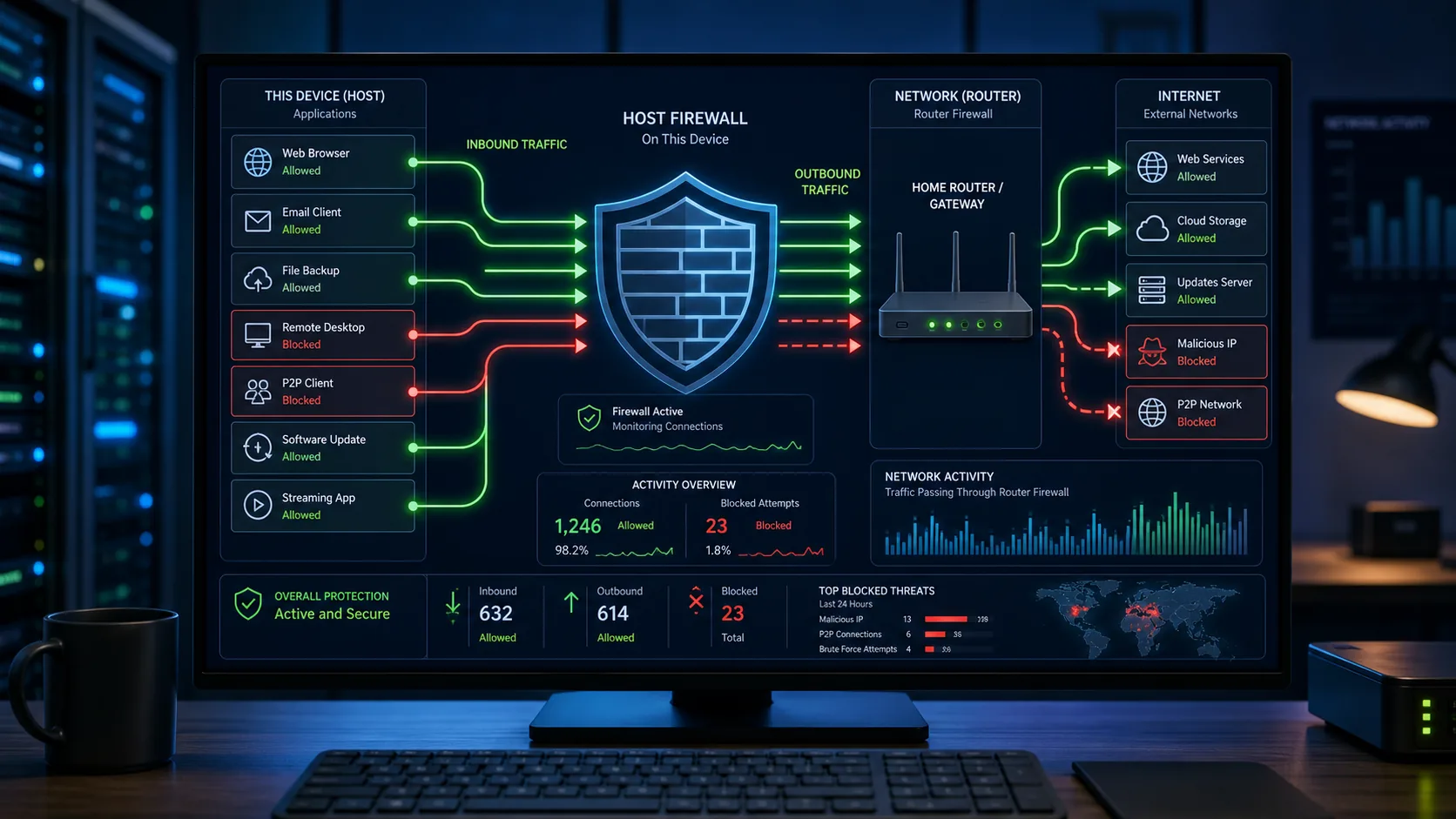
- Filter unsolicited inbound traffic on every network profile
- Apply app, address, protocol and port rules predictably
- Give enough outbound visibility to spot unexpected connections
- Keep logs that explain which rule blocked a connection
- Fail safely without silently disabling the Windows networking stack
- Detect every malicious file, phishing page or stolen password
- Make an unpatched app safe merely by closing unused ports
- Replace endpoint antivirus, secure DNS, updates or backups
- Protect traffic after malware gains administrator control
- Turn NAT, a VPN or a red “blocked” counter into complete security
The best firewall software for Windows in 2026
| Rank | Firewall | Best for | Editorial score | Main trade-off |
|---|---|---|---|---|
| 1 | Microsoft Defender Firewall | Most Windows 10/11 PCs | 8.9/10 | Powerful rule engine, but the everyday interface gives little outbound-app context |
| 2 | Portmaster Free | Privacy filtering and per-app connection control | 8.6/10 | Deep network integration can complicate VPN, DNS and local-network troubleshooting |
| 3 | GlassWire | Visual traffic history and approachable blocking | 8.3/10 | Free firewall controls are limited; the useful advanced modes require Premium |
| 4 | TinyWall | Quiet default-deny allow-listing | 8.1/10 | Can make a fresh install appear “offline” until the required apps are whitelisted |
| 5 | simplewall | Technical users who want a tiny WFP controller | 8.0/10 | Advanced, default-block operation and persistent filters demand a recovery plan |
| 6 | ZoneAlarm Free Firewall | A traditional standalone two-way firewall | 7.2/10 | Officially incompatible with anti-malware products other than Microsoft Defender |
| 7 | Norton Smart Firewall | People already buying Norton 360 | 7.1/10 | No sensible standalone value; pricing and renewal belong to the full suite |
These scores assess the complete product for a home Windows PC, not the theoretical strength of the packet-filtering engine. An 8.9 doesn't mean Defender blocks “8.9 out of 10 attacks.” We considered safe defaults, application control, visibility, current maintenance, compatibility, recovery from a bad rule and whether the product adds enough value to justify another privileged networking component.
We deliberately didn't publish a fabricated “leak-test percentage.” Current independent consumer labs concentrate on malware, web and performance protection; comparable 2026 firewall-only results for every product in this list don't exist. A vendor successfully blocking its own demo or a port-scanner showing “stealth” can't rank behavior-based protection, rule safety and long-term compatibility.
Firewall comparison: engine, cost and outbound control
| Product | How it filters | Price snapshot checked July 23, 2026 | Outbound experience | Platforms |
|---|---|---|---|---|
| Microsoft Defender Firewall | Built-in Windows Firewall / WFP | Included with supported Windows editions | Outbound is allowed by default; advanced console and PowerShell can create block rules | Windows |
| Portmaster | Independent application firewall integrated with the network stack | Free core; Plus €40/year; Pro €80/year | Real-time per-app connections, global/app rules, DNS filtering and optional prompts | Windows, Linux |
| GlassWire | Controls the built-in Windows Firewall | Free monitor/basic block; Personal Premium $2.99/month billed annually | Clear app/host graph; Premium adds Ask to Connect, Lockdown, profiles and bidirectional control | Windows; Android app is a data monitor, not this PC firewall |
| TinyWall | Own filtering layers on WFP; no kernel driver | Free, no ads or paid upgrade | Quiet allow-listing, temporary rules, blocklists and learning modes without pop-up fatigue | Windows |
| simplewall | Own WFP filters, not a Windows Firewall front end | Free and open source; donations optional | Default-block app rules, logging, blocklists and system-rule control | Windows 7 SP1–11, x64/ARM64 |
| ZoneAlarm Free Firewall | Third-party two-way firewall and program control | Free | Program internet access, network zones and traffic monitoring | Windows 10/11 |
| Norton Smart Firewall | Suite firewall plus intrusion prevention | Included in Norton 360; Deluxe page showed $49.99 first year, $124.99 renewal | Automatic Program Control plus custom program and traffic rules | Windows, macOS |
Prices are public US/EU page snapshots, before tax, and can change by region, device count or promotion. GlassWire's annual Personal equivalent is $35.88 at the displayed monthly rate. Portmaster's free local firewall isn't the same product as its paid SPN routing service. Norton is shown to expose the real renewal decision—not to imply that a $124.99 security suite is a fair comparison with a free firewall.
Compatibility is more important than feature count. Two programs can both use Windows Filtering Platform while applying independent providers and rules. That doesn't guarantee conflict-free operation. Don't stack firewall tools merely because both installers complete; choose one control model, export its rules and know how to disable its filters from Safe Mode or a second administrator account.
Do you need a third-party firewall on Windows 11?
Usually, no. Microsoft's current Windows Firewall overview says the host firewall is built into every Windows edition and enabled by default. Its baseline blocks unsolicited inbound traffic unless it was requested or matches a rule, while allowing outbound traffic unless a rule blocks it. It supports application, service, IP address, protocol and port conditions across Domain, Private and Public profiles.
The built-in product isn't merely an on/off switch. Windows Firewall with Advanced Security and the NetSecurity PowerShell module can create scoped inbound and outbound rules, enable logging, inspect profiles and apply IPsec policies. Microsoft recommends keeping the default inbound-block model and leaving outbound allow as the practical default for most deployments. A blanket outbound-deny policy requires a maintained inventory of every app and service that legitimately needs the network.
A third-party tool is useful when its interface changes what you can operate safely. Portmaster shows app destinations and adds system-wide DNS filtering. GlassWire makes time-based traffic history understandable. TinyWall and simplewall enforce a deliberate allow-list. A suite firewall such as Norton or Bitdefender can combine reputation and intrusion-prevention signals with application rules. None of these advantages implies that Defender's filtering engine is weak.
Current community discussions match that split. r/techsupport users overwhelmingly tell ordinary Windows 11 owners to keep the built-in protection; r/Windows11 users asking for a Little Snitch-like interface more often recommend Portmaster, GlassWire, TinyWall or Fort Firewall. We treat those threads as usability evidence—especially reports of DNS, VPN, printer and update breakage—not as proof that one firewall catches more attacks.

How we evaluated firewall software
We began with four current Google-style searches—“best firewall software 2026 Windows 11,” “best free firewall for Windows 11,” “do I need a third-party firewall” and “best firewall software for a home network.” The leading pages repeatedly ranked antivirus suites, mixed router appliances with desktop apps and described firewalls as malware scanners. We preserved the useful product discovery, then rebuilt the comparison around the actual decision a Windows user faces.
Default safety
We checked what happens before the user creates rules: active profiles, inbound policy, outbound policy, prompts, local-network trust and whether a mistaken response creates a persistent block.
Application control
We compared app identity, destination visibility, rule scope, logging and whether the tool can separate inbound from outbound traffic without forcing a port-level course.
Maintenance evidence
Current official product pages, release histories and repositories had to support Windows 11 or an actively maintained WFP path. We removed abandoned Outpost-era recommendations.
Failure recovery
A firewall that blocks DNS, Windows Update, a VPN or a printer needs an intelligible log, reset path and documented filter removal. Security without recoverability trains users to disable protection.
Compatibility
We checked vendor warnings about antivirus coexistence, driver/WFP architecture and whether the product replaces, controls or works independently of Windows Firewall.
Honest scope
We separated a firewall from antivirus, DNS filtering, VPN, IPS and network monitoring. Bundled features count only when the page labels which layer performs the work.
This is an editorial product and configuration review, not a certification or exploit test. The architectural baseline comes from NIST SP 800-41 Rev. 1. Although published in 2009, its distinction remains sound: a network-edge firewall and a host-based firewall address different paths, and a host firewall can apply more granular per-device rules. Version-sensitive product facts come from live vendor documentation checked on the audit date.
1. Microsoft Defender Firewall — best for most Windows PCs
Why it ranks first: it's already present, starts before most user software, follows Windows network profiles and receives maintenance with the operating system. That removes a privileged third-party driver, a separate updater and an extra renewal decision. The advanced rule engine can filter by application path, service, IP range, protocol, local/remote port and profile; PowerShell makes rules auditable for technical users.
Windows uses Domain, Private and Public profiles. Public is the safer default for unidentified hotel, airport and café networks. A Private profile permits the rules you intentionally enable for home discovery, printers or file sharing. The dangerous mistake isn't choosing Defender—it's marking an untrusted network Private and clicking “Allow access” for an unfamiliar executable across every profile.
Where it falls short: the normal Windows Security panel doesn't present a friendly live list of every destination by app. Outbound traffic is permitted by default, and the advanced console can feel like an administration tool because it's one. Users who want to approve each new app or study tracker domains need a better interface or a separate application firewall.
Choose it if: you want a low-maintenance Windows baseline and rarely need per-app outbound policy. Skip to another pick if: seeing where each app connects, applying privacy blocklists or running quiet default-deny outbound rules is an explicit requirement.
2. Portmaster — best free privacy and outbound-control firewall
Portmaster is a free, open-source application firewall for Windows and Linux. Its current official page exposes every application connection, allows global and per-app block rules and adds system-wide tracker blocking plus encrypted DNS. The V2 line remains active after Safing joined IVPN; the local firewall and privacy features remain free.
The value is context. Instead of starting with a raw port rule, you can open an app, see its destinations and decide whether to block the app, a domain, a connection type or a country. That makes it useful for privacy-sensitive desktop programs, telemetry investigation and machines where users actually review outbound behavior.
The pricing page checked July 23 lists Free forever, Plus at €40/year and Pro at €80/year for up to five devices. Plus adds history, bandwidth visibility and reports; Pro includes the Safing Privacy Network. SPN is an optional routing layer, not proof that the free firewall is incomplete and not a replacement for understanding which applications are allowed.
Where it falls short: a deep application firewall touches DNS, VPN and local-network flows. Safing's documentation includes troubleshooting for broken internet access, shutdown/uninstall behavior and VPN compatibility for a reason. Export settings, create a restore point, learn the emergency disable path and test printers, local shares, games, VPN and sleep/wake before deploying it to a family member's only computer.
3. GlassWire — best visual network monitor with firewall controls
GlassWire's strength is the graph: it records which app contacted which host and when, then lets the user block the app from the same context. The official guide says the Windows app controls the built-in Windows Firewall rather than installing its own custom firewall driver. That's an important distinction: GlassWire is a usable management and visibility layer over Windows filtering.
The free plan provides real-time hardware and traffic monitoring, 24 hours of history, current-day alerts, suspicious-host checks and basic click-to-block control. Premium adds Ask to Connect, Lockdown Mode, firewall profiles, bidirectional control and unlimited history. The displayed Personal price was $2.99 per month billed annually on the audit date.
Why not rank it above Portmaster? the most useful proactive firewall modes are paid, while Portmaster includes deeper per-app privacy policy and secure DNS in its free core. GlassWire is easier to explain to someone asking “what used my bandwidth at 2 a.m.?” Its polished graph is more valuable than another generic “threats blocked” counter.
Caveat: previously created Windows Firewall rules can affect Ask to Connect behavior. GlassWire's own guide warns that resetting Windows Firewall rules may be needed for a strict fresh policy. Export known-good rules first; a reset can remove deliberate printer, game, VPN and remote-access exceptions.
4. TinyWall — best quiet allow-list firewall
TinyWall is free, has no ads or paid upgrade and intentionally avoids connection pop-ups. Version 3.5 was announced on June 7, 2026 with ARM support, a dark interface and fixes. The official project page also documents no data collection and no installed kernel component.
Its design counters prompt fatigue. A classic firewall can ask about so many unfamiliar executables that users eventually click Allow without reading. TinyWall expects the user to whitelist trusted programs through the tray menu, learning mode, executable selection or active process list. Temporary rules, blocklists, tamper protection, UWP support and boot-time filtering cover more than its small interface suggests.
The trade-off is immediate: default-deny behavior can block network access until required services and apps are permitted. This is a good security model for someone who understands the machine; it's a bad surprise for a remote relative who needs a video call to troubleshoot why the video-call app can't connect.
Choose it if: you want a quiet allow-list and will deliberately authorize apps. Skip it if: automatic decisions, rich destination history or central management are requirements.
5. simplewall — best tiny WFP controller for advanced users
simplewall is a free open-source application under one megabyte that configures Windows Filtering Platform directly. It isn't a user interface for Windows Firewall and the two can operate independently. The project's current GitHub documentation lists Windows 7 SP1 through Windows 11 on x64/ARM64, IPv6, Windows services, Store apps, WSL, rule editing, blocklists and allowed/dropped packet logging.
The latest release we verified was v3.8.7, a maintenance release. That current repository evidence matters more than old download-directory timestamps. Rules can be permanent or temporary until reboot, and the default configuration blocks applications unless allowed.
Why it isn't a beginner pick: installed WFP filters continue working when the UI closes. The project's own uninstall warning says filters must be disabled before removing the app. A user who deletes the program folder without removing filters can leave the computer in a confusing blocked state. Windows Update, NCSI, DNS, VPNs and WSL also need the correct system rules.
For technical users, that persistence is a feature: policy doesn't disappear because the tray app crashes. For everyone else, Portmaster or GlassWire provides more context and a clearer support path.
6. ZoneAlarm Free Firewall — current, but compatibility-limited
ZoneAlarm Free Firewall isn't abandoned. Its release history shows an update on January 19, 2026, and the official page supports Windows 10 and 11. It provides two-way filtering, program internet access, public/private zones, traffic monitoring and early-boot protection. Users who specifically want the traditional ZoneAlarm model can still download a real current product.
The limitation is unusually direct. The official requirements say ZoneAlarm is compatible only with Microsoft Defender and not with another anti-malware product; the vendor tells users to uninstall other anti-malware before installation to avoid stability and performance problems. That rules it out beside Bitdefender, ESET, Avast, AVG, Malwarebytes Premium and most other paid suites.
ZoneAlarm's page also uses aggressive claims such as “world's best” and old PCMag recognition. We don't convert a vendor superlative or a historical award into a 2026 test result. The software earns a place because it's current and differentiated, not because it's automatically stronger than Defender.
Choose it if: you run Microsoft Defender, know the ZoneAlarm workflow and want a conventional two-way firewall. Skip it if: you use any other real-time anti-malware product or want the lightest possible system.
7. Norton Smart Firewall — best only as part of Norton 360
Norton's Smart Firewall monitors inbound and outbound traffic and works with its Intrusion Prevention System. Automatic Program Control uses reputation to reduce prompts; advanced users can add Program Control and prioritized Traffic Rules. The current Norton feature page supports Windows 11 and macOS.
This is a suite decision, not a firewall purchase. Norton 360 Deluxe's US page showed $49.99 for the first year and a $124.99 renewal for the displayed plan on July 23. That bundle also includes antivirus, VPN, password manager, cloud backup and other services. Paying the renewal solely to replace Defender Firewall is poor value; buying the suite for its entire protection and household coverage can be reasonable.
Automatic rule decisions are convenient until an app, printer, local share or game is classified incorrectly. Norton's support pages document how to override Program Control and create custom rules. Keep automatic control unless you understand why a specific rule is necessary; broad manual exceptions can erase the protection you paid for.
Bitdefender's suite firewall is the closest alternative and exposes app, protocol, direction, port and IP rules plus alert and stealth modes. Read our current Bitdefender review, Norton review and Windows antivirus comparison if the real decision is a complete security suite.
Router firewall versus software firewall: you normally want both
A home router filters traffic at the network edge and commonly prevents unsolicited internet hosts from starting connections to private devices. NAT contributes to that behavior, but NAT is address translation—not a complete per-device security policy. A host firewall follows a laptop onto hotel Wi-Fi, filters traffic from other devices on the same local network and can apply rules to specific applications.
| Layer | Protects | Sees best | Blind spots | Practical action |
|---|---|---|---|---|
| Router / gateway firewall | All devices behind the gateway | Internet-to-home flows, ports, segments and device addresses | Traffic inside one LAN; app identity on a PC; laptop away from home | Update firmware, disable WAN admin/UPnP unless needed, review port forwards, isolate IoT |
| Windows host firewall | One Windows machine | Programs, services, profiles, local/remote addresses and ports | Other home devices and traffic that never reaches the PC | Keep all profiles enabled; scope sharing rules to Private/local subnet |
| Application/privacy layer | Selected app connections | Domains, trackers, history and user-facing app identity | Compromised administrator/kernel; devices without the agent | Use only when you'll maintain rules and troubleshoot DNS/VPN conflicts |
NIST's host-firewall guidance explains why perimeter protection alone is incomplete: attacks from an internal host may never cross the network firewall, while a personal firewall can apply granular inbound and outbound policy on the device. NIST's 2024 consumer-router profile and smart-home guidance add the other half—update the router, use a strong admin credential and segment IoT devices where the router supports a guest or separate network.
A VPN is another separate layer. It encrypts traffic between the device and VPN server and changes the public exit address; it doesn't decide whether an unknown local executable should access the internet. DNS filtering can block known domains, but it doesn't stop direct-IP traffic or a permitted app using an allowed domain. Firewall, VPN, DNS and antivirus overlap at the edges, yet none is a synonym for another.

How to configure a Windows firewall without breaking the PC
- Confirm the active provider and profiles. Open Windows Security → Firewall & network protection. Verify that Domain, Private and Public profiles are protected and note whether Microsoft or a third party is registered.
- Classify the current network correctly. Use Public for cafés, hotels and other untrusted networks. Use Private only for a home/work network where discovery and sharing are intentionally required.
- Export the known-good policy. Before a reset, default-deny experiment or third-party install, export Windows Firewall rules or the product configuration and create a restorable system checkpoint.
- Install from the official source. Verify the vendor domain or signed GitHub release. A firewall runs with deep network privileges; a repackaged download is a worse risk than the problem it promises to solve.
- Test in learning or default mode first. Exercise Windows Update, DNS, browsers, email, VPN, sleep/wake, printer, NAS, games, WSL and local discovery before switching to strict outbound blocking.
- Create the narrowest exception. Prefer a signed program/service rule scoped to the necessary profile and local subnet over opening a port to Any program, Any address and every profile.
- Read the block log before disabling protection. Identify the executable, direction, address, port and matching rule. Reproduce once, change one rule, then retest instead of adding a broad permanent allow.
- Document removal and recovery. Know how to turn off the third-party filters, restore exported rules and regain DNS/network access from an administrator account. Recheck the active firewall after uninstall and reboot.
Microsoft's rule recommendations are a good default: keep inbound blocking, make exceptions specific, apply them only to the correct profiles and document their purpose. An exception named “make printer work” with no date or address scope becomes permanent mystery access.

After the network layer is stable, address higher-probability failures: install updates, remove unsupported software, use a non-administrator daily account and enable phishing-resistant MFA. Our email security guide and secure browser comparison cover the routes a firewall can't judge from packets alone.

Firewall software FAQ
What is the best firewall software for Windows 11?
Microsoft Defender Firewall is the best default for most Windows 11 users because it's built in, enabled by default, profile-aware and supports detailed app, service, address, protocol and port rules. Portmaster is our best additional choice when you specifically need per-app outbound visibility, privacy filtering and secure DNS.
Is Microsoft Defender Firewall good enough?
Yes for most home PCs. It blocks unsolicited inbound traffic by default and can create detailed inbound and outbound rules. A third-party firewall mainly adds a friendlier interface, prompts, connection history, DNS filtering, reputation or suite integration. Keep Defender enabled on all profiles and avoid broad exceptions.
What is the best free firewall besides Windows Firewall?
Portmaster Free is our strongest general recommendation for application-level visibility and privacy controls. TinyWall is better for quiet allow-listing, simplewall for advanced users who want a small WFP controller and ZoneAlarm for a traditional interface only when Microsoft Defender is the anti-malware provider.
Should I run two software firewalls at the same time?
Not simply for “double protection.” Multiple products can create conflicting WFP filters, duplicate prompts and confusing ownership of rules. Some tools such as GlassWire intentionally control Windows Firewall, while simplewall uses independent WFP filters. Follow the vendor-supported architecture and test VPN, DNS, updates and local devices before keeping a combination.
Does a router firewall replace a Windows firewall?
No. A router handles traffic at the home network edge, while a host firewall follows the laptop to other networks, can filter traffic from devices on the same LAN and can apply rules to individual programs. Keep both layers active; also update the router and remove unnecessary port forwards.
Is NAT the same as a firewall?
No. NAT translates between public and private addresses and often prevents unsolicited inbound mappings as a side effect. It doesn't understand which Windows application should connect, doesn't follow a laptop away from home and isn't a substitute for explicit host and router security policy.
Can a firewall stop viruses and phishing?
A firewall can block disallowed network connections and sometimes use reputation or intrusion signatures, but it can't replace antivirus, web protection, updates or account security. A malicious file may arrive through an allowed browser connection, and a phishing page can use normal encrypted HTTPS traffic.
Why did my internet stop after installing a firewall?
Strict outbound policy may have blocked DNS, DHCP, Windows NCSI, the VPN, browser or system services. Check the product's block log and active profile, temporarily use its documented disable or learning mode, fix the narrow rule and retest. Don't delete a WFP-based app before following its filter-removal instructions.
Final verdict: keep Defender unless you can name the missing control
Microsoft Defender Firewall is the right answer for most Windows 11 PCs. It gives a sound inbound-block baseline, advanced rule capability and fewer moving parts. Spend the saved time removing unsupported software, updating the router and protecting accounts instead of installing a second firewall to make the security tray look busier.
If you can name the gap, choose the narrowest tool that closes it. Portmaster is the best privacy and per-app policy upgrade. GlassWire explains traffic history best. TinyWall makes default-deny quiet, while simplewall gives technical users direct, lightweight WFP control. ZoneAlarm remains current but its anti-malware compatibility warning is decisive. Norton Smart Firewall is worthwhile only when the rest of Norton 360 already earns the subscription.
The final test is recoverability. Export the old policy, keep Public networks public, scope every exception and learn where the block log lives before switching to strict mode. A firewall you can diagnose stays enabled; one that breaks DNS and offers no clear explanation gets disabled at the exact moment it's needed.