
Best Password Manager in 2026: Seven Picks for Different Threat Models
1Password is our best all-round paid choice, Bitwarden has the strongest broadly useful free plan, Proton Pass is the privacy pick, and KeePassXC gives careful users a genuinely local vault. The right answer depends less on the cipher in a marketing box than on recovery, sharing, passkey support, independent scrutiny and whether you can operate the product safely every day.
Quick answer: Choose 1Password if you want the best mix of secure account design, polished cross-platform apps and family controls. Choose Bitwarden if free unlimited devices, open source code and easy export matter more than the last layer of polish. Choose Proton Pass if email aliases and a generous privacy-focused free plan are the priority. Use KeePassXC only if you want to own the encrypted database file and are prepared to own its backups and sync failures too. Whichever tool you choose, protect the vault with a unique long passphrase and phishing-resistant MFA.
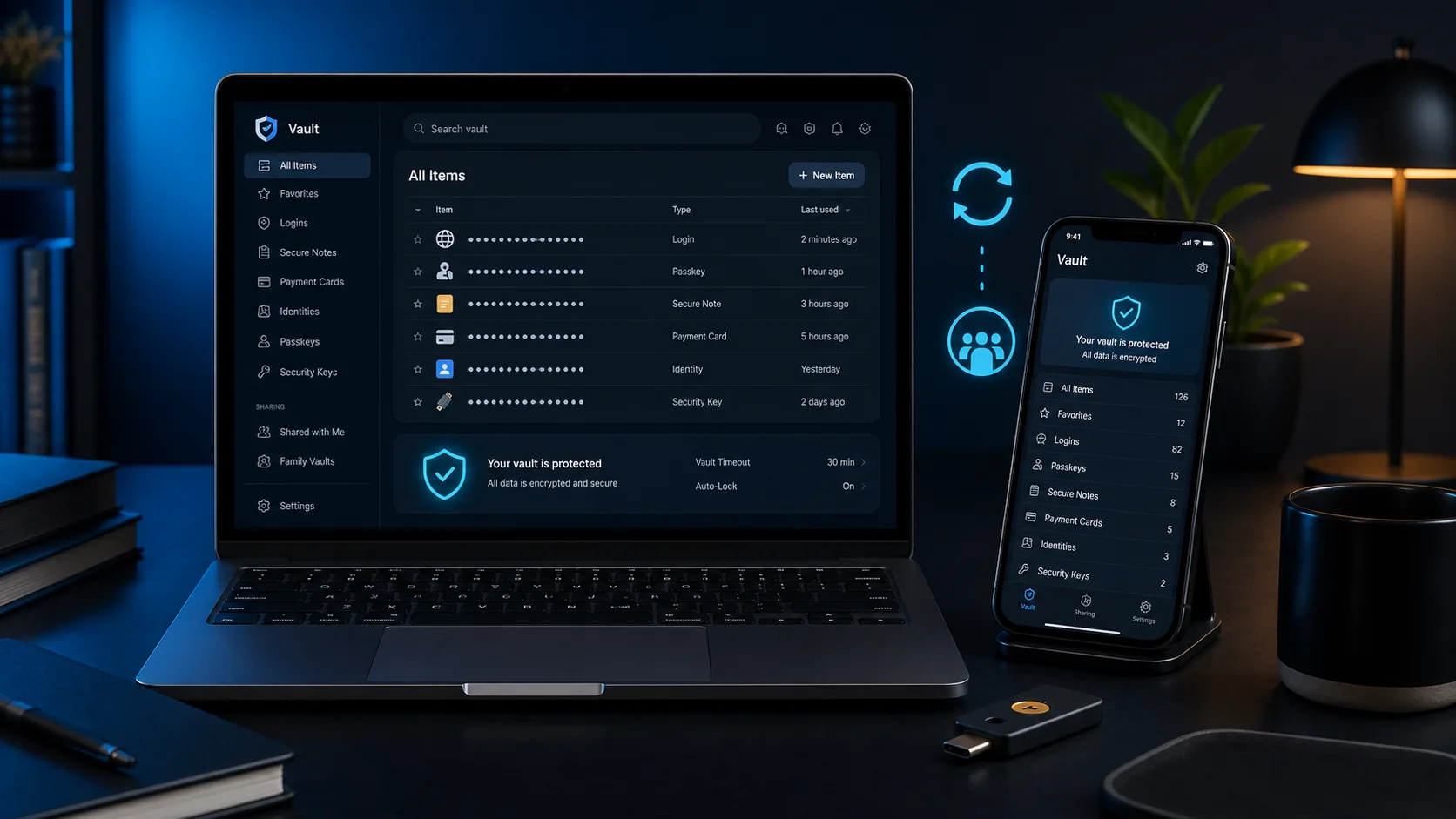
- End-to-end encrypted vault with a documented key design
- Passkeys, password generator, safe autofill and encrypted export
- MFA for the vault account, preferably hardware-key support
- Current apps or extensions for the platforms claimed
- Public security documentation, external review or open source code
- Unclear incident disclosure or weak recovery boundaries
- Pricing that hides renewal or essential security add-ons
- Export lock-in, stale clients or abandoned platforms
- Marketing “zero knowledge” as immunity from a compromised server
- Asking families to share one vault login instead of separate accounts
The best password managers of 2026
| Rank | Password manager | Best for | Editorial score | Biggest caveat |
|---|---|---|---|---|
| 1 | 1Password | Best overall paid manager and easiest family rollout | 8.8/10 | No permanent free plan; account recovery and sharing still have cloud trust boundaries |
| 2 | Bitwarden | Best free plan, open source users and low-cost families | 8.6/10 | 2026 malicious-server research found important design weaknesses; cryptographic migration is still relevant |
| 3 | Proton Pass | Privacy, email aliases and free unlimited-device use | 8.5/10 | Younger product with fewer years of workflow maturity than the leaders |
| 4 | Keeper | Families, regulated teams and granular sharing | 8.3/10 | Localized pricing and paid add-ons make the true renewal cost harder to compare |
| 5 | KeePassXC | Offline/local control and technical users | 8.2/10 | You're responsible for safe sync, versioned backups, mobile client choice and recovery |
| 6 | Dashlane | Phishing/scam alerts and a bundled VPN | 8.0/10 | Free plan is gone; personal prices changed in 2026 |
| 7 | NordPass | Simple onboarding and XChaCha20/Argon2id design | 7.9/10 | Free tier permits only one active device session and promotional pricing obscures renewal value |
Scores are our editorial assessment of the product as a complete system, not a cryptographic bake-off and not an average copied from an app store. A score can change when a vendor alters pricing, recovery, security architecture or export behavior. We don't claim that an 8.8 product makes an 8.6 product's encryption weaker in everyday use.
The ranking also assumes an individual or household. Businesses need policy enforcement, offboarding, ownership of shared credentials, audit logs, directory provisioning, break-glass access and legal review. Keeper, 1Password and Bitwarden offer stronger organizational controls than their personal tiers reveal, but a business purchase needs a separate deployment review.

Password manager comparison: free tier, price and recovery
| Product | Useful free tier | Price snapshot checked July 23, 2026 | Passkeys | Family / emergency model |
|---|---|---|---|---|
| 1Password | No; 14-day trial | US page displayed limited first-year annual offers from $2.99/month individual and $4.49/month family; standard annual totals disclosed as $48 and $72 | Yes | Five family members, separate vaults, shared vaults, family recovery controls |
| Bitwarden | Yes: unlimited items/devices and sharing with one other user | Free; Premium $19.80/year; Families $47.88/year for six, before tax | Yes | Emergency Access in paid plans; six Premium accounts in Families |
| Proton Pass | Yes: unlimited logins/devices, 10 email aliases and passkeys | Free is permanent; paid price is region/term dependent and loaded dynamically, so verify checkout and renewal | Yes | Paid emergency access and a six-user Family tier |
| Keeper | Trial, not our free-plan pick | Official page localizes the checkout; verify base plan, BreachWatch/file add-ons, tax and renewal together | Yes | Five private family vaults, shared folders, 10 GB family storage and emergency access |
| KeePassXC | Entire desktop app is free/open source | Free; donations optional | Yes through browser integration | No vendor recovery; share/sync the KDBX file only with a deliberate backup plan |
| Dashlane | No; free plan discontinued, 14-day trial | Paid personal prices changed from mid-February 2026; verify current renewal in the official checkout | Yes | Friends & Family covers the admin plus nine people |
| NordPass | Unlimited storage but one active device session | Free or promotion-driven Premium/Family; record both introductory total and renewal before paying | Yes | Six Family accounts; Premium adds emergency access and sharing |
Pricing pages frequently personalize discounts by country, term and customer status. That's why we quote a number only when the official page exposed both scope and billing cadence. A giant “70% off” isn't a comparison unit: divide the checkout total by covered users and years, then record the automatic renewal separately.
Bitwarden's January 2026 plan update is a useful example of why old reviews mislead. Its official page now lists Premium at $1.65 per month billed as $19.80 annually and Families at $3.99 per month billed as $47.88 annually, replacing the long-repeated $10/$40 figures. The free tier remains unusually complete.
How we chose these password managers
We rebuilt this page from primary evidence rather than repeating “AES-256” seven times. Every serious product can name a strong primitive. The harder questions concern how keys are derived, authenticated and shared; what a compromised server can ask a client to do; whether recovery silently changes the threat model; and whether ordinary users can recognize the genuine autofill prompt.
Architecture and threat model
We checked end-to-end encryption claims, key derivation, account secrets, local versus cloud storage and how the vendor describes recovery. “Zero knowledge” earns no automatic points because the term has no single strict technical guarantee.
Independent scrutiny
Open source helps, but visibility isn't the same as a completed audit. We looked for published third-party assessments, incident notices, bug bounties, security white papers and current academic work.
Daily security
A vault must generate unique credentials, match logins to the correct origin, support passkeys and MFA, lock predictably and avoid teaching users to paste secrets into unexpected prompts. Safe defaults matter more than feature count.
Recovery and sharing
Families need separate private accounts plus controlled shared vaults—not one shared master password. We reviewed emergency access, admin recovery, permissions, link expiration and the consequences of a lost device or deceased account owner.
Portability
We favor services with documented import and export. An encrypted export is best for backups; CSV is useful for migration but must be deleted securely because it exposes every credential in plaintext.
Honest cost
We checked current official plan pages on July 23, 2026, distinguished free from trial, separated first-year offers from renewal and refused to invent prices when checkout values were dynamically hidden.
This is an editorial comparison, not a penetration test. We didn't reverse engineer every client or certify a vendor's production server. Security judgments use vendor documentation, published audits and the 2026 IACR/USENIX research paper, then keep vendor responses separate from researcher findings.
The practical baseline is supported by current public guidance. NIST recommends a password manager, MFA and passwords of at least 15 characters when a password is unavoidable. The full NIST SP 800-63B-4 explains that distinct passwords limit credential stuffing and that verifiers should support paste/autofill. A password manager isn't an exotic risk for most people; password reuse is the known everyday failure it solves.
What the 2026 ETH/USI study changes about “zero knowledge”
In February 2026, researchers from ETH Zurich and Università della Svizzera italiana published Zero Knowledge (About) Encryption. They modeled a fully malicious password-manager server—one that can deviate from the protocol, alter responses and exploit recovery, sharing or backwards-compatible client behavior. The work identified 12 attacks against Bitwarden, seven against LastPass and six against Dashlane; the full version also analyzed 1Password. Many attacks allowed password recovery under that strong server-compromise assumption.
This isn't evidence that a random website can open your vault today. It's evidence that “the server only stores ciphertext” doesn't prove that a compromised server is powerless. A client may accept substituted keys, downgraded parameters, altered organization membership or other hostile instructions unless the protocol authenticates state end to end. The paper challenges the scope of marketing claims, not the strength of AES itself.
Vendor responses matter but don't erase the paper. 1Password says the additional issues reflect a public-key verification limitation already disclosed in its design paper and don't bypass the account password plus Secret Key protection. Dashlane says it validated the work and shipped a relevant extension fix in version 6.2544.1 on November 5, 2025. Bitwarden published a cryptography report and has described both fixes and larger account-encryption work; users shouldn't translate “addressed” into “every old account has completed every migration.”

1. 1Password — best overall paid password manager
Why it wins: 1Password combines a good account-security design with the least awkward family experience in this set. Each account uses an account password and a randomly generated 128-bit Secret Key; the service says both participate in key derivation, while Secure Remote Password helps authenticate without sending password-derived secrets. A stolen encrypted database is therefore not protected by the human password alone.
The apps cover Windows, macOS, Linux, Android, iOS and major browsers. Watchtower flags compromised, weak and reused logins; Travel Mode can remove selected vaults from devices before a border crossing; passkeys, secure sharing, recovery codes, SSH/developer items and family recovery cover more than ordinary website passwords. The Families plan gives five people separate accounts and shared vaults, so a parent can help recovery without seeing every private item.
The US pricing page showed limited first-year annual offers from $2.99 per month for Individual and $4.49 for Families on the audit date. The same page's FAQ disclosed standard annual totals of $48 and $72; new-customer promotions don't redefine renewal. There's no permanent free tier, only a 14-day trial.
Where it falls short: the Secret Key materially strengthens a stolen-vault scenario, but it doesn't make the cloud service irrelevant. The 2026 research and 1Password's own design paper acknowledge that a malicious server can lie about public keys used for sharing. Recovery also deserves setup: print or store the Emergency Kit offline, keep the account password out of email, and don't place the only copy of the Secret Key inside the vault it unlocks.
Choose it if: you can pay for a tool the whole household will actually use, need broad device coverage and want stronger protection than a human master password alone provides. Skip it if: a free plan, fully local storage or self-hosting is mandatory.
2. Bitwarden — best free password manager
Why it ranks second: Bitwarden Free stores unlimited logins, cards, identities, notes and passkeys across unlimited devices. It can share with one other user, generates passwords, supports encrypted exports and exposes its client/server code. For a person moving from reused browser passwords, that's enough to fix the highest-probability risk without a subscription.
Paid plans remain inexpensive even after the 2026 increase. The current official price table lists Premium at $19.80 per year and Families at $47.88 per year for six Premium accounts. Premium adds integrated TOTP, more security-key slots, 5 GB attachments, emergency access and vault-health tools; Families adds unlimited shared collections and family storage.
The security caveat is real: the ETH/USI paper demonstrated the largest number of malicious-server attacks against Bitwarden among the three primary subjects. Bitwarden's transparency made detailed analysis possible, and the company has published a response and remediation work, but this isn't a reason to say “open source equals audited and therefore safe.” Users should keep clients current, use Argon2id where the account offers it, enable a hardware security key or passkey for the account, and follow future account-encryption migration notices.
Self-hosting is an option, not a default recommendation. It removes Bitwarden's hosted server from the path but adds your server, TLS, backups, monitoring, updates and recovery to the trusted base. If your actual goal is “one encrypted file I control,” KeePassXC is simpler than operating a network service.
Choose it if: you need a capable free vault across Android, iPhone, Windows, Mac, Linux and browsers, or want a low-cost six-person family plan. Skip it if: your threat model treats any cloud server as hostile and you're unwilling to track protocol migrations.
3. Proton Pass — best privacy and email-alias bundle
Why it stands out: Proton Pass Free includes unlimited logins, notes and cards, unlimited devices, passkeys and ten hide-my-email aliases. The aliases can reduce username reuse and make it easier to disable an address exposed by a shop or newsletter. Paid tiers add an integrated authenticator, unlimited aliases, secure sharing, dark-web monitoring, attachments, custom-domain aliases and emergency access.
Proton encrypts more than the password field, including usernames and URLs, which matters because LastPass's 2022 incident showed how unencrypted site URLs can still expose a person's services and interests. Clients are open source. Proton published a Cure53 assessment in 2023 and says Recurity Labs assessed browser, mobile, desktop and CLI clients from January through April 2026.
The official price component didn't render a stable US paid figure in our research capture, so we won't freeze an old promotion as a 2026 fact. The free plan is the clean comparison; for Pass Plus, Family or Proton Unlimited, verify billing term, renewal and whether you actually need the Mail/VPN/Drive bundle in the live checkout.
Where it falls short: it has fewer years of edge-case polish than 1Password, and a bundle can tempt users to centralize email, recovery and passwords under one provider/account. Protect the Proton account with a hardware-backed factor and store recovery material outside Proton.
Choose it if: unlimited free sync plus email aliases solve both credential reuse and address tracking. Skip it if: you need the most mature family administration or want vendor-independent local storage.
4. Keeper — best for granular family and business controls
Why it's here: Keeper has separate personal and five-user Family vaults, unlimited devices, shared folders with permissions, one-time sharing, emergency access and 10 GB of Family file storage. The same product line scales into enterprise policies, audit reporting, directory/SSO integrations and privileged-access tools, which makes it easier for a household or small team to grow without migrating immediately.
Keeper documents local encryption/decryption, AES-256 and elliptic-curve key layers, and publishes a security model plus SOC 2 and ISO 27001/27017/27018 claims. Those certifications evaluate controls and management systems; they don't prove an app is invulnerable. We give more weight to the combination of architecture, audit history, clear admin controls and a long-lived product than to the badge row alone.
Cost caveat: the official personal page localized or dynamically omitted the exact price in our capture. BreachWatch and secure-storage bundles can alter the total. Compare the base vault, useful add-ons, tax and renewal on the final order screen; don't compare Keeper's base teaser to a competitor's fully loaded plan.
Choose it if: precise sharing, emergency access, family file storage or business governance matters. Skip it if: you want transparent flat pricing or the strongest no-cost personal tier.
5. KeePassXC — best local and offline password manager
Why it's different: KeePassXC stores the vault in a KDBX file you choose. There's no required vendor account and no cloud server that can alter a sync protocol. Version 2.7.12 was the current release on March 10, 2026; the project supports Windows, macOS and Linux, browser integration, passkeys, TOTP, YubiKey/OnlyKey challenge-response, password-health reports, attachments and command-line workflows.
KDBX 4 supports modern encryption and memory-hard key derivation. KeePassXC's documentation describes AES-256 or Twofish database encryption and configurable transformations; the broader KeePass format supports Argon2. A published independent audit was completed in January 2023. Free/open source doesn't remove operational risk, but it gives technically capable users a small, inspectable and vendor-independent storage model.
The cost of control: no company can restore a forgotten master passphrase or repair a corrupted only copy. Syncing the same database through multiple devices can create conflicts. Official desktop development doesn't provide one unified first-party mobile app; users choose a compatible KDBX client and must evaluate it separately. A key file is powerful only if it's backed up separately from the database and not casually copied beside it.
Choose it if: you can manage encrypted, versioned offline backups and prefer a file over an account. Skip it if: relatives need effortless recovery, cross-device sharing and one support desk.
6. Dashlane — best active phishing and scam warnings
Why it remains a contender: Dashlane combines password/passkey storage with vault phishing alerts, dark-web monitoring, AI-powered scam warnings and a Hotspot Shield VPN on paid personal plans. Friends & Family covers the plan admin plus nine other people, more seats than most household tiers. Current alerts can warn when a saved login is pasted or autofilled on a suspicious site rather than treating autofill as a passive convenience.
Dashlane is no longer a free recommendation. Its May 2026 support page says the Free plan has been discontinued; new users get a 14-day trial, then must pay or export. Personal prices changed from mid-February 2026, so use the live checkout rather than an old $4.99 review.
The 2026 ETH paper found six attacks in the malicious-server model. Dashlane's response says the relevant fix shipped before publication in extension 6.2544.1 and describes additional limitations/design choices. That's a positive disclosure response, not proof that every future server/client flaw is solved.
Choose it if: proactive phishing prompts and a VPN bundle justify a paid-only product. Skip it if: you need a permanent free tier or prefer to buy a password manager without bundled network/privacy tools.
7. NordPass — easiest XChaCha20/Argon2id option for beginners
Why it makes the list: NordPass documents an XChaCha20-Poly1305 encrypted vault and Argon2id key derivation with a 16-byte salt, plus apps, browser extensions, passkeys, autofill and encrypted storage. Premium adds password health, breach scanning, email masking, secure sharing, file attachments and emergency access. Family provides six separate Premium accounts.
The free plan's wording needs care. NordPass allows installation and synchronization on multiple devices, but its support page says only one device session can be active at a time. That makes it less frictionless than Bitwarden or Proton Pass for users who move constantly between phone and computer.
Nord's pricing pages are promotion-heavy and didn't expose a reliable price/renewal pair to our crawler. Compare the full two-year or one-year charge, tax and post-offer renewal—not the smallest monthly equivalent. A long prepaid term is valuable only after you have tested import, autofill and account recovery.
Choose it if: a straightforward interface and modern documented primitives matter, and one-session free use or a paid plan fits. Skip it if: free simultaneous multi-device access is essential or you dislike multi-year promotional pricing.
What about Apple Passwords, Google Password Manager and LastPass?
Built-in managers are no longer toys. Apple Passwords and Google Password Manager can generate unique logins, sync passkeys and warn about compromised credentials. The UK's 2026 NCSC guidance explicitly says convenience-first users can use the manager supplied by their browser or device maker. That's better than password reuse.
The trade-off is ecosystem reach. An Apple-only household may be perfectly served by Passwords; a mixed Windows/Android/iPhone family can find sharing, recovery and browser migration easier with a dedicated cross-platform vault. Before choosing, test the least convenient device—not the newest phone.
We didn't rank LastPass. Its own March 2023 incident update confirms that attackers obtained backups of all customer vault data plus customer metadata; sensitive vault fields were encrypted, while URLs and some other fields weren't. LastPass has since rebuilt infrastructure and published security improvements, but users can choose equally capable alternatives without carrying that stolen-vault exposure. Existing LastPass users shouldn't panic-export to an unknown app: choose a destination, secure it, import, rotate the highest-value credentials, then delete plaintext export files.
We also considered RoboForm for form filling and NordPass-style low-friction use. It can be a reasonable choice, but our current shortlist gives more weight to published architecture, open code/audits, free-plan reach or a clearly differentiated threat model. A manager outside the top seven isn't automatically unsafe.
Passkeys help, but they don't make the vault obsolete
Passkeys replace a shared password with a public/private key pair bound to the legitimate site. The FIDO Alliance describes them as phishing-resistant because a fake domain can't request the credential for the real domain. Five billion passkeys were estimated to be active by May 2026, but passwords, recovery codes, secure notes and older sites will coexist for years.
A password manager can become a passkey provider, syncing credentials across platforms instead of locking them to one phone vendor. Check that creation, use, sharing and export work on every target platform. Don't assume that every saved passkey is freely portable between all providers today; keep account recovery methods and a tested migration path.
Storing TOTP codes in the same vault is another convenience/security trade-off. KeePassXC's own FAQ says it can still be safer than not using 2FA, but separating the TOTP secret or using a hardware key provides stronger factor separation. At minimum, don't use the vault to generate the only factor that unlocks the vault itself.

How to set up a password manager safely
- Choose from the threat model, not the discount. Decide whether you need free sync, family recovery, offline storage, business policy, email aliases or phishing alerts before importing anything.
- Install only from the official vendor or app store. Verify the browser-extension publisher and domain. Search ads and cloned extension listings are a direct credential-theft risk.
- Create a unique vault passphrase. Use at least 15 characters as a floor; a longer random-word passphrase is easier to type. Never reuse an email, bank or old vault password.
- Add phishing-resistant MFA. Prefer two registered hardware security keys or a passkey where supported. Keep recovery codes offline and test the backup key before trusting it.
- Import, then remove plaintext. Export from the old manager, import into the new one, verify counts and attachments, then securely remove the CSV from Downloads, cloud sync, backups and trash.
- Rotate accounts in risk order. Change email, banking, identity, mobile carrier, cloud storage and domain registrar first. Replace reused and breach-exposed passwords before cosmetic weak ones.
- Build and test recovery. Print/store the Emergency Kit or recovery code, create a versioned encrypted backup, document family emergency access and perform a recovery drill on a second device.
Autofill is useful precisely because it should match the saved origin. If the manager refuses to fill a bank login, stop and inspect the domain rather than copying the password manually. Password-manager browser prompts can themselves be imitated; unlock through the known extension/app icon when anything looks unusual.
For the rest of the account chain, harden the email address that receives resets. Our email security guide covers phishing and recovery exposure, while the secure browser comparison helps reduce extension and browser risk. A good vault can't rescue an infected, unsupported device.

What current user discussions add
Current r/PasswordManagers threads don't converge on one winner. In a February 2026 recommendation discussion, long-term users repeatedly favored 1Password's interface and Secret Key, while Bitwarden remained the value/open-source reference. A May 2026 thread made the more useful point: browser-extension quality and the devices a person actually uses can outweigh an abstract universal ranking.
These are directional experience signals, not proof of cryptographic safety and not a crowd score. Communities overrepresent enthusiasts, support problems and affiliate recommendations. We use them to identify friction—autofill, family onboarding, browser switching, migration—not to invent “95% of users recommend” claims.
Best password manager FAQ
What is the best password manager in 2026?
1Password is our best overall paid choice because its account password plus Secret Key design, mature apps, passkeys, sharing and family recovery make a strong complete system. Bitwarden is the better answer for most free-plan users, Proton Pass for privacy/email aliases and KeePassXC for people who can safely operate a local vault.
Are password managers safe after the 2026 ETH study?
For most people, a reputable current password manager remains safer than reusing passwords. The ETH/USI study showed that a fully malicious cloud server could exploit design choices in several services; it didn't show that any website can simply decrypt every vault. Keep clients updated, enable strong MFA and choose a local vault if server compromise is inside your threat model.
What is the best free password manager?
Bitwarden Free is our broadest free recommendation because it supports unlimited passwords and devices, passkeys and sharing with one other user. Proton Pass Free is exceptionally close and adds ten email aliases. NordPass Free stores unlimited items but limits users to one active device session.
Is 1Password safer than Bitwarden?
1Password's separate 128-bit Secret Key gives it a meaningful advantage if an encrypted vault is stolen and a user's account password is weak. Bitwarden is open source, inexpensive and highly capable, but the 2026 malicious-server study found more attack paths in the examined design. Neither product is immune to a compromised device, phishing or unsafe recovery.
Should I store passkeys in a password manager?
Yes when cross-platform sync and recovery are important and the provider supports passkeys on all your devices. Passkeys are origin-bound and phishing-resistant. Confirm export/migration behavior before centralizing them, and keep account-recovery methods because not every site or provider supports the same transfer path.
Should 2FA codes be stored in the same password manager?
It's convenient and still better than skipping 2FA, but it weakens factor separation because one unlocked vault contains both password and code. Use a hardware security key or a separate authenticator for email, banking, the vault account and other high-impact services. Never store the vault's only recovery factor solely inside that vault.
Is an offline manager like KeePassXC safer than cloud sync?
It removes the vendor's cloud server from the threat model, but moves backup, sync, client choice and recovery to you. A well-maintained KDBX file with a strong passphrase and versioned offline backup can be excellent. A single copy in a consumer sync folder with no recovery drill can be worse than a mature cloud service.
How do I switch password managers without exposing everything?
Secure the new account and MFA first, export from the old manager, import immediately, verify entries and attachments, then remove the plaintext CSV from local storage, cloud sync and trash. Rotate email, financial and reused credentials first. Keep the old account briefly only if needed to verify migration, then close it according to the vendor's deletion process.
Final verdict: choose the failure mode you can manage
For most households, 1Password is the easiest recommendation: strong account design, mature apps and sane family recovery make it more likely that every member will stop reusing passwords. Bitwarden is the best value and the strongest free default, provided users understand that transparency includes reading uncomfortable research rather than declaring open source invulnerable.
Proton Pass is already a serious alternative when email aliases and privacy are central. Keeper fits permission-heavy families and managed organizations. KeePassXC is the right tool when a local encrypted file is the point, not a badge. Dashlane earns its place through active phishing/scam defenses; NordPass is approachable but less generous across simultaneously active free devices.
The product decision is only half the work. Use a unique long vault passphrase, register two strong factors, keep recovery material outside the vault, delete plaintext exports and rotate the credentials that can reset everything else. A slightly lower-ranked manager set up correctly beats the winner installed with a reused master password and no recovery plan.
If you're evaluating vendor-specific tools, read our separate Kaspersky Password Manager review, Trend Micro Password Manager review and Avast password safety analysis; those pages check whether an antivirus bundle's vault deserves to replace a dedicated service.