
How to Disable Avast Temporarily—and Turn It Back On Safely
On a current Windows build, right-click the Avast icon in the notification area, choose Manage Shields, select the shortest available interval and confirm OK, Stop. Use the unprotected window only to test a known, trusted problem; re-enable protection immediately and verify the status in both Avast and Windows Security.
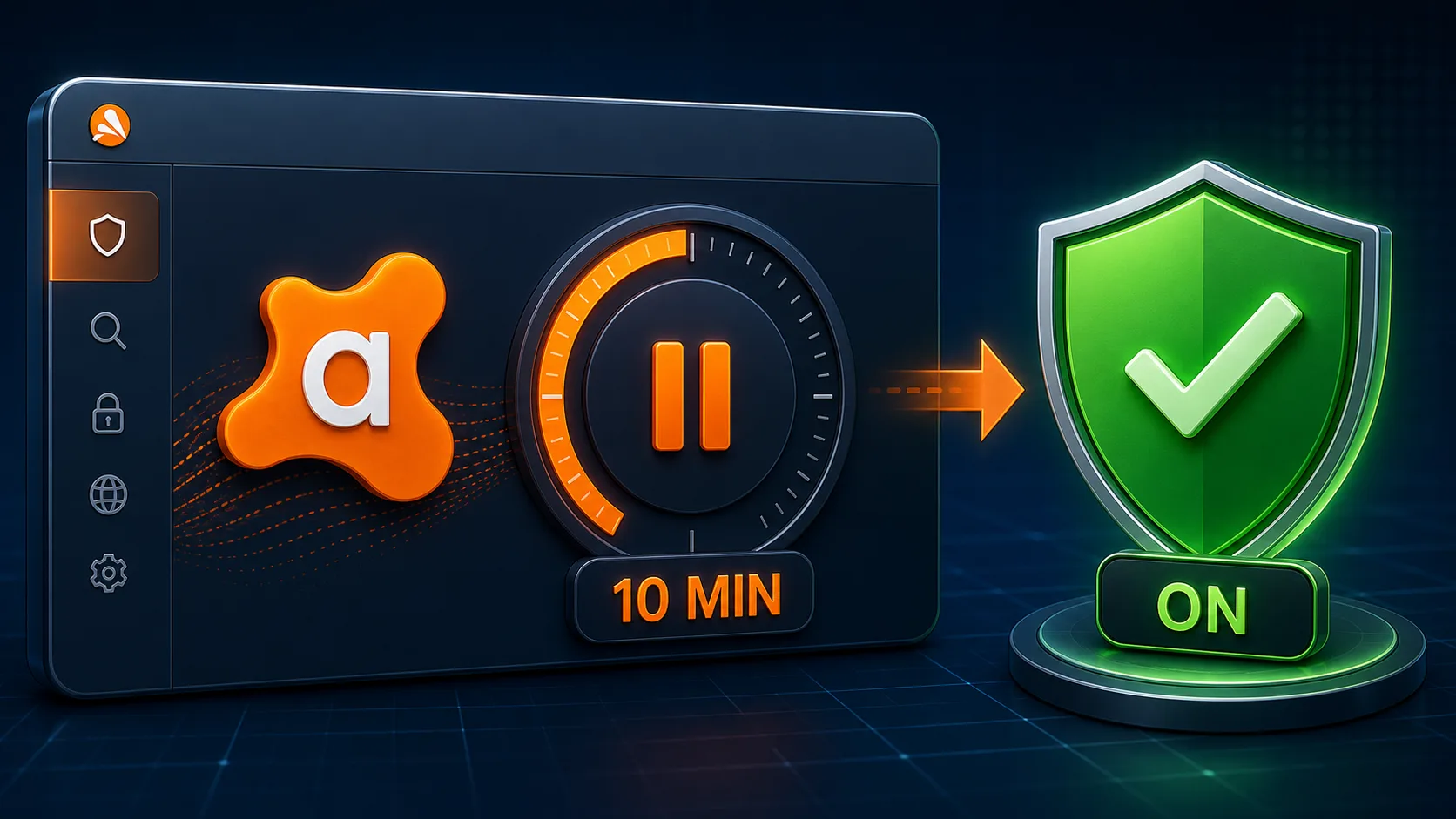
Quick steps for Windows: save your work → verify the file, app or site independently → right-click the orange Avast tray icon → choose Manage Shields → select the shortest timer, preferably 10 minutes when offered → click OK, Stop → run only the planned test → turn shields back on → open Windows Security and confirm that a real-time antivirus provider reports active protection. Don't assume Microsoft Defender automatically replaces a paused Avast installation.
Need a different Avast task? The complete Avast guide hub routes review, plans, Free versus Premium, setup, troubleshooting, privacy, features, billing and removal without mixing their steps.
- Reproducing a support-confirmed false positive
- Isolating which shield blocks a known app
- Testing a trusted vendor installer or update
- Diagnosing a local-network or mail-client conflict
- Following a specific Avast Support procedure
- A crack, keygen, cheat or pirated installer
- An attachment or tool supplied in a chat message
- A browser page that says antivirus blocks a “required update”
- An unknown file whose publisher can't be verified
- A permanent workaround for repeated detections
Before disabling Avast: confirm what is actually blocking you
Don't start with the off switch. Capture the exact product name, detection name, alert ID, file path, website domain and time. An orange Avast notification points to Avast; a blue “Windows protected your PC” dialog is usually Microsoft Defender SmartScreen; a browser interstitial may come from Chrome, Edge, Firefox, DNS filtering or an extension. Turning off the wrong control adds risk without changing the result.
Microsoft's current SmartScreen documentation says a downloaded app is judged using publisher and file-hash reputation. A newly released signed build can still be “unrecognized,” while an unsigned file produces a stronger warning. That isn't the same signal as an Avast malware detection. Check the dialog title and publisher instead of disabling every layer until something runs.
| What you see | First response | When a short shield pause is justified | Don't do this |
|---|---|---|---|
| Avast detects a file | Leave it in Quarantine; verify source, publisher and exact version; submit it for review | Only after independent validation, to reproduce the detection in a controlled test | Restore and add a broad folder exception because a forum says it's safe |
| Avast blocks a known site | Type the real domain; update Avast; check whether the vendor reports compromise | Only to determine whether Web Guard is causing a confirmed false positive | Disable all shields and enter passwords/payment data on the blocked page |
| Trusted app can't open a file | Test one relevant shield; check app logs, permissions and ransomware protection | Briefly, while offline if the test doesn't require a network | Leave File or Behavior Shield off after the test |
| App has no network access | Inspect Avast Firewall application/network rules | Briefly to prove the firewall is involved, then make a narrow rule | Turn off antivirus, firewall and router security together |
| Game or build is slow | Measure the same workload; update Avast; check scheduled scan and app-specific options | One repeatable benchmark with no new downloads or browsing | Use permanent disablement as a performance preset |
Verify the source before the pause, not during it. Download installers from the vendor's known domain or an authenticated store. Compare a published SHA-256 checksum when the vendor provides one, inspect the code-signing publisher, and confirm that the filename and version match the release notes. A digital signature proves which certificate signed the file; it doesn't make every signed file harmless. If the file came from a Discord message, ad, mirror, crack site or unsolicited email, keep Avast on.

How to disable Avast temporarily on Windows 11 or 10
Avast updated its official consumer instruction on April 24, 2026. The current tray-menu label is Manage Shields. Many older pages—including the recovered version of this page—still say “Avast shields control” or send users through an obsolete Protection screen. Menu wording can roll out gradually by edition, but the current official route applies to Avast Free Antivirus, Avast Premium Security and Avast One.
- Record the alert and prepare the test. Save work, close unrelated apps and copy the detection name, alert ID, file path or blocked domain. Disconnect from public Wi-Fi; go offline when the test doesn't require a network.
- Verify the target independently. Obtain the app from its official developer or store, inspect the publisher and version, and compare the developer's checksum when one is published. Don't use an antivirus pause to make an unknown download possible.
- Open the Avast tray menu. In the Windows notification area near the clock, reveal hidden icons if necessary, then right-click the orange Avast icon.
- Select Manage Shields. Choose the current Manage Shields entry. If your maintained build shows slightly different wording, open Avast and use its protection settings rather than following screenshots from an old release.
- Choose the shortest time interval. Select the shortest offered duration that covers the test—normally 10 minutes when available. Avoid “permanently”; “until restart” is still much longer than most diagnostics need.
- Confirm OK, Stop. Read the scope in Avast's confirmation and approve the pause. Don't disable Self-Defense, stop services or kill Avast processes in Task Manager for an ordinary compatibility test.
- Run only the planned test. Don't browse, open mail, connect removable drives or download anything else. Stop as soon as you have a reproducible result; a successful launch doesn't prove the blocked file is clean.
- Restore and verify protection. Re-enable the shields in Avast or let the short timer expire, then confirm Avast reports protected status and Windows Security lists an active antivirus provider. Run an update and scan the tested item when appropriate.
These steps follow Avast's current temporary-disable procedure, but add the preparation and recovery checks the three-click vendor article can't cover. Avast itself says shield disabling is for temporary troubleshooting and leaves the computer vulnerable to attacks.
If the tray icon is missing, open Avast from Start and check whether the app is installed, activated and updating. A missing icon isn't proof that protection is absent. Conversely, an Avast process in Task Manager isn't proof that real-time shields are active; use the product and Windows Security status screens.

Disable one Avast Core Shield instead of all protection
A one-shield test gives a better answer and preserves unrelated defenses. In Avast Free Antivirus or Avast Premium Security for Windows, open ☰ Menu → Settings → Protection → Core Shields. The February 2026 Avast documentation lists three Core Shields: File Shield, Behavior Shield and Mail Shield. Open the relevant tab, untick Enable [Shield], select a time duration and click OK, Stop.
| Component | What it normally checks | A focused diagnostic | Exposure while off |
|---|---|---|---|
| File Shield | Files and programs as they're opened, run, modified or saved | Reproduce access to one independently verified local file while offline | New or changed files may execute or open without that real-time file inspection |
| Behavior Shield | Suspicious activity by running applications | Confirm whether a known signed app's behavior is causing the block | Malicious or compromised processes lose a major behavior-monitoring layer |
| Mail Shield | Mail received or sent through desktop clients such as Outlook or Thunderbird | Test one client/server connection without opening attachments | Desktop-client mail traffic and attachments lose this Avast inspection layer |
| Web Guard | Web traffic and suspicious URLs; formerly called Web Shield | Confirm a block, then use an exact URL/domain exception only if validated | Malicious downloads, scripts and phishing pages lose that web-filter layer |
| Firewall | Application, device and network communication rules | Test one trusted app or local device, then repair its rule | Network control changes; this is separate from pausing antivirus shields |
Web Guard was formerly Web Shield and is no longer one of the three Core Shields in Avast's current Windows Core Shields article. Its location varies with Avast One, Avast Free/Premium and subscription features. Follow the label in your maintained product, not an old image that groups four shields together.
Change only one control, reproduce once, turn it back on and record the result. If disabling File Shield changes nothing, re-enable it before testing Behavior Shield. Turning off three components at once may make the problem disappear, but it doesn't tell you which component or rule caused it.
How to temporarily disable Avast on a Mac
The Mac product doesn't use the Windows tray path. Current Avast Security and Avast Premium Security for Mac name the protection components File Shield, Web Guard and Email Guard. Web Guard was formerly Web Shield. Open Avast Security, choose the Core Shields area, and switch off only the component needed for the test. macOS may ask for the password used to start the Mac.
Avast's current Mac troubleshooting advice is deliberately sequential: switch off File Shield, retry the original action, re-enable it if the problem remains, then repeat with another shield. Once you identify the component, configure the smallest exception instead of leaving it off. In the current preferences, File Shield accepts a file, folder or application; Web Guard accepts a website/domain and service type; Email Guard accepts a mail server and protocol.
| Task | Windows 10/11 | macOS | Return check |
|---|---|---|---|
| Pause everything briefly | Tray icon → Manage Shields → shortest duration → OK, Stop | Prefer one shield at a time; Mac controls are component-based | Product says protected; no red/off status |
| Test one file/app | Menu → Settings → Protection → Core Shields → File Shield | Avast Security → Core Shields → File Shield | Switch restored immediately after one test |
| Test one website | Use the current Web Guard control for the installed edition | Core Shields → Web Guard | Retest known safe site; no unrelated browsing while off |
| Create a narrow exception | Menu → Settings → General → Exceptions | Menu → Preferences → relevant shield → Add exceptions | Review and remove exception after vendor fixes the conflict |
The detailed current paths and exception types are in Avast's Mac Core Shields documentation. Don't follow old instructions that tell you to disable an “Avast Shield” with no specific component name.

Will Microsoft Defender turn on when Avast is paused?
Don't assume it will. On ordinary Windows 10 and Windows 11 devices, Microsoft documents that Defender Antivirus automatically enters disabled mode when a non-Microsoft antivirus is registered as the primary solution. Pausing Avast's real-time shields doesn't necessarily unregister or uninstall Avast, so Windows can continue to treat Avast as the provider while its shields are off.
Microsoft's current third-party antivirus compatibility table says Microsoft Defender Antivirus is disabled automatically when a non-Microsoft antivirus is the primary product on Windows 10/11 without Defender for Endpoint. Enterprise modes differ, but passive Defender isn't real-time replacement protection either.
Open Windows Security → Virus & threat protection after the pause. Review the provider/status section rather than interpreting the Windows Security app icon itself. The app is a dashboard for multiple providers; opening it doesn't prove Microsoft Defender is actively scanning. If Windows reports no active provider, end the test and restore Avast.
If you're replacing Avast permanently, uninstall it through Windows, restart, update Windows Security and verify Defender becomes active—or install the chosen replacement and verify that provider. Running two full real-time antivirus engines together can cause conflicts. For our current protection comparisons, see the Windows antivirus guide and the full Avast review.
Safer alternatives to turning off all Avast protection
Use a narrow exception
For a verified file, folder or URL, go to Menu → Settings → General → Exceptions → Add exception. Exclude the exact target, not a drive, Downloads folder, user profile or wildcard. An exception removes future inspection, so note why it exists and review it after the vendor fixes the conflict.
Allow one app through Firewall
If only network access is blocked, repair the app or network rule. Avast documents separate flows for Avast Free/Premium and Avast One. A firewall rule answers a communication problem without suppressing File or Behavior Shield.
Update Avast and restart
Right-click the tray icon and choose Update → Engine and virus definitions, then Update → Program. New definitions can correct a false positive; a program update can fix an interface or compatibility bug. Retest before creating a lasting exception.
Use Quarantine, not deletion
Quarantine isolates a detected file and preserves the option to submit it for analysis. Don't permanently delete an irreplaceable suspected false positive, but don't restore it merely because an application stops working.
Use Passive Mode only for the right job
Avast Passive Mode disables active protection but keeps definitions and manual scanning. Avast positions it for coexistence/troubleshooting with another antivirus, not as an everyday low-interference setting. Verify which product is the active real-time provider after restarting.
Uninstall instead of disabling forever
If you no longer want Avast, remove it cleanly and verify the replacement. A permanently disabled but registered antivirus can create the worst state: no useful Avast protection and no guaranteed Defender takeover.
An exception isn't automatically safe simply because it's narrower. The official Avast exceptions guide warns that excluded files, folders and websites aren't scanned and may leave the computer vulnerable. Use the smallest exact path or domain and remove it when it's no longer required.
What to do when you think Avast found a false positive
A false positive is possible, but “I wanted to run it” isn't evidence. Keep the item in Quarantine. Confirm the official publisher, distribution URL, exact version and signature; compare the developer's published checksum; check whether the developer acknowledges the detection; and ask whether the program's behavior legitimately resembles remote control, credential access, process injection or evasion.
Avast's current Quarantine workflow lets you send a file to Threat Labs as False positive and include the program name, publisher, version and reason. “Restore and add exception” is available on Windows, but Avast explicitly calls restoration a high-security-risk action intended for specific advanced cases. Submit first when time allows.
You can also use Avast's file or URL review form with the detection name and alert ID. Don't upload a confidential document, proprietary build, private link token or customer data to a public scanner without authorization. If it's work software, the developer or security team should make the submission through an approved channel.
After Avast clears the item or the developer ships a fixed build, remove any temporary exception and rescan. If independent signals still disagree, don't turn the antivirus off to force the result; use a disposable isolated analysis environment or ask the vendor/security team.
Avast Firewall problems need a firewall rule, not a global antivirus pause
A local printer, NAS, VPN, game or business app can fail because Avast classifies the network as public/untrusted or blocks an application rule. Open Protection → Firewall, identify the exact network or app, and inspect its rule. Avast's official firewall access guide documents trusted-network and application-access flows for both Avast Antivirus and Avast One.
Trust only a network you control. Hotel, café, airport and shared-building Wi-Fi should stay untrusted. For an application, allow the signed executable that needs access and limit scope when the UI offers it. Don't make an entire temporary-download directory trusted.
If you must prove the firewall is involved, pause the firewall for one controlled attempt while other shields remain on, then re-enable it before changing the rule. Our firewall software guide explains why host firewalls, router/NAT, DNS filtering, VPNs and antivirus solve different problems.
How to turn Avast back on—and prove protection returned
Don't wait for a vague memory that “the timer should be done.” Open Avast and use its red/off status action to turn protection on, or right-click the tray icon and use the enable option exposed by the current menu. Every shield you manually changed should show enabled. Reconnect to the network only after the protection state is clear.
- Avast status: the main screen reports protected, not “You are unprotected” or “Some shields are off.”
- Component status: File Shield, Behavior Shield, Mail Shield and any tested Web Guard/Firewall component show on as applicable to your edition.
- Windows status: Windows Security → Virus & threat protection reports an active, up-to-date antivirus provider.
- Updates: check engine/virus definitions and program updates before rescanning the item.
- Exception review: confirm you didn't add a broader exception than intended; write down any temporary one.
- Follow-up scan: scan the tested target and run a normal scan if it executed while protection was paused.
Don't use the EICAR test file casually on a work-managed device or a system with automated incident response; it can trigger a real security workflow. For a consumer PC, Avast provides its own protection-test guidance, but status and update checks are sufficient for the ordinary pause-and-return procedure.

If Avast shields won't turn back on
Restart once and open Avast as normal. Check that the program and virus definitions are current. Avast's status page may offer Resolve, Turn on, Update or Restart now for a specific condition. Don't keep browsing while the product reports unprotected.
If the button changes back to off or a component fails, use Avast's supported repair flow in Windows Apps/Installed apps. The current repair instructions warn that customized settings can return to defaults, so capture important exceptions or network rules first. Reinstall only from the official Avast installer if repair fails.
Windows Security can show stale provider information when its security-center registration or Windows Management Instrumentation data is unhealthy. The practical rule is to resolve disagreement rather than choose the greenest-looking screen. If Avast says protected but Windows says no provider, or vice versa, update/restart and follow official Avast support; keep sensitive activity off the device until both agree.
Don't disable Avast Self-Defense, rename program folders, stop protected services or delete files manually to fix a stuck shield. Those actions are used by malware too and can leave an unrecoverable installation state. Repair, clean uninstall and verified reinstall are the supported routes.
FAQ about temporarily disabling Avast
Is it safe to disable Avast for 10 minutes?
Only for a prepared, trusted troubleshooting test. Save work, close unrelated network-facing apps, verify the target first and use the shortest timer. Don't browse, open mail, attach removable drives or download another file while shields are off. Re-enable and verify both Avast and Windows Security when the test ends.
How do I disable all Avast shields temporarily on Windows?
Right-click the Avast icon in the Windows notification area, choose Manage Shields, select the shortest offered duration and click OK, Stop. The label comes from Avast's April 2026 support article for Avast Free Antivirus, Premium Security and Avast One. Avoid permanent disablement for troubleshooting.
Can I disable only one Avast shield?
Yes. In Avast Free Antivirus or Premium Security, open Menu → Settings → Protection → Core Shields, select File Shield, Behavior Shield or Mail Shield, untick Enable for that shield, choose a short duration and confirm. Test one component at a time and restore it before moving to another.
Does Microsoft Defender turn on automatically when Avast is paused?
Not reliably. Windows normally disables Defender Antivirus when a non-Microsoft antivirus is registered as primary. Pausing Avast shields may leave Avast registered, so don't assume Defender becomes active. Check Windows Security → Virus & threat protection and end the test if no active provider is reported.
How do I temporarily disable Avast on a Mac?
Open Avast Security, enter the Core Shields area and switch off only the relevant File Shield or Web Guard component; test once and turn it back on. Current Mac products also expose Email Guard separately. If the conflict is confirmed, add the narrowest file, app, domain or mail-server exception instead of leaving a shield off.
Should I disable Avast to install a program it detects?
Not until the program is independently verified. Use the official vendor/store, inspect the code-signing publisher and exact version, compare a developer-published checksum, keep the item in Quarantine and submit the detection to Avast as a possible false positive. A crack, keygen or chat-supplied installer isn't a safe exception case.
What is Avast Passive Mode?
Passive Mode disables Avast active protection, including Core Shields and Firewall, while allowing definitions, program updates and manual scans. Avast positions it for troubleshooting or coexistence with another antivirus. It isn't a substitute for verifying that another real-time provider is actually active.
What should I do if Avast won't turn back on?
Stop network-sensitive activity, restart, update the program and definitions, and use Avast's Resolve or repair workflow. Check the status in both Avast and Windows Security. Don't disable Self-Defense or delete Avast program files manually; use the official repair, uninstall and reinstall paths.
Bottom line: pause less, diagnose more
The current Windows path is short: right-click the tray icon, choose Manage Shields, select the shortest timer and confirm. The safe workflow is longer because it includes the parts that prevent a ten-minute compatibility test from becoming an unprotected browsing session: verify first, limit scope, run one test, restore immediately and check both status sources.
Most problems don't require all protection to be off. A single-shield test identifies the component; an exact exception preserves protection elsewhere; a firewall rule fixes network access; Quarantine and Threat Labs handle a suspected false positive; repair fixes a broken installation. If you want Avast gone, uninstall it and verify the replacement instead of leaving a registered product permanently disabled.