
AVG Cleaner Review 2026: Useful Storage Tool, Optional Upgrade
AVG Cleaner is a legitimate Android storage utility with a strong file overview, photo analysis and an easier way to review app clutter. The free version can help when a phone is genuinely short on space. Premium mostly buys automation, hidden-cache access and fewer ads—not a lasting speed boost—and its most powerful actions still need careful review.
Quick verdict: AVG Cleaner scores 6.4/10. Try the free Android app if storage is below roughly 10%, you want one screen for large files, duplicates and unused apps, and you'll inspect every deletion. Premium is optional for most people because Android, Files by Google, Google Photos and automatic app archiving already cover the core jobs. Don't install the old AVG Cleaner for Mac: AVG says it no longer receives updates.
Need a different AVG task? The complete AVG guide hub routes review, plans, setup, troubleshooting, Web Shield, privacy, browser, VPN, Android, utilities, billing and removal without mixing their steps.
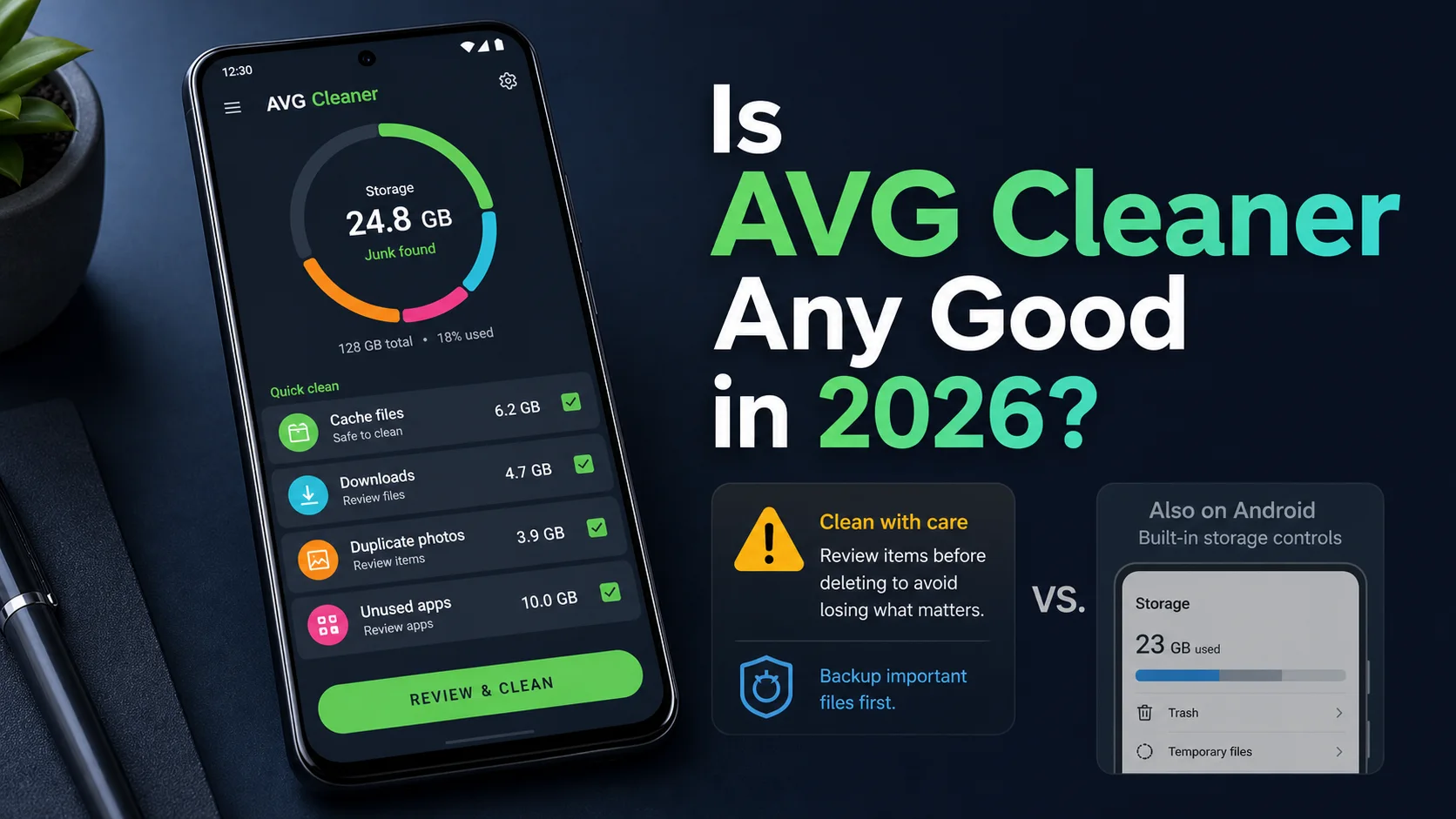
- Clear overview of large files, media and installed apps
- Free tier works for basic review and visible-cache cleanup
- Potentially valuable files are separated for manual review
- Photo/video optimization can preserve originals
- Maintained Android app with a large installed base
- Deleted Quick Clean items can't be restored
- Hidden-cache cleaning still hits Android restrictions
- Sleep Mode can stop messages, sync and security alerts
- Free version uses ads and requests broad access for some tools
- Old Mac app no longer receives updates
AVG Cleaner at a glance
AVG Cleaner is a storage-management app, not an antivirus. Its current maintained product is AVG Cleaner for Android. It inventories cache, residual files, installed APKs, downloads, screenshots, large media and apps; suggests duplicate or low-quality photos; and can compress media or stop selected background apps. It doesn't scan files for malware and doesn't replace the separate AVG AntiVirus app.
The useful part isn't a magic “clean” button. It's seeing what consumes storage in one place. Android's Settings, Files by Google, Photos and Play Store divide those jobs across several screens. AVG groups them and adds recommendations. That can save time on an older phone, a small 64 GB device or a family member's cluttered handset.
The July 2026 Google Play listing showed more than 100 million downloads, a 4.6 rating and roughly 1.96 million reviews. Those numbers show reach, not proof that every feature works on every Android version. Store ratings are volatile, include different app releases and must not be turned into our editorial score.
Our 6.4/10 rating weighs the present app, not AVG's old marketing whitepapers. AVG published a cleaner performance paper in 2015, but Android permissions, storage isolation, background-process rules and device hardware have changed too much to treat that test as a 2026 benchmark. We credit observable storage recovered and don't invent a battery or speed percentage.
AVG Cleaner in 2026: Android, Mac and AVG TuneUp are different products
| Name | Current status | Platform | What to do |
|---|---|---|---|
| AVG Cleaner | Maintained and updated on Google Play | Android phones/tablets; some Chromebooks via Android app support | Use only the official Google Play listing from AVG Mobile |
| AVG Cleaner for Mac | Old product; AVG says it no longer receives updates | Official page lists macOS 10.12 through 11 Big Sur | Don't treat it as a current macOS cleaner or install it on a modern Mac |
| AVG TuneUp Premium for Mac | AVG's current recommended Mac optimization product | Supported macOS versions vary with the current release | Evaluate separately; it isn't the Android Cleaner subscription |
| AVG TuneUp for Windows | Separate desktop maintenance product | Windows | Read our AVG TuneUp review; don't use Android Cleaner claims as Windows evidence |
This correction matters because the recovered article recommended a 2019-era Mac app as though it were current. AVG's own Mac installation page now labels AVG Cleaner an old product that no longer receives updates and points users to AVG TuneUp Premium for Mac. A utility with broad file access shouldn't be kept around after its vendor ends updates.
The Android app was updated on July 8, 2026 in the checked Play listing. Install from Google Play, confirm the developer is AVG Mobile/Avast Software, and avoid “premium unlocked” APKs. A cleaner needs enough access to inspect files and apps; a modified package turns that legitimate need into an unnecessary security risk.

What AVG Cleaner Free and Premium actually do
AVG's current Android FAQ separates ordinary visible cleanup from paid automation and hidden-cache access. Device model, Android version and system restrictions can change what the app can complete.
| Feature | Free or paid | Useful job | Boundary to know |
|---|---|---|---|
| Quick Clean | Core scan free; some categories paid | Reviews visible cache, thumbnails, residual files, APKs and selected media/app data | Downloads, screenshots, trash and app data may be valuable; deletion isn't reversible |
| Deep Clean | Premium | Guides removal of hidden cache across apps | Android may require approval per app; results vary by OS/device restrictions |
| Automatic Cleaning | Premium | Schedules approved categories | AVG says hidden cache can't be cleaned in the background |
| Browser Cleaner | Premium | Removes selected browser data | All browser-data items start selected in AVG's documented flow; review logins and site data |
| Media overview | Core analysis | Finds large video, folders, old/similar/bad/sensitive photos | “Bad” and “similar” are suggestions, not proof a photo is disposable |
| Photo/video optimizer | Availability may vary | Compresses media to save storage | Compression changes the file; keep originals until quality is checked |
| Apps overview | Core analysis | Shows usage, growth, notifications and potential drainers | Rarely opened banking, travel, recovery or authenticator apps can still be important |
| Sleep Mode | Premium | Force-stops selected background apps | Stopped apps can't sync or notify normally until reopened |
| No ads / support controls | Premium | Removes third-party ads and adds direct support/frequency control | This convenience may be more meaningful than the cleanup automation |
Quick Clean divides results into “Unneeded files” and “Files to review.” AVG leaves the second group unticked because it may contain downloads, screenshots, large old files, app data and photos you want. That separation is a good safety design. Preserve it—don't select the entire review group simply to maximize the gigabyte total.
Deep Clean is the strongest Premium argument for a device whose hidden caches repeatedly grow. It isn't fully automatic. AVG's support material and its June 2026 Play Store replies acknowledge that Android can require manual approval and that results depend on device and system restrictions. Automatic Cleaning can't clear hidden cache as a background action, so “set and forget” has a real platform limit.
AVG Cleaner Premium price: verify the live Google Play checkout
AVG doesn't publish one universal public price on the support pages we checked. Its FAQ says available plans can vary by region and regulation, and the Play listing presents in-app purchases without a single worldwide renewal amount. A US-dollar figure copied from another review can be wrong for a different account, offer, country or billing cycle.
Open AVG Cleaner → Upgrade, choose a plan, and stop at the Google Play confirmation screen. Record the exact charge, billing interval, trial end, renewal amount, device entitlement and whether the offer is Cleaner Premium alone or Premium Plus with AVG AntiVirus Pro. Judge the annual renewal, not a weekly equivalent or introductory monthly caption.
Premium Plus covers Cleaner Premium and AVG AntiVirus Pro for up to five Android devices according to AVG's current FAQ. Cleaner Premium by itself is for this app; it doesn't unlock the desktop AVG TuneUp product. That naming is easy to misunderstand, so keep the Google Play receipt and verify which SKU appears under Payments & subscriptions.
Uninstalling doesn't cancel billing. AVG and Google Play Help both make that explicit. Cancel through Play Store → profile → Payments & subscriptions → Subscriptions → AVG Cleaner → Cancel subscription, or through the AVG Account if AVG processed the purchase. Keep the confirmation and check the end date.
Does AVG Cleaner speed up Android? Storage and memory are different
AVG Cleaner can make a low-storage phone easier to use by freeing space. Google's current slow Android troubleshooting guide says phones may develop problems when less than 10% of storage is free. On a 64 GB device packed with video and downloads, recovering several gigabytes can restore room for app updates, camera capture and temporary work.
That isn't the same as making the processor faster or permanently adding RAM. Android manages cached processes so apps can reopen quickly; memory is reused when the system needs it. Google says you don't usually need to close apps unless one is unresponsive. Force-stopping everything can trade a momentarily emptier process list for missed notifications and slower relaunches.
Cache is also not automatically “waste.” It avoids downloading or recomputing data. Clearing a broken or bloated app cache can solve a problem; clearing every cache on schedule may only make apps fetch the same data again. Measure free storage before and after, then test the exact symptom. If the only improvement is 3 GB reclaimed, report a storage win—not a 30% speed boost.
For a genuinely slow phone, update Android and apps, restart, check storage, identify the problem app, test safe mode if supported and inspect battery/device-care diagnostics. Heat, battery health, damaged storage, weak hardware, malware, network delay and a poorly coded app aren't repaired by a junk scan.

Is AVG Cleaner safe? The app is legitimate; deletion still needs judgment
AVG Cleaner from the official Play listing is legitimate software. The danger isn't that an ordinary cache scan is secretly malware. It's approving a legitimate destructive action against the wrong file, photo, browser state or app.
| Action | What can go wrong | Safe check |
|---|---|---|
| Delete Downloads / app data | Documents, offline media, ringtones, exports or unsynced work can disappear | Open the file list, sort by path/date and copy anything irreplaceable first |
| Remove “bad” or similar photos | The chosen image may have the best expression, focus, crop or metadata | Compare full-screen; never bulk-approve an algorithmic quality label |
| Optimize media | Compression can reduce detail or replace the source | Keep originals, compare at 100% and test one representative file |
| Clean browser data | Sites can sign out or lose preferences/offline data | Untick credentials/site data you need and verify password sync/recovery first |
| Sleep/force-stop apps | Messages, alarms, backup, VPN, password sync and security alerts can stop | Exclude communications, authentication, backup, security and device services |
| Uninstall an unused app | Local-only data or an infrequent but essential app may be lost | Open the app, export/sync data and confirm it remains available in Play Store |
Sleep Mode deserves special care. AVG says a force-stopped app normally can't access memory or send notifications until manually reopened and specifically advises against stopping messaging or security apps. Add cloud backup, authenticator, health, parental-control, accessibility and device-management apps to that exclusion list.
Community reports are useful as failure modes, not proof that everyone will lose files. Current Play reviews and Android discussions include complaints about per-app cache approval, upgrade prompts and mistaken deletion. We didn't turn anecdotes into a universal verdict. They reinforce AVG's own warning: review files and expect Android-version differences.
AVG Cleaner permissions, ads and privacy
A useful cleaner must see enough to inventory storage, media and apps. Features may request photos/media/files access, usage access, notification access or accessibility-related control. Sleep Mode uses elevated interaction to help force-stop selected apps; AVG's Play listing says Accessibility permission is used to help users stop background apps with one tap. Grant it only if you'll use that feature.
The July 2026 Play data-safety panel said the app may share location, app activity and other data types; may collect location, personal information and other data; encrypts data in transit; and supports deletion requests. Those are developer disclosures, not an independent privacy audit. Read the live panel because categories can change with releases and region.
AVG's current product privacy policy says app/media overviews are processed locally for core service, describes device/service/usage data retention, and lists Firebase Analytics/Crashlytics and AppsFlyer. It also says the free version serves third-party ads through named advertising partners. Premium removes third-party ads; it doesn't mean the app processes no service or device data.
Use Android Settings → Privacy/Permission manager to audit access after setup. If you only need Files by Google and Settings, remove AVG rather than leaving broad permissions dormant. If you keep it, deny any optional permission whose feature you don't use and revisit access after major app updates.
What Android and Google tools already do for free
Start with the tools already trusted on the phone. Paths vary by manufacturer, but current Android supports storage categories, cache controls, unused-app management and app archiving. Samsung Device Care and other vendor dashboards add their own storage review.
- Settings → Storage: shows category use and opens file/app cleanup. Google's Android storage guide covers Smart Storage, Free up space, cache, downloads and automatic app archiving.
- Files by Google: reviews junk, duplicates, screenshots, downloads, large files and unused apps. Google warns its junk deletion is permanent too, so the same review rule applies.
- Google Photos: removes local copies only after backup when “Free up space” is used. Verify the backup account and status before deleting device copies.
- Unused apps: Android can delete temporary files, revoke permissions and stop background work/notifications for apps not used for a long time.
- App archiving: supported devices can remove app software while retaining the icon and user data for restoration later.
- Per-app cache: Settings → Apps → [app] → Storage & cache → Clear cache targets one proven problem. “Clear storage” is different and permanently resets app data.
Files by Google handles most of AVG Cleaner's common discovery tasks without a Cleaner subscription. AVG's advantage is a more consolidated dashboard, photo/media optimization, scheduled categories and Deep Clean guidance. Pay only if those extras solve a recurring problem on your actual device.
Don't replace AVG Cleaner with an unknown cleaner boasting RAM boost, CPU cooling or virus removal in one tap. Prefer the OS/vendor tools, Files by Google, a reputable app with a clear privacy policy, or manual removal inside the app that created the files.

Who should use AVG Cleaner—and who should skip Premium?
Try the free app if: storage is genuinely constrained; files are spread across downloads, social folders and duplicate media; the built-in manager is confusing; or you're helping a less technical family member review clutter. Continue with ads only if the free experience is acceptable and permissions match features you use.
Consider Premium if: hidden cache repeatedly consumes meaningful space, you value one-tap guidance despite occasional Android approvals, you want scheduled low-risk cleanup, or removing ads/direct support is worth the live renewal price. First confirm that Deep Clean works on your exact device and Android build.
Skip Premium if: your phone has comfortable free space, Files by Google already finds what you need, you dislike recurring utility subscriptions, you rarely review automated actions or the price screen is unclear. A cleaner is optional maintenance software, not security protection.
Skip the old Mac app entirely. It no longer receives updates. Use current macOS storage settings, remove applications through supported methods and evaluate AVG TuneUp Premium for Mac as a separate current product only if the built-ins are insufficient.
How to use AVG Cleaner safely on the first run
- Confirm the real problem. Open Settings → Storage and record total/free space. If the phone is slow with plenty of storage, troubleshoot updates, heat, battery and the specific app instead of assuming junk.
- Back up irreplaceable data. Verify Photos backup, copy important Downloads/documents and confirm the account can restore them. A backup icon isn't proof the latest file uploaded.
- Install only from Google Play. Check the package is AVG Cleaner from AVG Mobile/Avast Software, review the live data-safety panel and update Android first.
- Grant permissions feature by feature. Allow media/files access for analysis only if needed. Don't grant Accessibility/Sleep Mode control unless you'll use it and understand which apps can be stopped.
- Scan without selecting everything. Expand every category. Leave Downloads, screenshots, app data, personal media and uncertain APKs unticked on the first pass.
- Delete one low-risk batch. Start with ordinary visible cache or a few verified files. Record the recovered space, reopen key apps and check messages, logins, media and downloads.
- Test Premium before relying on it. If considering Deep Clean, confirm how many per-app approvals your device requires. Keep messaging, backup, authentication and security apps out of Sleep Mode.
- Audit billing and access. Record the Google Play renewal, cancel separately if value is weak, then review AVG's permissions. Uninstalling alone doesn't cancel the subscription.
A good first run should be small and measurable: a known amount of space recovered with every important file, message and app still available. The biggest cleanup number isn't the safest or most useful result.

AVG Cleaner FAQ
Is AVG Cleaner any good in 2026?
Yes as an Android storage inventory, especially on a low-capacity or cluttered phone. It organizes cache, media, large files and apps well. Most users don't need Premium because Android and Files by Google cover the core cleanup jobs; AVG's paid value is Deep Clean guidance, automation, no ads and support.
Is AVG Cleaner safe to use on Android?
The official Google Play app is legitimate, but deletions still carry risk. AVG says Quick Clean files can't be restored. Review Downloads, screenshots, app data and suggested photos manually, keep backups and exclude messaging, backup, authenticator and security apps from Sleep Mode.
Does AVG Cleaner really speed up a phone?
It can help a phone that's critically low on storage by reclaiming room for updates and temporary work. It doesn't make the CPU faster or add RAM. Android normally manages background processes, and clearing cache can make the next app load slower. Measure storage and the exact symptom before and after.
Is AVG Cleaner free?
There's an ad-supported free version with basic cleanup and analysis. Premium adds Deep Clean, Automatic Cleaning, Browser Cleaner, Sleep Mode, dashboard controls, direct support and no third-party ads. Exact plans and prices vary by region and are shown in the app's Google Play purchase flow.
Can AVG Cleaner recover deleted files?
No. AVG states that items deleted with Quick Clean can't be restored. Back up photos, videos and documents first, expand every Files to review category and delete a small verified batch. Don't treat a cloud icon or thumbnail as proof an original is safely backed up.
Why does AVG Cleaner need Accessibility permission?
The Play listing says Accessibility permission helps users stop background apps with one tap. That supports Sleep Mode and is broader than ordinary file analysis. Grant it only if you use that feature, exclude essential apps and remove the permission if you stop using AVG Cleaner.
Does AVG Cleaner still work on Mac?
The old Mac app may still install on legacy systems, but AVG says it no longer receives updates and lists compatibility only through macOS 11 Big Sur. Don't use it as a current cleaner. AVG recommends its separate AVG TuneUp Premium for Mac product.
Does uninstalling AVG Cleaner cancel Premium?
No. AVG and Google Play both say uninstalling an app doesn't cancel its subscription. Cancel in Google Play Payments & subscriptions or through the AVG Account if AVG processed the purchase, then keep the confirmation and verify the subscription end date.
Final verdict: useful storage triage, not required Android maintenance
AVG Cleaner earns 6.4/10. The maintained Android app is easy to understand, the media/app overview is genuinely useful and the separation between presumed junk and files requiring review is sensible. A cluttered, low-storage phone can benefit from one guided inventory.
Premium is difficult to recommend broadly. Android may still demand manual hidden-cache approvals, Automatic Cleaning can't remove hidden cache in the background, and Sleep Mode can trade background activity for missed functionality. Google already provides Storage, Files, Photos, unused-app optimization and archiving, while the exact AVG price is account/region dependent.
Use AVG Cleaner Free to discover what is taking space. Back up, clean one small category and measure the actual gain. Upgrade only when a paid feature works on your exact phone and is worth the live renewal. On Mac, retire the old AVG Cleaner—the vendor has.