
Kaspersky Security Cloud Ended: 2026 Migration Guide
Kaspersky Security Cloud is no longer a current consumer product line. Kaspersky removed the Security Cloud name when it launched Standard, Plus and Premium; the direct paid-license successor is Kaspersky Plus. Outside the United States, most owners should migrate through My Kaspersky and verify every entitlement. US users need a different vendor because Kaspersky stopped sales and the Commerce Department cutoff ended signature, codebase and Kaspersky Security Network updates in September 2024.
Quick answer: don't buy, freshly install or renew a product advertised as Kaspersky Security Cloud in 2026. It's a legacy name and old installers may not match a current OS/browser. Outside the US, sign into My Kaspersky and move the active Security Cloud license to Kaspersky Plus using the official installer or activation-code workflow. In the US, uninstall after preparing a replacement: continued possession isn't penalized by the BIS determination, but the vendor can't provide the updates and cloud-network service an antivirus needs. “Security Cloud” also never meant cloud backup—it described adaptive protection and Kaspersky Security Network connections.
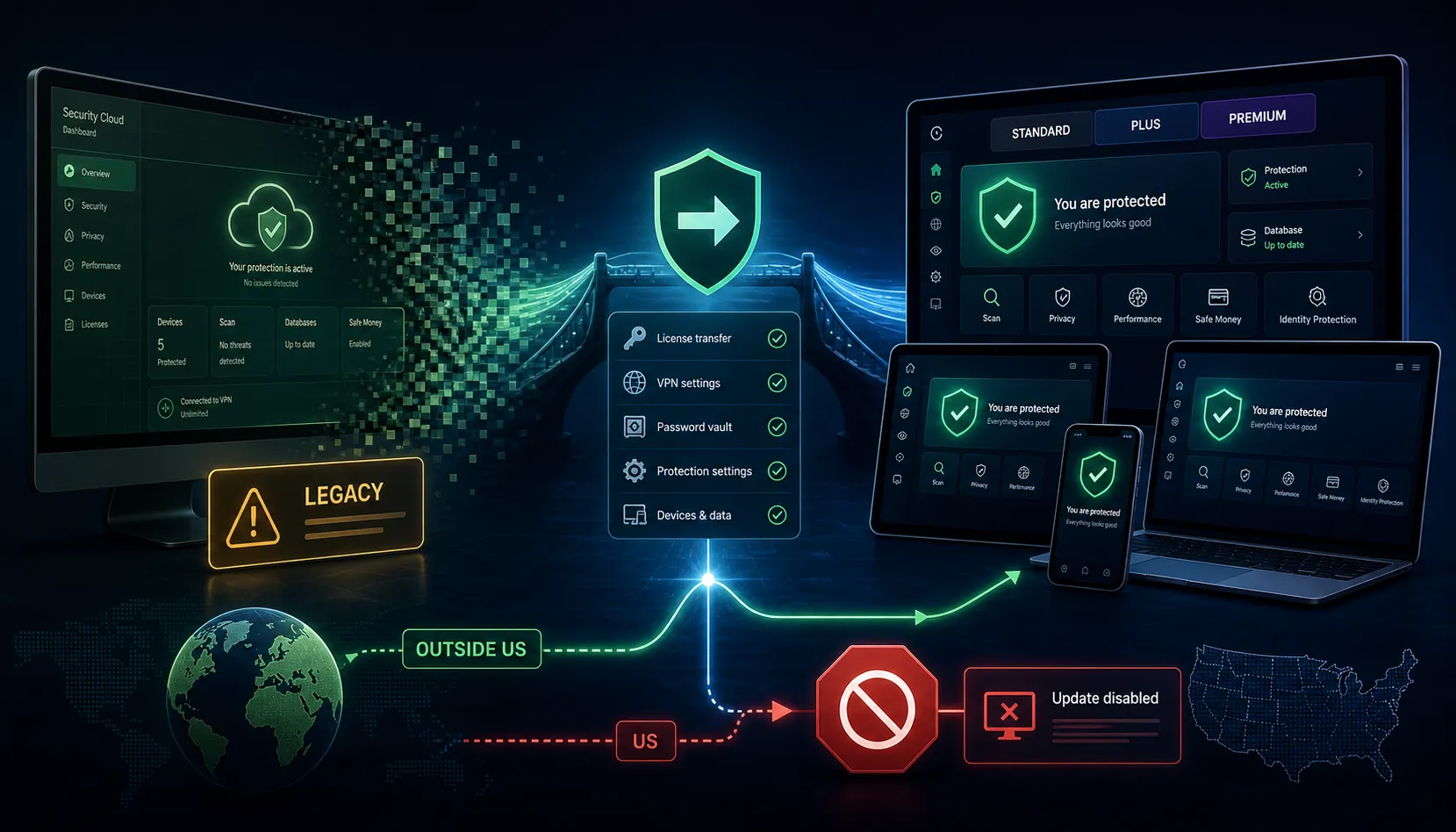
- Existing paid licenses can map to Plus outside restricted regions
- My Kaspersky account links devices, activation and companion services
- The current successor retains antivirus, firewall, Safe Money and privacy tools
- Plus includes VPN and Password Manager under current plan descriptions
- The current engine remains excellent in independent malware testing
- Security Cloud branding was retired during the 2022 consumer-line transition
- Old installers, extensions and system requirements are legacy artifacts
- Settings and companion-service entitlements don't all migrate automatically
- US users can't receive code, signature or KSN service updates
- Reseller keys and region-locked activation can create renewal/migration failures
Is Kaspersky Security Cloud discontinued?
Yes as a consumer product line and branding. In August 2022, Kaspersky introduced Standard, Plus and Premium and said the old “Internet Security” and “Security Cloud” names were gone. It described the transition as gradual: old products would stop selling while support continued for a period. Current Kaspersky storefronts and trial pages promote the new plans, not a new Security Cloud release.
Kaspersky’s current legacy-product support page says existing products outside restricted markets still receive the newest virus databases, support and the latest available legacy download. That means a maintained non-US installation isn't instantly unprotected. It also doesn't turn Security Cloud back into an actively sold product generation: plan a controlled move to Plus to reduce operating-system, browser-extension and lifecycle risk.
Kaspersky's official new-product-line announcement maps Kaspersky Security Cloud to Kaspersky Plus. Current support still hosts old manuals and offers legacy downloads/renewal help, which explains why search results can look alive. A support page existing isn't evidence that the old SKU is a good fresh install.
Our 2.0/10 legacy score reflects lifecycle risk, not a claim that the historic engine was poor or malicious. A security suite depends on current signatures, application modules, browser-extension compatibility, TLS inspection and operating-system drivers. A retired name with old installers is the wrong dependency even when the successor engine tests well.
Don't confuse the consumer suite with Kaspersky Endpoint Security Cloud or Security Center Cloud Console. Those are separate business products with different licensing, management and current maintenance. This page concerns Security Cloud Free, Personal and Family for home users.
Kaspersky Security Cloud wasn't cloud storage or backup
The old marketing name suggested a cloud-hosted antivirus, but most protection ran on the device. “Cloud” described account-connected adaptive recommendations, reputation lookups through Kaspersky Security Network (KSN), cross-device status and plan-level services. Your files weren't automatically backed up merely because Security Cloud was installed.
KSN gave the product fast reputation and threat context. The old help explicitly said that if KSN data couldn't be retrieved, Security Cloud made decisions from local antivirus databases. That fallback is useful during a temporary outage; it isn't a safe permanent model after signatures, codebase updates and KSN access end.
The paid suite did include Backup and Restore functionality on supported Windows configurations, but the user selected a destination and schedule. A local/external-drive backup remained dependent on the drive; a Dropbox or other cloud target depended on a separately configured service. Before migration, locate the actual backup files and test a restore. Never uninstall on the assumption that “Cloud” contains a vendor-hosted copy.
Likewise, Password Manager and VPN were companion services with their own apps, data and entitlements. They may remain linked to the same My Kaspersky account, but antivirus migration isn't proof that a vault, VPN subscription, Safe Kids profile or backup schedule moved unchanged.
Your migration route depends on where you live
| Situation | 2026 status | Correct action |
|---|---|---|
| United States or US person/system | New agreements prohibited from July 20, 2024; signature/codebase updates and KSN operation stopped after Sept. 29, 2024. | Choose another supported antivirus, prepare it, uninstall Kaspersky and verify the replacement is active. |
| Outside US, current paid Security Cloud license | Legacy license can normally map to Kaspersky Plus; availability and entitlements vary by region. | Use My Kaspersky and the official current installer/activation-code path, then verify every component. |
| Outside US, Security Cloud Free | Security Cloud Free is legacy; current limited free availability varies. | Install the current official Kaspersky Free only if offered for the region, or choose another supported free product. |
| Government, regulated or managed device | Policy may be stricter than consumer availability. | Follow organizational and national rules; don't self-migrate a managed endpoint. |
| Activation code from another country/reseller | Region restrictions and entitlement mismatch can block conversion. | Don't buy another gray-market key; ask official support to confirm the code and destination plan. |
The US Commerce Department's Final Determination announcement says users aren't penalized for continuing to possess Kaspersky software, but they assume the cybersecurity risk. That isn't permission for the vendor to keep the product current. Antivirus without current updates and cloud reputation becomes less useful every day.
Kaspersky disputes the US risk assessment and says the decision was geopolitical rather than based on product integrity. Its July 2024 compliance statement confirms stopped US sales contracts, the update cutoff and wind-down while preserving its disagreement. We present both positions; the operational result for a US home user remains the same.
Security Cloud Free, Personal and Family: what replaces each?
| Old package | Normal 2026 destination outside US | Verify before installing |
|---|---|---|
| Security Cloud Free | Current Kaspersky Free where the vendor offers it; otherwise another free antivirus | Region, operating system, device count and whether the current free plan is actually offered |
| Security Cloud Personal | Kaspersky Plus through official conversion | Remaining term, account email, device seats, VPN traffic and Password Manager premium state |
| Security Cloud Family | Kaspersky Plus is the direct technical mapping; Premium may better match household/support/Safe Kids needs | User invitations, seat count, Safe Kids subscription, family profiles and renewal owner |
| Expired legacy license | Buy a current Standard/Plus/Premium plan from the official regional store, or switch vendor | Introductory versus renewal total, auto-renewal, refund terms and required features |
| Legacy app in United States | No Kaspersky consumer-plan migration | Select an actively updated alternative before uninstalling |
Kaspersky's current support article says activation codes for Security Cloud can switch to Plus. On Mac, its current guide says installing the new Kaspersky application removes the previous app and transfers the license/subscription; Security Cloud maps to Plus. Windows instructions also direct Security Cloud toward Plus rather than Standard.
Before accepting the mapped plan, compare the remaining term, devices, renewal owner and next charge in our Kaspersky pricing and renewal guide. A successful activation doesn't prove the converted VPN, Password Manager or Safe Kids entitlement matches the old Family package.
There's a documented VPN caveat in legacy conversion guidance: depending on activation route and region, a converted old code may leave VPN in free mode unless the new paid entitlement is purchased/recognized. Don't assume the word “Plus” on the antivirus screen proves unlimited VPN. Open the separate VPN app and check the subscription/account state.
Don't repurchase Security Cloud from a marketplace because the old name looks familiar. Current support may still accept some renewal codes, but a fresh buyer should choose the current product and obtain a receipt, renewal terms and region-correct account entitlement.
What moves to Kaspersky Plus—and what may not
Plus is the closest current feature tier. It includes Standard's antivirus, anti-phishing, firewall, ransomware protection, Safe Money and privacy controls, then adds unlimited VPN, Premium Password Manager, data-leak monitoring, Wi-Fi/home-network tools, backup and encrypted vault features under current plan descriptions.
Verify the companion products individually: use the Kaspersky VPN review, Password Manager review, Safe Kids review and Safe Money guide instead of assuming one successful antivirus upgrade proves every service migrated.
Feature names overlap, but configuration migration isn't a bit-for-bit image. The 2022 transition rebuilt the interface around Security, Performance, Privacy and Identity. Legacy PC Cleaner functions changed, Private Browsing moved toward the browser extension, and some old behavior/settings can reset during upgrades.
Before switching, capture exclusions, trusted applications, scan schedules, firewall rules, encrypted-connection exclusions, Safe Money sites, notification choices and KSN consent. Recreate only rules you still understand. Blindly copying a broad exclusion can preserve a hole created years ago for software no longer installed.
Family users need a separate inventory. Record which My Kaspersky account owns the subscription, invited users, device names, Safe Kids profiles and companion apps. Kaspersky Premium may add family/identity/support value, but it isn't automatically “better” if you need only a few Plus seats. Compare the live plan matrix and annual renewal total in your region; the old article's prices are obsolete.
Is the current Kaspersky successor still effective?
Outside the US, current independent evidence remains strong. In AV-Comparatives' February–May 2026 Real-World Protection Test, Kaspersky Premium blocked 399 of 400 cases for a 99.8% protection rate and recorded three false positives. It received the highest Advanced+ award level.
That result tests the current Kaspersky Premium 21.24/21.25 engine with cloud connectivity and updates allowed. It doesn't validate an old Security Cloud build, an offline US installation after the cutoff, the VPN, Password Manager, backup restoration or national-security governance. Lab strength and lifecycle/region risk are separate axes.
Our current Kaspersky antivirus review covers the maintained consumer engine and the US restriction in depth. The practical conclusion here is simpler: excellent successor detection justifies migration only where the current software and services are legally and operationally available.
How to migrate from Kaspersky Security Cloud safely
- Choose the region route first. US users select a non-Kaspersky replacement. Outside-US users confirm current Kaspersky consumer products are sold and supported in their country.
- Inventory the My Kaspersky account. Record the owner email, activation code, remaining term, renewal state, devices, users and separate VPN, Password Manager and Safe Kids entitlements.
- Preserve data and settings. Test external/cloud backups, sync the password vault, save recovery material, screenshot exclusions/firewall/Safe Money/scan settings and note any encrypted vault location.
- Obtain only the current official installer. Use the regional Kaspersky site or My Kaspersky for Plus/Premium, or the chosen alternative's official site. Reject Security Cloud archives and reseller bundles.
- Install with the supported handoff. Follow the official activation-code/app-switch guide. Let the installer remove the legacy app where documented; don't run two real-time engines permanently.
- Verify protection before cleanup. Confirm app version, current database timestamp, real-time protection, firewall, browser extension and account/device status. US replacements should show their own active engine in the OS security center.
- Verify every companion entitlement. Open VPN, Password Manager and Safe Kids separately; check premium/free state, vault access, device sharing, traffic limit and recovery, then test one backup restore.
- Remove legacy residue and test. Delete old installers, unregister duplicate devices, remove orphaned extensions, reboot, run an update and quick scan, and keep the rollback notes until a week of normal use passes.
Kaspersky's current activation-code migration guide maps Security Cloud to Plus and explains switching while an old license remains active. If the code fails, stop and ask official support to validate region/entitlement instead of buying a second key.
For a fresh supported-market installation, start with the Kaspersky setup guide. If the handoff fails, use the complete uninstall guide only after preserving the account and companion data.
Common Security Cloud migration problems
The old subscription appears, but Plus is free
Check that the new app is signed into the same My Kaspersky account and the activation code is attached there. Confirm the code's country and remaining term. A legacy conversion may not grant every companion-service entitlement; VPN is the most visible mismatch.
Record the old and new application versions, operating system, account email, activation region and exact entitlement before changing another setting. The broader Kaspersky troubleshooting guide handles update, repair, subscription and performance failures without stacking a second real-time suite.
Settings disappeared after installation
Scan schedules, UI choices, KSN consent, protection levels, trusted URLs and extension behavior can reset across application generations. Rebuild rules from the recorded inventory, but discard obsolete exceptions. Don't disable encrypted-traffic scanning globally to fix one website.
Password Manager or Safe Kids data is missing
Confirm the companion app uses the same account and has completed synchronization. Don't reset/delete a vault or child profile until support has checked the account. An antivirus plan migration isn't a data-recovery tool.
A US installation still says “protected”
A green dashboard can reflect running services and an old local database. Check the database timestamp and ability to receive application/KSN updates. The BIS service cutoff, not the color of a legacy status card, determines whether the vendor can maintain protection.
The reseller offers a cheap “lifetime” Security Cloud key
Don't buy it. Kaspersky consumer products use licenses/subscriptions with region and activation rules; Security Cloud isn't the current storefront. Use an official regional store or established retailer that names a current plan, term, seats, renewal and refund policy.
Best alternatives for US and privacy-sensitive users
| Alternative | Best fit | What replaces Security Cloud well | Trade-off |
|---|---|---|---|
| Bitdefender | Broad suite and low-interaction protection | Strong web/ransomware protection, multi-platform plans and current US updates | Plan/renewal complexity and upsells |
| ESET | Technical controls and lighter suite | Firewall/network tools, granular rules and current US support | Fewer bundled identity/family extras |
| Norton 360 | US households wanting bundle features | VPN, password tools/monitoring and family-oriented tiers | Renewal price and account complexity |
| Microsoft Defender | No new subscription and minimal migration | Built into supported Windows, updates through Microsoft and no third-party key | Fewer cross-platform suite extras and more user-managed hardening |
| Malwarebytes | Simple malware-focused replacement | Clean interface and current US availability | Less complete replacement for VPN/password/family bundle workflows |
Switching brands doesn't remove the need to audit telemetry, renewal and companion apps. Export or verify password-manager data before canceling the old plan, and confirm the new antivirus—not both products—owns real-time protection after restart.
The full Kaspersky alternatives guide compares current protection, performance, bundle features and no-gap migration by use case; the table below is the shorter Security Cloud-specific route.
Kaspersky Security Cloud FAQ
Is Kaspersky Security Cloud discontinued?
Yes as a current consumer product line. Kaspersky removed the Security Cloud name when it introduced Standard, Plus and Premium in 2022. Legacy support pages/installers may remain, but new buyers should use a maintained current product. The normal paid-license successor outside restricted regions is Kaspersky Plus.
What replaced Kaspersky Security Cloud?
Kaspersky Plus is the direct replacement for Security Cloud and Total Security in Kaspersky's official transition guidance. Premium adds identity, priority-support and household extras that may suit old Family users. Security Cloud can't be treated as the same thing as Standard.
Can I use Kaspersky Security Cloud in the United States?
Possessing/continuing to use it isn't penalized by the US Final Determination, but Kaspersky has been unable to provide US signature updates, codebase updates or KSN operation since September 29, 2024. That makes continued use a cybersecurity risk; replace it with a supported vendor.
Will my Security Cloud license transfer to Kaspersky Plus?
Outside restricted regions, current Kaspersky guidance maps an active Security Cloud activation code/license to Plus. Sign into the same My Kaspersky account and follow the official installer/code path. Region, remaining term and companion-service entitlements can affect the result.
Does Kaspersky Security Cloud back up my files online?
No automatic vendor cloud backup is implied by the name. The suite used cloud reputation/adaptive services and offered a separately configured Backup and Restore feature on supported systems. Locate the real backup destination and test a restore before uninstalling.
Will VPN, Password Manager and Safe Kids migrate automatically?
Don't assume they will. They're separate apps/services tied to My Kaspersky and plan entitlements. After the antivirus handoff, open each app, verify the same account, premium/free state, devices, vault/profile access, VPN traffic and recovery. Preserve data before resetting anything.
Is Kaspersky Plus effective outside the US?
Current test evidence is strong: Kaspersky Premium protected against 399 of 400 cases (99.8%) with three false positives in AV-Comparatives' February–May 2026 Windows test. That result applies to the current, connected successor—not an old Security Cloud build or an unupdated US installation.
What is the best Kaspersky Security Cloud alternative?
Bitdefender is the closest broad-suite replacement, ESET suits granular control, Norton 360 suits US bundle/family buyers, Microsoft Defender minimizes cost/migration and Malwarebytes suits simpler malware-focused use. Compare current region, platforms, renewal, privacy and required companion features.
Final verdict: migrate the license, not the legacy product
Kaspersky Security Cloud was competitive in its active years, but it isn't a sound 2026 install. The name disappeared from the maintained consumer lineup, and old support pages don't restore current lifecycle status. Its score here is 2.0/10 because an antivirus that should be replaced can't be recommended as a dependency.
Outside the US, the practical path is orderly rather than dramatic: inventory the account, preserve settings/data, convert the active license to Plus, verify VPN/Password Manager/Safe Kids separately and remove legacy residue. Current Kaspersky detection remains excellent where updates and KSN are available.
In the United States, the decision is closed: use another vendor. The legal determination lets individuals keep old software without penalty but stops the services that keep it dependable. A local green checkmark can't replace current signatures, modules and cloud intelligence.
For every Kaspersky lifecycle, billing, component and repair route, continue through the Kaspersky help hub rather than treating this legacy page as a current product review.