
McAfee LiveSafe Review 2026: Renew, Switch or Uninstall?
McAfee LiveSafe isn't dead: McAfee still maintains an official LiveSafe page, lists it in current system requirements and supports active subscriptions. Its protection engine has strong current lab context, but the real decision is financial. Keep it when the renewal quote is fair and unlimited household devices matter; compare McAfee+ when buying fresh; use Microsoft Defender when you only need core Windows protection.
Quick verdict: McAfee LiveSafe earns 7.8/10. An active, current build is a capable multi-device security suite—not malware and not an abandoned product. Renew only after checking the exact amount in My Account: McAfee's US LiveSafe trial terms viewed July 30, 2026 showed $39.99 for the first paid term and $109.99/year afterward, while existing-account quotes can differ. If you're shopping from scratch, compare the current McAfee+ lineup rather than assuming the LiveSafe and McAfee+ bundles are identical.
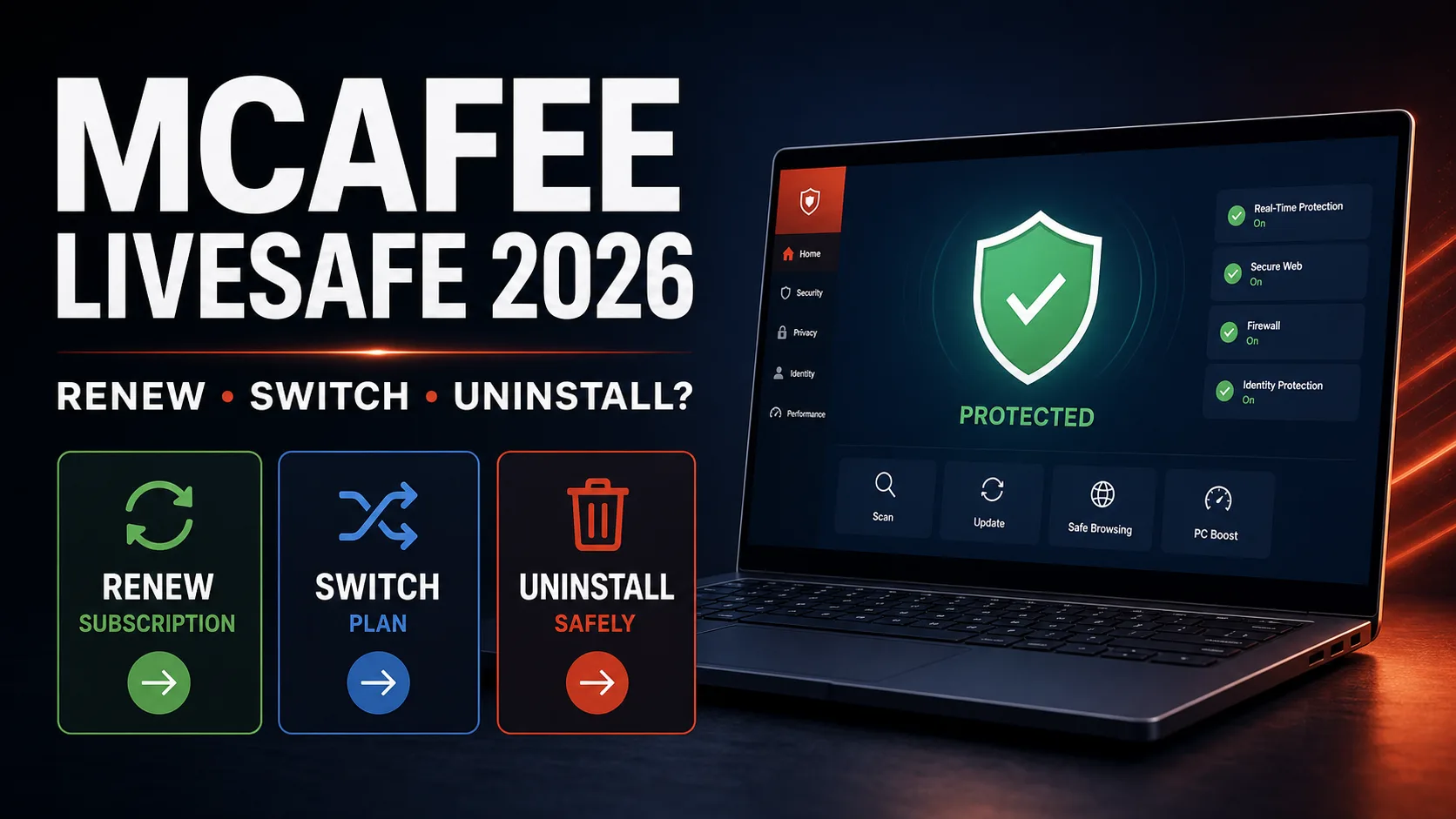
- Current McAfee support and system requirements still name LiveSafe
- Unlimited personal household devices under the official plan wording
- Strong 2026 McAfee Total Protection engine results provide relevant context
- Cross-platform antivirus, web, identity and privacy tools in one account
- Current McAfee software performed very well in a low-end-PC lab test
- Renewal can be much higher than the first paid term
- Exact features and auto-renew benefits vary by country and account
- The lab product is Total Protection, not the exact LiveSafe SKU
- Windows Defender is sufficient for many careful single-PC users
- Preinstalled trial prompts and removal friction drive persistent complaints
McAfee LiveSafe in 2026: supported, still sold, but no longer the storefront focus
Several current review pages call LiveSafe discontinued, legacy-only or fully renamed to McAfee+. McAfee's own pages don't support that simple claim. The US McAfee LiveSafe product page still showed a Buy Now control, free-trial terms, subscription renewal language, unlimited personal-device coverage and a current feature list when checked on July 30, 2026.
McAfee also gives LiveSafe its own section in the current system requirements: Windows 10 RS5 or newer and Windows 11 on x64, Windows 11 on ARM64, macOS 13 or newer with app build 4.23+, Android 10+, iOS 16+ and ChromeOS 102+. The same page names LiveSafe as eligible for the Virus Protection Pledge where country, purchase channel and auto-renew conditions are met.
What has changed is the buying context. McAfee's main storefront emphasizes McAfee+ plans and identity/scam features. LiveSafe still appears in OEM bundles, retail cards, older accounts and its own direct page. A LiveSafe owner shouldn't assume an automatic migration to one exact McAfee+ tier unless the renewal screen or McAfee support states that for the account. A new buyer should compare the live bundles instead of buying an old activation key merely to preserve the LiveSafe name.
Should you renew, switch plans or uninstall LiveSafe?
| Your situation | Best next action | Reason | Check before acting |
|---|---|---|---|
| Active plan, many household devices | Consider renewing | Unlimited owned personal devices can make the per-device price competitive | Exact renewal, device eligibility and VPN/identity entitlements |
| Preinstalled trial on one Windows PC | Compare, then usually decline | Microsoft Defender already supplies capable core antivirus | Whether you need VPN, identity monitoring or multi-device coverage |
| New purchase | Compare McAfee+ and rivals | Current plans make feature and identity tiers easier to compare | First term, renewal, device rules and country-specific benefits |
| Renewal far above alternatives | Turn off auto-renew and switch | No lab result makes an uneconomic subscription compulsory | Expiry, data export, replacement activation and refund window |
| Unsupported OS or expired build | Upgrade or remove it | Unsupported security software creates false confidence | App version, OS support and replacement status |
| Repeated prompts or app problems | Troubleshoot once, then remove | Usability is part of security | Account status, pending update, clean uninstall and support case |

Don't let sunk cost decide. A one-year key already paid for can be used while it remains supported, but it doesn't justify a future renewal. Conversely, removing LiveSafe solely because of old internet memes throws away a current paid entitlement without checking actual device count and account features.
Protection in 2026: strong McAfee engine evidence, with a product-name caveat
No major independent lab result we found is labeled “McAfee LiveSafe.” Labs test McAfee Total Protection, currently version 1.35–1.38. LiveSafe belongs to the same consumer family and likely shares important protection components, but a review must not relabel a Total Protection result as a direct LiveSafe test. We use these results as engine and vendor context, not proof of every LiveSafe feature.
AV-TEST's April 2026 Windows page lists McAfee Total Protection 1.36 at 6/6 Protection, 6/6 Performance and 6/6 Usability—18/18. February 2026 was also 18/18. That's credible evidence that the current McAfee Windows stack can compete at the top of AV-TEST's methodology.
The latest AV-Comparatives Real-World Protection Test was less dominant: McAfee Total Protection blocked 394 of 400 cases, a 98.5% protection rate with six compromises, four false positives and an Advanced award. McAfee sat in cluster 2 behind the cluster-1 products.
In the March 2026 Malware Protection Test, McAfee Total Protection 1.36 protected against 9,997 of 10,000 cases (99.97%) but generated 14 false positives, enough for an Advanced rather than Advanced+ award. Taken together: excellent file/malware protection, good but not category-leading web attack results, and a false-alarm cost worth acknowledging.
These numbers contradict the claim that McAfee is inherently fake or unable to protect a current PC. They also contradict marketing that implies perfection. Antivirus remains one layer alongside patching, phishing-resistant authentication and backups.
LiveSafe pricing and renewal: the number that changes the verdict
McAfee's US LiveSafe offer currently advertises a free trial followed by $39.99 for the first paid term. The same official terms list a $109.99 yearly renewal at the current price. A trial can be charged seven days before it ends; a normal annual subscription may be charged about 30 days before expiry. Prices, taxes and included services vary by country and sales channel, so the amount shown inside your own McAfee account is the one that matters.
This is why a LiveSafe review needs two scores, even if we publish one editorial rating. At $39.99, unlimited eligible personal devices plus VPN and family tools can be good value. At $109.99, a one-PC household should compare Microsoft Defender, Bitdefender, Norton and current McAfee+ plans before allowing the charge.
Auto-renewal, refunds and protection benefits
You can change auto-renewal in McAfee My Account. McAfee's current refund policy and subscription terms say an initial purchase is generally refundable within 30 days, while an annual auto-renewal is generally refundable within 60 days of the charge. Check the country-specific terms before relying on those windows.
Turning off auto-renewal can remove eligibility for the Virus Protection Pledge and other qualifying benefits. It doesn't instantly uninstall the app, and uninstalling the app doesn't cancel billing. Treat subscription cancellation, refund requests and software removal as three separate tasks.
What LiveSafe includes—and what each feature actually does
The exact bundle depends on country, retailer, device and account age. The table reflects McAfee's current US LiveSafe product page and system-requirements material, not a promise that every old OEM key exposes every tool.
| Feature | Practical value | Boundary to check |
|---|---|---|
| Antivirus and ransomware protection | Real-time scanning, web and file protection | Keep the app and operating system supported and updated |
| Unlimited personal devices | Useful for a household with several Windows, Mac, Android, iOS or ChromeOS devices | Only devices you own for personal use; platform features differ |
| Secure VPN | Encrypts traffic on public networks | Eligibility can depend on auto-renewal, region and subscription channel |
| Identity monitoring | Alerts when monitored personal data appears in known breaches | An alert isn't identity-theft insurance or automatic remediation |
| Password Manager | Generates and stores unique credentials | Verify export options before changing subscriptions |
| WebAdvisor | Warns about risky sites and downloads | Browser support and extension permissions change over time |
| Safe Family | Parental controls and device rules | Availability and controls differ by platform |
| QuickClean, Shredder and PC tools | Removes selected files and offers cleanup utilities | Not a substitute for backups; optimization gains may be modest |
| Virus Protection Pledge | Qualifying customers can receive removal help or a refund under the pledge | Requires eligibility, supported setup and often auto-renewal |
For 2026 device compatibility, McAfee lists Windows 10 RS5 or newer and Windows 11, macOS 13 or newer for current Mac builds, Android 10 or newer, iOS 16 or newer and ChromeOS 102 or newer. Its Windows minimums include 2 GB RAM, about 1.3 GB free space and a 1 GHz processor. Confirm the live system requirements before activating an old retail key.
Performance: light in one current test, but measure your own PC
AV-Comparatives' April 2026 low-end performance test gave McAfee an impact score of 3.3, the lowest—and therefore best—score in that particular group. Again, the lab tested Total Protection, not the exact LiveSafe SKU. The result supports the current McAfee engine's efficiency on the tested configuration; it doesn't guarantee identical startup, browser or scan behavior on an OEM laptop.
Measure before and after on the device that matters: cold boot, browser launch, a large file copy and a full scan. Let the first update and initial scan finish before judging idle use. If you see persistent slowdowns, first remove any second real-time antivirus. Running two security suites simultaneously can duplicate file hooks, produce conflicts and make both harder to evaluate.
Performance also includes interruption cost. A suite that posts frequent upgrade prompts or hides subscription status can be a worse fit even when its benchmark score is good. Notification controls, clear billing and an uninstall path belong in the buying decision.
LiveSafe vs McAfee+, Defender, Bitdefender and Norton
| Choice | Best fit | Main advantage | Watch before choosing |
|---|---|---|---|
| McAfee LiveSafe | Existing key or household with many eligible devices | Broad bundle and unlimited owned personal devices | $109.99 current renewal, channel-specific entitlements |
| Current McAfee+ plans | New buyer comparing McAfee today | Clearer current storefront and identity tiers | Device limits, renewal and benefits vary by tier |
| Microsoft Defender | Careful one-PC Windows user | Built in, no separate subscription, low friction | No equivalent all-in-one VPN/family/identity bundle |
| Bitdefender | User prioritizing strong independent-lab consistency | Strong protection record and mature controls | Plan limits and renewal price |
| Norton | User wanting security, VPN and backup in one suite | Broad Windows-focused package | Renewal, prompts and exact cloud-backup allowance |
The fair comparison isn't “McAfee versus no protection.” Windows automatically returns to Microsoft Defender after a compatible third-party antivirus is removed, provided Defender hasn't been disabled by policy or another security product. The real choice is whether LiveSafe's household extras justify the renewal and account friction for you.
Why community opinion is harsher than the lab results
Current community reports repeatedly focus on preinstalled trials, browser extensions and removal trouble. In July 2026, one r/McAfee removal thread described MCPR and WebAdvisor returning or failing to finish; a May 2026 r/pchelp LiveSafe thread centered on the Windows permission prompt during uninstall. These reports are useful evidence about onboarding and trust, not a statistically representative protection test. We found no defensible basis for converting anonymous complaint volume into an infection rate or star score.
The split is understandable. Independent labs evaluate malware samples, false positives and performance under controlled conditions; owners experience billing, notifications, OEM bundling and support. McAfee can post strong protection numbers and still lose a user who never intentionally chose the trial. A useful review has to report both realities without pretending they measure the same thing.
If LiveSafe arrived with a new computer, open the app and My Account before clicking a renewal prompt. Record the subscription email, expiry, current renewal amount, device count and included services. That turns a vague “keep or uninstall?” decision into an auditable one.
How to uninstall LiveSafe safely
Start with the normal operating-system uninstall. On Windows, use Settings → Apps → Installed apps, choose McAfee LiveSafe, remove all relevant McAfee security components you no longer need, and restart. Then open Windows Security and confirm Microsoft Defender Antivirus is active and its definitions are current.
If the normal removal fails, McAfee provides the Consumer Product Removal tool, known as MCPR. McAfee advises downloading a fresh copy for each use, following the on-screen validation and restarting after completion; the process can take 20 minutes or more. Use McAfee's current MCPR instructions, not a tool from a third-party download site.
Removing the local app does not turn off auto-renewal. Use McAfee's cancellation instructions to manage billing, save the confirmation, and request an eligible refund separately. If you're switching products, install and update the replacement only after LiveSafe has been removed and the machine restarted.
Eight checks before you renew, switch or uninstall
- Identify the subscription. Open My Account and record the product name, sales channel, country, expiry and account email.
- Read the actual renewal. Compare the displayed next charge with the introductory price; don't infer it from an old receipt.
- Count protected devices. List only personal devices you own and still use, then check whether each operating system is supported.
- Inventory the extras. Note whether you use the VPN, password manager, identity monitoring, WebAdvisor or Safe Family.
- Measure the PC. After updates and the first scan finish, test boot, browser launch, file copy and scan behavior.
- Compare replacements. Price Microsoft Defender plus any separately needed VPN or identity service against McAfee+, Bitdefender and Norton.
- Protect the transition. Export required vault data, confirm backups, remove LiveSafe normally and restart before installing another suite.
- Verify billing and protection. Save cancellation or refund confirmation and confirm one active, updated real-time antivirus remains.
McAfee LiveSafe FAQ
Is McAfee LiveSafe discontinued in 2026?
No. LiveSafe isn't dead: McAfee still maintains an official product page, purchase/trial terms and current system requirements that explicitly list it. McAfee's main consumer storefront emphasizes McAfee+ plans, so new buyers should compare those plans, but that isn't proof that every LiveSafe subscription was discontinued.
Does LiveSafe automatically become McAfee+ Premium?
Don't assume that. Products sold through McAfee, a retailer or a computer maker can have different entitlements. Read the product name and next-term details in your own McAfee account or ask support to confirm the exact migration offer.
How much does McAfee LiveSafe renew for?
McAfee's current US LiveSafe trial terms show $39.99 for the first paid term and a current renewal price of $109.99 per year. Your country, tax, retailer and account can differ, so verify the next charge in My Account.
Is LiveSafe protection good enough?
Current independent evidence for McAfee Total Protection is strong overall: AV-TEST awarded 18/18 in April 2026, while AV-Comparatives measured 98.5% in its February–May real-world test and 99.97% in its March malware-protection test. Those are Total Protection results, not the exact LiveSafe SKU, so they're evidence about the current McAfee engine rather than a direct feature-by-feature LiveSafe test.
Is Windows Defender better than McAfee LiveSafe?
Defender is the simpler value choice for many careful single-PC users because it's built into Windows. LiveSafe can be the better household bundle when unlimited eligible devices, VPN, identity monitoring or family tools are genuinely used. Compare the renewal, not just the first-year price.
Can I run LiveSafe and another antivirus together?
Don't run two full real-time antivirus suites unless both vendors explicitly document compatibility. Duplicate scanning and system hooks can cause conflicts, slowdowns and confusing alerts. Keep one primary real-time product active.
Does uninstalling LiveSafe cancel the subscription?
No. Local removal and billing cancellation are separate. Turn off auto-renewal or cancel in My Account, save confirmation, and request an eligible refund separately.
What should I do if LiveSafe won't uninstall?
Try the normal operating-system uninstall and restart first. If that fails, download a fresh MCPR tool only from McAfee, follow its validation steps, restart, then confirm Microsoft Defender or your chosen replacement is active and updated.
Verdict: renew the entitlement, not the logo
McAfee LiveSafe earns 7.8/10. Its current protection-engine evidence is credible, the low-end performance result is excellent, and unlimited personal devices can make an existing $39.99 entitlement unusually practical. We deduct points for the gap between introductory and $109.99 renewal pricing, channel-dependent feature ambiguity, and the notification/billing friction reflected in community reports.
Renew if your account price remains competitive and several household devices actively use the bundle. Switch if one or two devices are paying mostly for unused extras. Uninstall an expired OEM trial or a broken installation—but first separate cancellation from removal and confirm another real-time antivirus is active.