
Is Scanguard Legit? The Evidence, Red Flags and Real Verdict
Scanguard is a real antivirus product sold by a traceable security group and tested by an independent lab. The harder question is whether its protection, renewal model and support experience make it the right purchase for you.

Quick verdict: Scanguard is legitimate commercial antivirus software, not a conventional fake-antivirus program. It has a current contracting group, live account/support infrastructure and fresh independent Windows test results. We would still compare it carefully: SE Labs measured 95% Protection Accuracy in January–March 2026 while several rivals scored 100%, and the introductory-price, auto-renewal and separately billed add-on model needs active management.
Our verdict: Scanguard is real, but “legit” is only the first gate
This page is a trust check, not a replacement for the full hands-on Scanguard review. We use legal and laboratory evidence to answer whether a real product and seller exist, then preserve the separate buying decision. Features, scan behavior, performance and competitor comparisons need their own evidence; passing the legitimacy threshold does not give a product a high editorial score by default.
There is enough current evidence to reject the simple claim that Scanguard is a sham product. A buyer enters a contract with named Total Security entities, the service has a functioning portal and support system, and SE Labs has repeatedly installed and attacked Scanguard Essential Antivirus in comparative Windows tests. In the most recent public quarter available during this check, the product protected 98 of 100 test threats and earned an AAA award.
That does not convert into an unconditional recommendation. Independent testing placed Scanguard below the products that achieved 100% Protection Accuracy, and its purchase can include a large first-term discount, a higher renewal price and optional services with their own renewal controls. A legitimate subscription can still be poor value for a particular household. A legitimate support process can still feel difficult when the account email is lost or the buyer misunderstood cancellation versus termination.
We therefore use a conditional verdict: Scanguard is a real, independently tested antivirus that may be suitable when the exact checkout and renewal terms are understood. Buyers who want the strongest current lab result, a simpler bundle or broader public test coverage should compare alternatives. Anyone looking at a surprise invoice, browser warning or inbound “refund” call should verify the event independently; a real brand can be impersonated.
| Question | Evidence found | What it does not prove |
|---|---|---|
| Does a traceable seller exist? | Current Total Security terms, addresses and company records | That the purchase is good value |
| Does the product perform antivirus work? | Current comparative SE Labs Windows results | Perfect protection on every platform |
| Are the charges understandable? | Published renewal, cancellation and refund terms | That every buyer noticed each condition |
| Is this specific alert genuine? | Only a matching portal, receipt and official support record can establish it | A logo, phone number or familiar product name alone |
“Is Scanguard legit?” is really four different questions
Most search results answer one question and pretend they answered all four. A Companies House entry establishes that a company was registered; it cannot tell you whether an antivirus blocked a targeted attack. A high lab score describes a tested build and threat set; it cannot tell you whether an add-on will renew separately. A positive customer review describes one experience; it cannot authenticate the invoice sitting in your inbox.

This separation is especially important in antivirus. Fraudsters borrow trusted security names for fake-renewal and refund scams, while genuine antivirus sellers use subscriptions, introductory discounts and upgrade prompts. Calling every unpleasant charge “malware” obscures the billing evidence; calling every branded popup “legitimate” exposes the user to impersonation. The practical answer has to identify which of the four problems the reader actually has.
Who owns Scanguard now: Total Security within Point Wild
The public-facing brand still matters. The current Scanguard site carries a 2026 Total Security Limited footer and connects to the same legal/help ecosystem examined here. That link between brand, contract and support is stronger identity evidence than a copied logo on a download mirror. It remains a verification aid, not proof that every page using Scanguard’s name belongs to the group.
Ownership research needs a date because names in this group have changed. An old article may accurately describe Protected.net at the time it was written yet still mislead a reader about the party named in today’s agreement. We prioritize the live terms and privacy policy, then use corporate-history and registry sources to explain how the names connect. That method also avoids treating a rebrand as proof of wrongdoing or, in the other direction, treating a polished new name as a clean bill of health.
Scanguard’s current Terms of Service, last updated March 11, 2026, define the service group as Total Security Limited, Total Security U.S. LLC and affiliates, and state that those entities are part of Point Wild. The current privacy policy repeats the Total Security entities and lists UK and Boston contact addresses. The Scanguard main-site footer also identifies Total Security Limited.
The ownership language changed because the corporate group changed. Point Wild’s published company history says Pango Group merged with Total Security in December 2024 and the combined company rebranded as Point Wild. Older reviews that say only Protected.net owns Scanguard are describing an earlier stage of the same broader business history, not the clearest current identity.
This matters when checking a receipt, privacy request or legal notice. “Scanguard,” “Total Security,” “Total Security Group” and “Point Wild” can appear in current materials without proving impersonation. It also means the exact seller/payment descriptor deserves inspection rather than a match against one brand word. The current contract—not an old affiliate review—should control any dispute about renewal, cancellation or privacy rights.
The company record is real; its meaning is limited
The UK’s official Companies House record lists SCANGUARD ANTIVIRUS LIMITED, company 11173771, as active. It was incorporated on January 29, 2018, and its last accounts were made up to January 31, 2026. That is useful evidence that the name is connected to a traceable registered business history rather than a disposable anonymous download page.
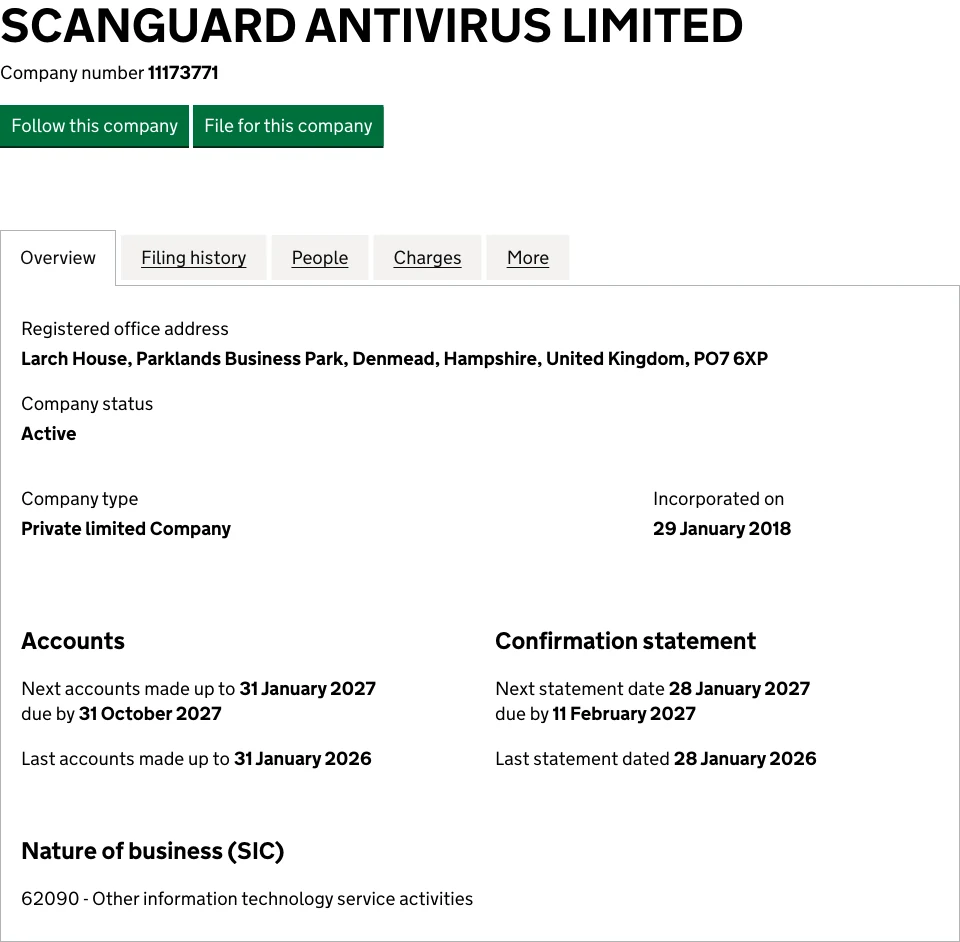
Two qualifications prevent this evidence from being overstated. Companies House itself warns that it does not verify the accuracy of everything filed, and a registered company can sell a mediocre or confusing product. More importantly, Scanguard’s current consumer terms identify Total Security entities as the contracting group. The named Scanguard company record is one piece of corporate evidence, not a substitute for reading the seller and terms shown at the actual checkout.
Fresh SE Labs results prove real protection—not perfect protection
The distinction between “detected” and “protected” matters here. An antivirus can notice part of an intrusion after the attack has already achieved something useful, while SE Labs gives more credit for blocking the chain early and penalizes a compromised system. That is why we lead with Protection Accuracy and the raw outcomes instead of displaying the AAA badge alone. Awards are useful summaries, but a buyer deserves to know how many attacks progressed and how the same products compared under the same methodology.
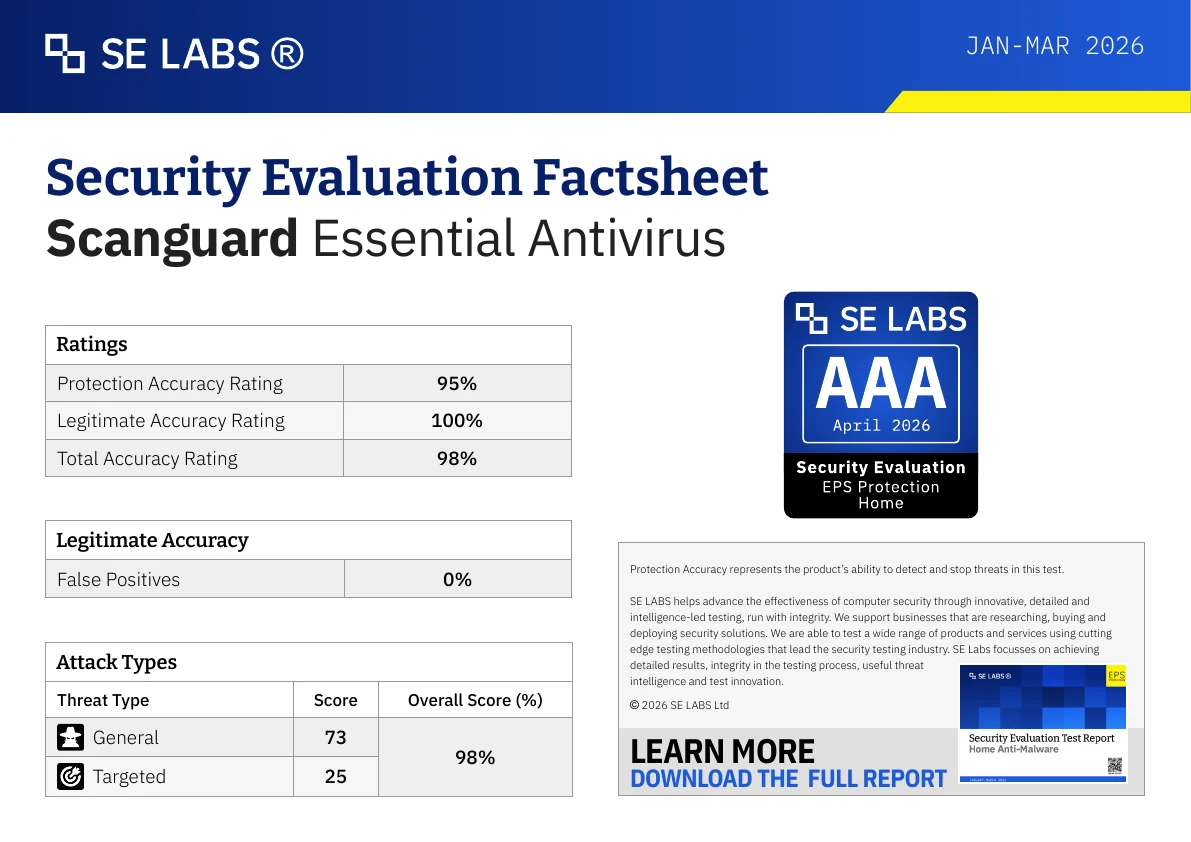
The strongest technical evidence is the SE Labs January–March 2026 Scanguard factsheet and its full comparative report. SE Labs subjected each Windows home product to the same mix of public threats and targeted attacks. Scanguard detected 98 threats, blocked 97, neutralized one and was compromised twice, producing protection against 98 of 100 attacks.
| SE Labs metric, Jan–Mar 2026 | Scanguard result | Plain-English reading |
|---|---|---|
| Threats protected | 98 of 100 | Two test systems were compromised |
| Protection Accuracy | 95% | Outcome scoring rewards early blocking and penalizes compromise |
| Legitimate Accuracy | 100% | Tested legitimate apps/sites were handled correctly |
| Total Accuracy | 98% | Combined protection and legitimate handling |
| Award | AAA | Strong result, but not a perfect score |
Kaspersky, Norton, McAfee and Microsoft achieved 100% Protection, Legitimate and Total Accuracy in the same report. Avast had 100% Protection and a rounded 100% Total Accuracy with 99% Legitimate Accuracy. Scanguard therefore has current evidence of credible protection, yet the same source gives a reader clear reasons not to call it the strongest product in that test.
Scanguard improved sharply after a weak 2025 quarter
SE Labs itself provides the useful context. Its July 2025 analysis criticized the earlier protection result, while its May 2026 release placed Scanguard among the AAA home-product group but still named Kaspersky, Norton, McAfee, Microsoft and Avast as the strongest performers. That wording is more informative than an affiliate page displaying only the award.
A single award badge hides the most useful part of the story: movement over time. In its July 2025 analysis, SE Labs said Scanguard’s April–June 2025 product achieved only 81% Protection Accuracy and 93% Total Accuracy, resulting in an AA award. The lab explicitly described that protection result as very poor even though correct handling of legitimate software raised the total.
Later quarters improved. The September 2025 factsheet showed 95% Protection and 98% Total Accuracy; the late-2025 report also gave Scanguard AAA while recording a missed public threat and three missed targeted attacks. By January–March 2026, Scanguard again reached 95% Protection and 98% Total Accuracy, while its targeted-attack count improved to 25 of 25 and two general threats still compromised the test systems.
The fair conclusion is neither “one bad result proves a scam” nor “one AAA badge ends the discussion.” The product demonstrated a sustained improvement from the weak Q2 2025 result and now sits in credible territory, but it remained below the 100% protection leaders. Future recommendation pages should keep following the trend instead of recycling an old VB100 screenshot or treating the current result as permanent.
| Period | Protection Accuracy | Total Accuracy | Editorial reading |
|---|---|---|---|
| Apr–Jun 2025 | 81% | 93% | Weak protection; AA |
| Sep 2025 | 95% | 98% | Clear improvement; AAA |
| Sep–Nov 2025 report | High 90s | High 90s | AAA, but several attacks progressed |
| Jan–Mar 2026 | 95% | 98% | Credible current result; AAA |
Why Scanguard still has a “scam” reputation
The vendor’s own Billing Help Centre exposes the categories that repeatedly cause confusion: subscription details, charge identification, invoices, promotional pricing, renewal reminders, overcharge concerns and separately managed services. Their existence does not prove misconduct. It does show that the commercial relationship has enough moving parts that a buyer should not rely on the checkout headline alone.
The reputation is not mainly about whether an executable can scan malware. It grows from the buying experience: a heavily discounted first term, a much higher standard renewal, optional services added at checkout, promotional prompts inside free/limited states and confusion between canceling future renewal and requesting an immediate termination/refund. A customer who expected one all-inclusive price can experience a genuine authorized renewal as a nasty surprise.
Scanguard’s terms say the promotional price applies only to the initial limited term and that the subscription renews at the communicated renewal price. Its billing help says add-ons can be tied to the same account while renewing separately. The Scanguard pricing and renewal guide maps these controls in detail. Those disclosures make the business more traceable, but disclosure somewhere in a contract is not the same as excellent checkout clarity.
Support friction deepens suspicion. Losing access to the original account email, failing identity verification or canceling the core antivirus while leaving an add-on active can turn a simple request into multiple contacts. The responsible editorial response is to show the exact recovery path and document what happened—not to dismiss the user as careless or declare criminal fraud without transaction evidence.
Customer reviews are useful signals, not a verdict
We also separate a review of the software from a review of the commercial relationship. “The scan ran quickly” speaks to usability; “I could not cancel after losing my email” speaks to account recovery; “it found threats other products missed” is an unverified technical observation unless the samples and test conditions are available. Putting all three into one star average hides the failure mode a prospective buyer actually cares about. Our article preserves the category and looks for corroborating official or laboratory evidence.
During this check, the claimed Scanguard Trustpilot profile displayed 2,372 reviews and a 4.3/5 score. The platform says Scanguard invites customer reviews and has a paid Trustpilot subscription. Recent visible summaries emphasized easy installation and use, while negative reviews included cancellation/support difficulty and compatibility complaints. That is a real consumer-experience signal, but the headline score is not an antivirus test.
G2 displayed only ten reviews on an unclaimed profile during research. Reddit and older technical forums contain strong negative opinions about Scanguard and related Total Security/Protected.net brands, but exact Scanguard discussions are sparse and often years old. They explain why people search “scam”; they do not establish the behavior of the August 2026 build or prove that every billing dispute was unauthorized.
Review sampling has predictable distortions. Invited reviews can overrepresent recent buyers, complaint forums overrepresent unresolved cases, and affiliate review sites may earn money after a purchase. We use community evidence to identify recurring questions—renewal clarity, prompts, installation and support—then verify policies and technical claims against primary documents and labs. We do not average incompatible sources into a fictional trust score.
Is Scanguard malware or a PUP?
The current evidence supports calling Scanguard antivirus software, not malware. SE Labs installed the product in a controlled comparative test and observed it blocking or neutralizing real attack chains. The signed installer, active legal/support infrastructure and repeat participation in independent testing are inconsistent with the usual fake-antivirus model that exists only to display fabricated infections or install a payload.
Older reviews and forum posts report aggressive upselling, alarming scan results, website blocks or behavior described as potentially unwanted. Those reports should not be erased, but they are version-sensitive and frequently lack a current file hash, detection name, reproduction path or vendor response. “My other antivirus flagged it” can describe a true malicious detection, a potentially unwanted classification, a web-reputation block or a conflict between two security products. The label alone does not identify which.
Use a safe test instead of disabling all protection. Download through the verified portal described in the Scanguard installation guide, inspect the publisher/signature, keep Defender or another provider available until Scanguard is registered, and stop if the file comes from a mirror or requests unrelated remote access. If a current signed build receives a specific detection, preserve the alert, engine name, path and version so it can be investigated rather than waved away.
A Scanguard-branded invoice, popup or call may still be fake
Antivirus refund scams work precisely because the brand sounds plausible. A message claims a renewal was charged, provides an urgent number and offers a refund. The caller then asks for screen sharing, banking access, a one-time code or installation of remote-control software. The existence of a real Scanguard subscription business does not authenticate any of those instructions.
| Signal | More consistent with a genuine account event | High-risk impersonation signal |
|---|---|---|
| Where you verify | You independently open the bookmarked official portal | The message says only its link/number can stop the charge |
| Transaction evidence | Portal service, receipt and card descriptor agree | No matching portal record; only a PDF or browser warning |
| Support action | Account verification and documented billing workflow | Remote desktop, gift card, crypto or bank-login request |
| Urgency | Published renewal/refund dates can be checked | Immediate threat to lock the computer or empty the account |
| Software | Installer comes from the verified Scanguard portal | A caller sends an unrelated support tool or script |
Close the message without clicking, open the portal independently and compare My Subscriptions, My Services and billing history. If the charge is absent, use Scanguard’s official transaction-search or unrecognized-charge route by navigating from the Help Center. If you already gave a stranger remote access or banking credentials, disconnect the device, contact the bank through its official number and treat it as a security incident rather than a normal cancellation.
A safe Scanguard purchase needs evidence before the card entry
Use an email address you expect to keep and protect it with a strong unique password. Account loss is not merely an inconvenience when that inbox receives verification codes for cancellation or billing changes. Save the customer number and invoice in a password manager or encrypted records, but never store the card security code. If the purchase is for a relative, decide who will control renewals and support before entering a card so responsibility does not disappear when the original installer is unavailable.
Capture the checkout page showing the product name, initial term price, renewal price/date, license count, included features and every optional service. Confirm that Windows or macOS and the processor are supported. The current Scanguard requirements page excludes Windows on ARM and contains contradictory Windows-version wording, so compatibility deserves a check before removing a working provider.
Open the portal after payment and compare each service with the receipt. Disable any add-on you did not intend to keep, record the renewal controls and set a calendar reminder well before the date. The terms say annual or multi-year customers may receive a renewal notice up to 30 days before renewal; “up to” is not a replacement for your own record, and monthly plans do not receive that notice.
Finally, judge value against the current lab result and bundle. Scanguard’s 95% Protection Accuracy is respectable but not the top result in its latest comparison. If VPN, ad blocking, identity protection or unlimited devices are essential, compare the combined renewal cost rather than the attractive antivirus entry price. A simpler competitor bundle can be better value even when Scanguard itself is legitimate.
If you already bought Scanguard, classify the problem before acting
The official Scanguard billing-questions page publishes card-descriptor guidance and routes for unrecognized charges. Navigate to it independently rather than copying a link from an invoice email. A genuine portal record, matching receipt and recognizable descriptor can resolve a memory or account issue; a mismatch should remain open until the merchant and payment provider identify the transaction.
Build a short timeline before contacting support: checkout date, initial amount, each named service, renewal notice date, renewal transaction, cancellation attempt and case number. Screenshots should show the relevant service and timestamp while masking full card details, home addresses and unrelated subscriptions. A timeline turns “Scanguard charged me again” into a testable claim—core renewal, separately renewing add-on, duplicate transaction, wrong account or impersonation—and gives both support and the payment provider something concrete to investigate.
For a normal renewal you recognize, turn off auto-renewal in the portal if you do not want another term; access usually continues until the paid period ends. For a refund, cancellation alone is not enough. Scanguard’s current refund guide says the service must be terminated and a separate eligible request submitted—generally within 30 days for annual/biannual plans and 14 days for monthly, quarterly or add-on services.
For an amount you do not recognize, first check every service and email identity tied to the payment method. Scanguard’s official billing contact route includes a transaction-search process when a charge is not visible in the accessible account. Save the statement descriptor, amount, date, currency, invoice and support case. Do not publish a full card number or send it to an address copied from an unsolicited message.
If the technical product is the issue, keep another supported provider active before uninstalling. A red real-time toggle is a protection problem; a missing entitlement is an account problem; a renewal dispute is a billing problem; a fake invoice or remote-support call is a security incident. Treating each as the right category produces faster evidence and avoids making the computer less secure while trying to solve a payment question.
Scanguard legitimacy and safety FAQ
These answers separate current verified facts from reputation, old reports and brand impersonation.
Is Scanguard a legitimate antivirus?
Yes. Scanguard is a real commercial antivirus service with current Total Security legal terms, traceable UK and US entities, support and billing systems, and independent Windows protection results from SE Labs. That answer does not guarantee best-in-class protection or value, and it does not prove that a random Scanguard-branded email, popup or phone call is genuine.
Who owns Scanguard in 2026?
Scanguard’s March 2026 terms identify Total Security Limited, Total Security U.S. LLC and affiliates as the service group and say they are part of Point Wild. Point Wild says Pango Group merged with Total Security in December 2024 and the combined company adopted the Point Wild name.
Is Scanguard malware or a potentially unwanted program?
Current independent SE Labs testing supports the conclusion that Scanguard is functioning antivirus software, not a conventional fake-antivirus payload. Older reports describe aggressive prompts or other products flagging Scanguard-related behavior, but those historical observations are not proof that the current signed build is malware. Download only through the verified portal and keep another provider active until installation is verified.
Does Scanguard actually stop malware?
In SE Labs’ January–March 2026 Windows test, Scanguard protected against 98 of 100 threats, earned 95% Protection Accuracy, 100% Legitimate Accuracy and 98% Total Accuracy, and received an AAA award. Several competitors achieved 100% Protection Accuracy, so the result is credible evidence of real protection—not evidence of perfect or category-leading protection.
Why do people call Scanguard a scam?
The reputation is driven largely by the gap between promotional first-term pricing and renewal pricing, separately renewing add-ons, upgrade prompts, cancellation/refund confusion and older negative forum posts. Those are valid consumer-experience questions, but they should be examined with receipts, current terms and current tests rather than converted automatically into a malware or fraud claim.
Are Scanguard renewal emails and popups genuine?
Not automatically. Criminals routinely imitate real antivirus brands in fake invoices, browser warnings and refund-support calls. Do not call a number or install a tool from the message. Close it, open the bookmarked Scanguard portal independently, compare the subscription and billing history, and use the official Help Center if the record does not match.
What company name may appear in Scanguard documents?
Current documents can refer to Scanguard, Total Security, Total Security Group and Point Wild. Companies House also has an active SCANGUARD ANTIVIRUS LIMITED record, while the current consumer terms identify Total Security Limited and Total Security U.S. LLC as contracting entities. Check the exact descriptor and receipt instead of relying on one familiar word.
Can Scanguard charge more after the first year?
Scanguard’s current terms say an introductory discount applies only to the initial limited term and the subscription renews at the renewal price disclosed at enrollment or before renewal. Add-ons may renew separately. Save the checkout evidence, check My Subscriptions and read the current renewal date and amount before paying.
Does cancelling Scanguard automatically produce a refund?
No. Turning off auto-renewal normally stops the next charge while leaving the service active through the paid term. Scanguard’s current help pages say a refund requires termination and a separate eligible request, generally within 30 days for annual or biannual plans and 14 days for monthly, quarterly or add-on services.
Should I buy Scanguard?
Consider it only if the exact current price, renewal amount, device support and separately billed extras are clear to you. Its 2026 SE Labs result is credible, but several competitors scored higher protection and may bundle more features with simpler billing. If transparency, top lab performance or a single all-inclusive subscription matters most, compare alternatives before checkout.
Bottom line: legitimate product, conditional recommendation
Scanguard clears the legitimacy gate: traceable current terms, real account infrastructure and credible independent protection testing. It does not clear every buying gate automatically. Its latest protection result trails several leaders, the product’s test history has moved materially, and the renewal/add-on structure rewards careful record-keeping.
Use the exact evidence for the exact question. Company records establish traceability, SE Labs measures protection, current terms define the purchase and the independent portal authenticates a charge or message. If any one of those four checks fails, stop and investigate before paying, installing or granting access.