
Antivirus Renewal Price Report 2026: The Year-Two Jump
Our reproducible snapshot found a 100.8% median price increase across six directly comparable US annual antivirus offers. Four of the six doubled or more at renewal. A separately reported UK McAfee example rose 166.7%.
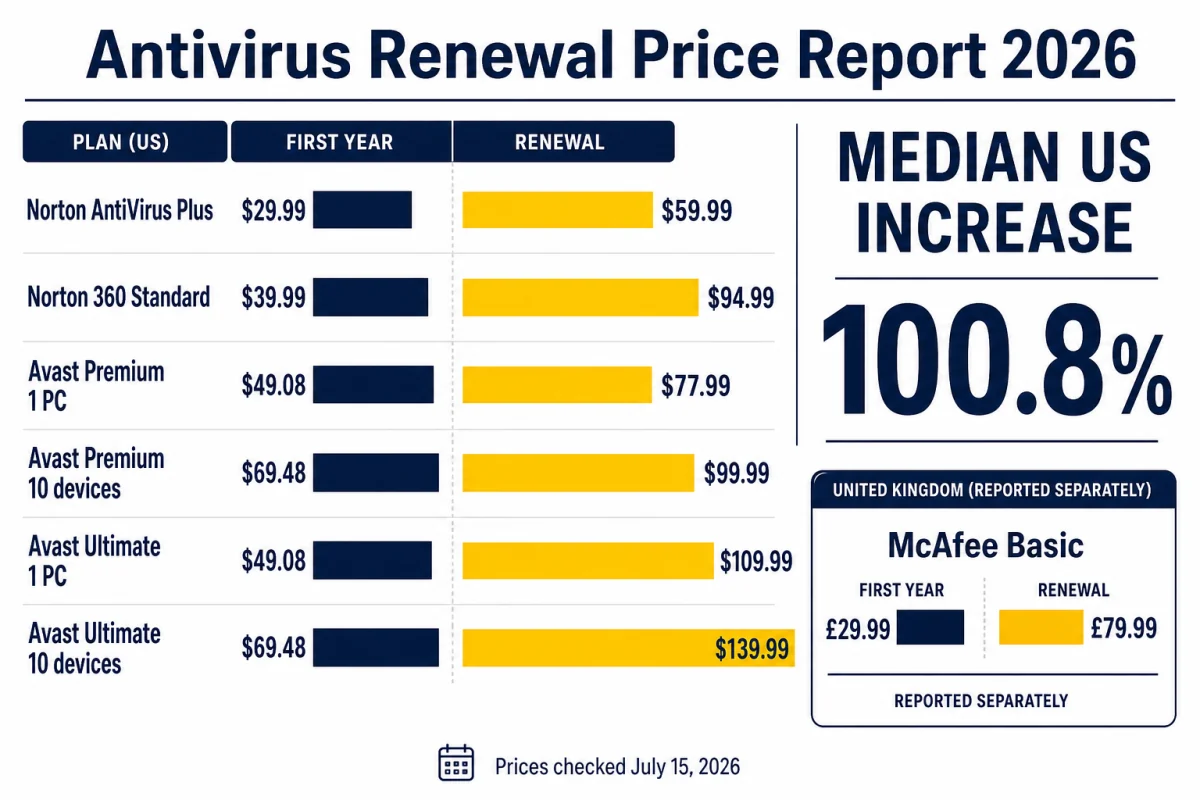
Headline finding: the median US first-to-renewal increase was 100.8%, with a range from 43.9% to 137.5%. This is a small, auditable snapshot of offers whose official pages disclosed both figures—not a market-wide estimate.
Key findings from the July 2026 snapshot
100.8% median increase
The middle US annual price jump was just over double the introductory price.
4 of 6 doubled
Both Norton rows and both Avast Ultimate rows increased by at least 100%.
$43 median dollar rise
The median absolute US increase was $42.76 per annual subscription.
Currencies kept separate
The McAfee UK row is a standalone pound-denominated example, not part of the US median.
The six-product US basket cost $307.10 at the displayed introductory prices and $582.94 at the displayed annual renewal prices—a $275.84 difference. That basket is illustrative: nobody should buy all six products, and a summed basket weights each plan equally.
AV-Comparatives' 2026 consumer-summary research independently notes that first-year antivirus offers are often materially lower than later automatic-renewal prices. Our study narrows that observation to source-dated plan rows that another researcher can recheck.
First-year and renewal prices
| Product and market | Intro price | Renewal price | Increase | Percent |
|---|---|---|---|---|
| Norton AntiVirus Plus · US · 1 device | $29.99 | $59.99 | $30.00 | 100.0% |
| Norton 360 Standard · US · 3 devices | $39.99 | $94.99 | $55.00 | 137.5% |
| Avast Premium Security · US · 1 PC + 1 mobile | $49.08 | $77.99 | $28.91 | 58.9% |
| Avast Premium Security · US · 10 devices | $69.48 | $99.99 | $30.51 | 43.9% |
| Avast Ultimate · US · 1 PC + 1 mobile | $49.08 | $109.99 | $60.91 | 124.1% |
| Avast Ultimate · US · 10 devices | $69.48 | $139.99 | $70.51 | 101.5% |
| McAfee Basic · UK · 1 device | £29.99 | £79.99 | £50.00 | 166.7% |
Official sources: Norton's product pages disclose savings against the renewal price, while its renewal list effective March 2026 gives the annual amounts. Avast's US store labels each first-year price and the renewal comparison. McAfee's UK antivirus page states the current auto-renew amount beside Basic.
Norton's storefront and renewal list don't use perfectly aligned Standard plan names. Our Norton 360 plans and pricing guide documents that mismatch, the current device allowance, three-year totals and the relevant billing and refund terms.
Methodology: what qualified for the dataset
- Market and date were fixed. We captured public US or UK consumer pages on July 15, 2026.
- The official vendor had to disclose both amounts. Search snippets, coupon sites and reseller prices didn't qualify.
- The same plan, term and device tier had to continue. We didn't compare a one-device intro plan with a ten-device renewal.
- Renewal language had to be explicit. “Regular,” crossed-out or list prices were excluded unless the page identified them as renewal or auto-renewal.
- Currency groups stayed separate. No exchange-rate conversion was used.
- We preserved source wording. The CSV includes URLs, check date and the page's renewal phrase.
- We calculated percentage increase. (renewal price − first-year price) ÷ first-year price × 100, rounded to one decimal.
The US median uses the six `US-USD-annual` rows. We sort their percentage increases and average the third and fourth values: (100.0% + 101.5%) ÷ 2 = 100.75%, reported as 100.8%. The UK row is never included in that statistic.
Download the raw CSV with formulas-ready fields and source notes.
What the numbers mean—and what they don't
The first-year price is a customer-acquisition discount. The renewal price is the cost of staying on the same disclosed annual plan if the then-current terms apply. The difference isn't evidence of a hidden charge when it's clearly presented; it's still large enough to change the value calculation.
A higher percentage doesn't automatically make the product worse. A bundle may add services you value, and a low first-year price can still save money. Nor is a smaller percentage automatically good: the absolute price, device count, service quality and cancellation terms matter.
Why the dataset has seven rows, not fifty
Many public pages showed a sale price and a crossed-out “regular” amount without explicitly calling it the automatic-renewal price. Others rendered prices dynamically, changed plan names by country or put the future amount only in a checkout flow. We excluded those rows rather than converting ambiguous marketing into a factual renewal claim.
- The sample is intentionally small and not statistically representative of every antivirus vendor.
- It covers selected annual consumer plans visible without an account.
- It doesn't measure retention offers, student pricing, taxes or refunds.
- It doesn't score protection quality or bundle usefulness.
- Norton and Avast contribute multiple tiers, so vendor behavior isn't equally weighted.
- The UK example illustrates another market but can't be averaged with dollars.
This exclusion log is a strength. Trend Micro and Panda displayed promotional/list prices, while TotalAV explained renewal concepts without a stable exact public plan row we could match under the same rule. They can enter a future edition when the evidence is comparable.
How to avoid renewal shock without losing protection
- Save the checkout and renewal disclosure. Record plan, devices, term, currency and tax wording.
- Set a reminder 30 days before renewal. Leave time to compare and migrate bundle data.
- Ask which extras you used. VPN, backup, identity and password tools should earn their place.
- Compare like with like. A free engine plus separate services may be better or worse value than a suite.
- Cancel through the account and retain confirmation. Check the card statement after the renewal date.
- Verify the replacement before uninstalling. Keep one active real-time antivirus throughout the handoff.
Our expiry guide explains how protection hands off, and free versus paid antivirus helps decide whether the bundle is worth renewing.
Frequently asked questions
How much do antivirus prices rise at renewal?
In our six-row US July 2026 snapshot, the median increase was 100.8%, ranging from 43.9% to 137.5%. This small sample isn't a market-wide average.
Which antivirus had the largest US increase in the dataset?
Norton 360 Standard rose from $39.99 to $94.99 in the captured offer, a 137.5% increase.
Why is the McAfee UK row separate?
It's priced in pounds. We don't convert or mix currencies because exchange rates would add a variable unrelated to vendor renewal pricing.
Are renewal prices guaranteed?
No. The pages describe current renewal amounts and vendors may change them with notice. Confirm the account-specific amount before billing.
Does cancelling auto-renew cancel current protection?
Normally the paid term continues until its end date, but benefits tied to automatic renewal can differ. Read the exact account terms and prepare the next protection before expiry.
Can I reuse this dataset?
Yes. Download the CSV and cite Antivirus-Review.com, the July 15, 2026 check date and the underlying vendor pages. Recheck prices before publishing a current claim.
Why were some major vendors excluded?
We excluded pages that didn't publicly and explicitly match a first-year price to the automatic-renewal price for the same plan, market, term and device tier.
Bottom line
The renewal jump is often as important as the malware score. Our small transparent sample found a median US increase of 100.8%; the practical fix is to price year two before buying year one.