
Microsoft Defender vs Bitdefender: Is the Free Baseline Enough in 2026?
The built-in engine stopped being the punchline years ago. What $59.99 buys you over $0 in 2026 is thinner than paid-antivirus marketing implies — but it isn't nothing. Here's the honest ledger.
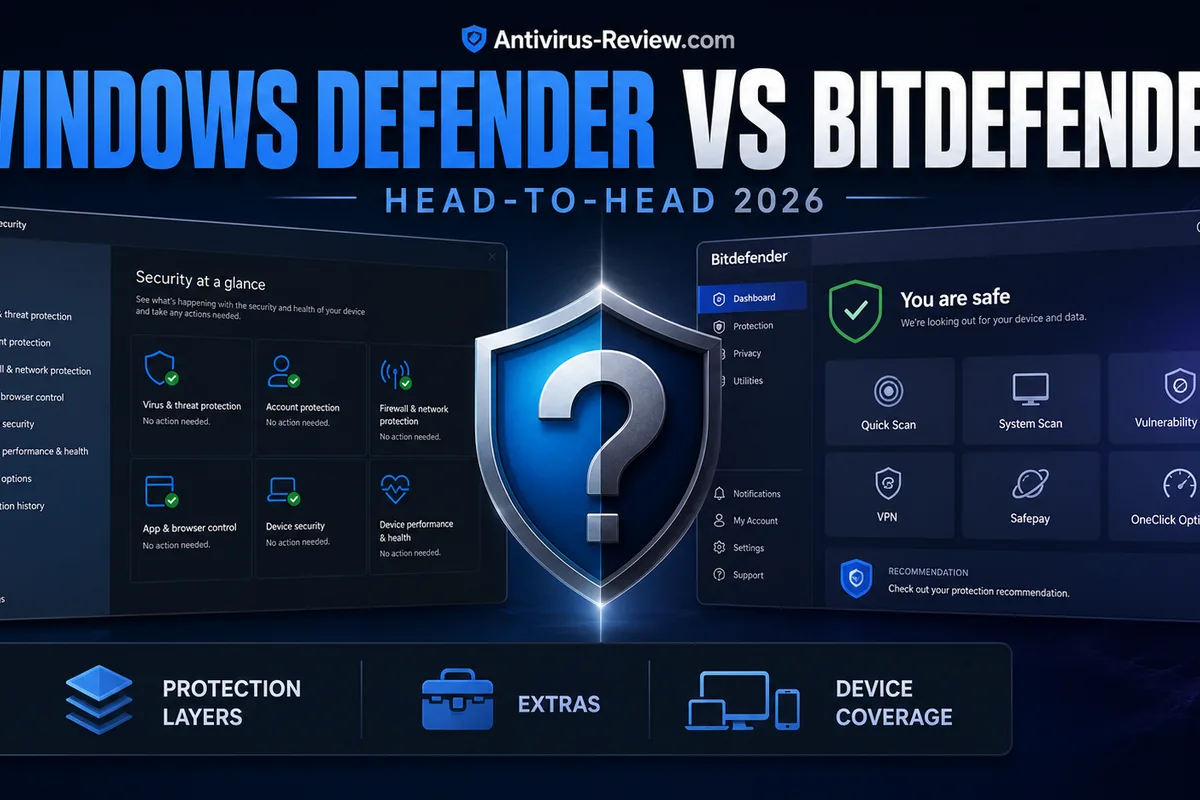
Quick answer: Keep Microsoft Defender if you run one updated Windows 11 PC and already handle backups, passwords and MFA — 17.5/18 at AV-TEST and zero real-world false alarms is a real result. Pay for Bitdefender Total Security for the stronger protection margin (99.5% vs 99.0%, 97.6% vs 89.2% offline), Safepay, parental controls and multi-device coverage.
Microsoft Defender vs Bitdefender at a glance
Every paid-antivirus vendor needs you to believe Defender is a compromise. The current labs disagree: 18/18 at AV-TEST with 100% protection in March, 99.0% in AV-Comparatives' real-world cycle, and the only zero-false-alarm result of the group. For a single well-managed Windows 11 machine, that's not a baseline — it's a recommendation.
Bitdefender's case survives anyway, on three facts: a half-point more real-world protection (99.5%), a nine-point offline-detection gap (97.6% vs 89.2%), and everything Defender simply doesn't do — cross-platform coverage, Safepay, webcam controls, parental controls, a password manager.
| Microsoft Defender | Bitdefender | |
|---|---|---|
| Editorial rating | 8.9 | 9.0 |
| AV-TEST (Mar–Apr 2026) | 17.5/18 Top Product (Defender 4.18, May–June 2026) | 18/18 Top Product (Total Security 27.0, March–April 2026) |
| Price path | $0 — built into Windows, no subscription or renewal | Total Security $59.99 first year (individual) / $79.99 (family); renewal higher — Bitdefender emails terms 45 days ahead |
| Best fit | An updated Windows 11 PC run by someone who handles backups and passwords | Paid family security with the strongest current protection evidence |
Lab showdown: what the current cycles actually say
| Current test | Microsoft Defender | Bitdefender |
|---|---|---|
| AV-TEST Windows 11, current cycles | 17.5/18 Top Product (Defender 4.18, May–June 2026) | 18/18 Top Product (Total Security 27.0, May–June 2026) |
| AV-Comparatives Real-World, Feb–May 2026 (400 cases) | 99.0% protected · 4 compromised · 0 false alarms — best FP result of the cycle | 99.5% protected · 2 compromised · 5 false alarms · Advanced+ |
| AV-Comparatives Malware Protection, Mar 2026 | 89.2% offline detection · 99.93% online protection · 3 false alarms | 97.6% offline detection · 99.94% online protection · 4 false alarms |
| AV-Comparatives Performance, Apr 2026 (impact, lower is better) | 12.9 — light at idle, visible spikes after large file changes | 9.6 — good, but heavier than several rivals in this cycle |
The real-world row is closer than the price gap implies: Bitdefender 99.5% with two compromises, Defender 99.0% with four — and Defender did it with zero false alarms, the cleanest accuracy in the cycle. Bitdefender's five FPs are still good; zero is better.
Offline is where paying buys protection rather than convenience. With the cloud disconnected, Defender detected 89.2% of the sample set against Bitdefender's 97.6%. Defender leans hard on its cloud layer; a laptop that works offline — flights, site visits, spotty rural connections — runs closer to that 89.2% than the online figure. That single number is the strongest honest argument for Bitdefender on a mobile machine.
Pricing and renewal reality
| Microsoft Defender | Bitdefender | |
|---|---|---|
| Checked July 14, 2026 | $0 — built into Windows, no subscription or renewal | Total Security $59.99 first year (individual) / $79.99 (family); renewal higher — Bitdefender emails terms 45 days ahead |
| Refund window | Nothing to refund | 30-day money-back on eligible direct purchases |
| Free tier | The product is free | No free suite (trial only) |
One side of this table is $0 forever, no renewal, no account, no upsell. That does real work in the comparison: whatever Bitdefender offers must beat free, not merely be good. Bitdefender Total Security runs $59.99 for the first year (individual), renews higher on emailed terms, and refunds within 30 days.
The honest framing: you're not paying $59.99 for detection — Defender's is nearly as good online. You're paying for the offline margin, the feature set, non-Windows devices, and centralized family management. Price those against your actual life, not against fear.
Feature comparison
| Feature | Microsoft Defender | Bitdefender |
|---|---|---|
| Platforms and devices | Windows only (consumer scope) | Windows, macOS, Android, iOS — 5 devices (25 on family plan) |
| VPN | None | 200 MB/day/device in Total Security; unlimited only in Premium ($79.99+) |
| Password manager | None (Edge/Microsoft account tools are separate) | Password Manager included |
| Firewall / hardening | Windows Firewall + SmartScreen | Yes, plus Safepay and webcam/mic controls |
| Cloud backup | None (OneDrive is separate) | No cloud backup |
| Parental controls | Microsoft Family Safety, configured separately | Parental controls included |
This is Bitdefender's table. Defender brings SmartScreen, Windows Firewall integration and Controlled Folder Access — capable, but assembled from Windows settings and separate Microsoft services (Family Safety, OneDrive). Bitdefender ships parental controls, Safepay, webcam/mic protection, a password manager and anti-ransomware layers in one subscription that also covers macOS, Android and iOS.
If your household is Windows-only and you already use a password manager and backup service, most of that column is redundant. If you're securing kids' devices and a mix of platforms, it's the whole argument.
What changes on Windows, Mac and mobile
A feature-table check mark doesn't mean equal coverage everywhere. Microsoft Defender currently supports Windows only (consumer scope). Its firewall/hardening position is: Windows Firewall + SmartScreen. VPN: None. Backup: None (OneDrive is separate).
Bitdefender currently supports Windows, macOS, Android, iOS — 5 devices (25 on family plan). Its firewall/hardening position is: Yes, plus Safepay and webcam/mic controls. VPN: 200 MB/day/device in Total Security; unlimited only in Premium ($79.99+). Backup: No cloud backup. Before paying, list the devices you actually own and mark the one feature you need on each. A Windows-only backup or separately configured family tool shouldn't be counted as a full cross-platform benefit.
The practical test is one Windows machine plus the least-supported device in your household—usually a Mac, iPhone or Chromebook. Check that web protection, account login, notifications and removal all behave sensibly there during the refund window. That exposes platform gaps faster than comparing another row of marketing icons.
Setup, alerts, support and the exit route
Microsoft Defender: no separate subscription app: controls live across Windows Security, SmartScreen and Family Safety. The current refund position is nothing to refund. Its official support page linked below is the right place to verify removal, renewal and platform-specific steps before the refund clock expires.
Bitdefender: a dense but coherent dashboard; Safepay and the protection modules reward a one-time setup pass. The current refund position is 30-day money-back on eligible direct purchases. Save the order email and identify who charged the card: a vendor, an app store and a reseller can have different cancellation paths even when the product name is identical.
For a fair trial, install only one contender at a time, update it, run the same normal workload for several days, then check browser launches, file copies, notifications, quarantine restoration and account cancellation. Protection scores come from controlled laboratories; ease of ownership is the part you can verify on your own hardware.
Performance on a real PC
Counterintuitively, the paid product is lighter here — Bitdefender's 9.6 April impact score beat Defender's 12.9, and neither approaches the heaviest products. Defender's known weakness is spiky behavior after large file changes: game-library installs, repository clones, dependency installs. The Antimalware Service Executable threads on r/techsupport haven't disappeared, and our test log (28–38% CPU during a full scan, ~21 minutes for 280 GB) matches them.
Bitdefender spikes too — every scanner does — but its scheduler is more configurable. On a developer machine that churns files all day, that configurability is worth something real.
Can you run Microsoft Defender and Bitdefender together?
Windows normally places Microsoft Defender Antivirus into passive mode when a properly registered third-party suite such as Bitdefender becomes the primary provider. That hand-off is useful; forcing two real-time engines to inspect every file can create duplicate alerts, locked files and avoidable scan spikes.
After installing or removing Bitdefender, reboot and open Windows Security → Virus & threat protection. The provider shown there's the source of truth. Defender's optional periodic scanning is a limited second-opinion feature, not permission to force both products into full real-time mode. If the old product still appears, use its official cleanup instructions before judging the replacement's speed.
How we compared Microsoft Defender and Bitdefender
Our editorial testing and fact-check method separates four questions that are often blended into one score: protection and false alarms from the latest comparable independent Windows cycles; system impact from AV-Comparatives' April 2026 protocol; ownership cost from dated first-term, renewal and refund terms; and fit from platform limits, included tools and the setup a reader actually needs.
The lab rows aren't our home-made malware test and the community links aren't votes. Each result keeps its test name, date and denominator so a small one-cycle margin isn't presented as permanent truth. Prices are snapshots, not promises: checkout region, campaign and seller remain the contract. We revise the verdict when a new comparable cycle or material product term changes it.
Primary sources and real-world checks behind this comparison
For Microsoft Defender, we checked the current product or pricing page and the official support documentation. For Bitdefender, we checked its current product or pricing page and official support documentation. Those pages establish plan names, supported systems and bundle limits; the independent lab links in the table establish protection, false alarms and performance.
Community reports are used only to identify what a buyer should test. A current Microsoft Defender discussion focuses on whether the built-in engine is enough, scan-time CPU spikes and the value of third-party bundles. A current Bitdefender discussion focuses on renewal controls, scan-time CPU spikes and exclusions for specialist software. These threads are directional and can be biased; they don't override controlled malware tests. They do justify checking notifications, renewal controls, exclusions and uninstall behavior during the refund period.
Who should pick Microsoft Defender
- One or two updated Windows 11 PCs, managed by someone who reads prompts
- You already own the missing pieces: password manager, MFA, tested backups
- Zero false alarms and zero renewal management appeal to you
- You'd rather harden Windows (Controlled Folder Access, SmartScreen) than add software
Defender's condition is operational, not technical: its cloud layer and updates must stay on, and Windows 10 machines need ESU — consumer support ends October 13, 2026. Our Windows 10 ESU guide covers that deadline; an unpatched OS defeats any antivirus, free or paid.
Who should pick Bitdefender
- Your laptop works offline regularly — the 97.6% vs 89.2% offline gap is your row
- You need parental controls, Safepay banking protection or webcam/mic control
- The household includes macOS, Android and iOS devices under one subscription
- You handle risky downloads often enough to want the extra behavioral layers
Buy Total Security and skip the tiers above it unless you can name the feature. And keep expectations straight on VPN: 200 MB/day/device is an emergency allowance, not a VPN replacement.
Frequently asked questions
Is Windows Defender really good enough in 2026?
For an updated Windows 11 PC run by someone who handles backups, passwords and MFA — yes. 17.5/18 at AV-TEST, 99.0% real-world protection and zero false alarms is a current, verifiable record, not marketing.
What does Bitdefender actually add over Defender?
Three things with evidence behind them: a nine-point offline-detection margin (97.6% vs 89.2%), a small real-world edge (99.5% vs 99.0%), and features Defender doesn't have — Safepay, parental controls, webcam protection, password manager, non-Windows coverage.
Why is Defender's performance score worse than Bitdefender's?
AV-Comparatives' April report scored Defender at 12.9 total impact vs Bitdefender's 9.6 — Defender is light at idle but spikes during scans after large file changes. AV-TEST still gave both 6/6 for performance.
Is Defender enough on Windows 10?
Only with ESU enrollment. Consumer Windows 10 support ends October 13, 2026; after that, an unpatched OS undermines any antivirus. See our Windows 10 ESU guide for enrollment and costs.
Can I run Bitdefender and keep Defender active too?
Windows handles this automatically: installing Bitdefender registers it as the active provider and Defender steps down (periodic scanning can remain). Two full real-time engines shouldn't run simultaneously.
Final verdict
The 2026 answer is conditional, and the conditions are yours, not the products'. Microsoft Defender is a legitimate primary antivirus for an updated, well-managed Windows 11 PC — the current cycle's only zero-false-alarm result, 17.5/18, and free forever. Paying to replace it “for a better engine” is mostly paying for marketing.
Bitdefender Total Security earns its $59.99 in specific, nameable situations: laptops that live offline (that 89.2% offline number is Defender's one soft spot), households with kids and mixed platforms, anyone who wants banking hardening and webcam control in one place. Those are real needs, and Bitdefender serves them with the best protection evidence in the paid market.
Default to Defender. Upgrade when you can point at the row in the table that describes your life. If you can't point at one, you already have your answer — and it's free.
Full write-ups: Microsoft Defender Antivirus review · Bitdefender Total Security review · all head-to-head comparisons.